Music Streaming Comes Of Age

Last Saturday was the 10th International Record Store Day, an annual event to celebrate independent music shops. A key feature is the list of exclusive and limited edition vinyl releases, most of which can only be bought in selected participating stores – in person and on the day. But there are also loads of other promotions and live events, designed to get people browsing the racks in their local retail outlet. In an age when streaming services now account for the bulk of US music industry revenues, what is the future of the neighbourhood record shop (those that are still left, that is)? Will streaming services kill off digital downloads, as well as sales of physical product like CDs and records?
Despite the sense of doom that has permeated the record industry in recent years (if not decades!), there is also a feeling that, just as the internet has not yet managed to kill off the publishing industry, digital has not yet killed the radio star. The independent music industry in particular has found a way to survive, and retail stores are still an important part of the business.

So, what are the recent trends in music industry sales and business models?

First, the continued rebound in vinyl sales (at least in the UK) show that there is renewed interest in this 70-year-old format, with industry data showing a 25-year high (but not yet a return to the 1980s’ peak). Record Store Day is generally credited with boosting vinyl sales. And to be fair, even music streaming services have contributed to this growth, through curated content, recommendation engines and user preferences: meaning that listeners get exposed to a wider range of music and artists than they would from traditional Top 40 radio, and they get to explore and discover new music.

Second, digital downloads, once seen as the industry growth engine, are facing a pincer attack, from streaming services as well as vinyl sales. No wonder that Apple is expected to slowly and quietly retire the iTunes download store, and shift more focus onto its own Apple Music subscription service. The music industry (especially the dwindling number of major labels) didn’t really “get” the internet. Having just competed in the CD-format wars, the major labels then competed on digital file formats, and tried to lock their digital content to proprietary players and software protocols. Some of this reticence was justified – thanks to digital piracy and illegal file sharing – but they didn’t (and still don’t) help themselves by poor CX on their retail websites (if they have an e-commerce presence at all), and adherence to arcane geo-blocking.

Third, many musicians are benefiting from increased exposure via streaming services – although with Apple Music and Spotify seemingly leaving the other platforms far behind, the downside risks from a dominant duopoly don’t need spelling out. Especially as the royalty payments from streaming are generally much smaller than they would have been from physical sales, “traditional” downloads and radio airplay. This source of friction between labels, their artists, music publishers and online content platforms surfaced again earlier this month, in a spat with YouTube over fees for video streaming.

Fourth, in a new move in the streaming wars and the battle to win mobile screen real-estate, Australian startup Unlockd has just secured a deal with MTV UK to stream free music videos in return for viewing ads. It’s also a move designed to counter ad-blockers and locked screens, while finding another way to distribute sponsored content. Elsewhere, some mobile carriers are now including music streaming services as part of customers’ un-metered data consumption, although what this may mean for artist royalties and the revenue share from ad-supported content on Spotify etc. is unclear.

Fifth, as another example of how the music industry is having to adapt, UK startup Secret Sessions is using a combination of social media, independent/unsigned artists and major brand licensing deals to find new ways to generate revenue streams for artists that can no longer count on income from traditional sales-based royalty deals, especially with the diminished licensing revenues from streaming services.

Sixth, as further evidence that all is not well in the world of music streaming, SoundCloud continues to lose its way. Once the music service of choice for user-contributed content created by independent and unsigned musicians, it got greedy and has been subject to recent speculation about its financial health and future.

Initially, SoundCloud was all about the makers and producers – helping artists connect with their audience, via a simple but effective website and mobile app. It also meant that at first, SoundCloud charged musicians and labels under a “pay to publish” model, while listeners could simply stream (and sometimes download) all this content for free. Then, it alienated many of its earliest supporters and champions, by introducing “ad-supported” streaming (with priority access going to labels and artists with big marketing budgets, who could also attract/demand the lion’s share of the advertising revenue).

SoundCloud also seriously messed with the app, making it far less useful to artists, and then introduced its own subscription-based streaming service, SoundCloud Go. Only, it wasn’t satisfied with just one subscription model, and recently announced an “upgrade” – whereby the “old” service became “SoundCloud Go+“, and a “new” SoundCloud Go was launched. Confused? You will be….

Meanwhile, Bandcamp continues to outperform the industry, in terms of annual sales growth, and has become a unique platform that offers music streaming, digital downloads and even physical product. (Frustratingly, Bandcamp is still blocked from selling digital content directly via iOS devices – even though much of this content is unavailable on either iTunes or Apple Music. Surely that’s anti-competitive?) And now there’s an amusing string of “SoundCloud vs Bandcamp” memes doing the rounds which may say a lot about the respective fortunes of these rival services.

Finally, the last word on the current state of music streaming and digital downloads should go to the artist known as L.Pierre. He has just announced the release of his latest and final (vinyl-only) album under that particular moniker, with an accompanying artist statement which could be seen as both an indictment upon and a requiem for the music industry.

NOTE: Apologies to my readers for any confusion regarding the timing and accessibility of this post. Thanks to WordPress, this article “missed” its scheduled time, and the outgoing e-mail notification had a faulty link. Normal service will hopefully be resumed next week…

Next week: Startup Vic’s E-commerce Pitch Night

Building a Global/Local Platform with Etsy

In a recent and very informative fireside chat, Linda Kozlowski, COO of Etsy was in conversation with Sarah Moran, CEO of Girl Geek Academy. Key themes of the discussion included the challenges in building a “global/local” platform, making sure you are addressing the right audience needs, and in a two-sided market place, knowing how to balance the interests of sellers and buyers.

etsyOrganised by StartupVic and hosted by inspire9, it was yet another example of how fortunate Melbourne is to attract and host so many leading global figures in the startup world, willing to share their insights (as well as learn more about the local startup scene – which probably does not get as big a rap as it should, especially in mainstream media).

With previous operational roles at both Alibaba and Evernote, Linda brings a strong combination of experience in tech and market places, and describes her current position as covering “CX and revenue from end-to-end”. Her primary focus is on product development, global expansion and addressing sellers’ problems.

At Etsy, the aim is to develop a global product platform that is culturally diverse. There is a natural tension between fully localised customisation (which can be costly to maintain – translation, version control, managing updates), and a “best of breed” model that can serve most users (which can lead to too many compromises). So instead, Etsy pursues a strategy of locally originated products and features, combined with open APIs.

Etsy has also identified sellers as their core audience. This means that so much of the CX is actually determined by sellers’ needs, to whom Etsy then serves up customers to the platform via social media, content marketing and SOE. Etsy sees this as a point of differentiation when considering traditional retailers who often end up squeezing their suppliers on pricing and margins.

In balancing the needs of two-sided markets, again Etsy focuses on the seller first – because buyers want to see depth of inventory and a range of quality products, so get sellers on-board and the buyers will come.

Asked how Etsy avoids buyers going direct to suppliers, Ms Kozlowski commented that it all really depends on where transactions happen: make the CX is so sticky that sellers want to stay on the platform, offer great seller features, and bring in quality buyers. On the other hand, it’s a healthy market place, so there is no mandating or exclusivity – because of course, successful sellers will sell in multiple places.

Etsy believes in investing in the right technology and the right marketing at the same time. For example, although the business was started in 2004, Etsy only began brand marketing in 2016. The types of marketing deployed include storytelling, identifying key differentiators, understanding customer influences, extensive content strategy, plus performance marketing (site traffic, SEO) to see what else customers may be looking for. According to Ms Kozlowski, a retail site should spend about 20-30% of revenue on marketing, otherwise you are buying traffic and customers (red flag to investors!) Alternatively, establish some ROI goals for marketing costs, especially performance marketing, and during the startup phase (up to 1 year) begin with 15-20% of revenue.

At the heart of Etsy’s business model is an evolving technology and e-commerce platform that allows micro-businesses to run at scale. The USP is a community of network effects: 1.7m sellers, 27m buyers, 40m products, 12,000 “teams”, whose “captains” recruit other sellers. (Australia is actually in Etsy’s Top 5 markets.) In addition, Etsy aims to act with integrity in respect to dispute resolution and addressing fraud – they use machine learning to detect rogue sellers (although often, buyer disputes are a reflection of seller inexperience, rather than fraudulent behaviour). Etsy also offers training and support to resolve disputes, and the community is very good at policing itself.

What are some of the unexpected challenges of market places? When it comes to distinguishing between commodity items and unique creative products, technology will under-price and displace commodity goods that are easily made. It’s also important to build human-to-human connections, and to have a global perspective – for reasons of quality and diversity, and not self-limiting your business, especially when it comes to managing different market and economic cycles. Remember to “follow the data”, and anticipate demand and trends. Among some of the technology challenges, dealing with different devices in different countries can be an issue.

In conclusion, Ms Kozlowski offered some advice for anyone thinking of launching a market place:

First, consider why there are very few local e-commerce markets in Australia (from my personal perspective it’s a complex mix of retailers getting burned in the dotcom boom/bust, cosy market duopolies, and perpetual geo-blocking…). But let’s not forget that Alibaba has just opened its Australian & New Zealand HQ in Melbourne, likely to ruffle a few feathers in the retail sector.

Second, embrace a local/global mix (for the reasons mentioned above)

Third, don’t price too low (although Australia is notorious for being a “price-sensitive” market…).

Finally, the conversation ended with a tantalising glimpse of “the future consumer” (Gen Z) where makers connect directly with buyers.

Next week: Spaceship launches the future of superannuation

Update on the New #Conglomerates

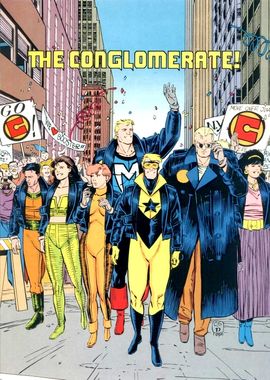
My blog on the New Conglomerates has proven to be one of the most popular I have written. I’d been contemplating an update for a while, even before I heard this week’s announcement that Verizon is buying the bulk of Yahoo!. Talk about being prescient…. So, just over two years later, it feels very timely to return to the topic.

Image sourced from dc.wikia.com

Image sourced from dc.wikia.com

Of the so-called FANG tech stocks, when I was writing back in May 2014, Facebook had recently acquired WhatsApp and Oculus VR. However, apart from merging Beats Music into its own music service, Apple has not made any big name deals, but has made a number of strategic tech acquisitions. Meanwhile, Amazon has attempted to consolidate its investment in delivery company, Colis Privé, but got knocked back by the French competition regulators. Netflix finally launched in Australia in March 2015, and within 9 months had 2.7 million customers, a growth rate of 30% per month. Finally, Google has since renamed itself Alphabet, and purchased AI business Deep Mind.

Over the same period, Microsoft appears to have reinvigorated its strategy: back in May 2014, Microsoft had just completed its acquisition of Nokia. Since then, Microsoft has announced it is buying LinkedIn (following the latter’s purchase of Lynda.com in 2015), but has also shut down Yammer, which it had only bought in 2012. The acquisition of LinkedIn has been framed as a way to embed corporate, business and professional customers for its desktop and cloud-based productivity tools (and maybe give a boost to its hybrid tablet/laptop PCs). On the other hand, Microsoft has a terrible track record with content-based products and services, as evidenced by the Encarta fiasco, and the fact that Bing is an also-ran search engine. I think the jury is still out on what this transaction will really mean for LinkedIn’s paying customers.

So, what are the big tech themes, and where are the New Conglomerates competing with each other?

First, despite being the “next big thing”, VR/AR is still some way off being fully mainstream (although Pokémon GO may change that….). Apple and Google will continue to go head-to-head in this space.

Second, content streaming is not yet the new “rivers of gold” for publishing (and the sale of Yahoo! might confirm that there’s still gold in those advertising hills….). But music streaming (Apple, Spotify, Amazon and Google – plus niche services such as Bandcamp and Mixcloud) is gaining traction, and Amazon is building more content for SVOD (to compete with Netflix, Apple and Google). But quality public broadcasters such as BBC, ABC and NPR are making great strides into audio streaming (via native apps and platforms like TuneIn) and podcasting. One issue that remains is the fact that digital downloads and streaming still suffer from geo-blocking, and erratic pricing models.

Third, Amazon continues to build out its on-line retail empire, even launching private label groceries. Amazon will also put more of a squeeze on eBay, which does not offer fulfillment, distribution or logistics and is a less attractive platform for local used-goods sellers compared to say, Gumtree.

Fourth, Amazon is making a play for the Internet of Things (which, for this discussion, includes drones), but both Apple and Google, via their hardware devices, OS capabilities and cloud services, will doubtless give Amazon a run for its money. Also, watch for how Blockchain will impact this sector.

Finally, payments, AI, robotics, analytics and location-based services all continue to bubble along – driven by, for example, crypto-currencies, medtech, fintech, big data and sentiment-based predictive tools.

Next week: Another #pitch night in Melbourne…


Customer service revisited: Navigating The Last Mile

From time to time, I like to comment on the current state of customer service, because this is still one of the key areas where companies can differentiate themselves. So, based on recent experiences with a bank, an insurer, a telco and an e-commerce site, I’m sharing my thoughts on the Last Mile – where even great products and great companies can fall down due to their inability to truly understand the customer experience they create.

Image sourced from LinkedIn

Image sourced from LinkedIn

1. The Bank

After waiting over 30 minutes in a call-centre queue, I eventually spoke to someone who said she could help me with a query regarding the disparity in the amount and rate of interest earned on one of my savings accounts. But first, I was given a choice: either accept an instant $50 “goodwill” payment now, or wait for the outcome of her investigation. Because the amount I was querying was several times that offer, I requested she look into the matter further.

Leaving aside the fact that she failed to get back to me within her stated timeframe (I only managed to re-engage the bank when I queried the lack of response via their social media account…), it transpires that she gave me incorrect product information. This underscores one of my main complaints about customer service – inadequate product and process training. Her supervisor who picked up the query then offered me a $10 “goodwill” payment for my trouble (overlooking I had already been offered $50!).

It was only when I insisted that the amount I was potentially out-of-pocket was closer to $300, and following a protracted and somewhat terse negotiation did the supervisor choose to exercise her (undefined) discretion and settle for an amount in between $50 and $300. While the outcome was closer to what I had expected, the customer service process and experience were far from satisfactory.

2. The Insurer

My home and contents policy recently came up for renewal. I noticed that, even with a customer loyalty discount, the premium increase was far higher than current CPI. It seemed to me that a previous “special discount” I had been offered when I last updated my policy at a bricks and mortar branch, rather than by phone or online, was now being clawed back (and then some) with the latest premium increase.

So, I shopped around online and found a better deal. When I rang the original insurer to advise them I was cancelling and taking my business elsewhere, they said: “Is there anything we can do to keep your business?”. My response was, “Too late.”

I accept that premiums may have to increase. But rather than simply sending out a renewal notice asking for more money, I think the better strategy would be to provide an explanation for the increase, and demonstrate the additional value I would be getting for renewing my policy. I resent being taken for granted, because the insurer clearly assumed I would simply pay the increase on demand, and only attempted to offer a better deal when I rang up to cancel.

3. The Telco

Late last year, I switched telcos, because the service was increasingly reliable, and I had experienced poor customer service from the start of my contract. In the process of transferring my mobile, fixed line and internet accounts, I notified the telco that I was dissatisfied with their service, and was taking my business elsewhere. I also initiated the return of my telco-supplied modem, to avoid incurring any additional fees or expenses. 

However, the telco continued charging me for certain services, long after I had discontinued using them, and 2-3 months after they had been ported over to my new service provider.* I requested the refund of the overpayments. The telco refused, because they claimed they had not actually been formally notified that I wished to cancel the services. So I lodged a complaint via the TIO, but the telco still denied any liability, and refused to refund my money.

Eventually, a TIO Investigation Officer was assigned to my case, and he agreed that on any reasonable reading of my complaint, the telco should have concluded that I was cancelling the service. The telco continued to resist my request for a refund:

E-mail received May 31: “[We have] reviewed the complaint and have decided that we will not be changing our position on the matter.”

I believe that the Case Officer then suggested that the telco listen again to the calls I had made, and place them in the context of the other contemporaneous events and the full history of my contract. He also advised the telco that he was prepared to initiate a full and formal investigation of the complaint.

Only then (and in a remarkably speedy U-turn, worthy of a politician) did the telco respond:

E-mail received June 7: “Thank you for your time and patience throughout this case, it is really appreciated (sic). We apologise for the poor level of service you’ve received that led you to escalate to this point. This is not the kind of service we want our customers to experience and it’s very unfortunate that you have to go through this, especially after you cancelled as a result of the poor service.
 
We will be crediting the account with $XX for the period from the XXth December 2015 to the XXth February 2016 when the service was active after it should have been terminated.”

I’m clearly grateful to the TIO for their assistance, but frankly, it shouldn’t have to get to that point. For an organisation that prides itself on superior customer service, the telco in question clearly does not understand customer experience.

4. E-commerce

There are several reasons why I prefer to order online, rather than buy from local shops: convenience, choice, availability, service and often price as well. Speed of delivery is usually not a factor, especially when ordering from overseas (although in many cases, ordering from overseas can be quicker than buying from a local online store).

However, I’ve recently experienced some delays in overseas deliveries, and upon investigating the matter, discovered that, quite apart from a lack of knowledge on the part of some customer service reps (that old chestnut), the multiple links in the supply chain can result in mis-communication and mis-alignment of their respective operating systems.

For example, if the online retailer does not actually fulfill the order, or if they or their nominated carrier outsources customs clearance and/or the final delivery, there may be as many as 6 or 7 hand-off stages in the process. Unless all the back-end platforms talk to each other (and in the same language), the risk of stuff falling between the cracks is very high.  (The notion of same-day delivery by drone is probably some way off…)

What is particularly frustrating is when one part of the vendor’s website has the (overdue) ETA as one date, but another part of the same website shows a much later ETA – even within a single platform! Perhaps if retailers got their upstream systems in order, the Last Mile would be more likely to take care of itself?

*Footnote: My original provider is merely a re-seller, and therefore is subject to wholesale access provisions. According to some information I received from my new provider, it is illegal for a telco to charge for services over which they no longer have any control or access.

Next week: Field report from Melbourne #Startup Week