The General Taxonomy for Cryptographic Assets

It’s not often I get to shamelessly plug a project I have been involved with – so please indulge me in the case of Brave New Coin’s recent publication, “The General Taxonomy for Cryptographic Assets”. It’s a significant piece of work, designed to bring some structure to the classification of this new asset class.
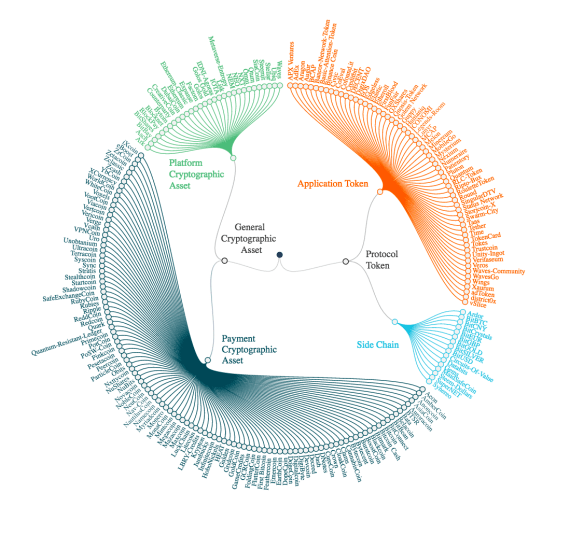
In particular, it aims to help market participants (traders, brokers, investors, fund managers, asset managers, portfolio managers, regulators etc.) make sense of the growing list of digital currencies, as not all tokens are the same. Each one has a specific use case that needs to be understood in the context of Blockchain applications, whether decentralized protocols, or trust-less payment solutions.

Currently capturing around 60 data points and metrics on around 700 tokens, in the coming months the underlying database will double in size, and constantly maintained thereafter to keep current with the most significant assets.

Useful for portfolio screening, construction and diversification, the Taxonomy methodology and underlying database, when combined with Brave New Coin’s aggregated market data and indices will provide a 360-degree view of each asset, combining key elements of a CUSIP or ISIN record, a company directory profile and a regulatory filing.

The significance of having access to robust market data and reference data tools cannot be underestimated, given the price volatility and emerging nature of this new asset class. The Taxonomy will be presented at various Blockchain and Crypto events over the coming weeks, but for further information, the authors can be contacted at: contact@bravenewcoin.com

Next week: APAC Blockchain Conference
Blockchain, or Schmockchain?

About a year ago, I was having dinner with family and friends, explaining the work I am doing in blockchain and cryptocurrency at Brave New Coin. My mother, in her mid 80s, asked if she should be buying Bitcoin as part of her retirement savings – I suggested she talk to her financial adviser first….

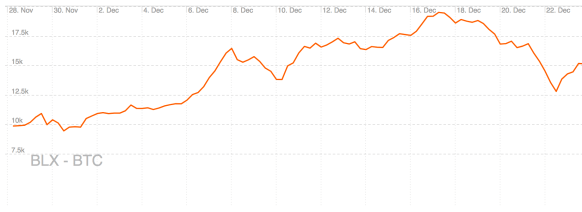
The BLX: Bitcoin Liquid Index (Source: Brave New Coin)

Then, late last year, the  Wall Street Journal made a splash with a front page headline: Bitcoin Mania: Even Grandma Wants In on the Action. This was just after the price of Bitcoin broke through US$10,000 for the first time, as part of its year-end rally after a year-long bull run. Of course, since late November, Bitcoin has gone from $10k to $16k, back down to $13k, back up to nearly $20k, then back to around $10k, before falling further to as low as $6k, while recently “stabilising” between $9k and $11k.

It wasn’t just cryptocurrencies (or even CryptoKitties) that were getting the hype and the headlines. An American soft drink company saw its stock price soar when it changed its name to Long Island Blockchain Company, and announced plans to invest in cryptocurrency mining technology. Amid some backlash (and SEC action against similarly motivated name changes), those plans have since been modified.

Just last week, I received an e-mail from a financial planner in regional Australia:

“I’m a 30-year veteran of the financial industry. I’ve just returned from the Annual Self Managed Superannuation Fund conference where it was evident the industry is treating crypto like a new little toy. Most wish to sound intelligent about what it is, but over 98% have no idea. When asked, the speaker from ASIC fobbed it off as a high risk area, and moved the topic to Investment property….”

He went on to explain how he didn’t just want to help his clients understand how to invest in this new asset class; he also wanted to leverage the underlying blockchain technology to improve his financial services practice, and offer better solutions to his clients.

If blockchain technology is good enough for the ASX, then it should be good enough for the individual investors whose share portfolios are traded, cleared and settled (either through their brokers, or via their superannuation funds) on the ASX itself.

Which was a key point made by Rick Klink, founder of OpenMarkets, during a presentation at a recent Startup Grind event: why shouldn’t his business take advantage of this new technology, and the new assets it is creating, to reduce customer transaction fees, streamline trading processes, and enable portfolio diversification.

Once you cut through the noise, there are examples of companies bringing scalable and real-world blockchain solutions to market that benefit a range of industry sectors, from supply chain logistics to biotech research, from agri-product provenance to IP registration and tracking. 2018 could be the year when the hype becomes reality.

Next week: Startup Vic’s Professional Services Pitch Night


The year ahead in Blockchain, crypto, FinTech….

I’m approaching my second anniversary working within the Blockchain and digital currency sector, but already it feels like a lifetime – such has been the pace at which the industry has grown and evolved.

The number (and size) of Initial Coin Offerings (ICOs) in 2017 was staggering. The cryptocurrency markets were equally breathtaking for their price gains (and corrections), matched only by the speed and extent to which some regulators responded. It was a rollercoaster ride, but by the end of the year, it’s fair to say this new asset class had finally arrived.

(For a round-up of 2018 forecasts and predictions for the sector, my colleagues at Brave New Coin have been publishing some handy guides.)

My personal (but far from unique) view on cryptocurrencies in general is that they represent a new asset class. As such we are seeing huge opportunities for investment and innovation, backed by Blockchain and other decentralized and distributed ledger technologies (DLT), as well as some truly innovative and disruptive solutions. There is still some hype, and considerable asset price volatility, plus pure investor speculation; but there are some great projects out there building solid business models; and sound investment cases for network protocols, industry utilities, scalable solutions and core platforms.

In 2018, I expect to see one or more of the following developments:

  1. A fully deployed, government-backed Blockchain project that will change the way citizens engage with public services
  2. A truly decentralized autonomous organisation that learns to make decisions for itself  (based on a set of dynamic, self-replicating governance rules) as to how resources are allocated, stakeholders are rewarded and participants are incentivized (for all its faults, the DAO was possibly the first new corporate structure since the joint stock company)
  3. Following Japan’s lead, more governments will recognise cryptocurrencies as legal forms of payment, while at least one Central Bank will issue a public digital currency as a form of legal tender (not just an inter-bank instrument)
  4. Traditional securities (equities, bonds, commercial paper, asset securitization) will be issued in the form of digital tokens (via a new form of Token Issuance Program) leading to wider distribution, fractional ownership and reduced cost of capital raising, plus streamlined share registry and custodial services, thanks to DLT
  5. Likewise, “traditional” digital tokens will be issued as formal securities, backed by new types of financial products, allowing for greater financial innovation and funding flexibility
  6. At least one crypto-backed ETF will list on a major exchange, along with more crypto-derivatives such as swaps and options.
  7. One or other crypto-currency will be adopted as a day-to-day payment solution for micro-payments

Only two or three years ago, none of the above seemed very likely, or at least not in the short-term. Today, there are multiple initiatives working across each of these trends. So this is not a case of “if”, but “when”.

Enjoy the ride!

Next week: Bring Your Own Change


Token Summit II San Francisco

While in the US this month, I attended Token Summit II in San Francisco, courtesy of Techemy, the parent company of Brave New Coin.

Apart from Bitcoin’s latest all-time highs (and of course, CryptoKitties), the main topics on Blockchain solutions, cryptocurrency trading, token issuance programs and digital asset management were:

Governance – bringing transparency, oversight and standards
Scalability – how to grow the technology in a sustainable way
Interoperability – compatibility and connectivity between chains
Regulation – especially of securities as tokens, and vice versa
Decentralized exchanges – making P2P trading truly viable
Metronome – the “first cross-blockchain cryptocurrency”
Messari – “EDGAR for cryptocurrencies”
Transaction computation vs verification – getting the balance/distinction right
Custody – what the institutional markets are looking for in this new asset class

Demonstrating the demand for access to industry thought leaders and information about the best and brightest projects, Token Summit could have filled a venue twice the size – a growth trajectory befitting the asset class.

Next week: MoMA vs SFMOMA