Non-binary Politics?

Regular readers to this blog may have noticed the absence of new posts in the past few weeks. This silence is in large part due to other personal priorities. There is also an overwhelming sense that all is not well in the world, and it hardly seemed appropriate to add to the endless commentary and op-eds on current events.

As world leaders grapple with yet another breakout of ideological warfare, I can’t help being reminded of the Bush Doctrine, built on President George W’s edict that “if you are not with us, you are against us”.

Such binary perspectives overlook the fact that no dispute can be neatly categorised in stark, polarised terms. Yet on so many geopolitical and social issues, we are being forced into making “yes/no”, “either/or”, “left/right”, “A/B” decisions. Ironic, given that in many domains we are also being encouraged to adopt non-binary views!

Whatever happened to bipartisan politics, consensus building, or non-equivalence? Why are we being co-opted into taking unequivocal positions? Have we forgotten that two wrongs don’t make a right?

I’m trying to get more comfortable with ambiguity and ambivalence – especially when few things can be cast in purely “black or white” terms. In fact, the more we can say “it’s OK to be in the grey”, the better our public discourse should become.

Next time: The Mercurial Music of Calexico


More Cold War Nostalgia

I’ve written before about a lingering fascination for the Cold War. In recent weeks, I’ve been re-visiting Yorkshire TV’s 1978-80 spy drama “The Sandbaggers”. Only 20 episodes were produced (across three series), in large part because the creator and main writer, Ian Mackintosh (a former officer in the Royal Navy) disappeared, and in apparently mysterious circumstances.

Putting aside the occasional non-PC language, the series stands up today. The core geopolitical themes remain relevant (even down to names of the principal parties); the ongoing friction between the espionage industry and their political and bureaucratic bosses; the continued unease between ideological purity, political pragmatism and operational reality; and the paradox of the surveillance society in the pursuit of preserving our individual liberties and personal freedoms.

The scripts are taut, with no spare dialogue. We don’t need to see every step in the plot in order to follow the narrative. The characters are not particularly appealing, but we still manage to feel some empathy for them. And although the production does incorporate library footage for some external shots, there is enough location filming to make overseas sequences appear credible and authentic.

The series was filmed and set when the Cold War was still at its height. Since 1974, the Doomsday Clock had sat at 9 minutes to midnight; in 1980, it was back down to 7 minutes to midnight (the same as its post-war setting); and by 1981, it was just 4 minutes to midnight. By 1991, this trend had been reversed, in the wake of Glasnost and Perestroika in the former Soviet Union, and the fall of the Berlin Wall. Even China seemed to be opening up under the leadership of Deng Xiaoping.

Now, the Clock is showing less than 2 minutes to minute – and who knows what a similar scenario to the August 1914 “Month of Madness” could lead to in the theatre of nuclear war.

Next week: American Art Tour

Hong Kong – Then and Now

I’ve visited Hong Kong twice in the last 6 months, and what a difference half a year can make.

Back in October, the Covid hotel quarantine programme for visitors and returning residents had just ended (which largely prompted my visit). I still had to undergo a PCR test on arrival, plus regular testing for the first 7 days of my stay. In addition, for the first 3 days I was unable to dine-in at cafes, restaurants and bars, or visit public places (museums, cinemas, gyms, etc.), until I had a blue “all clear” QR code on a tracking app. Masks were still mandatory for everyone, indoors and outside, but the QR check-in system was only sporadically enforced.

Of course, this being Hong Kong, the 3-day ban did not prevent me from taking taxis or public transport, going to work, or shopping. So, earn, spend, travel!

Compared to my previous visit in August 2019, there were no signs of any public protests (thanks to ongoing legal and political measures), nor many visitors from mainland China or overseas. The number of expats out and about in Central was well down (although I suspect a lot of people were still working from home), and I don’t recall there being many crowds even during peak shopping and business hours in the CBD.

I visited M+, the amazing new art museum in the West Kowloon Cultural District – which was probably the most popular location I saw during my stay, in part because admission was still free. There was a really interesting and charming exhibition of art and design in Hong Kong since 1945, from the context of cultural, social, commercial, industrial and political developments.

On a past visit, the ground had not yet been broken on the Cultural precinct, and the only art exhibition on show was a series of pop-up installations housed in re-purposed shipping containers (a link to Hong Kong’s important role as an entrepôt?).

Staying near Clearwater Bay also meant being among fewer people, and even gave an opportunity to visit a beach I had never seen before – where local residents had posted signs to encourage visitors not to despoil this small and natural idyll amid Hong Kong’s ever-expanding reclaimed land development.

Talking to some local contacts, there was a suggestion that the key motivation for scrapping the hotel quarantine programme in October was due to the Hong Kong FinTech Week being held the following month along with the much-postponed Hong Kong Rugby Sevens tournament (both expected to attract lots of bankers, brokers, traders and investors…). Yes, in Hong Kong, money still talks.

Fast forward to March, and my latest visit was a stark contrast. Not only were airfares much more expensive than late last year, but the number of visitors (especially from the Mainland) had also boomed. Now that there were no PCR tests or mask mandates, and as domestic tourism has opened up, it seems everyone was desperate to get to Hong Kong. Apparently, in the 30 days since the mask mandate was lifted, 1.5 million people had entered the Special Administrative Region, compared to the few thousand monthly visitors in previous months.

During March alone, Hong Kong hosted the Clockenflap festival, Art Basel Hong Kong, Art Central, a major golf tournament and the WOW Web3 Summit, as well as the Hong Kong Rugby Sevens restored its regular (and rightful) spot on the international sporting calendar.

Out and about in Central on a Friday night at the Tai Kwun art and entertainment precinct almost felt like old times, with people competing for taxis along Hollywood Road. I also got my fill of art – Joan Miró at the HK Museum of Art, Yayoi Kusama at M+, modern Chinese art at the JC Contemporary, and installations and pop-up shows at the K11 and Landmark malls.

From a business perspective, most of my meetings centred on the recent consultation process for Hong Kong’s proposed regulations on Virtual Assets, due to come into effect in June this year. It’s expected to boost the number of licensed crypto exchanges and brokerages operating in Hong Kong, and is a significant leap forward compared to past conversations I have had on the topic, where there was a general reluctance to engage in any meaningful discussions. Now it seems, whether encouraged by Beijing, or seeing the regulatory push back on crypto in the USA, Hong Kong is seeking to become a regional and global hub for all things web3, DeFi, tokenisation and digital currencies. (Not content with the WOW Web3 Summit in March, Hong Kong hosted the Web3 Festival earlier in April.)

Hong Kong is usually very good at reinventing its economic profile following business downturns and market setbacks – especially in the areas of trade, technology, commerce and finance. Perhaps the shift towards embracing virtual assets is simply a pragmatic move. While a large part of GDP is still driven by property and traditional finance, there is a recognition among some that the future is digital…

As much as things change in Hong Kong, they also largely stay the same. Back in October, there was 100% compliance with the mask mandate – but the vast majority of passengers ignored the compulsory seat belt regulation on buses. A breach of the former would have attracted a HK$1,000 fine; the latter, HK$5,000 and 3 months’ imprisonment.

Finally, talking of masks, it’s not that long ago that masked protestors on the streets of Hong Kong were a major legal and political issue. Since then, wearing any sort of mask on a public march or demonstration has been illegal. While I was in Hong Kong last month, the city witnessed its first authorised protest march in several years (about the environmental impact of land reclamation). In a new twist on the right of assembly, march numbers were strictly limited, and all demonstrators had to wear a visible number to identify them. From the TV coverage I watched, the march stewards contained the moving protest behind a rope cordon – so that participants did not literally step out of line.

(On this last trip, I also took a side-trip to Macau – more on that next time.)

Next week: Revisiting Macau – Asia’s Casino Theme Park
 

Finding a Voice

Australia’s Prime Minister recently announced his Government’s plans to hold a national referendum on the “Indigenous Voice to Parliament“. The Voice is a key outcome from the Uluru Statement from the Heart, and the path towards Treaty and Truth. It will require amendments to the Australian Constitution. The inevitable debate about the detail, purpose and scope to be enshrined in the Voice has now been heightened by the death of Queen Elizabeth II, and related issues of Australia’s pre- and post-colonial history, the experience of Federation and the fate of the Republican movement.

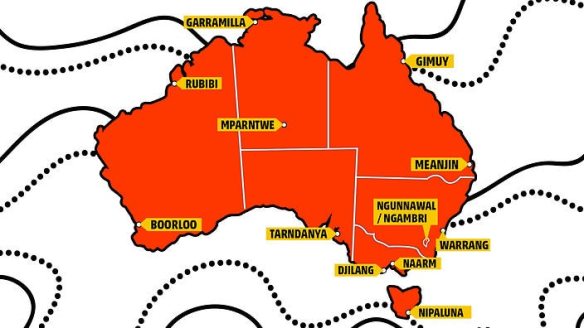
NAIDOC guide to Indigenous place names in Australia (image sourced from SBS)

One of the first comments in the wake of the Prime Minister’s announcement came from the Green Party, who indicated that their support for the Voice would be conditional on there being a Treaty first. Indeed, Greens Senator Lidia Thorpe called the proposed referendum “a waste of money”, indicating that she wanted to see a Treaty with Indigenous Australians before any talk of a Republic. Since the Queen’s death, it seems the Senator has changed her mind, and is now calling for both a Treaty and a Republic. But the Prime Minister has determined that the first order of business for his Government is the Voice, and that the Republican debate is not for his first term in office.

The question to be presented in the Referendum will be:

“Do you support an alteration to the Constitution that establishes an Aboriginal and Torres Strait Islander Voice?”

And the proposed additions to the Constitution would read something like this:

1.There shall be a body, to be called the Aboriginal and Torres Strait Islander Voice.
2.The Aboriginal and Torres Strait Islander Voice may make representations to Parliament and the Executive Government on matters relating to Aboriginal and Torres Strait Islander Peoples.
3.The Parliament shall, subject to this Constitution, have power to make laws with respect to the composition, functions, powers and procedures of the Aboriginal and Torres Strait Islander Voice.

While refusing to be drawn on the precise details of the Voice, the Prime Minister has defined what it is NOT going to be: “Not a third chamber, not a rolling veto, not a blank cheque.” Meanwhile, two bodies have been appointed to prepare for the Referendum proposal and implementation: the Referendum Working Group, and the Referendum Engagement Group, whose terms of reference are not entirely clear – and Senator Thorpe complained that the appointees “did not represent First Nations voices”.

Given the history of Referendums in Australia (most notably the failure of the Republican Movement to secure a “Yes” vote in 1999), it’s understandable that people are either wary about the form of the question and/or the Constitutional amendments, or are concerned about the apparent lack of detail that the Government has so far provided on the remit of the Voice. There is a possibility that the electorate votes “Yes” in the Referendum, but that agreement cannot be reached on the changes to the Constitution, or the structure of the Voice. So it’s understandable that some people are seeking more detail, or at least more clarity.

Whatever the sequence of events (Voice, Treaty, Republic?), it’s going to be a complicated process. For example, putting the Republic before the Voice may mean that the latter becomes redundant, assuming the Republican Constitution embeds principles such as the United Nations Declaration on the Rights of Indigenous Peoples. And Treaty before Republic would mean that the agreement(s) would be between the First Nations people and the Australian Constitutional Monarchy, whose Head of State is now King Charles III.

Perhaps that is the point – the formal process of healing, reconciliation and reparation cannot be meaningfully done without some involvement by the British Crown, in whose name Indigenous lands were appropriated in 1788. But does that potentially “absolve” Australia’s post-Federation Governments and Administrations from any responsibility for the act of British colonisation? Since Federation in 1901, Australia has had ample opportunity to make amends. It is no longer possible to suggest that any change to the Australian Constitution would require Royal Assent by the King or Queen in person – the purely ceremonial role of the British Monarchy in respect to Australia’s domestic affairs has always been predicated on the advice from both the Governor General (who serves as the Monarch’s local representative, and who gives Royal Assent to Australian Acts of Parliament), and Australia’s own government ministers and civil servants. In any event, it’s long been understood that the Crown would not prevent Australia becoming a Republic; in effect, the Crown could not intervene in any Constitutional amendment. Such a change is entirely a matter for the Australian Parliament.

The Westminster Act of 1931 confirmed that Australia is an independent state able to form its own foreign policy and defence free from British control; and the Australia Act 1986 formally severed all remaining legal ties between Australia and the United Kingdom except for the Monarchy. So a Treaty with Indigenous peoples could have been possible since 1901 when the Commonwealth of Australia Constitution Act came into force, heralding Federation. (Interestingly, King Charles III has had to be proclaimed by the Federal Government, and by each State – which might suggest the need for multiple Treaties?)

Another argument against embodying the Voice within the framework of the current Australian Constitutional Monarchy is because it would appear to “ratify” colonisation, and thereby imply Sovereignty had been granted (retrospectively?) to the Crown, which would therefore negate the need for Treaty. Indeed, the whole point of Treaty is to re-assert that Indigenous Sovereignty was never ceded, and that unlike other British colonies such as Canada and New Zealand, the British Crown has never attempted to negotiate any form of direct agreement with the Indigenous Nations of Australia.

Alternatively, Associate Professor Hannah McGlade has stated that a national Treaty needs a national body to negotiate (hence a key purpose of the Voice).  Further, she argues that Aboriginal Sovereignty relates to the “right to shape the national dialogue” on issues of primary concern to the Indigenous population. While not quite equating to full self-determination, it does provide a persuasive argument in favour of establishing the Voice to Parliament.

Finally, some other factors to consider as we move through this multi-faceted debate on Treaty, the Republic, and defining Australia’s post-colonial, post-Federation and post-Monarchy identity:

1. A Republic is no guarantee of getting Treaty right – indeed, look at the number of republics that have ridden rough-shod over their own indigenous and minority peoples – oppression and dictatorship is not the preserve of monarchs and emperors.

2. There is the question of how Crown land in Australia will be resolved, both in relation to Treaty, and the Republic. This would include the commercial arrangements for agriculture, mining and tourism, as well as land development and construction.

3. Inconsistencies in how Indigenous people are acknowledged at public events, meetings and in other similar settings. Here in Victoria, we are very used to some statement of recognition towards Indigenous nations and the traditional custodians of the land, along with their elders past, present and emerging. On my recent trip the Kimberley, I was surprised that no such formal statements were made when visiting culturally significant landmarks, usually under the direction of official tour guides, including National Parks. Not that there was an absence of awareness, knowledge or public signage, but I had expected there might have been a more vocal expression from some of our hosts.

4. Despite the need for a cohesive approach to the Voice and Treaty, it would be a mistake to view the Indigenous populations and their respective Nations as an homogenous entity. Even within Indigenous communities, as in any society, there are differences and inconsistencies. So there will be different demands placed on those charged with navigating the Voice, and negotiating Treaty. But a speedy outcome should not preclude the establishment of a solid consensus. After all, what’s 240 years compared to 50,000?

Next time: Recap…