Hands on the wheel

A couple of weeks ago, I got some hands-on experience of the potter’s wheel (or Wheel Throwing, to use the technical term). I’ve played around with modelling clay before, but this was probably my first attempt at ceramics, and certainly the first experience of wheel throwing. The result (so far) can be seen in the photo below…
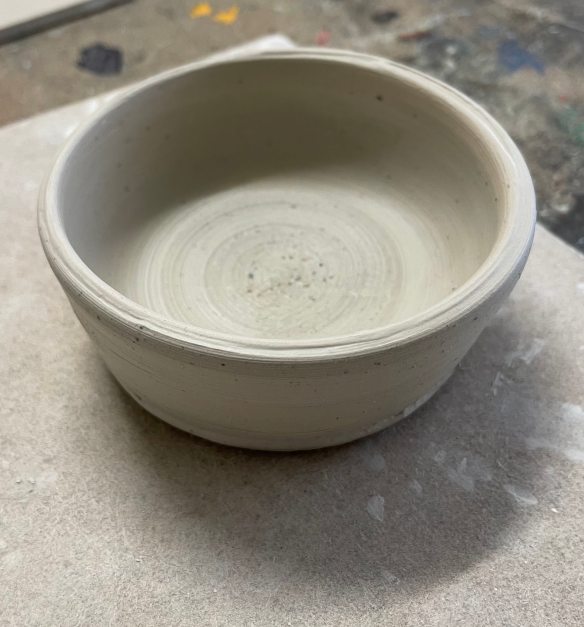
The class was a 2.5 hour introductory workshop, conducted by Little Woods Studio in Collingwood (via WeTeachMe), and I highly recommend it. I don’t think I was any good, but that’s not the point. The only pot I managed to make (shown above) is actually quite small, and wouldn’t have happened without a lot of direct assistance from the instructor, who was incredibly patient.

Learning the physical technique of throwing, fixing and initially shaping the clay on the wheel is a skill in itself that needs more than a couple of hours to achieve a consistent level of proficiency.

Then there are the many variables to consider – the quality of the clay and whether it has been prepared sufficiently; the amount of water to use, and how much arm and hand pressure to apply; the stability and responsiveness of the wheel; the height of wheel and stool; and probably the weather (barometric pressure). Then there is knowing when and how quickly to start bringing up the sides of the pot, what thickness of base to settle on, and what wheel speed to achieve – too often, I ended up collapsing the walls just as was beginning to shape the rim; or I applied too much bracing support from my arms so that my hands ripped the clay off the wheel again. (Is this where the phrase, ‘to throw a wobbly’, comes from?)

And this is all before the two-stage process of firing and glazing, when anything might happen to cause the pot to crack or crumble. Hopefully, in a couple of weeks, I’ll be able to pick up the finished item, a souvenir of my first (and probably only) pottery class.

If nothing else, I now have a huge respect for potters, and a greater appreciation for the fruits of their labours.

Next week: William Kentridge – Modern Polymath
NGV Triennial

As Melbourne and Victoria continue to emerge from lock-down, it was great to see that the NGV International has re-opened for the summer with the latest edition of its Triennial show. And while we should all be grateful to have the opportunity to visit this exhibition in person (rather than on-line), it’s not without some shortcomings.

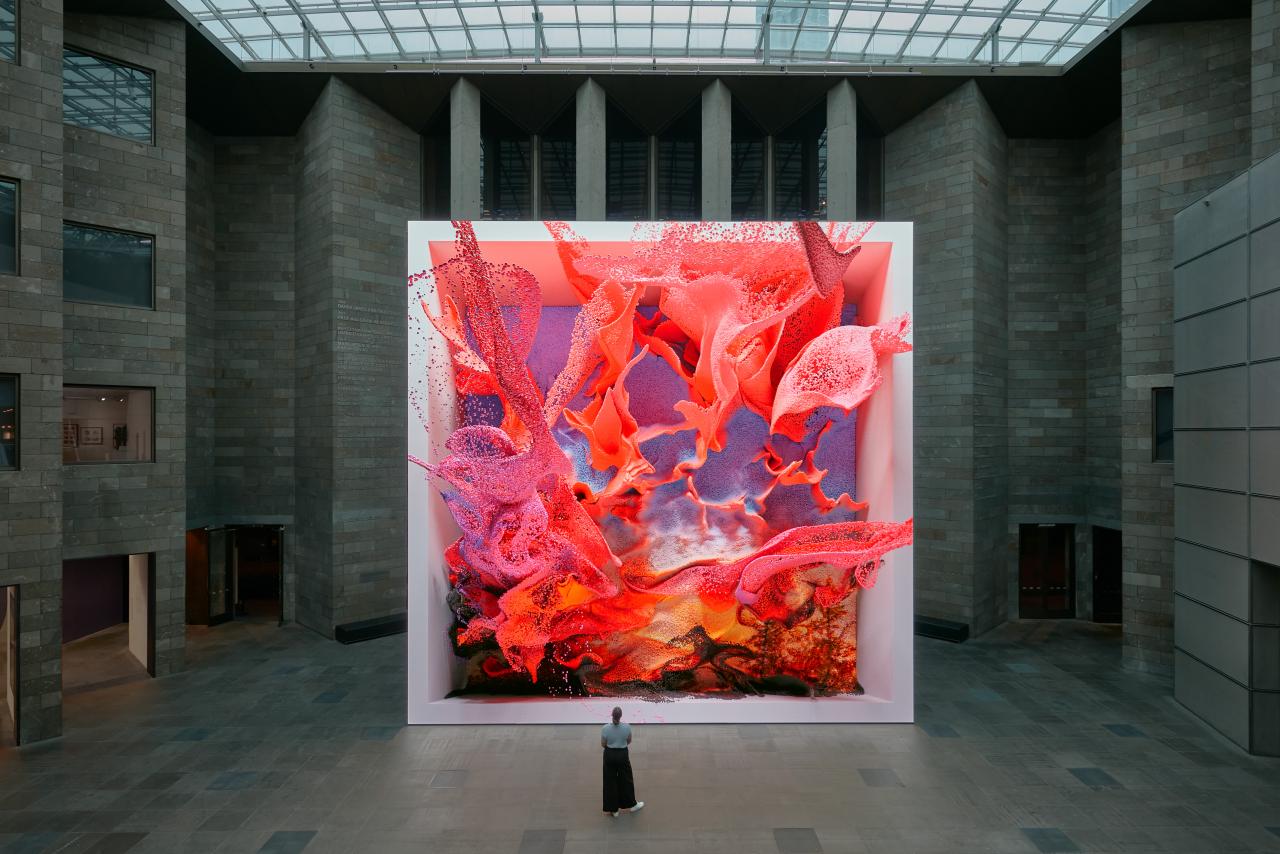
Refik Anadol: Quantum Memories (image sourced from NGV website)

First, the good news: no doubt it was a logistical headache to co-ordinate this exhibition while Melbourne was in strict lock-down for much of the past 10 months. Making admission free is also a wonderful public gesture given that the local population was starved of art exhibitions for most of last year – in particular, we missed out on the NGV’s winter blockbuster season.

The curators are also to be commended on assembling a diversity of artists, work and media; and for placing a great number of these new pieces among the NGV’s permanent collections, which forces visitors to assess these contemporary exhibits within the context of historic work.

But that’s probably where the positive ends.

A major drawback of this exhibition is the lack of anything truly ground-breaking, innovative or even challenging. It all felt very safe – but maybe that’s just what we needed after our extended social isolation: work that is comforting, familiar, cozy, cuddly, soothing, and certainly bright (lots of lively colours).

As a result, however, there seemed to be an emphasis of form over substance, technique over content, and scale over context. Much of the three-dimensional work felt flat and one-dimensional. Even the opening centrepiece, Refik Anadol’s “Quantum Memories” that dominates the entrance lobby, is a classic example of the “medium is the message”. Comprising a giant digital screen (incorporating a clever trompe-l’œil 3-D effect) to stream animated, computer-programmed images, ultimately gave the impression that this was all about the technology and the scale of the work. It was difficult to identify any meaning beyond mere decoration.

And unfortunately, “decorative” was a recurring theme, alongside some rather kitsch and lazy imagery – especially the digital and animated wallpaper that featured in several of the permanent galleries. These “displays” reminded me of cheesy son et lumière or pedestrian CGI effects – it may be technically adept, and even stylish to some degree, but that’s as far as it goes. Perhaps “deep” and “complex” are out of favour at the moment, as we make way for “shallow” and “simple”.

While some work might attempt to convey a more profound response, when shorn of its original context, the message is lost and the result is a void. I wasn’t necessarily looking for “deep and meaningful”, but I was hoping to be provoked or inspired. Or at least have my curiosity piqued.

Triennial? Could try harder.

Next week: Expats vs Ingrates?

Craft vs Creativity

In a recent blog on Auckland, I mentioned seeing some Maori artifacts or Taonga during a gallery tour. The curator had mentioned that these objects raise questions of whether they are art, or craft. Does the distinction matter? Not necessarily, but I think it’s important to understand the difference between craft (largely skills-based) and art (largely aesthetically-driven). Often these concepts overlap, and are sometimes misconstrued, which in turn influences how we attach value, appreciation, importance and significance to particular objects.

Anton Gerner, A Cabinet With No Front Or Back 2019, Fiddleback Blackwood, Celery Top Pine. (Image sourced from Craft Victoria)

What often gets viewed as “pure” art is more a result of design, technique and skill – attributes which are more usually associated with craft (or “applied” art). Indeed, it is noticeable how viewers seem to appreciate “effort” over “creativity”. A great number of exhibitions I see in contemporary art galleries are more about illustration, decoration and process – and it’s as if the time taken to create the work or the complexity of the object is more important than the actual aesthetic outcome.

On the other hand, a lot of work that is assigned to the category of “craft” is capable of sitting alongside sculptures and 3-D work in an art gallery. Equally, a lot of work (especially in the fields of ceramics, textiles and jewellery) has neither the aesthetic form to be considered as art, nor the functional form to be regarded as craft.

For me, craft involves considered decisions about the choice of material, the design and production process, plus the intended function (even if the latter is only for decorative purposes). Whereas art is usually undertaken for the purpose of arriving at an intended creative outcome, with the choice of materials etc., often being secondary to the final aesthetic result.

Both art and craft can be seen in cultural, social and even political terms. They are also informed by context and narrative. But successful art should convey more creativity than applied craft or technique. And craft is often diminished if it fails to conveys some practical element of function – what’s the point of a beautiful jug if it cannot pour water?

Two recent exhibitions underline how the distinction between “art” and “craft” is often blurred: the Victorian Craft Awards, and MasterMakers at RMIT Gallery. In the Craft Victoria display, most of the pieces had no real practical purpose (other than decoration); yet, in terms of achieving an aesthetic goal, it felt like this was subservient to the materials and the process. While in the RMIT exhibition, there was an emphasis on the materials, plus an acknowledgement that even very technical processes can also result in objects that offer aesthetic pleasure – where form and function truly combine, and are inherently equal in the work. (The Anton Gerner furniture at Craft Victoria also manages to achieve that combination.)

We still don’t really know why the first cave paintings were made – were they an early form of graffiti? do they tell a story or capture events for posterity? were they the result of experimenting with pigments or dyeing techniques? or were they the result of some existential desire to give rise to a form of human expression? or simply to have something nice to look at? But we know we can appreciate them for their aesthetic level as well as their technique – in addition to their historical significance.

Next week: Notes from Phuket