Latest #FinTech Round-Up

The first quarter of 2016 has seen some significant FinTech developments in Australia. It feels the sector has finally “come of age”, at least in terms of government policy, as well as some significant deals. For anyone who may have missed the action, here is a very brief round-up:

FinTech_AustraliaThe formation of FinTech Australia as an umbrella group in late 2015 was seen as an important step in reducing inter-state rivalry. Following its first AGM in March, hopefully it will help the industry to attract further visibility, gain critical mass and co-ordinate the debate around legislation, funding, compliance and regulatory licensing, as well as fostering innovation and collaboration.

At the same time, the Federal Government has established the FinTech Advisory Group composed of some heavy hitters and key influencers. One of the first outcomes has been the Treasury’s response to a number of regulatory changes that the industry is prioritizing.

Having spoken to several members of both the Advisory Group and the FinTech Australia Committee, there is a clear sense that the industry has finally “broken through” to get on the ideas and innovation agenda.

FinTech Melbourne hosted a very interesting Meetup on Women in Fintech, set against the backdrop of the continuing gender diversity debate (in particular, across tech startups). An all-women panel comprising Charlotte Petris from Timelio and Jemma Enright from MoneyBrilliant, and facilitated by Anita Kimber from EY, explored some of the opportunities and challenges (and the struggles along the way) of being a startup co-founder, their experiences of launching new businesses and products, and how they go about hiring the right talent and building great teams.

Meanwhile, in London, The FINTECH Book was being launched, which includes a contribution written by DragonBIll‘s Melbourne-based CEO, Luke Hally.

Over at the MBTC , the Melbourne Bitcoin Meetup group hosted Brave New Coin‘s CEO, Fran Strajnar. Fran gave a detailed presentation on the market news, financial data and analytical infrastructure that Brave New Coin is building to support crypto-currencies and block chain technology, including the new Bitcoin Weighted Average Price (aka B-WAP). This new analytic will likely prove to be a key component for real-time and historical pricing data on specific bilateral transactions (e.g., calculating end of day evaluations or annual tax reconciliations), as well as providing underlying reference data (e.g., for index-linked instruments and associated derivatives, swaps, options and forwards). Exciting stuff indeed!

Finally, ASIC, as part of its work in building a more supportive regulatory environment (under its Innovation Hub) has announced a bilateral agreement with the UK’s FCA on greater co-operation between the respective market regulators, that may lead to mutual recognition for FinTech companies. Another similar deal is being explored with Singapore.

Next week: 4 more #startup hopefuls pitch at Startup Victoria


Challenging Monocultures via Crop Rotation

Agricultural scientists are advocating a return to crop rotation. They argue that if farmers diversify what they grow each season, they can achieve more sustainable environmental and economic outcomes. Whereas, industrial-scale, intensive and single crop farming depletes the soil, and requires the use of expensive (and potentially harmful) pesticides and chemical fertilizers. In short, monocultures are self-limiting and ultimately self-destructive.

Indoor salad garden, Itoya department store, Ginza, Japan (Photo © Rory Manchee, all rights reserved)

Indoor salad garden, Itoya department store, Ginza, Japan (Photo © Rory Manchee, all rights reserved)

The same concept applies to teams and organisations. If we only associate with people who look, talk, sound, think and act like us, we not only risk group-think, we also promote unconscious collective bias. While it might seem comfortable to only deal and interact with “people like us”, it creates unrealistic cognitive and cultural homogeneity.

I understand why we often talk about “finding our tribe”, but for me, I find connections and shared values among several tribes: partly because no single community can provide for all our needs; partly because at their worst, monocultures can result in in-breeding….

One antidote to organisational monocultures is to promote diversity (especially cognitive diversity), so you mix up the elements that make up a team or an entity. Another solution (a bit like crop rotation itself) is to alternate and rotate roles on a project, within a team or at the executive level. (Some corporate boards already practise this.)

I once had a marvellous CEO who liked to boast that he had worked in every department within the company, from editorial to production, from sales to marketing. Not only did he have a more complete view of the organisation, he also had a much better understanding of how to get each department to collaborate.

At the individual level, alternating roles within the organisation can help them to acquire new skills, develop fresh perspectives, build different networks, gain valuable experience, and avoid going stale.

If you are uncomfortable with the horticultural or biological analogies, then perhaps the work of Michael Simmons is more palatable. From his research, “simply being in an open network instead of a closed one is the best predictor of career success”.*

Another way of looking at this notion of “crop rotation” is through the lens of a corporate turnaround, or a company trying to move from start-up to scale-up.

In the former scenario, the owners, board and CEO recognise that they need to bring in different people, even if only on a short-term basis, to help them:

  • Review the status quo objectively
  • Identify new ideas and fresh thinking
  • Enhance in-house skills and resources
  • Apply a circuit-breaker to unblock the stalemate
  • Join the dots between different parts of the organisation, the market and the client base

In the latter situation, bringing in specialist advisers, or “pop-up boards”, can:

  • Provide an injection of strategic focus
  • Develop a dynamic business planning process
  • Ramp up capacity or capability in a very short space of time
  • Open up new networks or provide access to capital, resources and markets
  • Expand the team’s “bench strength” at critical times

As an independent consultant with a portfolio of interests, I provide an interim resource to my clients, fulfilling different roles depending on their specific requirements. I also serve on pop-up and advisory boards.  And because I am naturally curious, and like to immerse myself in different ideas, I am an “open networker”, meaning that I engage and connect with different people across the various groups of which I am a member. Where I increasingly add value is in joining the dots between otherwise unconnected or seemingly disparate elements.

Next week: Latest #FinTech Round-Up

* Thanks to Jessica Stillman at Inc.Com for bringing this article to my attention

Whose IP is it anyway?

Why should we claim ownership of our IP? This was the topic up for discussion at the recent Slow School dinner on Collaborative Debating presented by Margaret Hepworth. I won’t reveal how a collaborative debate works (I recommend you sign up the next time Slow School runs this class…), but I do want to share some of the issues and insights that were aired. In particular, the notion that shared knowledge is the basis for greater prosperity.

The use of Creative Commons means knowledge becomes easier to share (Photo by Kristina Alexanderson, image sourced from flickr(

The use of Creative Commons means knowledge becomes easier to share (Photo by
Kristina Alexanderson, image sourced from flickr)

First, the discussion centred on IP issues relating to ideas, content, knowledge, creative concepts and theoretical models. Not surprising, as the participants were all independent professionals, consultants, bloggers, creatives, facilitators, teachers and instructors. So we didn’t address the areas of patents, registered designs or trade marks.

Second, as someone who has worked in the publishing, data and information industries for nearly 30 years, I believe it is essential that authors, artists, academics, musicians, designers, architects, photographers, programmers, etc. should be allowed both to claim copyright in their work, and to derive economic benefit from these assets. However, I also recognize that copyright material may often be created in the course of employment, or under a commercial commission or as part of a collaborative project. In which case, there will be limitations on individual copyright claims.

Third, the increasing use of Open Source and Creative Commons means that developers, authors and end users have more options for how they can share knowledge, access resources and foster collaboration through additive processes and “common good” outcomes. A vital component of these schemes is mutual respect for IP, primarily through acknowledgment and attribution. Equally, an online reputation can be established (or destroyed) according to our own use of others’ material, especially if we are found to be inauthentic.

Leaving aside the legal definitions of IP and how copyright laws work in practice, the discussion explored the purpose and intention of both authors (as “copyright creators”, narrowly defined) and end users (as “licensees”, broadly defined). There was general agreement that sharing our content is a good thing, because we recognise the wider benefits that this is likely to generate.

But there is a risk: merely acknowledging someone else’s authorship or copyright is not the same as accurately representing it. Obviously, plagiarism and passing off someone else’s ideas as your own are both copyright infringements that can give rise to legal action. Even with the “fair use” provisions of copyright law, a critic or even an acolyte can mis-interpret the content or attribute a meaning that the author did not intend or even anticipate. As one participant noted, “Copyright is not just concerned with what we claim ownership over, but what others may claim as their own.” Not for nothing have we developed “moral rights” in respect to authorship of copyright material.

Although we did not discuss specific issues of copyright remuneration (e.g., through royalties, licensing fees or financial consideration for copyright assignment), there was a proposition that establishing copyright protection can lead to social, intellectual and even economic limitations. The understandable, but often misguided need to protect our copyright (as a form of security) is driven by fear, underpinned by scarcity models. Whereas, a more generous approach to copyright can actually lead to greater shared prosperity, based on the notion of the abundance of ideas and knowledge. And since, as one speaker put it, “there is no such thing as an original concept because all ideas build on previous knowledge”, the inherent value in IP is in how we contribute to its nurturing and propagation.

At the end of the discussion, and reflecting on my own recent experiences with copyright infringement and geo-blocking, I found I had shifted my position – from one that tends to take a more absolute view on copyright ownership, to one that identifies the need for some further modification to the current copyright regime, along the lines of the following:

  • Copyright ownership should not entitle the owner to abuse those rights – if anything, the copyright holder ought to be placed in a position equivalent to a trustee or custodian, to ensure that they act in the best interests of the IP asset itself, not merely their own interests. That should not preclude the owner from being compensated for their work or being allowed to commercialize it, otherwise, why would anyone bother trying to create new ideas or content?
  • Establishing copyright in ideas and creative concepts needs to be supported by a notion of “intent” or “purpose” (a bit like mens rea in criminal law). For example, if the intent is to merely prevent anyone else using or sharing the idea, then any copyright protection might be limited to a much shorter duration than the usual “life of author plus XX years” model.
  • Equally, under a “use it or lose it” provision, if copyright owners (and/or their publishers, distributors and license holders) elect to take their content out of circulation from a market where it had been widely available, then they would need to establish good cause as to why the copyright should not be open to anyone else to use and even commercialize (subject to reasonable royalty arrangements).
  • If we accept that all knowledge is additive, and that the proliferation of collaboration and co-creation is because of the need to share and build on what we and others have already created, how can we ensure the integrity and mutual benefits of open source and creative commons initiatives? One analogy might be found in the use of blockchain technology to foster contribution (adding to and developing an existing idea, concept, model or platform) and to support authentication (to validate each idea extension).

Perhaps what we need is a better IP model that both incentivizes us to share our ideas (rather than rewards us for restricting access to our content), and encourages us to keep contributing to the furtherance of those ideas (because we generate mutual and ongoing benefits from being part of the collective knowledge). I’ve no idea what that model should look like, but surely we can agree on its desirability?

Next week: Finding purpose through self-reflection

Making the most of the moment…

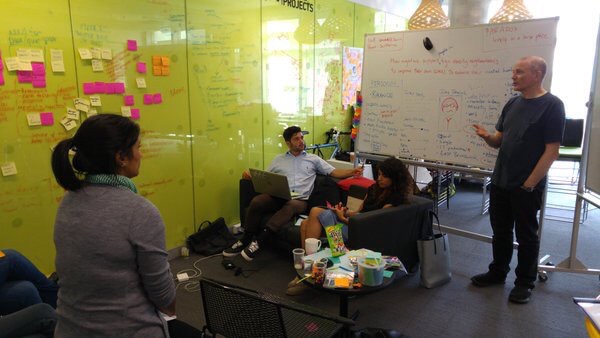
I’m the first to admit that I am not very good at practising meditation. It’s not that I don’t aspire to a state of mindfulness, but I sometimes find it hard to “be in the moment”. It does not come easily or naturally to me, because I’m often too busy thinking about the objective context, rather than the subjective conscious experience. So it was really interesting to see this photo of myself at last weekend’s Global Service Jam, organised by the Melbourne Jam Team at Swinburne Design Factory, and supported by Deloitte Digital, the School of Design Thinking and Huddle.

“This is where the magic happens…” (Photo by Johan Pang – image sourced from Twitter)

This photo was probably taken about halfway through the 48-hour event. Our team had got to the stage where we had articulated our problem statement (after much ideation…), scoped a solution model, done some validation through research and field interviews, and refined our key persona, all supported by some feedback from role-play and scenario testing. We had also just completed a lightning prototyping workshop, so the team needed to decide the overall form of our proposed service design solution, and reach agreement on the presentation format. Although there was so much still to do, we were at risk of revisiting things that had already been decided, because it felt like there was some remaining uncertainty about our prototype and some of the choices we had made along the way.

I don’t recall the exact “moment” (how imprecise a measure of time is that word?) but without realising it I found myself almost urging the team to stick with our existing decisions, and work through the remaining tasks based on the information we had to hand. It was a subconscious reaction to the message we had been given in the prototyping workshop about making decisions based on “the authority of the moment”. (Thank you, Rez Ntoumos!)

Sure, we weren’t having to make split-second, life-or-death decisions under enormous pressure, but if there was any “magic” here, it was probably about being able to be in the zone – the willingness to submit to the situation, to go with the flow. Throughout the weekend, we were advised not to fall in love with a particular idea or solution, but at the same time we were encouraged to get behind the team decisions and the options we chose – partly to sustain momentum, and partly to make sure we met the project deadlines!

There is a huge lesson here, because it goes some way to addressing the dilemma that many organisations face in making and implementing decisions (be they boards, policy makers, executive teams, startups, project managers, entrepreneurs, product developers or designers….). While it’s important to have robust decision-making processes, and it’s vital to consider all available data, the quality of any decision may not rest on whether it was the “best” choice to make, because usually only the benefit of hindsight can tell you that. If, however, at the time, it seemed like the right or appropriate choice, then in that moment it has to be the best-available decision.

Of course, there needs to be governance, transparency, authority and information to support, justify and legitimise the decision. Good decisions are usually those which can be fully articulated, the reasons easily communicated, and the implications clearly understood. Then once a choice has been made, the organisation or team that gets right behind the decision is more likely to succeed in the execution. All organisations at some point make “bad” decisions or inappropriate choices, but I think more often, even good decisions can suffer through poor implementation.

I acknowledge the need to get better at meditating, to enhance mindfulness for both personal reflection and clarity of thinking. Above all I recognise the enormous value of making the most of the moment when it comes to decision-making.

Next week: Startup Victoria’s latest pitch night