How to spend $60m on #Innovation and #Entrepreneurship for #Startups

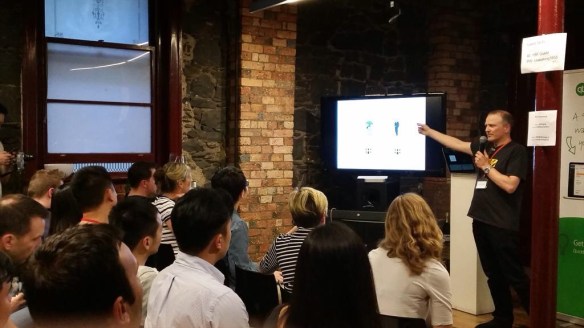
In the recent Victorian State Budget, the government allocated $60m over 4 years to supporting startups, via innovation and entrepreneurship. While not an insignificant sum, it’s still not a huge amount in the overall scheme of things. Having made the announcement, the government hurriedly undertook some rapid community and stakeholder consultation, to figure out how to spend the money. I was fortunate enough to be invited to one of the consultation exercises, a half-day lightning conference organised by Dandalo Partners, facilitated by Collabforge, and hosted by Teamsquare co-working space.
LightningConference

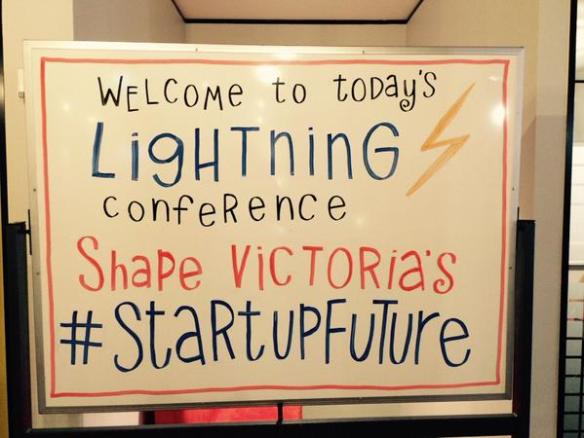
The theme of the Lightning Conference was #StartUpFuture

At the outset, there was an assumption that whatever recommendations came out of the consultation process, a new quango would be formed to oversee the implementation of the program and distribution of the funding. I don’t think I was alone when I expressed my concern that this was rather like putting the cart before the horse – the implication being, “Why seek our opinion, views and recommendations if you’ve already decided the solution?”

To their credit, the organisers took this on board – for example, rather than creating yet another entity, maybe the funding could be facilitated by an existing body such as Startup Victoria – but it felt that the consultation exercise was at risk of “going through the motions”.

Across the various topics that were discussed in the self-forming and self-directed breakout sessions, there were probably 5 key themes:

  1. Community
  2. Infrastructure
  3. Funding
  4. Sustainability and 
  5. “Picking Winners”. 

Here are the main points from each of those themes:

1. Community

There was general agreement that the local startup and entrepreneurial community is well-established, reasonably well-connected (I myself knew about 10% of the participants from various networks) and growing fast.

However, there was also a common view that more could be done to bring entrepreneurs and like-minded people together. For example, how do people know what ideas or projects everyone is working on, how can people find help or make offers of help in terms of matching skills, experience, knowledge, resources? How do we connect suppliers and investors to startups?

Sure, there are numerous meetups and regular startup events, but is there a better way to leverage this potential?  And there are various matching services linking entrepreneurs to mentors, but they are rather ad hoc, and in the case of connecting startups and investors, there are probably more challenges than there are opportunities (see Funding, below).

In short, how can the community come together in a more collaborative way?

2. Infrastructure

It’s quite easy to see that Victoria (mainly Melbourne) has a vibrant startup ecosystem, simply based on the number and frequency of meetup events, founder workshops and hackathons. But there still appear to be numerous obstacles to getting started – from establishment costs and bureaucratic red tape, to tax impediments and access to funding.

Some of these challenges are being addressed at Federal level (e.g., streamlining the company registration process, tax cuts for SMEs, and changes to both equity crowdfunding and employee share schemes). But that’s part of the challenge in itself – at the individual State level, there is relatively little that can be done on fiscal policy (apart from payroll tax and land tax), and all reforms relating to securities financing need Federal legislation and the involvement of market regulators.

The State government has more autonomy around local industry policy settings and planning, as well as making funding available via grants. This means, though, that government is forced to prioritize one sector over another (see “Picking Winners”, below), and a system of grants often results in a mini-industry that is created around grant applications, awards and distribution.

At a practical level, some participants took the view that more could be done to facilitate early stage startups and product prototyping – such as a continuous education and open-enrollment program for entrepreneurs, and co-working spaces for small-scale manufacturing, materials-testing, and engineering. (I am aware of at least a couple of local projects in this space – a biotech co-working lab and an “Internet of Things” open access workshop).

If the State government is looking to plug a gap, investing in R&D facilities might be one option.

3. Funding

This remains the biggie – and a topic previously covered both in this blog, and via numerous commentators and advisers. Even though there are many local pitch competitions, incubators and accelerator programs (plus Shark Tank and That Startup Show make for interesting/amusing viewing…) the elephant in the room is that there are too many startups chasing too few investors.

Competition for resources is positive, as long as it’s an efficient, transparent and accessible market, where the laws of supply and demand are equitable and the rules of engagement are clearly understood.

One industry veteran noted that the local investor community can normally provide small-scale startup funding up to $5m (via “family, friends and fools” and angel backers), and even larger, early-stage equity funding over $50m (via Venture Capital, Private Equity and Family Offices). But in the $5m-$50m range there are far fewer options.

Leaving aside the pros and cons of traditional secured and unsecured bank lending and emerging P2P lending platforms, there is a funding gap that could be filled via Australia’s superannuation scheme:

  • First, we need to find ways to get large retail and industry super funds along with other institutional investors to invest directly in local startups. At present, thanks to the Silicon Valley effect, these instos are more comfortable handing their money to US-based fund managers who then charge a premium to invest the assets in local startups. (I call this a very expensive boomerang….)
  • Second, in the absence of suitable investments for retail investors who may want to allocate part of their portfolio to startup opportunities, part of their superannuation assets could be used to invest in early-stage startups via a form of savings products or fixed income bonds. The retail bond market (such as it is) is heavily skewed towards sovereign debt (treasury bonds) and bonds issued by financial institutions (often in the form of hybrid securities, which are essentially a form of deferred equity). There have been attempts (and even regulatory reforms) to encourage the development of a deeper retail bond market in Australia, but these efforts appear to have stalled.

An enlightened approach to asset allocation could direct even a very small part of the $1.8tn superannation savings into startups that could have significant outcomes. If SMEs are seen as the backbone of future economic activity and jobs (as well as innovation and entrepreneurship), helping to accelerate startup growth will deliver multiple long-term dividends.

4. Sustainability

This wasn’t a huge topic of discussion, but it deserves an honourable mention because it surfaced in several ways:

  • Economic (e.g., making better use of available resources, not funding startups that go nowhere etc.)
  • Social impact (e.g., the growth of social enterprises)
  • Environmental (e.g., the conscious capitalism movement and the importance of “for purpose” enterprises such as B-Corps that want to minimize their environmental footprint)
  • Government (e.g., how to foster startups that want to help deliver better public services, and how to change public sector procurement policies that give startups more of a look-in)

There is also a need to reflect the changing demographics of the workplace, so that sustainable employment opportunities (in whatever form they exist) are made available to both mature-age workers and new school leavers.

So perhaps part of the $60m could be put towards (re)training initiatives.

5. “Picking Winners”

First up, let me say I always get nervous when we put our elected representatives in charge of deciding the fate of specific industries, especially when it’s taxpayers’ money at risk. Call me a cynic, but I’m not sure that picking winners is the government’s forte. I understand the need to support certain sectors that contribute to GDP growth, create employment opportunities, generate taxable revenue, instil industry innovation and develop cutting-edge technology – but the example of the domestic automotive industry is one where political ideology probably got the better of sound economics, as public subsidies eventually came to look like throwing good money after bad.

If nothing else, picking or backing winners is fraught with problems of favouritism, lobbying, murky back room deals and “jobs for the boys”. Better to create the foundations upon which broader innovation and entrepreneurship can thrive, and let the market decide. That way, the government can still claim the credit, and frame the conversation around its role as an enabler.

On the day, the discussion was more about the long lead time before anyone would know whether the program had been successful (assuming we can agree on what success should look like). In reality, re-tooling innovation and entrepreneurship is a 10-year initiative (which is difficult to manage in the face of short-term policy settings linked to 3 and 4-year election cycles).

  • Should we teach entrepreneurship and innovation in schools (alongside coding and STEM subjects)?
  • Should government use local plebiscites to determine where/when/how the funding should be allocated?
  • Should we use the money to directly fund startup founders (rather like the UK’s enterprise allowance scheme in the 1980s)?

There was also a suggestion that the money could be used to promote local startup success stories, in order to foster an understanding of truly viable startups, to identify and fast-track high-potential entrepreneurs, as well as define what is takes (time, money, resources, networking and connections) to build scalable and sustainable startup businesses (i.e., companies generating $250m+ in revenue, not lifestyle ventures or small family owned concerns).

If we do need to pick winners, perhaps we can easily agree which ones they are based on current trends, future needs and demographic demands:

  • Health, biotech and medtech
  • Fintech and big data analytics
  • Education and lifelong learning
  • Renewables and green technologies
  • High-tech engineering and manufacturing

In which case, we should simply help the State government prepare an investor profile, set an optimum portfolio performance target (based on financial returns, innovation scores and a mix of social and environmental outcomes) and give the $60m to a skilled fund manager.

FOOTNOTE:

For further ideas, please see 10 Random Ideas…

POSTSCRIPT:

A couple of further contributions to the innovation debate from AVCAL around tax reform, and from OneVentures around superannuation allocation.


Next week: Medtech’s Got Talent
Will streaming kill the music industry?

The resurgence in vinyl sales is certainly not enough to save the music business. But will streaming finally cook the goose that once laid Gold Discs?

statistic_id273308_music-album-sales-in-the-us-2007-2014

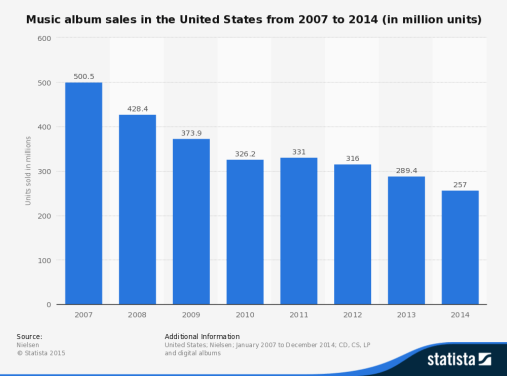
US album sales (in all formats) are in decline. (Source:  Statista)

What can we learn from the music industry based on the apparent rebound of vinyl sales in recent years? Is streaming doing enough to halt the decline in total music revenue? Will CD’s soon disappear altogether? What future for LPs in a world of “Album Equivalent Sales”, “Track Equivalent Albums” and “Streaming Equivalent Albums”?

Are there parallels here with other content, publishing or entertainment sectors?

Back to Black

Last month the 8th annual Record Store Day was launched with a fanfare of upbeat data for vinyl sales. It was a good news story in an otherwise depressing saga of declining album sales, stagnating revenues, and mixed messages about the impact of digital downloads and streaming services on the music industry.

Coming off a very low base (like, near-extinction levels), the extraordinary sales growth of vinyl (especially in Australia) can be attributed to a combination of factors, although it is difficult to see how any single trend is responsible for this growth:

  • The growing popularity of Record Store Day itself (although it’s not without its problems – see below)
  • Baby boomers buying their record collections all over again
  • Hipster interest in analogue technology
  • Record labels mining their back catalogues
  • Niche market interest among audiophiles, collectors and the cool kids
  • New approaches to packaging vinyl with downloads and other bonus content
  • DJ culture
  • Secondary markets via E-bay and Discogs
  • Retailing switching from megastores to specialist shops

Infographic: Vinyl Comes Back From Near-Extinction (Source: Statista)

Where Is The Money Coming From?

Latest industry data suggests that digital sales (downloads and streaming) are now on a par with physical sales (CD, vinyl and the rest). Overall revenue has stabilised, having fallen from a peak in 1999. And streaming services are enjoying huge growth.

But the true picture is harder to establish:

First, while the IFPI provides global aggregated data, each local industry body (RIAA, BPI, ARIA etc.) likes to tell a different story from its national perspective. So it’s difficult to compare like with like. (For example, while Taylor Swift is supposed to be a worldwide phenomenon, she does not figure at all in the BPI data for 2014…..) One brave soul has tried to compile data for the past 20 years.

Second, because of the changes in distribution and consumption, music sales have to be counted in different ways:

  • Wholesale revenue vs retail sales
  • Physical sales vs digital sales
  • Per unit download sales vs streaming equivalents
  • Product revenues (e.g., album sales) vs licensing revenues (e.g., soundtracks)
  • Subscription fees (e.g., Spotify) vs per download revenue (e.g., iTunes)
  • Advertising income from video streaming vs royalties from broadcasting and soundtracks

Third, when more and more music is accessed via video platforms like YouTube, Vimeo, and Vevo, streaming platforms like Spotify, Pandora and Omny, or apps such as Bandcamp, Soundcloud, Mixcloud and Shazam, “sales” data starts to become less and less relevant. (And some people are still hanging on to the ailing MySpace platform….).

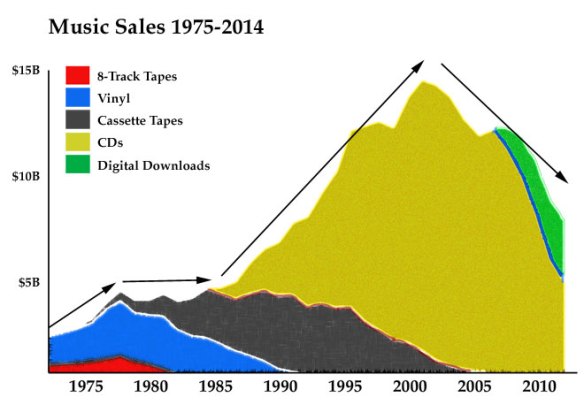
The bottom line is that despite the growth in streaming services, digital sales (in whatever format or media) are not yet enough to compensate for the continued decline in album sales in particular, and music overall:

The peak era of CD sales is over. (Source: Talking New Media)

Record Store Day Woes

The success of Record Store Day has divided opinion as to whether it is actually a “good thing” for the industry. It started as a campaign by independent record labels, distributors and retailers to revive the habit of buying records in-store. Labels produce limited edition and often highly collectible items for the occasion, and there are rules as to how, when and where these releases can be made available to the public.

At first, it really was driven by the independent labels, many of whom brought out interesting product that otherwise wasn’t available, such as label samplers, unreleased material and one-off artist collaborations.

Now, the major labels have jumped on board, meaning the market is flooded with unnecessary re-releases (do we really need Bruce Springsteen‘s ’70s and ’80s albums reissued on vinyl?) drawn from their extensive back catalogues (no need to pay for recording costs or new artwork!).

This means that smaller labels who release new vinyl records on a regular basis (not just once a year) get bumped from the production line, as the major labels exert their purchasing power over the pressing plants.

In addition, some Record Store Day releases are so badly distributed that stores are unlikely to take delivery of the items in time for the event. Or bad decisions lead to over-supply of certain items, which end up in the bargain bins (major labels again especially guilty of this offence).

Some store owners appear reluctant to participate because they feel embarrassed about the prices they may have to charge for many of the limited releases, which get bought by speculative customers, rather than collectors, fans and enthusiasts – a fact borne out by the immediate listings and inflated prices on E-Bay and Discogs….

As one store owner I talked to commented: “Every day should be record store day…”

What Else Does The Data Reveal?

For all the new young pop stars that the industry keeps churning out, there’s nothing like longevity and back catalogue to prop up the sales numbers. For example, Barbara Streisand was in the Top 10 for US album sales (and with new material!), and the likes of Pink Floyd, Led Zeppelin, Miles Davis, Bob Marley and Oasis feature in the top-selling vinyl records. Will Record Store Day 2025 herald the vinyl release of Justin Bieber’s pre-pubescent “demos”?

The decline of album sales has been particularly steep in the genres of Hip-Hop and R&B, while rock and pop continue to dominate the market. Some industry commentators have suggested that music sales are merely “in transition” as consumers switch from buying CD’s and downloading music to subscribing to streaming services. Meanwhile, in the US, country music’s #4 position by overall consumption reflects substantial album sales, as streaming is still a small component for the genre.

And those vinyl sales numbers? They’re simply a blip on the chart and largely driven by avid fans willing to shell out for deluxe editions….

The future is streaming?

Apple and others certainly believe (or hope) that streaming will save the music industry. Having demolished the market for CDs, iTunes is in a battle for its own survival among competing streaming services, where Apple itself is about to lead the charge having acquired the Beats platform.

But others are not so sure, predicting that streaming is already in decline, along with download sales:

First, the streaming platforms are yet to make a profit. Part of this is due to the cost of content that has to be licensed from the record labels and artists. Part is also due to the cost of acquiring customers, even if this can be done via social media, because the decline in music buying has been so abrupt, so the industry may be permanently damaged that streaming cannot bring back paying customers.

Second, even though streaming may overtake downloads by next year, there’s still nothing certain that teen pop fans (the target audience) will pay $7.99 – $9.99 per month to listen to music via so-called “freemium” services. Evidence suggests that consumers are happy with the free services, even if they have to put up with ads.

Third, while I agree that the freemium model is a fixture in the digital economy, the problem with Spotify et al is that they are not growing the market for music, but simply cannibalising it by displacing existing platforms (commercial radio, digital downloads, physical sales), while being tied to third-party distribution channels (the internet) and devices (smart phones, tablets and computers).

Anyway, subscription-based music streaming is nothing new, and was first launched over 100 years ago (and thanks to Mark Brend’s “The Sound of Tomorrow”, I learned that Mark Twain was the first subscriber).

If the “old” record companies are charging streaming services too much to license their content, then the streaming services should just find other sources – there’s plenty out there – but then, just like the major record labels, they are not really interested in music, only in shifting product and promoting “artists” (even if they are still figuring out how to make digital pay). The record labels don’t help themselves with their reliance on back catalogue, and their archaic territorial licensing practices either – forcing customers to circumvent geo-blocking barriers (legally or otherwise…).

Unfortunately, file sharing, illegal downloads and “free” streaming have meant customers don’t feel compelled to pay for digital music content. Personally, I prefer to curate my own listening, and not let someone else dictate what I hear, even if the service “knows” my preferences…

And the moral of the story is…?

More distribution platforms, more formats and more content may not be enough to save ailing industries, whether it’s music or television, newspapers or movies. These businesses will have to learn to live with lower margins and/or smaller market shares. The quality of a home-made movie uploaded onto YouTube may not be anywhere near that of a Hollywood blockbuster, but if cat videos are what grab punters’ attention (and by default, pull in the advertisers), the studios may have to find alternative strategies. And if music fans prefer to use free streaming services, the industry has to do a better job of producing content that consumers may be willing to pay for.

Ironically, in publishing, one sector that has been written off ever since the arrival of CD-ROM’s and the internet, teen consumers are still happily buying and reading print editions, alongside e-books. More so than other content industries, publishing has rapidly adapted to the new user-defined model: aspiring authors find it easier to self-publish (e.g., via Tablo and dedicated crowdfunding platforms such as Pubslush and Unbound); they can easily connect with an audience (especially in the realm of fan fiction); and a platform like Wattpad allows writers to test material before they commit to formal publication, and lets readers vote for what they’d like to read more of.

Next week: Making connections between founders and investors


3 Ways to Fund Your #Startup

At a recent forum organised by Startup Victoria, co-founders and advisors discussed alternative ways of funding a startup. Part of Startup Week, the event was hosted by inspire9 and sponsored by BlueChilli and Slush Down Under.

button-41706_1280Bootstrapping

Doug English from CultureAmp talked about the benefits of bootstrapping, especially for B2B startups: “You have fewer clients, but with bigger budgets, and fewer of the hassles associated with a consumer startup.”

Initially, the founders used consulting work as a means of funding themselves, but focussed on specific market segments and customer domains – in short, they got paid to learn about their clients.

Having several co-founders was also helpful in providing “cheaper access to more labour”.

However, they have learned a significant lesson from those early consulting gigs: although they were able to secure upfront lump sum payments for client development work, they are still supporting some of those initial product features and functions, without necessarily getting paid for it. Whereas, if they had aligned product development with their client road map, they would have been able to generate recurring and iterative revenue from new product features. In short, annual payments and subscription fees help with the cash flow!

There was also the opportunity cost of bootstrapping, instead of bringing in external funding. The team realised that pursuing VC funding was always going to be a long haul, so they decided against it; but they then found themselves in the position of receiving an unsolicited approach from a VC source.

Note: CultureAmp recently closed a Series A round of funding for $8.1m.

Crowdfunding

Alan Crabbe, co-founder at Pozible explained how the team had seen a trend in crowdfunding projects in music (Europe) and film (US), and saw an opportunity in the visual arts. A key strategy was to use story-telling through video to help artists pre-sell their projects. Success can be rapid – one Brisbane project was funded within 3 hours. Globally, $5bn raised has been through crowdfunding – but beware domain name squatters…

Three trends have helped crowdfunding as an alternative funding platform:

  • Social Media – to provide critical mass
  • Online Video – experiencing exponential growth
  • Payment Innovation – e.g., PayPal etc.

Alan had a number of tips for anyone contemplating crowdfunding their startup project:

  1. Use social media comments, likes and other feedback to validate your idea
  2. Taking a more hands-on approach means they have a success rate of around 60%
  3. Find your audience first – typically among the FFF (“family, friends and fools”) and your other networks

As for equity-based crowdfunding, he observed that nothing happens quickly in Australia, but predicted it might be a reality within 6-9 months’ time.

Note: a couple of local platforms that resemble equity-based crowdfunding are already in operation: VentureCrowd and ASSOB – but as with anything of this nature, read the small print, and make sure the model is right for your business or startup idea.

R&D tax breaks

The final speaker was Sean Moynihan from PwC who talked about some of the R&D tax incentives available from the government. A major hurdle for many startups is that these tax breaks are generally only available to companies that have notional R&D deductions of at least $20,000.

Other programs such as the Export Market Development Grant are being phased out, and even incentives for product design must be able to demonstrate research activity and expenses. Since these initiatives can largely be described as “matching” programs, they can be summarised as “no taxable revenue, no grant available”.

PwC have launched their own service to assist companies navigate the R&D claim process.

Although an estimated $1.8bn will be made available in R&D grants this year, less than 10% will go to startups.

Note: the closing date for grant applications for the year ended June 30, 2014 is April 30.

Conclusions

Although there is a noticeable change in VC attitudes, most early-stage funding finds its way to B2C startups, because B2B is just “too hard”. However, even angel investors want to see an established client base, a revenue stream, and a well-defined team of founders.

With lower tech and product development costs in mobile apps and software tools, bootstrapping is a more realistic option for many startups, and the received wisdom appears to be to hold out for as long as you can before bringing in external funding.

Crowdfunding is gaining traction for specific projects or more tangible products (including some apps) – but legal and other restrictions means it’s not really a viable option for raising equity. (Maybe P2P lending for businesses will offer alternatives to a bank overdraft, a personal loan or even secured lending?)

Next week: Taxing the Intangibles – coming soon to a screen near you!


How to Survive a #Startup Weekend

A rite of passage for any startup founder or budding entrepreneur is a weekend hackathon, and a Startup Weekend is probably the best way to throw yourself in at the deep end. As part of Startup Week, the York Butter Factory hosted Melbourne’s first fintech event. Here’s how I managed to survive the ordeal….

IMG_0210

Your correspondent in full flow at the Final Pitch…

Rather than provide an hour-by-hour account of my experience (the schedule is on the website and you can read the Twitter feed), here’s my thoughts on what it takes to participate and get the most out of the experience:

Courage

Take a leap of faith, step up and pitch an idea at the open mike session on the first night. Not only does this force you to craft your message, it also helps overcome any nervousness or awkwardness in joining a room full of total strangers with whom you will be working for the next 54 hours. My idea didn’t get enough votes, but it did spark several interesting conversations with other participants, such that I will probably take it further.

Stamina

Pace yourself. Yes, you could spend every available hour on finishing that customer validation, or refining the pitch, or making sure your demo site is up and running – all of which are important – but you also need to make time for rest, sleep, eating (all catering is laid on) and exercise. Again, 54 hours is a long time to spend on a single activity.

Open Mindedness

I had some idea from the program notes what to expect, but I still didn’t really know what it would it be like. So it was great to just go with the flow, to see what would happen. The format, structure and schedule (as well as the rules and requirements for the Final Pitch competition), pretty much define what goes on. But your attitude and willingness to be open to new ideas determine how much you get out of the experience.

I should also mention the value in having direct access to so many experienced mentors throughout the weekend – although I know from the experience, it’s hard not to get too defensive when mentors find fault with your project, and difficult to remain true to the idea when some of the feedback is contradictory.

Teamwork

Building teams to collaborate on a startup idea forms the basis of the hackathon model. As my own idea did not get enough votes at the open pitch, I looked to join a team that was a good fit in terms of the idea, the mix of skills to complement my own, and the ability to execute. As a “non technical” participant, I was extremely fortunate to be part of team that had a great balance of back-end and front developers, design skills and mobile deployment. Plus, given the theme was fintech, it was fantastic working with people from a banking IT background. (It also helped that several team members were veterans of Startup Weekend.)

Defining Roles

Although we didn’t spend a great deal of time creating or defining roles within the team, each of us played to our strengths, by self-determining what we would work on, and what our contribution would be. The only tricky decision was choosing who would present the Final Pitch to the panel of judges – but a process of elimination, preference and negotiation resulted in yours truly taking on the role.

Tools

In addition to the various software, hosting and domain name resources provided to each team, I was impressed by how many other tools the team plugged into – such as Trello, GoogleForms, Hangouts, ThemeForest, CanvasModel Design and Launchrock – most of which were free. We also spent some time reviewing competing and complementary products as part our MVP validation.

Less Is More

We could have spent a lot of time on customer validation – but we chose instead to talk to 3 or 4 key target customers for the MVP (qualitative), and run an on-line survey (quantitative) which generated around 100 responses overnight (not bad considering it was a weekend…). We also had more content than we actually used: the lean canvas business model was used sparingly, as was a competitor heat map; but it also meant that when we came to developing our pitch presentation, we had the luxury of being able to take stuff out and only focus on the important and most relevant points. Thanks, also, to a presentation template that one of the team had just used at a recent management course!

Practise

Having been chosen to make the Final Pitch on behalf of the team, and despite quite a lot of experience in making business presentations and in public speaking, I was extremely grateful for the coaching, feedback and rehearsals the team put me through. Getting to know the material, understanding the anchor points and how to navigate from topic to topic, helped me to give a presentation that flowed logically and hopefully demonstrated that the team had met the competition brief.

The Result?

Unfortunately our team did not win, nor did it place in the top 3. The judges pinged our presentation for being “too confident”, and for not demoing our prototype (we did briefly put up our beta website) – but given the working prototype mostly comprised some backend coding, it wouldn’t have been that interesting from a visual perspective.

Notwithstanding our disappointment on the night, the team is planning to get together to see how far we can take the idea, and separately I’ve been asked to join a new team at an upcoming hackathon.

(If anyone is interested, we designed a P2P payments tool called PayMee)

Next week: 3 Ways to Fund Your #Startup