How to Survive a #Startup Weekend

A rite of passage for any startup founder or budding entrepreneur is a weekend hackathon, and a Startup Weekend is probably the best way to throw yourself in at the deep end. As part of Startup Week, the York Butter Factory hosted Melbourne’s first fintech event. Here’s how I managed to survive the ordeal….
IMG_0210

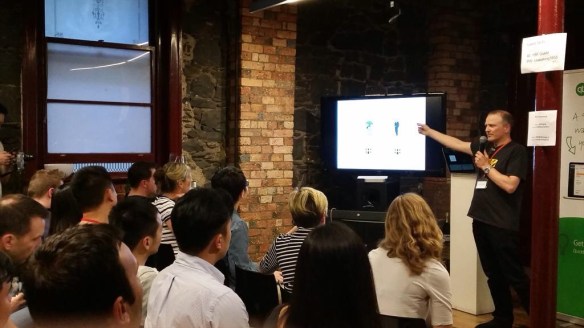
Your correspondent in full flow at the Final Pitch…

Rather than provide an hour-by-hour account of my experience (the schedule is on the website and you can read the Twitter feed), here’s my thoughts on what it takes to participate and get the most out of the experience:

Courage

Take a leap of faith, step up and pitch an idea at the open mike session on the first night. Not only does this force you to craft your message, it also helps overcome any nervousness or awkwardness in joining a room full of total strangers with whom you will be working for the next 54 hours. My idea didn’t get enough votes, but it did spark several interesting conversations with other participants, such that I will probably take it further.

Stamina

Pace yourself. Yes, you could spend every available hour on finishing that customer validation, or refining the pitch, or making sure your demo site is up and running – all of which are important – but you also need to make time for rest, sleep, eating (all catering is laid on) and exercise. Again, 54 hours is a long time to spend on a single activity.

Open Mindedness

I had some idea from the program notes what to expect, but I still didn’t really know what it would it be like. So it was great to just go with the flow, to see what would happen. The format, structure and schedule (as well as the rules and requirements for the Final Pitch competition), pretty much define what goes on. But your attitude and willingness to be open to new ideas determine how much you get out of the experience.

I should also mention the value in having direct access to so many experienced mentors throughout the weekend – although I know from the experience, it’s hard not to get too defensive when mentors find fault with your project, and difficult to remain true to the idea when some of the feedback is contradictory.

Teamwork

Building teams to collaborate on a startup idea forms the basis of the hackathon model. As my own idea did not get enough votes at the open pitch, I looked to join a team that was a good fit in terms of the idea, the mix of skills to complement my own, and the ability to execute. As a “non technical” participant, I was extremely fortunate to be part of team that had a great balance of back-end and front developers, design skills and mobile deployment. Plus, given the theme was fintech, it was fantastic working with people from a banking IT background. (It also helped that several team members were veterans of Startup Weekend.)

Defining Roles

Although we didn’t spend a great deal of time creating or defining roles within the team, each of us played to our strengths, by self-determining what we would work on, and what our contribution would be. The only tricky decision was choosing who would present the Final Pitch to the panel of judges – but a process of elimination, preference and negotiation resulted in yours truly taking on the role.

Tools

In addition to the various software, hosting and domain name resources provided to each team, I was impressed by how many other tools the team plugged into – such as Trello, GoogleForms, Hangouts, ThemeForest, CanvasModel Design and Launchrock – most of which were free. We also spent some time reviewing competing and complementary products as part our MVP validation.

Less Is More

We could have spent a lot of time on customer validation – but we chose instead to talk to 3 or 4 key target customers for the MVP (qualitative), and run an on-line survey (quantitative) which generated around 100 responses overnight (not bad considering it was a weekend…). We also had more content than we actually used: the lean canvas business model was used sparingly, as was a competitor heat map; but it also meant that when we came to developing our pitch presentation, we had the luxury of being able to take stuff out and only focus on the important and most relevant points. Thanks, also, to a presentation template that one of the team had just used at a recent management course!

Practise

Having been chosen to make the Final Pitch on behalf of the team, and despite quite a lot of experience in making business presentations and in public speaking, I was extremely grateful for the coaching, feedback and rehearsals the team put me through. Getting to know the material, understanding the anchor points and how to navigate from topic to topic, helped me to give a presentation that flowed logically and hopefully demonstrated that the team had met the competition brief.

The Result?

Unfortunately our team did not win, nor did it place in the top 3. The judges pinged our presentation for being “too confident”, and for not demoing our prototype (we did briefly put up our beta website) – but given the working prototype mostly comprised some backend coding, it wouldn’t have been that interesting from a visual perspective.

Notwithstanding our disappointment on the night, the team is planning to get together to see how far we can take the idea, and separately I’ve been asked to join a new team at an upcoming hackathon.

(If anyone is interested, we designed a P2P payments tool called PayMee)

Next week: 3 Ways to Fund Your #Startup
Update: Health, AusPost, eTaskr and Slow School

Over recent months, I have blogged about health and the digital economy, the challenges facing AusPost, the progress of eTaskr and the birth of Slow School of Business. Here are some updates on each of these topics:

IMG_0211Apple launches developer platform for health apps

On top of launching “Health” with iOS8, Apple has released a software tool called ResearchKit designed to help researchers and developers build and test new health apps.

I think that while we hear a lot about the Internet of Things (#IoT), health is one area where the connection of the physical and the digital will really deliver tangible benefits (not just a fridge with a screen…).

Australia Post plans to raise the cost of sending letters

In the wake of declining letter volumes (and poorer financial performance), AusPost is considering jacking up the price of letter postage, and introducing a 2-speed letter service.

While this is not a surprising move, it does seem shortsighted. Given the increase in parcel volumes, especially from e-commerce and small online purchases, I reckon AusPost would be better off with more refined domestic parcel rates. For example, using exactly the same dimensions and weight, I can either send an item as a “large letter” for $2.10 (which is perhaps too cheap?), or as a “small parcel” for $7.45 (which is incredibly expensive for an item that might cost no more than $25). Maybe different band rates of 50g, from 100g up to 500g (the current weight limit for a small parcel/large letter) or even 1kg  might be a better option, coupled with improved payment and lodgment automation? Just saying…

etaskr secures seed funding

Described as a “private label elance”, etaskr is a graduate of the AngelCube accelerator program, and was a finalist at last year’s Big Pitch organised by Oxygen Ventures.

Following their appearance at the Big Pitch, etaskr have recently closed $1.3m in seed funding from Oxygen Ventures. As mentioned in an earlier blog, etaskr is starting to see traction among corporate clients, including overseas markets, but the nature of the B2B sales cycle has meant that investors, incubators and accelerators are traditionally wary of such startups. Hopefully, this latest development will start to change market perception.

Slow School founder in the news

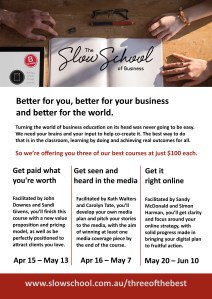
Finally, Carolyn Tate, the founder of Slow School of Business has been busy launching a new program of short courses (including Three of the Best) a new website and a new book. Oh, and she’s also become a B Corp. (Declaration of interest: I am a participant in, and adviser to, Slow School.)

Previously featured in Slow Living (required reading for the Slow Movement), Carolyn has taken a simple idea based on collaborative and peer-to-peer learning, and created a potentially disruptive platform for professional development and corporate training. Slow School is also tapping into the growing trend for people to work as independent contractors, freelancers and consultants (rather than permanent employees), and the dynamics of the digital economy where participants are also looking to make deep, personal connections rather than just online “friends”.

The new normal?

Post GFC, we’ve been told to expect a low/slow/no growth environment – that this is the “new normal”. I would add to that digital disruption, non-traditional commercial models and emergent ecosystems as being the other key influences on how we do business in this new environment. From what I have skim-read of the latest Intergenerational Report, the language is still couched in traditional terms of “jobs”, “productivity” and “industries”. Yes, there is mention of innovation, demographics, technology and flexible workplaces (i.e., deferring retirement?), but nothing that inspires me to think our political leaders understand what is really going on within the startup economy and the broader digital movement.

Next week: How to survive a Startup Weekend

AngelCube15 – has your #startup got what it takes?

Startup Victoria‘s first Lean Startup meeting of the year heralded the launch of AngelCube‘s 2015 accelerator program (#AC15), for which applications are now open. A good opportunity to check in with previous successful applicants, and find out if your startup is made of the right stuff.

Screen Shot 2015-02-25 at 10.03.58 amThe info evening was hosted by inspire9, and supported by PwC, and Nathan from AngelCube kicked off proceedings by giving a run down on the accelerator program, the application process, and the type of startups that are more likely to be accepted.

What does the program offer?

  • A 3-month intensive learning and development experience
  • $20k in funding (in return for 10% of the business)
  • Co-working facilities
  • Working with Lean methodology (focus on Product-Market fit)
  • Access to great mentors and advisers, and early-stage investors
  • Participation in a fundraising roadshow (including time in the US)

There is an application form via AngelList, and the closing date is May 10 (but the sooner you can submit the better). From the hundreds of applications, AngelCube puts together a shortlist of 20, of which no more than 10 will likely be accepted.

What is AngelCube looking for?

  • Globally scalable tech startups (think beyond Australia!)
  • In-house tech skills/resources (it’s not really a matching service)
  • Great teams (more than the ideas themselves)
  • Customer traction (ideally revenue-generating)
  • Consumer-oriented solutions (rather than B2B)

What has the experience been like for successful graduates?

Three alumni of previous AngelCube programs offered some personal insights, and then participated in a Q&A with the audience of 400:

Screen Shot 2015-02-25 at 10.02.34 amFirst up was Peter from Ediply, a service that matches students to the course or university of their choice. Given the growth in education and lifelong learning, and the increasing numbers of students (especially from Asia) looking to study overseas, the business seemed like a natural fit for AngelCube. However, it was still a relatively new or unknown sector in terms of end-user or independent services (rather than in-house marketing and enrollment efforts) – which sort of broke one of AngelCube’s rules for acceptance: no established market. Peter stressed that the main reasons for applying were the need to overcome some development barriers, and to get out of a “Melbourne mindset”.


Screen Shot 2015-02-25 at 10.03.01 amAsh from Tablo (“YouTube for books”) probably broke another AngelCube rule, in that he was a sole applicant (not part of a team) and he had limited tech resources. AngelCube made him work harder, think big, and keep going – and helped him to become a disruptive force in publishing, with customers in 130 countries collectively publishing 1 million words a day. He’s also closed a C-round of funding, and has some impressive investors on his share register.

Screen Shot 2015-02-25 at 10.03.28 amLastly, David from etaskr (“a private label elance”) had to quit a full-time job with one week’s notice once he got accepted into AngelCube. He even had to Google how to pitch. Plus he came into the program with a totally different idea, got slammed, failed to get customer traction, and ended up pivoting to an enterprise software solution (and broke another AngelCube rule in the process – no B2B, because of the longer sales cycle). Despite having to live on very little money for 6 months (less than $200 pw) the team persevered, and are now starting to get traction, including overseas markets like Holland. His final words were “risk is not something to fear, but to overcome”.

Q&A with the audience

Most of the questions were about the application process for AngelCube, and how it helped the successful startups, particularly with going global. In large part, this due to some great networks, access to high-profile connections (“we got to meet the first employees at Yammer!”) and links to some influential investors. There was also some discussion about how to secure your first customers (mainly via social marketing techniques), and the challenge of enterprise sales (“it sucks, because you need 100 different minds to all say ‘Yes!'”).

Finally, for more insights, please visit these links to previous posts about AngelCube and some of the successful applicants.)

Next week: Help! I need to get some perspective…

Finding wisdom in a binary world

Sometimes I think that the thirst for data, combined with a digital mindset, is reducing our analytical and critical thinking to a highly polarised, binary-driven view of the world.

Rather than recognizing that most ideas and concepts are composed in “technicolor” we are increasingly reducing our options, choices, responses and decisions to “black or white” conclusions. Everything has to be couched in terms of:

  • on/off
  • yes/no
  • true/false
  • positive/negative
  • for/against
  • like/dislike
  • friend/unfriend
  • connect/disconnect

It feels that our conditioning is driven by the need for certainty, the desire to be “right”, and the tendency to avoid disagreement/difference. However, uncertainty is more prevalent than we may like to admit. To illustrate what I mean, here are four personal learning experiences I would like to share by way of demonstrating that not everything can be reduced to black or white thinking:

1. The scenario is the same, but the context, therefore the answer,  is different

Although I was born and grew up in the UK, I completed part of my primary education in Australia. Before returning to the UK, I was required to complete the 11-plus exam, to determine which secondary school I would attend in England. (The exam was mainly designed to test literacy, numeracy and verbal reasoning.) Here’s a multiple choice question which I got “wrong”:

Q. Why do windows have shutters?

I chose “to keep out the sun” as my answer. In fact, the “correct” answer was “to keep out the wind”. The invigilator was kind enough to include a note to the examiners that my answer was based on the fact that I had been living in Australia, where window shutters are primarily designed to keep out the sun (and therefore the heat). Whereas in the UK, shutters are largely used as a protection against the wind.

2. The facts are the same, but the interpretation is different

While studying for my law degree, I had to write an essay on reforming the use and application of discretionary trusts, based on the current legislation and recent court cases. I argued in favour of an alternative approach to the relevant court decisions, and deliberately took a contrary view based on my social and political outlook at the time, and influenced by what I saw were changes in public policy.

To my great surprise, the tutor gave me one of my highest ever grades in that subject – even though she disagreed with my conclusions, she recognised that my reasoning was sound, and my interpretation was valid.

3. The intention may be “constructive”, but someone will always choose to see only the negative

Early in my career, I participated in a TV documentary series about different types of interview situations. As a local government officer, it was my role to advise members of the public on how to navigate the various regulations and policies in respect to accessing council services, as they related to their own particular circumstances.

One interview I conducted was included in the final broadcast. I thought my advice was objective, and based on widely accepted principles, but without advocating or recommending a specific course of action, as I believed it was my job to remain impartial yet factual. I later discovered that another local council used part of the same interview footage to train their own staff in how not to conduct an interview, because it could have been mis-interpreted as a way to get around the system. So, whereas I thought I was being constructive, someone in a position of authority chose to see it as a negative influence.

4. The assumptions may be reasonable, but the results often prove otherwise

Years later, I found myself having to defend a proposal to launch a smaller, and cheaper, version of a global product in a local market. The received wisdom among many of my colleagues was that the proposal would result in less revenue, even if customer numbers grew. As part of the initiative, I also advocated shutting down a legacy local product in the same market – partly to reduce production costs, and partly because very few customers were actually paying for this outdated service. Again, I faced resistance because a number of internal stakeholders thought customers would refuse to pay for a superior service, and that the business would end up alienating existing customers and, by extension, upsetting the local market.

Subject to a detailed customer migration plan, some very specific financial metrics and frequent status reports, the project was greenlighted. 12 months’ after implementation, the results were:

  • Comparable revenue was doubled
  • Overall production costs were halved
  • A significant number of new clients were signed up (including several from new market segments)

The closure of the legacy product did see the loss of some customers (about 10-15% of the legacy client base), but this was mostly non-paying business, and was more than offset by the increased revenue and customer growth. [In my experience, significant platform migrations and product upgrades can result in up to 20% of customers electing not to switch.]

What are we to conclude from this?

It’s totally understandable that businesses want to deal only with certainty (“just give me the facts…”) and often struggle to accommodate alternative or contrary perspectives. But despite the prevailing digital age of “ones and zeroes”, we are actually operating in a more fluid and diverse environment, where new business opportunities are going to be increasingly less obvious or come from non-traditional sources. While we may find comfort in sticking to core principles, we may end up missing out altogether if we are not prepared to adapt to changing circumstances: context is all about the difference between “data” and “knowledge”.

Wisdom comes from learning to acknowledge (and embrace) ambiguity; individuals, teams, organisations and businesses are more likely to benefit from greater diversity in their thinking, resulting in richer experiences and more beneficial outcomes.