CoinAlts Fund Symposium, New York

Following on from last week’s theme on Blockchain, crypto and asset management, the recent CoinAlts Fund Symposium in New York brought together various parts of the fund industry to discuss issues connected to crypto investment, portfolio management and back office solutions.
Although conducted under a veil of non-attribution, it wouldn’t be betraying any confidences to describe some of the key talking points. If anything, the main themes echoed much of what I have heard at similar events over the past 6 months: scaling transaction capacity and establishing Blockchain interoperability; building industry standards for this new asset class; and creating valuation models for new token issuance projects.

In addition, the conferences addressed operational matters such as crypto fund administration, audit, custody, taxation and client reporting. All the usual back office functions that are taken for granted in other asset classes.

What was particularly noticeable about this event was the lack of international participation. In fact, a number of the speakers almost berated the audience for choosing to ignore overseas industry, market and regulatory developments at their peril.

For example, on regulation, it was suggested that if the SEC doesn’t provide some constructive guidance on new token issuance (especially so-called security tokens), the USA could be left behind. Indeed, one industry representative stated that for his company, the USA is only their third largest market. Another presenter drew attention to the fact that South Korea (a leading marketplace for Blockchain and crypto) produces 15 times as many engineers as the USA, while the USA produces 40 times as many lawyers as South Korea.

A recurring theme throughout the day was that without formal standards, clearer regulation, and institutional-strength tools and infrastructure, major asset managers, pension funds and Wall Street firms will remain very cautious about investing in digital assets, whatever their current level of interest.

Next week: Startup Exchange, Chicago
 

Token Investment Summit, Vienna

To demonstrate how far Blockchain, cryptocurrencies and digital assets have permeated the traditional world of asset management, the Token Investment Summit in Vienna (organised by Crypto42 and hosted by the Vienna University of Economics and Business) covered a number of topics of particular interest to institutional investors.

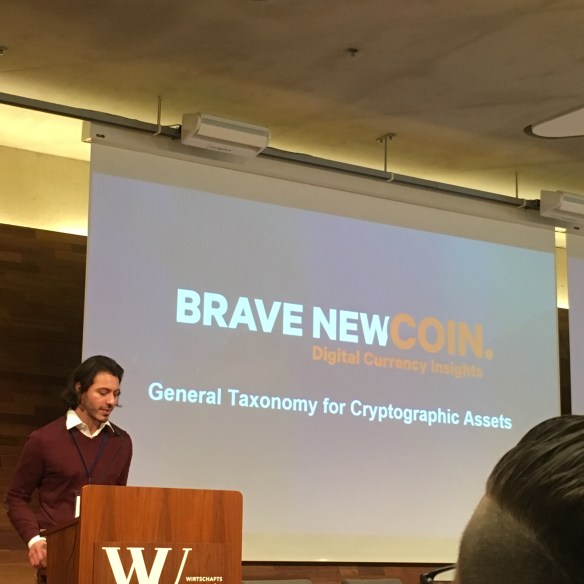
Brave New Coin Head of Research, Rafael Delfin introduces the General Taxonomy for Cryptographic Assets

William Mougayer kicked the day off, discussing the need to define “Blockchain fundamentals”. In particular, some of the token jargon needs to be better explained (air dropping, locking, burning), and some industry practices (token definition, protocol design, staking, and on-chain governance) require more formal and consistent standards. Projects need to address their “Token-Market Fit”; chains need to think about their scaling and interoperability; and tokens need to deal with decentralized exchanges, post trade clearing, and asset classification.

Next, Rafael Delfin from Brave New Coin presented the General Taxonomy for Cryptographic Assets (covered here before), followed by pitches on behalf of Rigoblock (decentralized fund infrastructure), HydroMiner (green mining), Conda (equity tokens via a crowdfunding platform), Artis (time-based value or asset transfer on chain), Streem (“start & end” events only) and Ocean Protocol (the data exchange network from BigChainDB).

There was an overview of ICO regulation, comparing some of the developments in Germany (Bundes Block’s Token Regulation Paper), Austria (University of Graz’s KryptoStaat project), Switzerland (FINMA paper on ICOs) and Gibraltar (GBX token listing using a risk-based model).

Much of the day was given over to discussing compliance, taxation, accounting, token economics and investment research (such as token valuation models, correlation analysis and crypto returns). There was also a local case study on the Optioment scam, and the potential criminal and civil breaches.

Finally, a panel of VCs provided their perspective how to navigate this asset class, as the industry weighs up the recent wave of more speculative tokens, and moves to more structured capital gains, especially from so-called security tokens.

Next week: CoinAlts Fund Symposium, New York


Beyond Blocks, Tokyo

Thanks to my work with Techemy and Brave New Coin, Content in Context is currently on the road, attending various Blockchain and crypto events in Tokyo, Vienna, NYC and Chicago. The next few blogs will attempt to capture notes from the field.

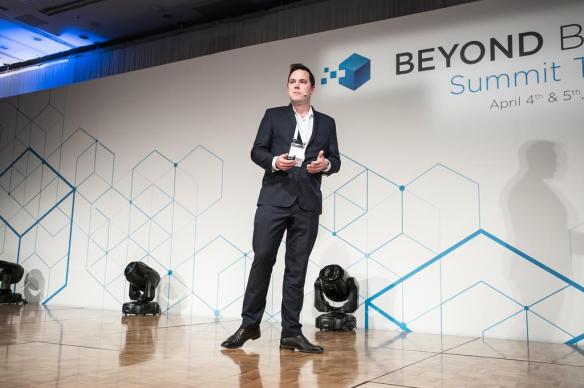
Techemy CEO, Fran Strajnar presents on the new asset class of digital value

In Tokyo, the Beyond Blocks Summit was a stellar affair, with marquee blockchain projects and major investors presenting on stage, alongside cosplay characters, light shows, upbeat music and a crowd of crypto fanatics.

Given the significant developments in Japan’s regulatory framework for crypto-currency trading, there was a lot of interest in the presentations by bitFlyer, Quoine and Smart Contract Inc.

As with the recent APAC Blockchain Conference in Melbourne, there was a strong representation from China’s growing base of Blockchain projects (but not ICOs, of course), keen to demonstrate their infrastructure projects.

There was much debate about regulatory developments across Asia, made all the more interesting by the announcement that Monex is acquiring Coincheck, despite (or because of?) the recent hack on NEM tokens held on the local exchange.

Among international key speakers were Patrick Byrne from Overstock and tZERO, John Burbank of Passport Capital, and Techemy’s own Fran Strajnar – all looking to the future of this new asset class, especially so-called security tokens.

Interspersed throughout the two days were panel discussions and presentations on scaling, infrastructure, decentralized exchanges, stable coins and the future of ICOs.

Although this was only their second event of this kind, the Beyond Blocks team have quickly established themselves on the conference circuit.

Next week: Token Investment Summit, Vienna


Tech Talk on Crypto

There’s an adage about not investing in something you don’t understand. There’s another about not betting more than you can afford to lose. And then there’s crypto, which in the words of TV commentator, John Oliver represents “Everything you don’t understand about money combined with everything you don’t understand about computers.” So it was with great interest that I attended last week’s General Assembly’s Tech Talk on Crypto, presented by a team from Bitcoin.com.au.

This intro to crypto was actually very illuminating, as much for the audience questions as the presentation itself.

To begin with, there was an attempt to explain the underlying technology of Blockchain; which, thanks to a certain YouTube video, seemingly reduced Blockchain to a trading platform or networked database. There was also an analogy to the internet itself: first, we just had protocols like TCP/IP; then we had web browsers; next we had e-mail clients; now we have Netflix.

Next was a reference to Bitcoin‘s mining infrastructure, its associated monetary policy, and the specifics of Bitcoin’s tokenomics. And then we jumped straight to Ethereum and the development of smart contracts – with particular reference to their potential to disrupt/transform the legal profession and the insurance industry.

There was brief mention Venezuela’s “petro”, a government-issued, oil-backed cryptocurrency, as evidence of further disruption in financial markets (although the petro has raised a number of concerns in some quarters). And, in a week when revelations about Facebook and Cambridge Analytica dominated the news, the speakers talked about Blockchain applications displacing even core social media, offering more privacy and control over our personal data and content.

The first of the audience questions were about crypto valuations. “The market decides”, which prompted some comments about market volatility and speculation. There were also some comments about regulation, tax, privacy and security.

Next question: “What about hacking?” “That’s more of a problem with exchanges, than user wallets.” That lead to a brief discussion of different types of wallet, which I’m not sure everyone in the audience fully understood.

We then moved on to look at other types of coins, and specific Blockchain use cases (such as remittance services, patient healthcare records, identity, P2P solar energy trading, voting, education etc.). In particular, Golem (crypto-powered network computing), Brave (crypto-enabled web browser), Steemit (earn crypto from your content) and TenX (an everyday crypto payment solution) were projects that the presenters liked.

Finally, to underscore how little some people understand about fiat currency and traditional financial markets, one attendee, struggling to fathom how the price of Bitcoin was determined, insisted that with equity markets, “the Stock Exchange sets the price…”

Next week: Startup VIC’s Retail & E-Commerce Pitch Night