5 Challenges for Performance Management

I recently facilitated a round-table discussion on Performance Management, with senior executives from commercial, not-for-profit and public sector enterprises. Our topic was current practice in Performance Management, and was hosted together with my colleagues at Bravo Consulting Group.

At the outset, we posed a number of discussion points, including:

Are there direct correlations between Performance Management, Employee Engagement and Productivity?

How is Performance Management linked to Rewards, Recognition and Compensation?

Do your people understand the context for Performance Management?

We also discussed the true costs of Performance Management systems (time, resources, software, administration), as well as the different attitudes of management, team leaders, HR and employees toward current processes.

The good news is that all the organisations represented are running annual or semi-annual employee appraisals. There was also an increased focus on performance outcomes (i.e., it’s not just about effort expended on job-defined tasks, but more about what is being achieved and how). And our participants reported the importance of using appropriate tools to deliver effective employee communications around corporate strategy, organizational goals, change management and project roll-outs to ensure greater alignment with, and context for Performance Management.

However, we identified a number of key challenges and critical issues facing any organization that takes Performance Management seriously, or who wishes to increase the effectiveness of their current practices:

1. Negative Perceptions of Performance Management

Despite the widespread use and acceptance of Performance Management systems, there remains considerable negativity around the process, the context, and the even discussions themselves. There appears to be a sense of foreboding when it comes to the mid- or end-of-year appraisal, a fact that was borne out for me just a few weeks ago: I was in the furniture display area of a well-known department store, when I overheard the floor manager say to one of her sales colleagues: “Mike says he’ll do your one-on-one at 3pm today.” What might appear to be a fairly innocuous statement visibly filled the employee with dread, at the prospect of his annual review. Surely Performance Management discussions should not be fraught with such unnecessary anxiety or stress?

2. Performance Management Systems Are All Different, And Too Rigid

Our round-table participants all reported using different software (and paper-based) systems, which is understandable given the proliferation of HRMS tools that support Performance Management. But many of these systems resemble accounting or project management software, and lack more qualitative or cultural performance measures. Alternatively, systems tend to be rigid, process-driven applications that often take a checklist and compliance approach to conducting Performance Management. They can also suffer from a “one size fits all” solution, and don’t readily help organizations to develop meaningful performance measures or point-in-time indicators, mainly because they are backward-looking and use retrospective data. Shouldn’t Performance Management help employees move towards the job that they want (and towards their longer-term career objectives), rather than confining the discussion to current or out-dated tasks?

3. Formal Processes Are Disconnected From Informal Processes

By making it a “process” (and an infrequent one at that), Performance Management becomes artificial, and divorced from day-to-day reality. This can result in performance issues being stored up and only “discovered” during the formal appraisal – which will add to the anxiety and stress if long-term resentments about manager-employee behaviours and relationships are only brought to light during the Performance Management process. A common outcome from the formal Performance Management process is a corrective or punitive response, due to the absence of continuing efforts to manage and direct performance. Why should employees only hear feedback about their performance at the end of the year, when it might be too late to address the issue, leading to knock-on implications for remuneration, recognition and promotion. Shouldn’t Performance Management be part of the everyday dialogue between colleagues?

4. Many Managers Are Simply Ill-Equipped To Have The Performance Conversation

Without the appropriate skills to foster meaningful and open dialogue with their direct reports, managers end up having to manage the Performance Management conversation, rather than helping their people self-manage their own performance. This awkwardness is compounded if there is a lack of organizational context for Performance Management; worse, poor performance is ignored or circumvented because managers do not feel confident to start the dialogue, which is not fair to the individuals concerned if they are not given the opportunity to discuss what might be the root cause of a performance issue. If there is no dialogue around Performance Management, how can employees know what they are being held accountable for, or appreciate the consequences of not meeting performance goals and objectives?

5. Performance Management Systems Ignore The Middle Majority

Most Performance Management systems (certainly the ones I have been exposed to) end up using forced bell curve distribution analysis to classify employees according to high, middle, low and under achievement categories of performance. I recall one former colleague who used to cite Garrison Keillor when annual appraisal ratings had to be allocated according to the expected distribution curve: “Well, that’s the news from Lake Wobegon, where all the women are strong, all the men are good-looking, and all the children are above average.”

When we asked our participants “what keeps you awake at night?”, one CEO commented that he worries about the middle 60%-65% of his employees – the bulk who “do a good job” – because more of his attention and focus is on the high and low performers (the top and bottom 15%-20% respectively). This “bias” can distort management perspective, and lead to disaffection in the middle band, unless there are adequate ways to recognize and reward solid performance independent of annual compensation or promotion. (This issue is particularly acute in Australia when we consider the impacts of slower economic growth, comparatively high wages and sluggish productivity – yet, employers face a war for talent as new and highly valued skills become harder to resource.)

Conclusion

If Performance Management could become a continuous dialogue, backed by meaningful performance criteria and underpinned by a greater emphasis on employee self-awareness and self-directed Performance Management, then organisations could spend more time on strategy and execution, and less time on managing individual performance. Not only would this create greater cost efficiencies in the Performance Management process itself, it would likely lead to improved productivity outcomes because there would be more clarity and engagement around goals, outcomes and incentives.
10 Examples of Cold War Nostalgia: We Can’t Get Enough Of It…

I don’t know if any historian, politician or media commentator has ever said it publicly, but someone must have coined the phrase, “You knew where you stood during the Cold War”.

tinker-dvdlrg

There was some strange comfort to be had in knowing exactly where the geo-political lines were drawn in the days before the Soviet invasion of Afghanistan and the Iranian revolution of 1979* – events which could be argued to have brought about the dismantling of the Iron Curtain, but also heralded an era of constant challenge to American hegemony.

35 years after those momentous events of 1979, numerous books, TV series and films continue to feed our appetite for Cold War nostalgia. Here is a (highly subjective and selective) list of 10 such contributions from recent years:

  1. “Stasiland” (2003) – While not strictly speaking about the Cold War, Anna Funder’s  contemporary work of non-fiction on East Germany’s surveillance regime is a powerful account of her investigation into the activities of secret police operatives and their victims, and what has become of them since the Berlin Wall collapsed and the re-unification of Germany
  2. “The Lives of Others” (2006) – This film, set in 1984, is a somewhat romanticized look at events described in Funder’s “Stasiland”, but still manages to convey the numbing effects of life behind the Iron Curtain
  3. “Equals” (2014) – The year will not be allowed to pass without SOME sort of reference/homage/pastiche/exhumation/sequel to George Orwell’s dystopian novel, “1984”, which was published 65 years ago, and set 35 years in the future of the titular year itself. While not exactly a Cold War novel, it’s seen as an allegory for life in the Soviet Union under Stalin, and a veiled warning to the rest of us about the threat of a totalitarian regime. Upcoming movie “Equals” is supposed to be a romantic interpretation of “1984”….
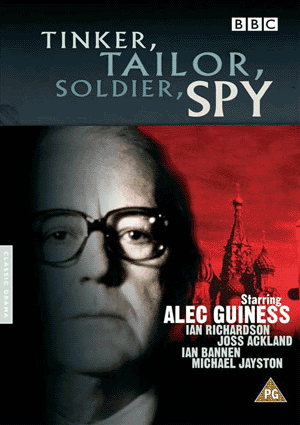
  4. “Tinker Tailor Soldier Spy” (2011) – A movie adaptation of John Le Carre’s spy novel (itself published 40 years ago, and first dramatised for TV 35 years ago when the Cold War was very much alive and kicking).
  5. “Foyle’s War” (2000-2013) – The latest episodes in this long-running TV detective series show our hero transitioning from investigating crime during war-time to the new world of espionage, counter-intelligence and Cold War intrigue.
  6. “The Hour” (2012-13) – This short-lived TV drama series was ostensibly a behind-the-scenes look at a 1950’s news and current affairs programme, but uses the Cold War events like the Hungary uprising and the Suez Crisis as a backdrop (along with a healthy dose of “reds under the bed” which implicitly references the Soviet agent scandals that rocked the British establishment during the 1950’s and 1960’s and beyond – Burgess, Maclean, Philby, Blunt et al).
  7. “Stephen Ward Was Innocent, OK” (2013) – Geoffrey Robertson delves into the truth behind the criminal prosecution and media castigation of a bit-player in the so-called Profumo Affair, which likely contributed to Ward’s suicide in 1963. The Profumo Affair of 1961 had it all – prostitution, Cold War politics and Soviet agents. And even though it led to the resignation of the UK’s War Minister, it has been suggested that the Establishment demanded scapegoats, and Ward was seen as a suitable victim.
  8. “Solo: A James Bond Novel” (2013) – William Boyd is the latest novelist to be invited to add to the Bond canon (original Bond author, Ian Fleming died 50 years ago), and chose to set the story in 1969 with a strong Cold War context. Boyd is, of course, no stranger to this genre – nearly all of his recent novels (“Any Human Heart”, “Restless”, “Waiting for Sunrise” and “Ordinary Thunderstorms”) incorporate elements of war-time espionage, betrayal, double agents and industrial sabotage that span the 20th century.
  9. “Sweet Tooth” (2013) – Ian McEwan uses the Cold War politics of the early 1970’s as the setting for his novel about love, trust, (self-)deception, “official” propaganda and bureaucratic betrayal.
  10. “Jack Ryan: Shadow Recruit” (2014) – Finally, bang up to date with a film version of the Tom Clancy novel. Clancy, who died only a few months ago, was a veritable Cold War warrior of the fiction world, and this latest addition to the Jack Ryan saga includes some (reassuring) Russian elements. I haven’t seen it yet, but I’m sure it will satisfy my appetite for Cold War nostalgia.

* The events of the 1979 US embassy hostage crisis in Tehran, of course, were recently dramatised to great effect in “Argo” (2012). And just this month, The Atlantic described current US-Iran relations in Cold War terms.

Pause : Edit : Delete – My new year’s resolution for content management

Last week, Apple confirmed it had acquired SnappyCam, an iPhone photo app that is capable of taking 20 frames per second.

At first glance, this seems like a great improvement on the iPhone camera function – until you start to think about some of the implications:

1. Does this mean we’ll be creating (and uploading, sharing, archiving) 20 times more digital photos than we do already?

2. Does Apple intend to remove some other functionality from the iPhone to make way for this enhancement (on the basis that they have just about packed in everything they can in the current iPhone 5S, and processing power and memory capacity are relatively finite)?

3. When will we ever find time to look at all these superfluous/supernumerous photos that Apple will be encouraging us to take?

For myself, I realise that I actually take far fewer photos than I did 10 years ago. In fact, I have never owned a digital camera, and basically lost interest in photography when it became virtually impossible to obtain film for my Nikon APS SLR camera. Previously, I had been using one of the very first Canon IXUS APS models, and before that, for many years I owned a solid and reliable 35mm SLR camera – a Praktica that was made in the former East Germany.  And while I have been using an iPhone to take photos for several years, I do so much more rarely than with any dedicated camera I have owned, even though the smart phone camera technology is much easier and more immediate.

Perhaps the ease of use is part of the problem with digital photography – there’s so little effort required, and practically zero cost involved, so it’s natural that some people just snap away with very little thought or consideration. Besides, if we don’t like a particular photo, we can just delete it. But I wonder if we are being disciplined enough in consigning our mistakes to the Trash icon. Yes, we save, upload and share our better attempts (and maybe we will look at them more than a few times over the years), but do we cull the rest?

I reflected on this as I began the process of clearing out my attic prior to an imminent house move. I found a large box of photographs, all neatly arranged in albums (by chronology and geography – no option to “tag” who was in the shot), representing a major investment in time and money over the years – the cost of the cameras themselves, the effort in composing each and every shot, the cost (and anticipation) involved to get the prints back from the developing lab (plus the mix of sheer horror and pleasant surprise with the results – and those frequently patronising labels telling me the film was under/over exposed… And while I do recall looking at some of these photos from time to time, for much of the past 10 years they have sat ignored and untouched in that same box. I’ll be the first to admit that not every picture was vital, essential let alone unique (for example, how many other tourists have taken photos of the Great Wall of China?), and while many of them still evoked vivid memories, and most of them conveyed a sense of narrative, I realise that I had to impose a more stringent editorial policy on what was deemed worthy of keeping.

So, in the age of digital content, when it seems we can take an infinite number of photos, capture endless hours of video, stream non-stop music and download whole libraries, I am resolved to adopt the following approach to my own content management:

PAUSE

Before saving/archiving any new content, take stock and consider whether I am ever going to want to view/watch/listen/play/read it again.

EDIT

Having decided it is really worthy of taking up space on my hard drive, catalogue it appropriately for easy retrieval. In addition, undertake regular culling of the archive. (What I found to my taste 5 years ago might not appeal today…)

DELETE

Anything that does not survive the above processes must be erased (not just backed up to the cloud or to another hard drive).

As businesses and organizations, we would also do well to apply a similar pruning process to our own operations, especially when we are facing certain constraints on capacity and resources. For example, before embarking on a new project or launching a new product, shouldn’t we be asking ourselves: what projects/products can we discontinue? When setting annual budgets and targets, shouldn’t we be questioning our assumptions on “continuing operations” – just because “we’ve always done it this way”, doesn’t mean we should continue to do so. When we reflect on what is important, can we really be sure we aren’t carrying any excess baggage? Part of this process will be driven by the need to prioritise resources, part of it will be determined by understanding what our customers and stakeholders truly value. Ultimately, what remains will likely be determined by its purpose and its relevance.

If you haven’t looked at that photo on your smart phone in over a year, what is it still doing there?

New Year Wishes: What I hope for in 2014

A new year normally brings with it the usual predictions for the 12 months ahead. Sometimes, as with political elections, the World Cup, fiscal budgets and the Oscars, most informed commentators can usually hope to get at least one or two things right. But as a former colleague once wrote, anticipating new developments in technology is like “trying to predict the unpredictable”.*

Rather than attempting to gaze into a crystal ball, here are a few of my personal wishes** for 2014

Politics

I think it’s interesting that in 2013, two of the political leaders that generated most of the news were Margaret Thatcher and Nelson Mandela – and in both cases, it was their passing that dominated the headlines. Neither had been in power for many years, yet in death they were more noteworthy than most of today’s world leaders. Why? Well, a lack of truly charismatic politicians could explain it. But I rather think the lure of holding political office has been undermined by the need to micromanage the machinery of government – so rather than attracting visionary leaders capable of projecting big picture thinking, we mostly get a collective mediocrity blinkered by the spin doctors and party pollsters, and rarely willing to tell the public what they actually think or what they personally believe in, for fear of offending voters in marginal electorates. Whether or not you agreed with or liked their particular brands of politics, it was pretty clear that both Thatcher or Mandela actually believed what they were saying when addressing parliament, giving interviews, or delivering campaign speeches.

In 2014 it would be wonderful to see the return of political leaders who were not simply trying to avoid defeat at the next election. Even better, wouldn’t it be wonderfully refreshing to hear politicians willing to amend their policies because they have been persuaded by informed argument, prepared to admit that they might have got it wrong, and able to speak their mind without being accused of knee-jerk reactions or heretical u-turns; situations change, so shouldn’t our politicians be entitled to adapt and clarify their thinking accordingly?

Leadership

Which brings me to my next wish – a willingness to openly embrace situational leadership. Yes, organisations should have a clear purpose, stated objectives and well-articulated means for achieving them, but there also needs to be flexibility and the ability to adapt and evolve based on changing circumstances.

We hear a great deal about the need for diversity on boards, among executive teams and across the workplace generally. Much of the diversity debate centres on gender and ethnicity – which is fine, but we require organisations with greater cognitive diversity. Such diversity could help avoid group-think, constructively challenge the status quo and counter the underlying causes of institutionalised inertia.

Business

Unless you are a single-product company, with a unique and proprietary production process, a guaranteed market monopoly, and an endless supply of materials and customers, your business cannot afford to exclude alternative thinking or ignore external perspectives on your industry, your markets or your products and services.

Equally, in a low-growth/no-growth market environment, companies have to develop or acquire better strategic growth skills. Expansion via capturing market share (usually achieved by competing on price, and resulting in lower margins) will be hard to sustain, and will likely result in a race to the bottom.

My big wish for 2014 is that businesses in general, and service industries in particular, will recognize what their true value proposition is, and build strategies for competing on quality (not just on quantity). For example, unless you understand your cost structures, and can relate those to your customers’ perceptions of what they are paying for, you will either waste resources on stuff customers don’t value, or miss opportunities for serving them better.

Technology and the Internet

It’s hard to think of any significant developments in popular technology or on the Internet during 2013. Sure, there was some consolidation among social media platforms, and product rationalisation at Yahoo! and elsewhere; but apart from launching iOS7 and the iPhone 5, Apple did not bring any major new products to market. Although Apple’s global share of smart phone sales may be declining, it may simply be market maturation rather than any product advances from its competitors. (There is also evidence that in key markets, iPhone 5 has boosted Apple’s smart phone sales, and the iPhone 5 itself lays claim to being the most popular model.)

The Internet continues to grow exponentially, largely driven by social media and user-contributed content. But I’m not sure that our collective knowledge and wisdom have improved at a corresponding rate. (Plus, targeted and streamed advertising means it takes much longer to watch YouTube clips, resulting in a lower return on the time we invest in consuming content.)

I’m hoping that 2014 will herald the launch of Internet 3.0 – an on-line environment that is more informative, more insightful and more interactive, and which connects more intuitively between my desktop and mobile devices. (For example, various upgrades to iOS and their associated back-ups forced me to transfer manually a large archive of Notes from my iPhone 4 to my iCloud account, simply because Apple unilaterally changed the way legacy content was “recognized” between my iPhone and my iMac.)

Culture

Perhaps we should also wish for a slightly kinder and more caring social media environment in 2014 – and as I heard one media commentator observe this week, professional sports people and other celebrities should probably refrain from using social media after 11pm, even if they are only slightly inebriated. Anyway, at the risk of revealing some of my own prejudices and preferences, this is what I expect from 2014 in Culture.

First up, I don’t want to see any more of the following categories of movie: sequels, prequels, comic-strip franchises, CGI extravaganzas or anything containing anthropomorphism (unless it’s a Director’s Cut of “Animal Farm”).

Second, I eagerly await the end of geo-blocking for digital content – copyright owners, music labels, publishers, licensors/licensees, distributors and on-line retailers please get your act together, and don’t make it unnecessarily difficult for me to buy your content just because of where I happen to live.

Third, I’d like to advocate a special tax on reality TV shows – the proceeds of which will be directed towards alleviating human suffering, solving important world issues, or nurturing genuine artistic/culinary/terpsichorean talent.

Finally, I hope that David Bowie’s return to form with 2013’s “The Next Day” was not a fleeting reminder of past glories….

NOTES:

* Anthony Kinahan in his introduction to “Now and Then 1974-2024: A Celebration of the Bicentenary of Sweet & Maxwell” (1999) a collection of essays on the future of legal publishing

** Aside from, of course world peace, the end of poverty and a global commitment to address the negative impacts of climate change