Will streaming kill the music industry?

The resurgence in vinyl sales is certainly not enough to save the music business. But will streaming finally cook the goose that once laid Gold Discs?
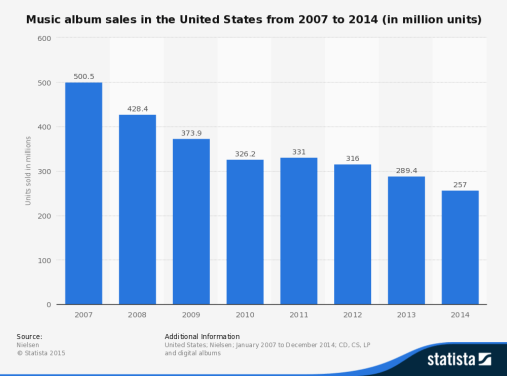
statistic_id273308_music-album-sales-in-the-us-2007-2014

US album sales (in all formats) are in decline. (Source:  Statista)

What can we learn from the music industry based on the apparent rebound of vinyl sales in recent years? Is streaming doing enough to halt the decline in total music revenue? Will CD’s soon disappear altogether? What future for LPs in a world of “Album Equivalent Sales”, “Track Equivalent Albums” and “Streaming Equivalent Albums”?

Are there parallels here with other content, publishing or entertainment sectors?

Back to Black

Last month the 8th annual Record Store Day was launched with a fanfare of upbeat data for vinyl sales. It was a good news story in an otherwise depressing saga of declining album sales, stagnating revenues, and mixed messages about the impact of digital downloads and streaming services on the music industry.

Coming off a very low base (like, near-extinction levels), the extraordinary sales growth of vinyl (especially in Australia) can be attributed to a combination of factors, although it is difficult to see how any single trend is responsible for this growth:

  • The growing popularity of Record Store Day itself (although it’s not without its problems – see below)
  • Baby boomers buying their record collections all over again
  • Hipster interest in analogue technology
  • Record labels mining their back catalogues
  • Niche market interest among audiophiles, collectors and the cool kids
  • New approaches to packaging vinyl with downloads and other bonus content
  • DJ culture
  • Secondary markets via E-bay and Discogs
  • Retailing switching from megastores to specialist shops

Infographic: Vinyl Comes Back From Near-Extinction (Source: Statista)

Where Is The Money Coming From?

Latest industry data suggests that digital sales (downloads and streaming) are now on a par with physical sales (CD, vinyl and the rest). Overall revenue has stabilised, having fallen from a peak in 1999. And streaming services are enjoying huge growth.

But the true picture is harder to establish:

First, while the IFPI provides global aggregated data, each local industry body (RIAA, BPI, ARIA etc.) likes to tell a different story from its national perspective. So it’s difficult to compare like with like. (For example, while Taylor Swift is supposed to be a worldwide phenomenon, she does not figure at all in the BPI data for 2014…..) One brave soul has tried to compile data for the past 20 years.

Second, because of the changes in distribution and consumption, music sales have to be counted in different ways:

  • Wholesale revenue vs retail sales
  • Physical sales vs digital sales
  • Per unit download sales vs streaming equivalents
  • Product revenues (e.g., album sales) vs licensing revenues (e.g., soundtracks)
  • Subscription fees (e.g., Spotify) vs per download revenue (e.g., iTunes)
  • Advertising income from video streaming vs royalties from broadcasting and soundtracks

Third, when more and more music is accessed via video platforms like YouTube, Vimeo, and Vevo, streaming platforms like Spotify, Pandora and Omny, or apps such as Bandcamp, Soundcloud, Mixcloud and Shazam, “sales” data starts to become less and less relevant. (And some people are still hanging on to the ailing MySpace platform….).

The bottom line is that despite the growth in streaming services, digital sales (in whatever format or media) are not yet enough to compensate for the continued decline in album sales in particular, and music overall:
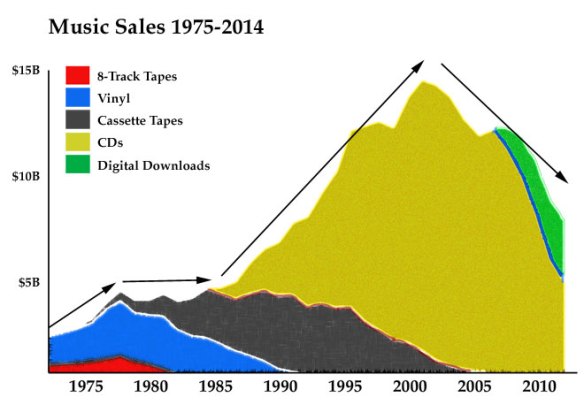
The peak era of CD sales is over. (Source: Talking New Media)

Record Store Day Woes

The success of Record Store Day has divided opinion as to whether it is actually a “good thing” for the industry. It started as a campaign by independent record labels, distributors and retailers to revive the habit of buying records in-store. Labels produce limited edition and often highly collectible items for the occasion, and there are rules as to how, when and where these releases can be made available to the public.

At first, it really was driven by the independent labels, many of whom brought out interesting product that otherwise wasn’t available, such as label samplers, unreleased material and one-off artist collaborations.

Now, the major labels have jumped on board, meaning the market is flooded with unnecessary re-releases (do we really need Bruce Springsteen‘s ’70s and ’80s albums reissued on vinyl?) drawn from their extensive back catalogues (no need to pay for recording costs or new artwork!).

This means that smaller labels who release new vinyl records on a regular basis (not just once a year) get bumped from the production line, as the major labels exert their purchasing power over the pressing plants.

In addition, some Record Store Day releases are so badly distributed that stores are unlikely to take delivery of the items in time for the event. Or bad decisions lead to over-supply of certain items, which end up in the bargain bins (major labels again especially guilty of this offence).

Some store owners appear reluctant to participate because they feel embarrassed about the prices they may have to charge for many of the limited releases, which get bought by speculative customers, rather than collectors, fans and enthusiasts – a fact borne out by the immediate listings and inflated prices on E-Bay and Discogs….

As one store owner I talked to commented: “Every day should be record store day…”

What Else Does The Data Reveal?

For all the new young pop stars that the industry keeps churning out, there’s nothing like longevity and back catalogue to prop up the sales numbers. For example, Barbara Streisand was in the Top 10 for US album sales (and with new material!), and the likes of Pink Floyd, Led Zeppelin, Miles Davis, Bob Marley and Oasis feature in the top-selling vinyl records. Will Record Store Day 2025 herald the vinyl release of Justin Bieber’s pre-pubescent “demos”?

The decline of album sales has been particularly steep in the genres of Hip-Hop and R&B, while rock and pop continue to dominate the market. Some industry commentators have suggested that music sales are merely “in transition” as consumers switch from buying CD’s and downloading music to subscribing to streaming services. Meanwhile, in the US, country music’s #4 position by overall consumption reflects substantial album sales, as streaming is still a small component for the genre.

And those vinyl sales numbers? They’re simply a blip on the chart and largely driven by avid fans willing to shell out for deluxe editions….

The future is streaming?

Apple and others certainly believe (or hope) that streaming will save the music industry. Having demolished the market for CDs, iTunes is in a battle for its own survival among competing streaming services, where Apple itself is about to lead the charge having acquired the Beats platform.

But others are not so sure, predicting that streaming is already in decline, along with download sales:

First, the streaming platforms are yet to make a profit. Part of this is due to the cost of content that has to be licensed from the record labels and artists. Part is also due to the cost of acquiring customers, even if this can be done via social media, because the decline in music buying has been so abrupt, so the industry may be permanently damaged that streaming cannot bring back paying customers.

Second, even though streaming may overtake downloads by next year, there’s still nothing certain that teen pop fans (the target audience) will pay $7.99 – $9.99 per month to listen to music via so-called “freemium” services. Evidence suggests that consumers are happy with the free services, even if they have to put up with ads.

Third, while I agree that the freemium model is a fixture in the digital economy, the problem with Spotify et al is that they are not growing the market for music, but simply cannibalising it by displacing existing platforms (commercial radio, digital downloads, physical sales), while being tied to third-party distribution channels (the internet) and devices (smart phones, tablets and computers).

Anyway, subscription-based music streaming is nothing new, and was first launched over 100 years ago (and thanks to Mark Brend’s “The Sound of Tomorrow”, I learned that Mark Twain was the first subscriber).

If the “old” record companies are charging streaming services too much to license their content, then the streaming services should just find other sources – there’s plenty out there – but then, just like the major record labels, they are not really interested in music, only in shifting product and promoting “artists” (even if they are still figuring out how to make digital pay). The record labels don’t help themselves with their reliance on back catalogue, and their archaic territorial licensing practices either – forcing customers to circumvent geo-blocking barriers (legally or otherwise…).

Unfortunately, file sharing, illegal downloads and “free” streaming have meant customers don’t feel compelled to pay for digital music content. Personally, I prefer to curate my own listening, and not let someone else dictate what I hear, even if the service “knows” my preferences…

And the moral of the story is…?

More distribution platforms, more formats and more content may not be enough to save ailing industries, whether it’s music or television, newspapers or movies. These businesses will have to learn to live with lower margins and/or smaller market shares. The quality of a home-made movie uploaded onto YouTube may not be anywhere near that of a Hollywood blockbuster, but if cat videos are what grab punters’ attention (and by default, pull in the advertisers), the studios may have to find alternative strategies. And if music fans prefer to use free streaming services, the industry has to do a better job of producing content that consumers may be willing to pay for.

Ironically, in publishing, one sector that has been written off ever since the arrival of CD-ROM’s and the internet, teen consumers are still happily buying and reading print editions, alongside e-books. More so than other content industries, publishing has rapidly adapted to the new user-defined model: aspiring authors find it easier to self-publish (e.g., via Tablo and dedicated crowdfunding platforms such as Pubslush and Unbound); they can easily connect with an audience (especially in the realm of fan fiction); and a platform like Wattpad allows writers to test material before they commit to formal publication, and lets readers vote for what they’d like to read more of.

Next week: Making connections between founders and investors



AngelCube15 – has your #startup got what it takes?

Startup Victoria‘s first Lean Startup meeting of the year heralded the launch of AngelCube‘s 2015 accelerator program (#AC15), for which applications are now open. A good opportunity to check in with previous successful applicants, and find out if your startup is made of the right stuff.

Screen Shot 2015-02-25 at 10.03.58 amThe info evening was hosted by inspire9, and supported by PwC, and Nathan from AngelCube kicked off proceedings by giving a run down on the accelerator program, the application process, and the type of startups that are more likely to be accepted.

What does the program offer?

  • A 3-month intensive learning and development experience
  • $20k in funding (in return for 10% of the business)
  • Co-working facilities
  • Working with Lean methodology (focus on Product-Market fit)
  • Access to great mentors and advisers, and early-stage investors
  • Participation in a fundraising roadshow (including time in the US)

There is an application form via AngelList, and the closing date is May 10 (but the sooner you can submit the better). From the hundreds of applications, AngelCube puts together a shortlist of 20, of which no more than 10 will likely be accepted.

What is AngelCube looking for?

  • Globally scalable tech startups (think beyond Australia!)
  • In-house tech skills/resources (it’s not really a matching service)
  • Great teams (more than the ideas themselves)
  • Customer traction (ideally revenue-generating)
  • Consumer-oriented solutions (rather than B2B)

What has the experience been like for successful graduates?

Three alumni of previous AngelCube programs offered some personal insights, and then participated in a Q&A with the audience of 400:

Screen Shot 2015-02-25 at 10.02.34 amFirst up was Peter from Ediply, a service that matches students to the course or university of their choice. Given the growth in education and lifelong learning, and the increasing numbers of students (especially from Asia) looking to study overseas, the business seemed like a natural fit for AngelCube. However, it was still a relatively new or unknown sector in terms of end-user or independent services (rather than in-house marketing and enrollment efforts) – which sort of broke one of AngelCube’s rules for acceptance: no established market. Peter stressed that the main reasons for applying were the need to overcome some development barriers, and to get out of a “Melbourne mindset”.


Screen Shot 2015-02-25 at 10.03.01 amAsh from Tablo (“YouTube for books”) probably broke another AngelCube rule, in that he was a sole applicant (not part of a team) and he had limited tech resources. AngelCube made him work harder, think big, and keep going – and helped him to become a disruptive force in publishing, with customers in 130 countries collectively publishing 1 million words a day. He’s also closed a C-round of funding, and has some impressive investors on his share register.

Screen Shot 2015-02-25 at 10.03.28 amLastly, David from etaskr (“a private label elance”) had to quit a full-time job with one week’s notice once he got accepted into AngelCube. He even had to Google how to pitch. Plus he came into the program with a totally different idea, got slammed, failed to get customer traction, and ended up pivoting to an enterprise software solution (and broke another AngelCube rule in the process – no B2B, because of the longer sales cycle). Despite having to live on very little money for 6 months (less than $200 pw) the team persevered, and are now starting to get traction, including overseas markets like Holland. His final words were “risk is not something to fear, but to overcome”.

Q&A with the audience

Most of the questions were about the application process for AngelCube, and how it helped the successful startups, particularly with going global. In large part, this due to some great networks, access to high-profile connections (“we got to meet the first employees at Yammer!”) and links to some influential investors. There was also some discussion about how to secure your first customers (mainly via social marketing techniques), and the challenge of enterprise sales (“it sucks, because you need 100 different minds to all say ‘Yes!'”).

Finally, for more insights, please visit these links to previous posts about AngelCube and some of the successful applicants.)

Next week: Help! I need to get some perspective…

Finding wisdom in a binary world

Sometimes I think that the thirst for data, combined with a digital mindset, is reducing our analytical and critical thinking to a highly polarised, binary-driven view of the world.

Rather than recognizing that most ideas and concepts are composed in “technicolor” we are increasingly reducing our options, choices, responses and decisions to “black or white” conclusions. Everything has to be couched in terms of:

  • on/off
  • yes/no
  • true/false
  • positive/negative
  • for/against
  • like/dislike
  • friend/unfriend
  • connect/disconnect

It feels that our conditioning is driven by the need for certainty, the desire to be “right”, and the tendency to avoid disagreement/difference. However, uncertainty is more prevalent than we may like to admit. To illustrate what I mean, here are four personal learning experiences I would like to share by way of demonstrating that not everything can be reduced to black or white thinking:

1. The scenario is the same, but the context, therefore the answer,  is different

Although I was born and grew up in the UK, I completed part of my primary education in Australia. Before returning to the UK, I was required to complete the 11-plus exam, to determine which secondary school I would attend in England. (The exam was mainly designed to test literacy, numeracy and verbal reasoning.) Here’s a multiple choice question which I got “wrong”:

Q. Why do windows have shutters?

I chose “to keep out the sun” as my answer. In fact, the “correct” answer was “to keep out the wind”. The invigilator was kind enough to include a note to the examiners that my answer was based on the fact that I had been living in Australia, where window shutters are primarily designed to keep out the sun (and therefore the heat). Whereas in the UK, shutters are largely used as a protection against the wind.

2. The facts are the same, but the interpretation is different

While studying for my law degree, I had to write an essay on reforming the use and application of discretionary trusts, based on the current legislation and recent court cases. I argued in favour of an alternative approach to the relevant court decisions, and deliberately took a contrary view based on my social and political outlook at the time, and influenced by what I saw were changes in public policy.

To my great surprise, the tutor gave me one of my highest ever grades in that subject – even though she disagreed with my conclusions, she recognised that my reasoning was sound, and my interpretation was valid.

3. The intention may be “constructive”, but someone will always choose to see only the negative

Early in my career, I participated in a TV documentary series about different types of interview situations. As a local government officer, it was my role to advise members of the public on how to navigate the various regulations and policies in respect to accessing council services, as they related to their own particular circumstances.

One interview I conducted was included in the final broadcast. I thought my advice was objective, and based on widely accepted principles, but without advocating or recommending a specific course of action, as I believed it was my job to remain impartial yet factual. I later discovered that another local council used part of the same interview footage to train their own staff in how not to conduct an interview, because it could have been mis-interpreted as a way to get around the system. So, whereas I thought I was being constructive, someone in a position of authority chose to see it as a negative influence.

4. The assumptions may be reasonable, but the results often prove otherwise

Years later, I found myself having to defend a proposal to launch a smaller, and cheaper, version of a global product in a local market. The received wisdom among many of my colleagues was that the proposal would result in less revenue, even if customer numbers grew. As part of the initiative, I also advocated shutting down a legacy local product in the same market – partly to reduce production costs, and partly because very few customers were actually paying for this outdated service. Again, I faced resistance because a number of internal stakeholders thought customers would refuse to pay for a superior service, and that the business would end up alienating existing customers and, by extension, upsetting the local market.

Subject to a detailed customer migration plan, some very specific financial metrics and frequent status reports, the project was greenlighted. 12 months’ after implementation, the results were:

  • Comparable revenue was doubled
  • Overall production costs were halved
  • A significant number of new clients were signed up (including several from new market segments)

The closure of the legacy product did see the loss of some customers (about 10-15% of the legacy client base), but this was mostly non-paying business, and was more than offset by the increased revenue and customer growth. [In my experience, significant platform migrations and product upgrades can result in up to 20% of customers electing not to switch.]

What are we to conclude from this?

It’s totally understandable that businesses want to deal only with certainty (“just give me the facts…”) and often struggle to accommodate alternative or contrary perspectives. But despite the prevailing digital age of “ones and zeroes”, we are actually operating in a more fluid and diverse environment, where new business opportunities are going to be increasingly less obvious or come from non-traditional sources. While we may find comfort in sticking to core principles, we may end up missing out altogether if we are not prepared to adapt to changing circumstances: context is all about the difference between “data” and “knowledge”.

Wisdom comes from learning to acknowledge (and embrace) ambiguity; individuals, teams, organisations and businesses are more likely to benefit from greater diversity in their thinking, resulting in richer experiences and more beneficial outcomes.


Online Pillar 3: #Education

Students don’t need to attend formal classes anymore – they can YouTube a tutorial, sign up for a MOOC, watch a TED talk, Google the answer to a question, or research a Wiki entry. And that’s just the free stuff. Online seminars and workshops, especially in the area of software programming and code writing, are big business; and even vocational courses are looking to deliver more content via the web.

This week is the final part in my mini-series on the Three Pillars. (See Health and Finance.) Of the three, Education has probably done the most to embrace online – it’s certainly been at the forefront of the Internet and the web, both of which have their roots in academia. Yet of the three, it is the one vertical segment that is most vulnerable to disruptive technologies and changing business models.

Lifelong learning is going to become vital in keeping ourselves informed, skilled, up-to-date, relevant and employable (whether as hired labour or as self-employed freelances). Even in retirement, services like the University of the Third Age (U3A) can help in maintaining our mental wellbeing.

Few of us establish long-term relationships with schools or educational establishments we have attended – at best, we may join an alumni group, but in my experience, many such organisations are designed around fund-raising activities, “old boy” networks, quasi-masonic rituals and/or sadomasochistic memory recall at the annual reunion; and they don’t do so well when former students become increasingly mobile in the global workplace. On the other hand, the ability to attend so many different educational establishments and be exposed to different types of education services makes for a richer learning experience.

Online academic reference and research services have been around since the 1980s, and it’s now possible to source post-grad dissertations and PhD papers via vast online library databases. Part of this is driven by the academic need to “publish or perish”, part by changes in the publishing and information industry, part by the need to foster collaboration via better dissemination of primary research.

For myself, I participated in my first online seminar about 15 years ago, and webinars are commonplace for professional development, distance learning and collaborative projects. I have also enrolled in online tutorials for one-off courses on very specific topics – less about getting a qualification, more about enhancing my knowledge.

Students today, including those in primary and secondary education, are expected to participate online, even though they may still attend daily “in person” classes:

  • tablet devices are mandatory – for access to textbooks, and for managing assignments
  • students interact with their teachers and classmates via Learning Management Systems
  • undergraduates are expected to develop online CVs as well as use dedicated social media platforms run by their colleges
  • ebooks are capable of being personalised and customised – e.g., uploading your own notes, accessing peer comments, and interacting with teachers

Mass Open Online Courses (MOOC) are a logical extension of the webinar model – but of course, you don’t get the same certificate or diploma you would receive (assuming you get one at all) if you had enrolled for the class, completed the assignments and passed the exams. Some universities and colleges license their content (syllabus and curriculum) for local delivery by another institution – a bonus for students in remote locations, or unable to access more expensive colleges. Maintaining the integrity and quality of this “distributed” learning is still a challenge, and mutual recognition of qualifications (as well as certification and authentication) may yet be a barrier to student mobility.

Recognition of prior learning is a key feature of vocational education – but I can see a demand for more services that help me validate what I know and what I have learned (in the absence of a formal qualification) as well as helping prospective employers in candidate selection. There are also challenges in monitoring mandatory Continuing Professional Development (CPD), especially in areas such as health services, where even relatively junior nursing and ancillary staff in hospitals are required to maintain an online learning diary or journal as well as evidence of training completion and competence. (Question: who would be responsible if a nurse engaged by a hospital via a labour service provider failed to maintain currency in patient care, resulting in avoidable harm?)

Ultimately, the role of lifelong learning is in helping to plan, manage and develop our careers. Just as we might have a financial plan (to prepare for the future), and we would expect to manage our health (via regular check-ups and preventative measures), why wouldn’t also have a career plan, supported by a learning pathway? And if we are increasingly comfortable accessing content via mobile apps and the web, why wouldn’t we expect to pursue our learning needs online as well?

Next week: Another #co-working space opens in #Melbourne