#StartupVic launches new-look #pitch event

The team at Startup Victoria have been working hard over the summer: not only have they brought on a whole bunch of new commercial sponsors, but they have also launched a new format for their pitch nights. The idea is to invite startup founders to register their interest in pitching to a panel of judges. The contestants get the opportunity to compete in front of a live audience, for a chance to win face time with local VC’s, along with some other startup goodies.

global_446720634It’s not Shark Tank (there’s no hard cash on offer), nor is it an open mic night (there is a pre-screening and audition process) – but it does enable entrepreneurs to test their pitch, get some early exposure, and receive some great feedback and advice. It also doesn’t matter what stage the startups are at, although businesses that already have some market traction or have built and tested an MVP are probably in a better position to compete.

The launch night saw pitches from four startups, who are at various stages of development. In no particular order they were:

Ad Hoc Media with Passenger Pad, a digital Out Of Home advertising medium for taxis, using interactive touch screens inside the cab. To date, there has been a low take-up rate of this technology by the taxi industry in Australia, mainly due to regulatory issues, but the landscape is changing. With a background in taxi electronics and hardware, the founders are about to launch with 400 taxis in Melbourne, and plan to expand to other cities. There is no doubt that using a combination of passenger, location and fare data (duration, time of day, pick-up and drop-off points), the screens will be able to offer brands and their media buyers targeted audiences and in-depth customer analytics. The challenge will be to offer advertisers a competitive rate card, especially as this is essentially a new medium: it offers viewer choice like TV, can serve up targeted content like web or mobile, and is ideal for special offers linked to location and time of day.

Global Patient Portal offers a free platform for e-health records. Having already launched in Kolkata, India with 40,000 users signed up in 11 weeks, GPP is aiming at lower socio-economic communities and emerging markets. The initial business goal is simple: to support ownership of e-health records by users. Using a combination of bootstrapping and NGO funding, GPP has been able to hire a team of “scribes” in India who sit in on patient consultations and capture the medical notes, which can then be referred to at the next consultation. (Currently, a lot of time and resource is wasted because patient records are captured on paper, which is easily lost once the patient leaves the clinic.) Commercial revenue will come from selling anonymized patient data (subject to legal compliance, privacy obligations and data accuracy) for research and policy planning purposes. In choosing to launch in Kolkata, GPP was aware that in some more affluent urban communities in India, the favoured means of patient communication is WhatsApp?, so they would be less likely to adopt a separate platform. Also, in Australia, having talked to GPs about the various government attempts to establish the e-health system for patient records, I am aware of a reluctance within the medical profession to buy in to the scheme: first, there is no financial incentive for them to capture patient data via a common e-health platform; second, why would they want to share patient data with their competitors?

prevyou is aiming to disrupt a large part of the recruitment and job ad market, by directly connecting students with job opportunities at SMEs. The two-sided market effectively crowdsources available jobs from SMEs, who typically do not have access to the hiring market or to full-time and dedicated HR resources. The goal is to streamline the hiring process, and to offer a mix of standard and premium services (e.g., video resumes, applicant screening, skills matching, personality profiling etc.) and later to add validation of applicant credentials and qualifications. In return, the business will take a commission once a job has been offered and/or candidate hired. While the focus is initially on capturing the market for casual and part-time jobs, the judges urged them to look at the enterprise HR market (under an outsourcing or white label model?). Looking ahead, there is the opportunity include student internships (although, like the legal issues with Year 10 work experience, internships and placements present additional challenges such as achieving student learning outcomes and other employment law issues).

OurHome is an app to help families manage, share and track household chores, so that children learn to take some responsibility around the house, and they can get rewarded for their contribution. It emerged out of an earlier app, Fairshare, that was aimed at shared houses. Apparently, people living in shared houses don’t care enough about whose turn it is to clean the bathroom, or are happy with paper charts and lists on the fridge door. Describing itself as “an integral household tool with indirect network effects (i.e., like Google, not Facebook)”, OurHome also claims to be the #1 chores app. Using advanced algorithms, and other features such as customisation and Dropbox integration, the app also introduces an element of gamification through rewards (intrinsic and extrinsic). For busy families, it replaces those fridge notes and task charts (although, as the judges noted, there’s no calendar yet). Of particular interest is the very positive feedback the team have had from families who have children with ADD.

Despite a few technical glitches (concerning mics and audio quality), the first new-look pitch night was a success, and Global Patient Portal won the on-line audience vote. I was luck enough to meet with one of the teams a few days later. They thought it was a useful experience, but they hadn’t quite known what to expect, and they had anticipated more of a grilling from the judges and tougher questions from the audience.

Next week: More In The Moment
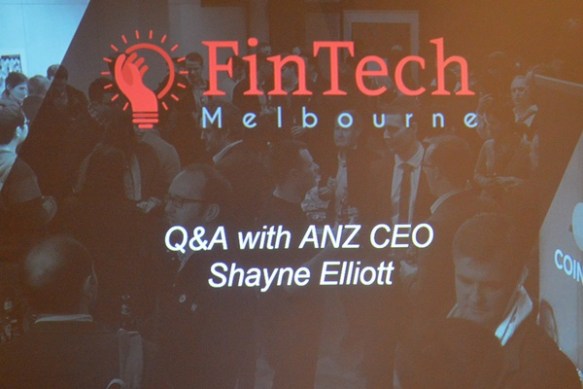


ANZ’s new CEO on #FinTech, CX and #digital disruption – 10 Key Takeaways

I went to the recent Q&A with the new CEO of ANZ, Shayne Elliott, organised by FinTech Melbourne. It was the first public speaking appearance by Shayne since becoming CEO (excluding his gig at the Australian Tennis Open), and followed a similar event last year with Patrick Maes, the bank’s CTO.

600_446693337The key themes were:

  1. Improving the customer experience (CX) is paramount
  2. Maintaining the high level of trust customers place in their banks is key
  3. Being aware of FinTech disruption is important, but remaining focused on core strategy is even more important
  4. FinTech can coexist with traditional banks, but the latter will win out in the end
  5. The bigger opportunity for FinTech is probably in SME solutions, rather than B2C
  6. Increased process automation is in support of CX, not about reducing headcount
  7. Big data and customer analytics are all very well, but have to drive CX outcomes
  8. Customers still see the relationship with their main financial institution in terms of basic transaction accounts, which is why payment solutions (a high volume/low margin activity) are vital to the banks’ sustainability
  9. ANZ is about to appoint a head of digital banking who will report direct to the CEO
  10. ANZ has been rated as one of the top global banks in terms of its use of Twitter and social media (but from what I have seen, much of the Big 4 banks’ social media presence can be attributed to their sports sponsorship…)

There was also some discussion around ANZ’s Asian strategy, and the statement last year that the “new” strategy is about becoming a digital bank. Shayne was quick to point out that they are not abandoning the Asian strategy (it’s not either/or) but because they embarked on Asia 8 years ago, most of the work has been done. Now they need to consolidate and expand the platform they have built. He also placed ANZ’s Australian business as being a comparatively small part of the group’s portfolio, and also took the view that despite ANZ’s size, resources and reach, digital products have to be developed market by market – it’s not a one size fits all approach. (Several FinTech founders in the audience took a very different perspective on this.)

And, in a bid to appear entirely approachable, both Shayne and Patrick were happy for people to contact them direct by e-mail… So if any budding FinTech founders have an idea to pitch to a major bank, you know who to contact.

Next week: Making the most of the moment…

Another weekend, another hackathon….

Last month, I competed in my second hackathon of the year, the #HSCodeFest sponsored by the Herald Sun and News Corp, and hosted by Melbourne University’s Carlton Connect. I’m pleased to say that our team of four, which was only formed on the first night, came 3rd in the pitch competition – with an idea for a news quiz app.

Screen Shot 2015-12-18 at 3.44.56 PMThat particular weekend was quite an eventful one for local startups – not only were there at least two other hackathons being held in Melbourne at the same time, but the State Government also announced its LaunchVic initiative. Small Business Minister, Philip Dalidakis found time in his busy schedule to address the #HSCodeFest participants, which was a great incentive. The previous weekend saw another Startup Weekend event, and last weekend Carlton Connect hosted yet another industry hackathon sponsored by the GE Industrial Challenge. And of course, since then we have had the Prime Minister announce the National Innovation and Science Agenda. To paraphrase Mr Turnbull, there’s never been a more interesting time to be a startup….

Having participated in Startup Weekend’s first #FinTech hackathon back in March this year, I was a lot more prepared, and had a much better idea of what to expect. Even though I didn’t pitch a specific idea on the opening night, I used my previous team-building experience to make sure we had a balanced mix of skills and expertise. I was also clear to make sure that once we had agreed on the project idea, everyone had specific roles, and we constantly checked in on progress and next steps.

As usual, the team generated far more content, data and ideas than we actually used in the pitch presentation. We also kept it very simple, by focusing on the key concept, demoing an MVP, outlining the commercial strategy, describing the business plan, and establishing just enough knowledge and awareness about the market opportunities, even though it had not been possible to fully scope them. For an insider’s view, check out my team-member Nathan’s blog.

We have seen over the past 12-18 months that the hackathon model is being deployed in many different ways to try to stimulate innovation and generate new business ideas. Even government departments and public utilities are getting in on the act, by enabling participants to access data sets, software, technology and APIs to see what they can come up with. Large corporates, who struggle to embed innovation into their organisations, are also holding internal competitions drawing on the experience of meetups, hackathons and pitch nights.

I only see this as a positive development, as long as the energy, enthusiasm and experience can be channelled into meaningful outcomes, which enable in-house talent and external expertise to combine to build great products and services that customers want, and/or identify and deliver significant process improvements and efficiency gains.

However, part of me is sceptical – as someone who is probably much older than the average age of a hackathon participant, I’m still amazed how many of my contemporaries either have no idea or simply don’t “get” the hackathon or meetup concept. They seem astonished that anyone would want to get together with total strangers, and spend their evenings let alone a whole weekend working with them, for “free”. To those of my peers who may see it that way, I would point out that participating in these events is a cheap and effective way of accessing new ideas and skills, meeting talented people, and acquiring new skills and knowledge.

Finally, if your organisation is thinking about running a hackathon or similar event for the first time, I’m more than happy to share my insights – contact me via this blog.

Since the holidays will soon be upon us, Content in Context is taking a short break. Normal service will be resumed on January 5. To my many regular readers and followers, I wish you all a safe and peaceful New Year.

Next: Surrealism, Manifestos and the Art of Juxtaposition

A big year in #FinTech

Looking back over the past year, it’s easy to see that 2015 has seen a giant leap forward for #FinTech in the Melbourne #startup scene. Much of this progress can be attributed to the efforts of the FinTech Melbourne Meetup Group, which, in little over a year, has established itself as one of the leading local startup groups, culminating in its first pitch night last month.
logo

Backdrop

There have been some significant business developments this year, including the launch and expansion of new P2P lending providers, payment platforms, digital currency solutions and robo-advice services. And while Melbourne does not yet have an equivalent to Sydney’s Stone & Chalk (a dedicated FinTech hub), there is enough momentum across the network of co-working spaces and the startup ecosystem of founders, advisors, incubators and accelerator programs to ensure that the city is building on its status as a financial centre.

For myself, the year in FinTech really got going with the inaugural FinTech Startup Weekend, which for me was a steep learning curve. I not only learned how to survive a hackathon, but I also gained a much deeper understanding of FinTech itself. I had become increasingly aware of the topic, via other meetup events, business networking and through reading (and writing for) specialist trade publications.* But until you actually see some of the innovative and practical ideas on new technical solutions for financial services, FinTech can seem like a lot of vaporware.

Emerging Winners

At the recent FinTech Melbourne Pitch Night, five local startups presented to a panel of distinguished judges in front of a packed audience at Melbourne Town Hall. Representing core fintech sectors (and the key messages from their pitches) were:

  • Fuzo – mobile payments platform: “2.5bn people don’t have a bank account”
  • CoinJar – a Bitcoin exchange: “targeting digital nomads”
  • StockLight – investment research: “24% of investors want help with analysis”
  • Moula – SME lending: “not a lender of last resort”
  • Timelio – cashflow finance: “factoring has missed the internet generation”

In what is traditionally a bank-dominated area of trade finance, Timelio is challenging the usual models for invoice discounting, while offering a new asset class for selected investors. I’ve featured Moula in this blog before, but this time around, I felt the presentation was quite low-key, and rather coy about the business model and the financials – maybe that’s because things are moving very quickly, and Moula is in the process of building significant traction via key commercial partnerships. The Fuzo pitch was quite complex (and probably too much technical information to present given the format), but the SIM card-based technology looks very interesting. StockLight‘s proposition is quite simple, and with access to quality content and a range of commercial models, could be one to watch as every financial institution is having to rethink wealth management and personal advice. However, on the night, CoinJar took out the first prize, and not for the first time, demonstrated how a simple concept can actually make the complex more straightforward: if nothing else, it proves that “Bitcoin can be done”.

Backlash

Some comments in the specialist trade publications have been quite scathing about FinTech, in particular those few startups that have embarked on public listings and IPOs. Much of this backlash relates to governance, disclosure and transparency; fair enough, they are important issues. But these criticisms should not be used to undermine the innovative technology, new business models and strategic partnerships that FinTech startups are bringing to the market.

Going mainstream

When otherwise conservative institutions such as industry superannuation funds start to embrace FinTech (e.g., Equip’s tie-up with Clover), or if the ASX decides to deploy blockchain technology to replace the CHESS clearing and settlement platform, it means that FinTech is definitely on the map, and can’t be written off or even ignored as some sort of irritating, disruptive upstart.

Next Steps?

In the wake of announcing the Victorian Government’s $60m LaunchVic startup initiative, the minister for small business, innovation and trade, Philip Dalidakis has been on a flurry of highly visible public speaking engagements, networking events and social media posts. Keen to get the message out there that his government intends to make Victoria a startup success, the minister is certainly generating considerable goodwill in the community.

I’m yet to understand fully the actual remit and stated goals of this new Quango. For example, what does “investing in core infrastructure” mean? Do we really need another bureaucratic body? Couldn’t the initiative have been better structured as a peak body to represent and support the private sector activities already underway?

If the minister is going to be true to his introductory remarks at the recent #hscodefest hackathon, the government needs to create the right environment for startups to flourish, not try to pick winners – leave that to the investors, entrepreneurs and industry experts. As an example, run a FinTech-themed hackathon to improve the Myki system…..

The Last Word…

Finally, for anyone needing an overview on crypto-currency and the future of money, I highly recommend Torsten Hoffmann‘s award-winning 2015 documentary, “Bitcoin: The End of Money as We Know It”, which received its Melbourne premiere last week at Collective Campus.

FOOTNOTE:

* I can’t claim any credit, but a few months after my Trade Finance blog, ICICI and Alibaba announced a new partnership – in part proving my theory that collaboration soon follows in the wake of disruption

Next week: Crate-digging in Japan