Counting the cost of Covid19

Here in Melbourne, we are nearly two weeks into Covid19 Lock-down Pt II, and as we know sequels are rarely as good as the original. The State Government of Victoria has also decreed that anyone under the Stage 3 restrictions has to wear a mask whenever they are outside their home. The irony is that relative to other parts of Australia, Victoria went harder and earlier under Lock-down Pt I, and was later and slower in opening up – in fact, we hadn’t got that far before the second Lock-down was announced.

Some of the details about mask wearing are still a bit vague (what about when I’m driving my car, or playing golf, or in a self-contained space where there is no-one else?), so good luck with the enforcement process. And what significant information do we know now that we didn’t know back in March under the first Lock-down, that somehow made it OK to NOT advocate or require wearing masks four months ago? Could we have made even better progress in suppressing and/or eradicating the virus if we had all covered our faces from the start?

Of course, the major failings by the State Government are evidenced by the apparent human errors associated with the lapses in the hotel quarantine programme, the failure to fully understand the nature (and extent) of key clusters (cruise ships, abattoirs, schools, aged care facilities, fast-food restaurants, logistics centres, public housing towers, and even health care staff), and the inadequacy of community consultation early in the pandemic.

There is also a suggestion that the public became complacent, due in part to the way the politicians and civil servants were telling us how good a job they were doing. No doubt the initial measures were successful in containing the numbers and flattening the curve. So some people over-compensated when Lock-down Pt I ended, and not only disregarded social distancing measures, they started gravitating back to social gatherings, pubs, restaurants and shopping malls. Plus, the undue focus on getting professional sport back on TV helped to suggest things were back to “normal” (even though no games are being held within Victoria).

Some Government spokespeople implied that certain Covid19 conspiracy theories had taken hold in the community, resulting in people not taking the virus seriously. This commentary (that the virus is a hoax, that it is all a plot to curtail individual freedom, and that the “experts” were pushing an authoritarian agenda) has also been linked to anti-vaxers, anti-5Gers and regular members of the tin foil hat brigade. In particular, some conspiracy theories suggest that the pandemic is an attempt to distract us from other issues.

There is a huge human and economic cost to the virus (the number of cases and fatalities, the restrictions on daily life, job losses, business closures and trillions of dollars of government and corporate debt). It will cost a lot more before the pandemic is over and/or we have a viable vaccine. But there has also been a huge cost in terms of public debate and intellectual rigour. Language has become a weapon, science has been politicised (i.e., it shouldn’t get in the way of a political agenda…) and experts have been undermined. Possibly not since Galileo and heliocentrism has science been so poorly debated, irrationally challenged, arrogantly dismissed and badly defended by our leaders – even as some of these same leaders and those around them caught the disease. (OK, the political debate on climate change is another case in point…) If trust in politicians was already at a low, the pandemic is taking a further toll on our democratic institutions. Which suits autocrats, populists, demagogues, fundamentalists and radicals alike in their hatred and contempt for liberal, pluralistic and secular societies.

Choosing to not wear a face mask has apparently become an expression of individual freedom and civil liberty. Whereas I thought wearing a mask during a pandemic caused by a respiratory disease was both common sense and a courtesy to other people.

Next week: Life During Lock-down


Fact v Fiction in Public Discourse

In an era of fake news, alternative facts, deep state conspiracy theories, absolutists and populists, “political truths” are wielded like linguistic weapons. Any form of dissent (or contrary evidence) is branded as “unpatriotic”, “undemocratic”, “unconstitutional”, “disloyal”, “treasonous”, “elitist”, or “subversive”.

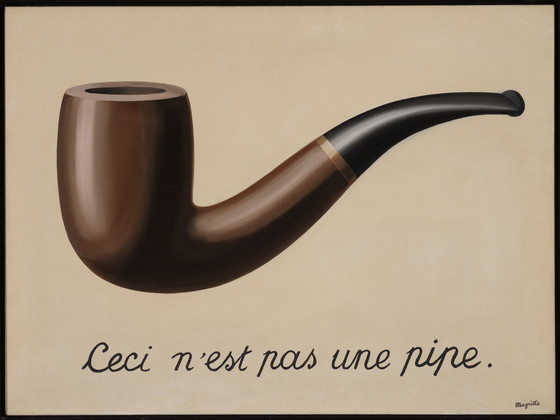
“The Treachery of Images” (Painting by Rene Magritte, image sourced from Los Angeles County Museum of Art)

Experts are treated with scepticism, scientists with suspicion, relativists with disdain, pluralists with apoplexy. Anyone seen to be challenging the status quo is dismissed as an “enemy of the people”. The public is being co-opted/coerced into buying wholesale certain political claims and party agendas (often hidden), without any opportunity to subject them to independent scrutiny or fact-checking.

Facts and logic are often the first victims in this abuse of language in the exercise of public discourse. Political slogans don’t even bother to avoid or deny accusations of propaganda: “Yeah? So what?” is often the response.

With that in mind, let’s play semantics and semiotics! To begin with, some opening statements:

1. This is a red car. (Observation, and a Fact if we agree on what is “red”) *

2. Red is the most popular colour of car. (Statement of Fact, if proved statistically) **

3. Red cars hold their value more than green cars. (Opinion, but also a Fact if it can be proved statistically, and we agree on what “value” means in this context)

4. Red cars are better than green cars, but blue cars are better than red cars. (Judgement tending towards a display of bias and prejudice)

Depending on the positioning and messaging, #1-#4 could be used in various marketing and advertising campaigns to sell red cars (or in the case of #4, sell blue cars).

Now, here are two reasonably uncontroversial propositions:

  • “Traffic laws are important to the functioning of society.”
  • “Good government relies on the democratic will of the electorate, and adequate funding of public services via taxation.”

We can see from the way language and truth are mangled in the service of current political debate and social commentary, that “statements of fact” can be easily positioned as “expressions of opinion” (and from there manipulated into pejorative and derogatory accusations or subtexts):

1. Red cars are involved in more road accidents than any other colour of vehicle
(Anyone who drives a red car is more likely to drive recklessly.)

2. People who drive red cars don’t observe the speed limit.
(Anyone who drives a red car is either a libertarian or an anarchist.)

3. People who drive red cars fail to pay their taxes.
(Anyone who drives a red car is anti-government.)

4. People who drive red cars are subversives.
(Anyone who drives a red car is a terrorist.)

5. People who drive red cars are law-abiding citizens.
(Anyone who drives a red car is a conservative. OR: Anyone who doesn’t drive a red car is a criminal.)

6. People who drive red cars give to charity but people who drive blue cars give more.
(Anyone who drives a red car is a better person than someone who drives a green car but not as good as someone who drives a blue car.)

The combination of sweeping generalisations and over-simplification in public discourse can obviously distort meaning and generate distrust. For example:

1. What if all taxis are red? That might mean they spend more time on the road, and therefore are more prone to be involved in traffic accidents.

2. What if more sports cars are red than any other colour? That might mean their drivers are more likely to speed. Or that their owners have more money. Or they are status conscious.

3. What if people who drive red cars come from a specific socio-economic, sectarian or ethnic demographic? Even then, they won’t all agree on the same issues, and they will likely display a similar range of divergent, opposing and contradictory views as the drivers of any other colour of car.

Unfortunately, the current environment for political debate and public commentary is being reduced to a binary state, where nuanced and subtle argument is being sidelined in favour of polarised and partisan politics, where facts are not allowed to get in the way of some convenient diatribe. If only politicians were accountable to voters under the Trade Practices Act – although we may soon see election campaigns subject to misleading and deceptive conduct legislation.

* Colour can also depend on context, as these experiments demonstrate: https://www.youtube.com/watch?v=FFC7EyR1lhU

** It’s not actually true: https://www.whichcar.com.au/car-news/most-popular-car-colours

Next week: Business as Unusual  

Can we come out now?

At the time of writing, the Victorian government has just announced the State’s very own measures as part of the “3 Steps to Recovery”, designed to ease the Covid-19 lockdown restrictions, in a controlled and manageable way. This follows last week’s meeting of the National Cabinet, where broad agreement was reached on a plan to help “prepare Australians to go back to work in a COVID-19 safe environment and getting the economy back to a more sustainable level“.

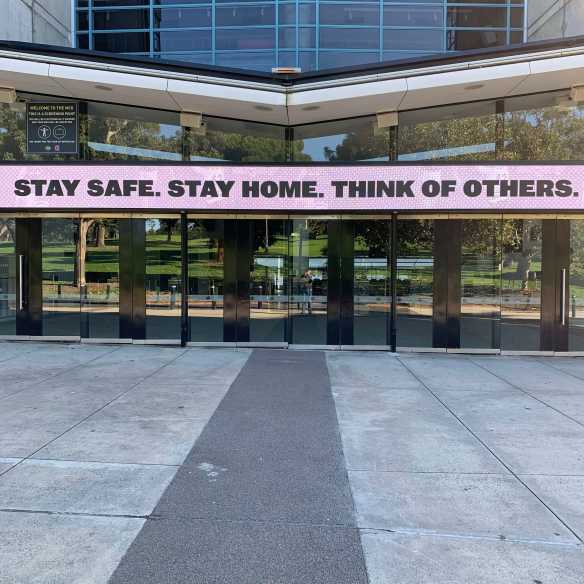
Even at the MCG, the advice is stay safe, stay home, and think of others

The biggest “winners” in Victoria will be our immediate friends and families (groups of up to 5 people can gather at each others’ homes), outdoor activities (groups of up to 10 people), wedding organisers and funeral directors (more people can attend ceremonies)…. oh, and the AFL (training can resume!).

But Premier Andrews has stressed that this is neither an excuse to host dinner parties every night, nor a reason to ignore established protocols and best practice on personal hygiene and social distancing. So no overnight raves or camping trips. And no dining-in at restaurants or cafes, and definitely no pubs, bars or clubs.

For some people, the continued Stage 3 restrictions seem too much to bear, with a few fringe elements (along with the anti-vaxxers and the anti-5Gers) being more vocal and more physical in their views. But they probably fail to see that no-one actually enjoys living under this regime, and nobody would do it if they had a choice or other safe options.

Thankfully, the majority of the population are willing to comply with the restrictions, however uncomfortable or inconvenient, because they realise the consequences of a second wave of infections (especially as we come into winter) would be worse than some temporary limitations on their freedom of movement. There is also a renewed albeit grudging respect for and trust in our political leadership (if not always felt towards individual ministers), and here in Australia we can also consider the political decisions and public advice in light of scientific data and medical evidence.

A large proportion of Covid-19 infections in Australia came via overseas travellers (cruise ships and ski trips), while some of thee first community infections came from gatherings such as weddings and religious services. And then there have been “hubs” within sectors such as aged care, meat processing and airport baggage handling.

There are still questions over plans to re-open schools, and sectors such as aviation, tourism and hospitality have a long way to go before “normal” service resumes. Parts of the retail sector have managed to survive thanks to on-line shopping and e-commerce solutions (supply chain logistics and delivery) but we should expect some businesses will never bounce back. Every employer will probably need to have a “Covid-19 Safe” operating plan before bringing staff back to work in significant numbers, whether as part of their best practices on risk management, or as a prerequisite to satisfy workplace health and safety obligations.

The apparent rush to get professional sport back on the field feels like a misplaced priority – especially given the controversy around NRL and AFL players who apparently lacked the self-discipline to comply with the social-distancing measures; and those players who are refusing the flu vaccine as a condition of rejoining their clubs. On this point, I rather admire the comments by Chelsea manager, Frank Lampard, who expressed his unease at the thought of professional footballers getting priority for Covid-19 testing, ahead of essential and front-line workers, simply to fast-track the resumption of the EPL.

Even with the various safety plans and gradual easing of restrictions, it’s up to each of us individually to be responsible for our own actions, and maintain a personal duty of care to each other so as not to risk spreading the infection, nor risk exposing others as a result of something we do or omit to do.

Next week: The Bitcoin halving – what happened?


The lighter side of #Rona19

After several weeks of lockdown during #Rona19, and despite the serious challenges that we still face from the Pandemic and its consequences, it’s typical of the human condition and our spirit of resilience that people have managed to find humour and goodwill in the depths of despair.

In no particular order (and without any judgement) here are just some of the distractions and interactions that have been keeping us amused during social isolation, as well as a few of the apparent positive effects:

  • The video conference call bloopers (memo to team: pants on)
  • Clips of dogs vs cats navigating home-made obstacle courses
  • #MeAt20 flashbacks
  • Elderly family members accidentally gatecrashing Houseparty online drinks
  • Some introvert pupils actually enjoying schooling from home
  • Clients and suppliers displaying genuine concern for each others’ welfare in e-mails and on calls (I just hope this empathy endures beyond the Pandemic)
  • People reducing food waste (less shopping, less fussy about use-by dates)
  • Homemade videos and photos recreating scenes from famous movies and artwork 
  • More wildlife in urban areas (I’ve also seen more birds, bugs, bees, butterflies and beetles in my back yard and in nearby parks)
  • Public libraries of iconic images for use as video call backdrops (conference calls will never be dull again…)
  • An apparent drop in traditional crime rates, and fewer typical hospital casualties (people not going out getting drunk, getting into fights or overdosing)
  • Hosting virtual dinner parties (no need to organise a taxi home)
  • Many homes now have a “clearance corner” awaiting charity shops reopening (all that time to sort out cupboards and drawers)
  • A visible reduction in air pollution (as evidenced by before/after photos from various cities)

Next week: Startupbootcamp’s Virtual Demo Day