“Why? Because we’ve always done it this way…”

A couple of blogs ago, one of my regular correspondents kindly laid down a challenge. He suggested that part of the answer to the problem I was writing about (i.e., how to manage data overload) could be found within Simon Sinek’s “Start With Why”.
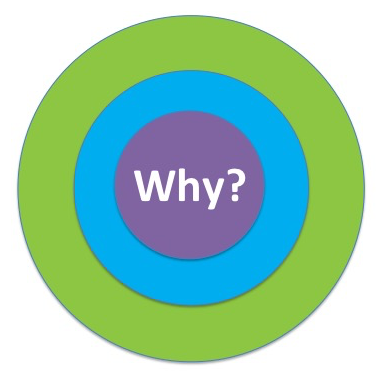
Why?I’m quite familiar with Sinek’s investigation of “Why?”, but I wasn’t sure it was applicable in the context of my topic. Don’t get me wrong – the “Golden Circle” is a great tool for getting leadership teams to explore and articulate their purpose, and it can help individual business owners to re-connect with the reasons they do what they do.

It can even facilitate new product and service development.

But, I believe it’s harder to apply at an operational or processing level, where the sorts of decisions I was referring to in my blog are typically being made: what tools to use, what systems to adopt, what software to deploy etc.

There are several reasons why organisations do things the way they do them. When undertaking a business process review, I frequently ask the question, “Why are you doing this?”

Here are some typical responses I’ve received (and my conclusions in parentheses):

  • “Because we have to” (compliance)
  • “Because we’ve been told to” (command and control)
  • “Because we’ve always done it like this” (inertia)
  • “Because everyone else is doing it” (cheap/easy/popular)
  • “Because our consultants recommended it” (cop-out)

In one experience, I had to implement a process change within a publishing team, comprising experts (writers) and technicians (editors). The problem was, that even though the content was published on-line, most of the production processes were done on hard copy, before the final versions were uploaded via a content management system. The inefficiencies in the process were compounded by a near-adversarial relationship between writers and editors, at times bordering on a war of attrition.

When I asked the team why they worked this way, their responses were mainly along the lines of “command and control” and “inertia”. Behaviours were reinforced by some self-imposed demarcation.

The writers felt it was their role as experts to demonstrate everything they knew about the topic (without necessarily saying what they actually thought); while the editors felt they were required to work within a rigid house style (to the point of pedantry), maintain writing quality (at the expense of timeliness), and to maintain content structure and format (over context and insight).

  • Both sides felt they were meeting the organisation’s purpose: to deliver quality information to their customers to help them make informed decisions.
  • Both believed they were following clear operational guidelines, such as production, technical, and compliance.
  • Both were passionate about what they did, and took great pride in their work.

Unfortunately, the procedures which they had each been told to follow were inefficient, at times contradictory, and increasingly out of step with what customers actually wanted.

Based on market feedback clients told us they:

  • favoured timeliness over 100% perfection;
  • preferred insights over data dumps; and
  • really wanted “little and often” in terms of content updates

Thankfully, the voice of the customer prevailed, and the introduction of more timely content management processes resulted in frequent updating (via regular bulletins) backed by the “traditional” in-depth analysis.

When starting a change management project, conducting a process review, or undertaking a root-cause analysis, if asking “Why?” doesn’t get you very far in getting to the bottom of a problem, I find that it can help to pose another question: “What would your customers think about this?” For example, if customers knew how many times a piece of data was handed back and forth before their order/request/enquiry was processed, what impression might that give about an organisation?

For most companies, their sense of purpose is driven by a strong or underlying desire to serve their customers better – it’s as simple as that.

Next week: The 3L’s that kill #data projects

A couple of No-No’s for content marketers

If you are just getting started in content marketing, or if social media is still a bit of a novelty for your organisation, there are a couple of things you should definitely avoid when attempting to use third-party content for your own promotional purposes: don’t misappropriate, and don’t misrepresent.

All marketers will be alert to false, deceptive or misleading advertising. More experienced content developers should also understand legal issues such as plagiarism, copyright infringement, passing-off and libel. However, even seemingly innocent and well-intentioned references made to third-party content may inadvertently border on unconscionable conduct.

Last week, I had the rather disturbing experience of a company attempting to use my blog to promote a service, and in a way that not only implied I was endorsing that service, but also suggested that my blog was somehow the reason why customers should sign up for it.

I found this problematic for three reasons:

First, I had no knowledge of or connection with this particular service, and the promotional message gave the impression I was endorsing it, which was obviously misleading, and it quoted my article out of context. At an extreme level, if I ever wrote a blog about the “10 reasons why I take public transport”, and then a political party co-opted my content to say “10 reasons why you should vote for our transport policy”, that would be misappropriation (of my content) and misrepresentation (of my views).

Second, even though the service referred to was being offered for free, if the company had managed to generate new clients via this particular campaign, there’s no direct benefit to me or my business, but lots of benefit to the company and/or its partners. In this increasingly self-directed, interconnected and collaborative environment, it’s important to make sure we are all “paying it forward” in a constructive and mutually beneficial way. (I have no problem with receiving a referral fee or a direct benefit in kind if my efforts have been instrumental in securing new customers for your business!)

Third, I am fortunate that a number of my blog articles have been re-syndicated via social media and other channels. In writing about third-party products and services, I am very careful not to endorse specific businesses or brands, other than to mention names (and link to relevant sites). Where I am providing criticism, I endeavour to do so under the auspices of “fair comment”. This is important when establishing credibility with an audience: that my content is seen to be authentic, that I demonstrate awareness about the purpose and context of my blog, and that I attribute whenever I am referencing or citing third-party content. (See an earlier blog I wrote on this topic) But, if in doubt, always ask the content owner in advance before linking, referencing, quoting, attributing or re-contextualising their content.

Finally, if I can be of any assistance in relation to your own content marketing, please let me know via this site.

How Can I Help?

My purpose in launching this blog was to develop a personal brand, to engage with an audience, and to provide a platform for my ideas and interests, especially in respect to navigating the “information age”.

At the risk of self-aggrandizement, I’d like to think that this blog is helpful, informative and even entertaining. After two years of blogging, I have a sizeable and regular audience, my content gets shared and commented on by numerous readers, and key articles continue to be read many months after publication. (Two of the most popular articles in 2014 were actually published in early 2013.)

Several of my core followers have mentioned why they enjoy my blog, and these are some of their reasons:

  1. The content is original and well written
  2. The articles make them think about things in new ways
  3. I write about novel ideas
  4. My thinking reveals hitherto hidden or less obvious connections
  5. I’m never afraid to state my opinion

Which all suggest to me that they derive value from my analysis and conclusions.

So, my offer of help is this: If you would like access to this creative process, either in support of a specific business opportunity, or to address a strategic issue you face, or simply to help with your own content development, please get in touch via this blog or direct by e-mail. In return, I will provide you with an initial assessment of the issues as I see them, and an outline solution, at no obligation. It’s simply my way of saying “thank you” to everyone who has made an effort to engage with Content in Context.


F for Facsimile: What are ‘Digital Forgeries’?

Last week, I attended the 2014 Foxcroft Lecture, given by Nicholas Barker, entitled “Forgery of Printed Documents”. The lecture prompted the question, what would we consider to be a ‘digital forgery’?

Make Up

The lecture was an investigation into a practice that emerged in the 18th century, when reproductions (‘fac similes’ – Latin for ‘make alike’) of early printed texts were created either as honest replicas, or to enable missing pages from antiquarian books to be restored to ‘make up’ a complete work. In some cases, the original pages had been removed by the censors, for others the pages had been left out in error during the binding process, and mostly they had simply been lost through damage or age.

Other factors created the need for these facsimiles: the number of copies of a book that could be printed at a time was often limited by law (censorship again at work), or works were licensed to different publishers in different markets, but printed using the original plates to save time and money.

Despite the innocent origins of facsimiles, unscrupulous dealers and collectors found a way to exploit them for financial gain – and of course, there were also attempts to pass off completely bogus works as genuine texts.

Replication vs Authentication

Technology has not only made the mass reproduction of written texts so much easier, it has also changed the way physical documents are authenticated – for example, faxed and scanned copies of signed documents are sometimes deemed sufficient proof of their existence, as evidence of specific facts, or in support of a contractual agreement or commercial arrangement. But this was not always the case, and even today, some legal documents have to be executed in written, hard-copy form, signed in person by the parties and in some situations witnessed by an independent party. For certain transactions, a formal seal needs to be attached to the original document.

Authenticating digital documents and artifacts present us with various challenges. Quite apart from the need to verify electronic copies of contracts and official documents, the ubiquity of e-mail (and social media) means it has been a target for exploitation by hackers and others, making it increasingly difficult to place our trust in these forms of communication. As a result, we use encryption and other security devices to protect our data. But what about other digital content?

Let’s define ‘digital artifacts’ in this context as things like software; music; video; photography; books; databases; or digital certificates, signatures and keys. We know that it is much easier to fabricate something that is not what it purports to be (witness the use of photo-editing in the media and fashion industries), and there is a corresponding set of tools to help uncover these fabrications. Time stamping, digital watermarks, metadata and other devices can help us to verify the authenticity and/or source of a digital asset.

Multiplication

In the case of fine art, the use of digital media (as standalone images or video, as part of an installation, or as a component in mixed media pieces) has meant that some artists have made only a single unique copy of their work, while others have created so-called ‘multiples’ – large-scale editions of their work. (The realm of ‘digital works’ and ‘digital prints’ produced by photographers and artists is worthy of a separate article.)

Making copies of existing digital works is relatively simple – the technology to reproduce and distribute digital artifacts on a widespread scale is built into practically every device linked to the Internet. Not all digital reproduction and file sharing is theft or piracy – in fact, through the wonders of social media ‘sharing’, we are actually encouraged to disseminate this content to our friends and followers.

The song doesn’t remain the same

Apart from the computer industry’s use of product keys to manage and restrict the distribution of unlicensed copies of their software, the music and film industries have probably done the most to tackle illegal copying since the introduction of the CD/DVD. At various times, the entertainment industries have deployed the following technologies:

  • copy-protection (to prevent copies being ripped and burned on computers)
  • encryption (discs and media files are ‘locked’ to a specific device or user account)
  • playback limits (mp3 files will become unplayable after a specific number of plays)
  • time expiry (content will be inaccessible beyond a specific date)

Most of these technologies have been abandoned because they either hamper our use and enjoyment of the content, or they have been easy to over-ride.

One technical issue to consider is ‘digital decay’ (*) – mostly, this relates to backing up and preserving digital archives, since we know that hard drives die, file formats become obsolete and software upgrades don’t always retrofit to existing data. But I wonder whether each subsequent copy of a digital artifact introduces unintentional flaws, which over time will generate copies that may render nothing like the original?

In the days of analogue audio tape, second, third and fourth generation copies were self-evident – namely, the audible tape hiss, wow and flutter caused by copying copies, by using machines with different motor speeds, and by minor fluctuations in power. Today, different file formats and things like compression and conversion can render very different versions of the ‘same’ digital content – for example, most mp3 files are highly compressed (for playback on certain devices) while audiophiles prefer FLAC. Although this is partly a question of taste, how do we know what the original should sound like? With a bit of effort, we can re-process an ‘original’ downloaded mp3 into our own unique ‘copy’ which may sound very different to the version put out by the record company (who probably mastered the commercially released mp3 from studio recordings created using high-quality audio processing and much faster data sampling rates).

So, would the re-processed version be a forgery?

(*) Thanks to Richard Almond for his article on Digital Decay which I found very useful.