Whose content is it anyway?

Faust 2.0

Every social media and digital publishing platform is engaged in a continuous battle to acquire content, in order to attract audiences and bolster advertising revenues.

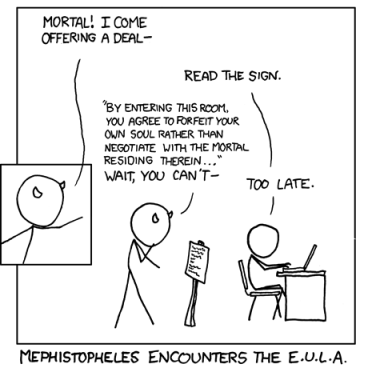
Content ownership is becoming increasingly contentious, and I wonder if we truly appreciate the near-Faustian pact we have entered into as we willingly contribute original material and our personal data in return for continued “free” access to Facebook, YouTube, Google, Flickr, LinkedIn, Pinterest, Twitter, MySpace, etc.

Even if we knowingly surrender legal rights over our own content because this is the acceptable price to pay for using social media, are we actually getting a fair deal in return? The fact is that more users and more content means more advertisers – but are we being adequately compensated for the privilege of posting our stuff on-line? Even if we are prepared to go along with the deal, are our rights being adequately protected and respected?

In late 2012, Instagram faced intense public backlash against suggestions it would embark upon the commercial exploitation of users’ photographs. While appearing to backtrack, and conceding that users retain copyright in their photographs, there is nothing to say that Instagram and others won’t seek to amend their end-user license agreements in future to claim certain rights over contributed content. For example, while users might retain copyright in their individual content, social media platforms may assert other intellectual property rights over derived content (e.g., compiling directories of aggregated data, licensing the metadata associated with user content, or controlling the embedded design features associated with the way content is rendered and arranged).

Even if a social media site is “free” to use (and as we all know, we “pay” for it by allowing ourselves to be used as advertising and marketing bait), I would still expect to retain full ownership, control and use of my own content – otherwise, in some ways it’s rather like a typesetter or printer trying to claim ownership of an author’s work….

The Instagram issue has resurfaced in recent months, with the UK’s Enterprise and Regulatory Reform Act. The Act amends UK copyright law in a number of ways, most contentiously around the treatment of “orphan” works (i.e., copyright content – photos, recordings, text – where the original author or owner cannot be identified). The stated intent of the Act is to bring orphan works into a formal copyright administration system, and similar reforms are under consideration in Australia.

Under the new UK legislation, a licensing and collection regime will be established to enable the commercial exploitation of orphan works, provided that the publisher has made a “diligent” effort to locate the copyright holder, and agrees to pay an appropriate license fee once permission to publish has been granted by the scheme’s administrator.

Such has been the outcry (especially among photographers), that the legislation has been referred to as “the Instagram Act”, and the UK government’s own Intellectual Property Office was moved to issue a clarification factsheet to mollify public concerns. However, those concerns continue to surface: in particular, the definition of “diligent” in this context; and the practice of some social media platforms to remove metadata from photos, making it harder to identify the owner or the original source.

Meanwhile, the long-running Google book scanning copyright lawsuit has taken another unexpected twist in the US courts. From the outset, Google tried to suggest it was providing some sort of public service in making long-out-of-print books available in the digital age. Others claim that it was part of a strategy to challenge Amazon.

Despite an earlier unfavourable ruling, a recent appeal has helped Google’s case in two ways: first, the previous decision to establish a class action comprising disgruntled authors and publishers has been set aside (on what looks like a technicality); second, the courts must now consider whether Google can claim its scanning activities (involving an estimated 20 million titles) constitute “fair use”, one of the few defences to allegations of breach of copyright.

Personally, I don’t think the “fair use” provisions were designed to cater for mass commercialization on the scale of Google, despite the latter saying it will restrict the amount of free content from each book that will be displayed in search results – ultimately, Google wants to generate a new revenue stream from 3rd party content that it neither owns nor originated, so let’s call it for what it is and if authors and publishers wish to grant Google permission to digitize their content, let them negotiate equitable licensing terms and royalties.

Finally, the upcoming release of Apple’s iOS7 has created consternation of its own. Certain developers with access to the beta version are concerned that Apple will force mobile device users to install app upgrades automatically. If this is true, then basically Apple is telling its customers they now have even less control over the devices and content that they pay for.

Corporate Governance – exercising a “duty of awareness” in the age of social media

68

Do we need a new theory of Corporate Governance? Is it time to look at a new model that reflects the current environment in which businesses operate, an era characterised by:

  • social media,
  • corporate and social responsibility,
  • shareholder and consumer activism,
  • increased market connectivity, and
  • rapid generational change?

Has the law fallen behind in being able to regulate and oversee contemporary corporate behaviour – where compliance with and adherence to the letter of the law may no longer be enough to meet community standards or satisfy shareholder expectations?

The question arose during a roundtable discussion I attended recently, comprising non-executive directors, entrepreneurs, corporate advisers and governance experts. Some of the issues we kicked around included:

  • the efficacy of running more frequent board interaction via the use of technology (as opposed to the standard face-to-face monthly board meeting);
  • the ethics of minimising cross-border taxation by multinational companies (even though it may be legal under international tax law);
  • the imperative to develop more inclusive and diversified boards (including networking into broader stakeholder groups);
  • the perils of ill-considered public comments made by CEOs (and the resulting social media backlash); and
  • the risk of harking back to some “golden age” of corporate behaviour (assuming such an era actually existed)

Our current perspectives on Corporate Governance largely derive from the late 1980s and early 1990s when a series of authoritative studies and reports led to new Codes of Practice and updated corporations laws – I’m referring to the work done by and in the name of Tricker, Carver, Monks, Cadbury, Greenbury, Hilmer and Hempel. And while in recent years we have seen increased scrutiny on CSR, directors’ remuneration and financial oversight by boards (plus Sarbanes-Oxley, Dodd-Frank and IFRS), the reality is that most of the earlier Corporate Governance reforms were introduced just as the internet went public and just as financial markets were being deregulated. So it could be argued that the reforms were ill-equipped for, or could not have anticipated, the changes to come – witness for example, the SEC’s recent approval of social media as an appropriate platform for corporate disclosure.

In Australia, Corporate Governance is described simply as “good decisions being made by the right person”, and the obligations of company directors are summarised as follows:

  • your primary duty is to the shareholders;
  • you must act with appropriate due care and diligence;
  • you must not allow the company to trade while insolvent;
  • you must exercise your powers in good faith and in the best interests of the company;
  • you must not improperly use your position of (or information obtained as) a director to benefit yourself or another person, or to cause detriment to the company.

On one level, the test of whether an organization has exercised good judgement in making a decision is, “would you be embarrassed if this was reported on the front page of tomorrow’s newspaper?” At another, Corporate Governance is reduced to a compliance checklist of risk mitigation measures.

The Australian courts (in the OneTel and Centro cases) have expanded and reinforced the duty of care (particularly in relation to the business judgement rule) to place greater accountability on individual directors to consider what a reasonable person would do in exercising their duty of care and diligence:

  • To understand the fundamentals of the business
  • To keep themselves informed of the company’s activities
  • To monitor the company’s activities (e.g., through active questioning)

The question we should be addressing is: “Does imposing a broad duty of care and specific fiduciary obligations ensure an appropriate level of Corporate Governance?” I would argue that in light of a rapidly changing operating environment, we would be well-advised to exercise a “duty of awareness” in respect of our Corporate Governance standards. In my view, directors need to take a wider perspective in understanding and monitoring the business fundamentals and the company’s activities. Some may argue that this is not a new duty, it has simply been forgotten in recent times – and in the era of social media, when it is far easier to “get caught out”, it would be prudent to have more regard for the broader context.

A “duty of awareness” offers an appropriate counter-balance to the numerous areas of self-regulation by industry sectors and by individual companies. It provides an objective test for assessing “if not, why not” explanations required under both voluntary and mandatory Codes of Practice – i.e., did the respondent take into account all relevant factors, and did the respondent adopt a sufficient level of awareness in evaluating its options under a chosen course of action?

The “duty of awareness” means that at an individual level, directors would be obliged to reflect on their contribution to and participation in board decisions; boards would need to consider the likely impact of their decisions on the company’s performance and on wider stakeholders; and companies would be expected to have regard to their standing as a good corporate citizen, not merely a compliant one.

Acknowledgements: I am grateful to Andrew Donovan of Thoughtpost Governance and Dale Simpson of Bravo Consulting Group for their invaluable contributions to this article.

Edifice and Artifice – Urban Planning and Verisimilitude

Art can provide a compelling antidote to all the moral, philosophical, economic, scientific, religious and political hyperbole that bombards and confronts us every day. By referencing the technical processes of artistic practice, the study of art history and the language of critical art theory, we can learn to interpret and navigate these conflicting forces, and even challenge them. In our increasing over-reliance on all things digital, we need an artistic sensibility to help us re-connect with tangible reality. There are also some suggestions that enlightened companies have started hiring art graduates to bring an alternative perspective to their organizations – to tap into hitherto under-utilised skills and to employ this external expertise for internal problem solving, decision-making and strategic analysis.

Two recent cultural experiences have provided me an opportunity to reflect on how more than ever we need art to help make sense of the world, especially when interpreting data and making strategic planning decisions based on informed assumptions, market research and business analysis – because the standardized digital representation of everything means we often fail to venture beyond the surface of things.

The first event was a screening of “Urbanized”, an intriguing documentary by Gary Hustwit, showing at the Australian Centre for the Moving Image. The film is the final part of Hustwit’s design trilogy (following “Helvetica” and “Objectified”) and looks at several examples of good (and bad) urban planning around the world.  It provides cause for both optimism and pessimism on the future of the city – but it is mostly a positive survey.

One critical section of the documentary is an exploration of Brasilia, a flawed example of a “planned” city, with marvellous civic edifices and expansive freeways – except that for the people who live there, especially poorer and car-less citizens, it just doesn’t work as a built environment where they are supposed to live, work and play. Scratch beneath the surface, and we see a dysfunctional city. The moral of this particular story is that planners need to engage with the community, and work from the perspective of the end user, not simply from a visionary blueprint. Meanwhile, Stuttgart provides a salutary lesson in how poor public communication around policy, decision-making and execution can lead to a government being voted out of office, yet the majority of voters remain in favour of the politicians’ original planning decision.

There are so many things to like about this simple but effective film: the absence of a voice-over, allowing the stories to largely speak for themselves (within the usual confines of editorial decisions); the choice selection of urban locations and planning case studies; a range of informed and mostly objective participants and commentators; plus simple cinematography and a great soundtrack. Now I want my own city to adopt the public bus system from Bogota and the bike lanes from Copenhagen (and maybe the High-Line Park from New York).

The second cultural event comprised two solo (but related) exhibitions at the National Gallery of Victoria, featuring the photography of Thomas Demand and Jeff Wall respectively. Both artists produce large scale works, both employ sculptured components (light boxes used as fames, images printed on Perspex to imply depth) and both of them use constructed or staged settings to create their images.

Thomas Demand’s work looks deceptively simple and straightforward – mostly large still-life pictures of urban, industrial and technology-based interiors. However, if we dig below the surface verisimilitude, we can see that the images are really photographs of models made from paper and cardboard – sculptures that meticulously and painstakingly recreate these scenes rather like stage-sets, which simultaneously seem totally familiar yet frankly disturbing. This latter response can be explained by the absence of people and an eerie lack of any human presence in the images, plus the knowledge that all this visual data is merely a form of hyper-reality; but at the same time it is actually false, or at best an impression or recreated memory.

In comparison to his counterpart, Jeff Wall’s photography has the appearance of being more naturalistic (especially as most of Wall’s images feature people in everyday settings), even though in some cases it is just as surreal and hyper-real. The latter is achieved by the use of scale and backlighting, while the former is implied by the contradiction and juxtaposition between subject (content), and setting (context). This body of work also incorporates more narrative elements, and manages to make external references to literature, film and art history.

Both artists are quietly academic in their practice, and to some viewers this might present a barrier to understanding if they are not familiar with the accompanying art theory or critical analysis. But this need not be an obstacle to our engagement with the work, allowing us to appreciate it for what it is, and to reach our personal interpretations and conclusions.

Art enables us to relate individual stories and collective experiences, and recognizes that there are many truths, not just a single truth. Without art, we would lose a vital tool to interpret and narrate much of the world around us that cannot be explained by other media. And in the digital age of “virtual” and “hyper” realities, increasingly art is the only tangible means we have to give context and substance to our imagination without it being compressed and dis-intermediated by reductionist and homogenised technologies.

Finally, art in the 21st century is probably the only continuous link we have to our past – because as language and technology have evolved over time, art remains a constant aesthetic touchstone.

http://www.acmi.net.au/lp_urbanized.aspx

http://www.ngv.vic.gov.au/whats-on/exhibitions/exhibitions/jeff-wall-photographs

http://www.ngv.vic.gov.au/whats-on/exhibitions/exhibitions/thomas-demand

Bring back the Court Jester….

Whenever politicians or public figures are subjected to unflattering or unfavourable press coverage, they invariably react by saying that they have been quoted or portrayed “out of context”. They frequently complain that their opinions, policies, decisions or behaviour have been misinterpreted, misrepresented or deliberately misconstrued so to create an adverse impression in the mind of the public. In my opinion, they would be well advised to engage the modern equivalent of a Court Jester as part of their professional media management or strategic planning.

In an age of spin-doctors, PR gurus, focus groups and management consultants how do our leaders manage to get themselves in such a pickle through their own words and deeds? One reason is that leaders are susceptible to surrounding themselves with like-minded people, who in turn become dependent upon the leader’s patronage, resulting in “yes-men” and giving rise to group think.

Another cause is the absence of critical thinking, a lack of self-reflection or poor self-awareness. Elsewhere, it may be a simple loss of focus on strategy or purpose, backed by the leader’s self-belief, sense of infallibility and the total denial of doubt – all hubris and no humility.

In days of yore, the Court Jester was an integral part of the royal entourage. Although appointed by virtue of the King’s patronage and serving at his majesty’s pleasure, the Jester had full license to give voice to those thoughts and views that other members of the court were afraid, unwilling or unable to express. Imagine if the Emperor had employed a Court Jester rather than listening to his tailor…. (1)

In our terms, the modern Court Jester would be engaged to provide critical but constructive feedback on proposed policies, strategies or decisions in anticipation of likely public reaction, so that the desired message can be communicated to greater positive effect. Whereas at present, too often leaders appear wrong-footed at press conferences or at shareholder meetings, seem completely ambushed by social media backlash, and express total surprise at harsh judgements made in the Court of Public Opinion.

One business commentator has recently suggested that organizations need to appoint a Chief Reason Officer (CRO), whose primary purpose is to maintain collective focus on strategic purpose and to deliver appropriate organizational outcomes. (2)

I would argue the CRO needs to be the conscience of the organization, be willing to challenge the status quo, and be expected to offer alternative perspectives to counter collective “wisdom” and accepted “common sense”. Maybe the job title should be “Chief Rational Optimist”. (3)

In a previous corporate role, I frequently found myself asking my colleagues, “Why do we do it this way?” to which the answer would often be, “Because we’ve always done it this way.” (Which is like a red rag to a bull.) Consequently, I would challenge common assumptions and question conventional thinking, while striving to present alternative viewpoints with the objective of introducing fresh ideas and generating innovative solutions. In fact, one of my senior colleagues once introduced me to a new member of staff as the organization’s “lateral thinker”. (Which I took as a sincere compliment.)

By appointing the role of a modern Court Jester, I believe organizations may find it much easier to hold themselves accountable for their decisions, and better anticipate the unforeseen, unnecessary and unforgivable consequences of their actions.

(1) In preparing this article, I reflected on the writing of Desiderius Erasmus, author of “In Praise of Folly”: “Man’s mind is so formed that it is far more susceptible to falsehood than to truth.” For a contemporary perspective, see also Chris Patty: “The Court Jester as a Metaphor for Learning and Change” http://www.tms.com.au/tms12-1d.html

(2) Bruce Rogers: “Why Companies Need a Chief Reason Officer” http://www.forbes.com/sites/brucerogers/2012/12/21/why-companies-need-a-chief-reason-officer/

(3) See especially, Jules Goddard and Tony Eccles “Uncommon sense, common nonsense” Profile Books (London, 2012) http://www.profilebooks.com/isbn/9781846686009/