How to Survive a #Startup Weekend

A rite of passage for any startup founder or budding entrepreneur is a weekend hackathon, and a Startup Weekend is probably the best way to throw yourself in at the deep end. As part of Startup Week, the York Butter Factory hosted Melbourne’s first fintech event. Here’s how I managed to survive the ordeal….
IMG_0210

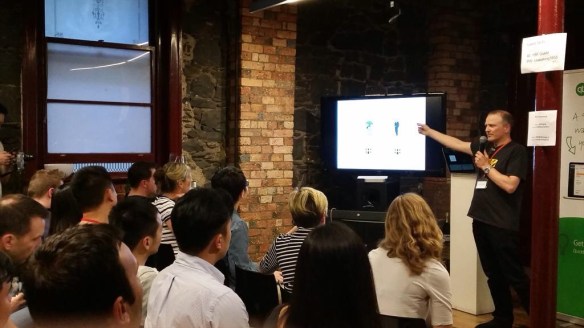
Your correspondent in full flow at the Final Pitch…

Rather than provide an hour-by-hour account of my experience (the schedule is on the website and you can read the Twitter feed), here’s my thoughts on what it takes to participate and get the most out of the experience:

Courage

Take a leap of faith, step up and pitch an idea at the open mike session on the first night. Not only does this force you to craft your message, it also helps overcome any nervousness or awkwardness in joining a room full of total strangers with whom you will be working for the next 54 hours. My idea didn’t get enough votes, but it did spark several interesting conversations with other participants, such that I will probably take it further.

Stamina

Pace yourself. Yes, you could spend every available hour on finishing that customer validation, or refining the pitch, or making sure your demo site is up and running – all of which are important – but you also need to make time for rest, sleep, eating (all catering is laid on) and exercise. Again, 54 hours is a long time to spend on a single activity.

Open Mindedness

I had some idea from the program notes what to expect, but I still didn’t really know what it would it be like. So it was great to just go with the flow, to see what would happen. The format, structure and schedule (as well as the rules and requirements for the Final Pitch competition), pretty much define what goes on. But your attitude and willingness to be open to new ideas determine how much you get out of the experience.

I should also mention the value in having direct access to so many experienced mentors throughout the weekend – although I know from the experience, it’s hard not to get too defensive when mentors find fault with your project, and difficult to remain true to the idea when some of the feedback is contradictory.

Teamwork

Building teams to collaborate on a startup idea forms the basis of the hackathon model. As my own idea did not get enough votes at the open pitch, I looked to join a team that was a good fit in terms of the idea, the mix of skills to complement my own, and the ability to execute. As a “non technical” participant, I was extremely fortunate to be part of team that had a great balance of back-end and front developers, design skills and mobile deployment. Plus, given the theme was fintech, it was fantastic working with people from a banking IT background. (It also helped that several team members were veterans of Startup Weekend.)

Defining Roles

Although we didn’t spend a great deal of time creating or defining roles within the team, each of us played to our strengths, by self-determining what we would work on, and what our contribution would be. The only tricky decision was choosing who would present the Final Pitch to the panel of judges – but a process of elimination, preference and negotiation resulted in yours truly taking on the role.

Tools

In addition to the various software, hosting and domain name resources provided to each team, I was impressed by how many other tools the team plugged into – such as Trello, GoogleForms, Hangouts, ThemeForest, CanvasModel Design and Launchrock – most of which were free. We also spent some time reviewing competing and complementary products as part our MVP validation.

Less Is More

We could have spent a lot of time on customer validation – but we chose instead to talk to 3 or 4 key target customers for the MVP (qualitative), and run an on-line survey (quantitative) which generated around 100 responses overnight (not bad considering it was a weekend…). We also had more content than we actually used: the lean canvas business model was used sparingly, as was a competitor heat map; but it also meant that when we came to developing our pitch presentation, we had the luxury of being able to take stuff out and only focus on the important and most relevant points. Thanks, also, to a presentation template that one of the team had just used at a recent management course!

Practise

Having been chosen to make the Final Pitch on behalf of the team, and despite quite a lot of experience in making business presentations and in public speaking, I was extremely grateful for the coaching, feedback and rehearsals the team put me through. Getting to know the material, understanding the anchor points and how to navigate from topic to topic, helped me to give a presentation that flowed logically and hopefully demonstrated that the team had met the competition brief.

The Result?

Unfortunately our team did not win, nor did it place in the top 3. The judges pinged our presentation for being “too confident”, and for not demoing our prototype (we did briefly put up our beta website) – but given the working prototype mostly comprised some backend coding, it wouldn’t have been that interesting from a visual perspective.

Notwithstanding our disappointment on the night, the team is planning to get together to see how far we can take the idea, and separately I’ve been asked to join a new team at an upcoming hackathon.

(If anyone is interested, we designed a P2P payments tool called PayMee)

Next week: 3 Ways to Fund Your #Startup

Help! I need to get some perspective….

At a recent professional networking event, I found myself in conversation with a business owner and tech entrepreneur. As I was describing my work, he suddenly asked, “Do you mentor your clients, because my business partner and I could use some help?”

perspective-35266_640I was somewhat surprised by the question, because although I see my role primarily as a business consultant and coach, it hadn’t occurred to me that what I did included mentoring, even though it’s probably in the mix of services and support I offer. And from experience, working with business partners can sometimes be likened to relationship counselling….

To be clear, though, I see that there are distinct differences between consulting, coaching, mentoring and counselling – even though the boundaries may at times be blurred.*

The one thing I believe they have in common is that they each bring external perspective, especially when there may be a need for fresh thinking, such as a new take on current processes, or simply a circuit breaker when businesses get in a rut or hit a road block.

Here’s what I regard as the essential and unique qualities of each of these roles:

Consultant

At its simplest, consulting can be described as initiating the dialogue between an organization and itself. When it concerns a review of ongoing operations, or a strategic initiative, most organisations call in consultants because they want an outsider’s view – not because they don’t know what they are doing, or can’t think for themselves.

As external consultants, we have the privilege to be invited into a client’s organisation; and our obligation to the client is to tell them what we really think, not what we think they want to hear. Our purpose is to capture the relevant information and “play it back” to the client to make sure we have understood what we have heard, whilst adding our honest interpretation of the data, along with some informed recommendations for action (which, of course, the client is free to disregard).

Our key contribution is to highlight inconsistencies or ambiguity in the data, to ensure that the client has considered all possible options, and to point out relevant external factors that the client may not be aware of. Above all, as a consultant I try to bring insights as well as perspective – what one person I have worked with described as “pure gold”.

Coach

The most effective coaches are those who can help clients identify specific goals, the steps required to achieve them, and then support them through the process. While business coaches can work with groups or teams, they are more suited to one-on-one relationships, to ensure they are keeping the client accountable for their own progress.

Many business coaches see their primary role as helping the client develop a strategic plan, and then making sure they stick to it, sometimes by telling them what to do. Whereas executive coaches may hone in on a particular aspect of an individual’s performance, to sharpen their skills and to make them more effective in their role; or in the case of a career coach, help them achieve a career change.

In some cases, a coach is similar to an instructor, and aims to help the client improve a skill or competency in pursuit of better outcomes and results. As a coach, I know the best work I do is when I get feedback like, “You’ve helped us to do in three weeks what it would have taken us three months!”

Mentor

Mentoring is mainly about helping the client to become the person they aspire to be. More so than coaching, mentoring is most effective in a one-on-one relationship, and unlike coaching may not be linked to specific or time-based goals. A mentor may bring deep domain knowledge and experience, but doesn’t instruct the client or tell them what to do. Instead, a mentor may ask, “So, what are you going to do about it?” when the client raises an issue or a problem.

While a coach may focus on “doing”, a mentor may be seen as helping to develop certain behaviours or attitudes. Although the mentor is also there to provide some external perspective, in some ways their role is to hold up a mirror so that the client can reflect on what they (and others) can see.

In some situations, a mentor can provide a role model, so long as this is not about following someone we admire, and more about self leadership. More importantly, a mentor can act as an advocate, which is significant for entrepreneurs, business owners, CEO’s and senior executives, for whom it can be “lonely at the top”.

The best mentoring probably happens when the “process” is invisible – and the dialogue happens in the moment. I know from experience that my role as a mentor has had most impact when I hear my words or ideas being expressed by others – not as plagiarism, flattery, imitation or even sycophancy, but because the mentee has taken on board what I have said, and made it their own.

Counsellor

Counselling could be defined as the dialogue around change and transformation, although it is different to mentoring in that it can address cognitive perspectives, as well as behavioral issues.

We are familiar with the role of change managers, but without engaging the organisation on the need for change, their work can become process-driven (and a thankless task). It’s much better to foster an open dialogue about the broader context and opportunity for change, which can open up new possibilities for transformation. Ideally, this approach can take some of the fear out of the change program, as well as creating a sustainable change model.

I have known some managers to use counselling techniques to resolve operational issues within their teams, because it can be an effective way to get to the bottom of a problem without apportioning blame and without being judgemental.

Counselling can cross the line into “giving advice”, which is not always helpful if clients are not receptive, or if it means clients don’t learn to think or decide for themselves. I once trained and worked as a counsellor in helping people resolve personal, employment, financial and legal problems. The key requirements of the role were helping the client to see that there may be a number of different solutions (without telling them which one to choose), and to uncover the underlying issues (rather than dealing only with the presenting problem).

The best counselling provides clients with a sense of empowerment, backed by a clear understanding of their responsibilities, and an appreciation for the consequences of choosing one course of action over another.

Putting it all together

As mentioned earlier, despite their differences, the roles of consultant, coach, mentor and counsellor can overlap – and there’s nothing wrong with this, as long as practitioners and their clients understand when and how the positions may alternate between one state and the next. Ultimately, it will depend on both the circumstances of the situation, and what is appropriate to the clients’ needs.


Note:

* There is a particular tendency to use the terms “coach” and “mentor” interchangeably, even though they are quite separate. For a good summary of the differences, see this recent article.

How Can I Help?

My purpose in launching this blog was to develop a personal brand, to engage with an audience, and to provide a platform for my ideas and interests, especially in respect to navigating the “information age”.

At the risk of self-aggrandizement, I’d like to think that this blog is helpful, informative and even entertaining. After two years of blogging, I have a sizeable and regular audience, my content gets shared and commented on by numerous readers, and key articles continue to be read many months after publication. (Two of the most popular articles in 2014 were actually published in early 2013.)

Several of my core followers have mentioned why they enjoy my blog, and these are some of their reasons:

  1. The content is original and well written
  2. The articles make them think about things in new ways
  3. I write about novel ideas
  4. My thinking reveals hitherto hidden or less obvious connections
  5. I’m never afraid to state my opinion

Which all suggest to me that they derive value from my analysis and conclusions.

So, my offer of help is this: If you would like access to this creative process, either in support of a specific business opportunity, or to address a strategic issue you face, or simply to help with your own content development, please get in touch via this blog or direct by e-mail. In return, I will provide you with an initial assessment of the issues as I see them, and an outline solution, at no obligation. It’s simply my way of saying “thank you” to everyone who has made an effort to engage with Content in Context.


Health Warning: Entrepreneurship is not all Plain Sailing

Last month’s gathering of Lean Startup Melbourne was devoted to the emotional and psychological downsides to being an entrepreneur. Whether building a startup or managing a successful corporate career, we are accustomed to reading about business success stories; but while we do learn something about corporate failures, we don’t hear much about the personal cost when things don’t go as planned.

But first, given the seriousness of this topic, if anyone reading this feels in need of help then there are some excellent information and support resources available listed here. There are also some useful reference articles such as this.

The evening’s panel Q&A discussion was preceded by a very moving account from Tom Howard, co-founder of Adioso on his own challenges in building a startup, about which he has written here. Tom’s frank and honest story about dealing with personal struggles while trying to manage investor expectations was neatly summed up in this observation: “Writing essays on our struggle was some of the best marketing.”

The panel members were drawn from a mix of startup, entrepreneurial and corporate backgrounds, and their stories revealed episodes of depression, near-bankruptcy and burn-out – tales possibly all too familiar to some experienced startup veterans in the audience, or merely spectres of what the future may hold for other budding entrepreneurs eager to learn from their peers. One of the panel, Andre Obradovic is now a public speaker on mental health issues, and has channeled his own experiences into advocacy and raising awareness.

If there was one recurring theme that ran through the discussion, it was the surprise at what happened to them – seemingly successful individuals who suddenly encountered severe setbacks (personal, financial, emotional, psychological), that came close to derailing their ability to function in their roles (as people, partners, parents or employers). The positive conclusion was that in recognising what was happening, and doing something about it, these individuals have managed to rebuild their lives and their careers, and are probably all the stronger and more resilient as a result.

Meanwhile, a number of hopeful startups were brave enough on the night to showcase their projects in the evening’s Startup Alley: Influx (outsourced customer support for online businesses), Cloakr (mobile device solution for coat check services), Jutsu (personal goal-setting app), Followus (social media site management for small business) and Brakeboard (braking systems for skateboards).

Finally, the evening’s event was sponsored by a clutch of generous supporters: Mondelēz InternationalInnovActionZendesk, Bluechilli, The X Gene and hosts Inspire9.