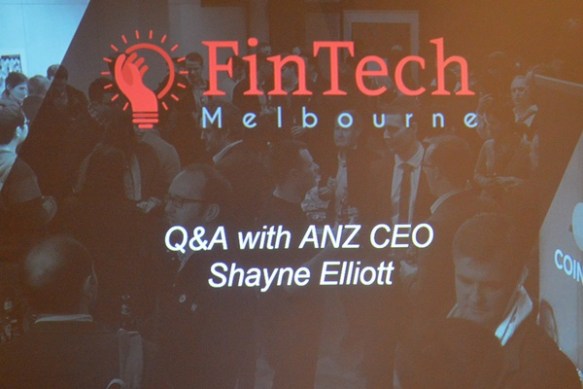
ANZ’s new CEO on #FinTech, CX and #digital disruption – 10 Key Takeaways

I went to the recent Q&A with the new CEO of ANZ, Shayne Elliott, organised by FinTech Melbourne. It was the first public speaking appearance by Shayne since becoming CEO (excluding his gig at the Australian Tennis Open), and followed a similar event last year with Patrick Maes, the bank’s CTO.

600_446693337The key themes were:

  1. Improving the customer experience (CX) is paramount
  2. Maintaining the high level of trust customers place in their banks is key
  3. Being aware of FinTech disruption is important, but remaining focused on core strategy is even more important
  4. FinTech can coexist with traditional banks, but the latter will win out in the end
  5. The bigger opportunity for FinTech is probably in SME solutions, rather than B2C
  6. Increased process automation is in support of CX, not about reducing headcount
  7. Big data and customer analytics are all very well, but have to drive CX outcomes
  8. Customers still see the relationship with their main financial institution in terms of basic transaction accounts, which is why payment solutions (a high volume/low margin activity) are vital to the banks’ sustainability
  9. ANZ is about to appoint a head of digital banking who will report direct to the CEO
  10. ANZ has been rated as one of the top global banks in terms of its use of Twitter and social media (but from what I have seen, much of the Big 4 banks’ social media presence can be attributed to their sports sponsorship…)

There was also some discussion around ANZ’s Asian strategy, and the statement last year that the “new” strategy is about becoming a digital bank. Shayne was quick to point out that they are not abandoning the Asian strategy (it’s not either/or) but because they embarked on Asia 8 years ago, most of the work has been done. Now they need to consolidate and expand the platform they have built. He also placed ANZ’s Australian business as being a comparatively small part of the group’s portfolio, and also took the view that despite ANZ’s size, resources and reach, digital products have to be developed market by market – it’s not a one size fits all approach. (Several FinTech founders in the audience took a very different perspective on this.)

And, in a bid to appear entirely approachable, both Shayne and Patrick were happy for people to contact them direct by e-mail… So if any budding FinTech founders have an idea to pitch to a major bank, you know who to contact.

Next week: Making the most of the moment…

Why The Service Sector Lacks Self-Awareness

If you did a root cause analysis of companies that rate poorly for customer service, I predict it would reveal one or more of the following:

  • Outdated processes
  • Inadequate staff training
  • Poor product knowledge
  • Operational silos

What it usually comes down to is a chronic lack of self-awareness. (This is not helped if there is a failure of leadership, or a toxic culture within the organisation.) Despite all the customer feedback forms, platitudes such as “your call is important to us”, and the regular customer advocacy reports, unless service providers can truly put themselves in the shoes of their customers, they will never have sufficient knowledge or self-awareness with which to fully evaluate the “customer experience”.

Image: Customer Feedback Device (Source: Smarte Carte)

Image: Customer Feedback Device (Source: Smarte Carte)

Today’s customers are more knowledgable (because they have access to more information, they can shop around, and in some cases, they have more choice). Today’s customers are also actively encouraged to engage with corporate social media (by following, liking and sharing, and by becoming surrogate brand advocates). However, the increased levels of expectation that this “engagement” creates are not always matched by the post-sales customer experience.

I have written before about how companies can improve their customer service, using a practical 7-point scheme. I would challenge any organisation that rates itself highly for customer service, to assess its performance against those criteria, as well using the ubiquitous customer satisfaction scores (CSAT, NPS®, CES, etc.).

Nearly every time I have an interaction with a telco, utility, bank or other service provider, I receive an immediate follow-up customer feedback request. Once upon a time, I would have been quite willing to provide constructive feedback, as I used to believe that it was important for the voice of the customer to be heard. Nowadays, I am more hesitant, because I don’t believe this feedback is ever properly acknowledged, analyzed or acted upon.

So many of these feedback request forms are self-serving, because the person you dealt with is in effect soliciting personal feedback on their individual performance. And while that is important, it is rarely done in the specific context of the customer’s own experience, and is more concerned with the company’s internal policies and procedures.

I am also increasingly sceptical about feedback processes that are ostensibly used for staff training. First, time is valuable, so it would be nice if companies could reward their customers for making the effort to engage. Second, on the rare occasions where a company has contacted me in response to a complaint submitted online or via a feedback form, I never learn what specific steps the company is taking to rectify problems caused by operational or policy failings. Thirdly, why should I be responsible for telling you how to train your staff or improve your service – surely that’s your job!

In many cases, it is not the performance of an individual customer service representative that is the problem. More likely, it’s poor customer service training, inadequate product knowledge or a myopic perspective, reinforced by silo operations. When even the most pleasant and competent service rep tells me, “I’m sorry, but it’s the way the system is designed…”, they probably don’t realize what a disservice they are doing: a “system” is only as good as the people who design it, and the people who implement it. So, they are in effect criticising their own colleagues, and the organisation they work for.

This lack of self-awareness by customer service staff is reinforced by the limited discretion in trying to resolve customer problems. Along with the use of internal jargon and bewildering acronyms, there is nothing worse than having to complain long or loud enough in order to escalate a problem. It would be wonderful if companies could empower their staff by giving them (well-defined) individual discretion on problem solving, and incentivize them for taking responsibility for the end-to-end resolution process.

In addition, it’s really infuriating being handed from one specialist, team or department to another, especially due to labyrinthine help line service menus. Telco on-boarding processes are particularly notorious for having complex operational procedures, multiple hand-offs and ring-fenced communications. I recall one large service provider who told me that in-bound call-centre staff were unable to speak directly to their own web support teams, and even if they communicated via internal e-mail, they could not guarantee a response.

If I am beginning to sound a bit like a broken record, it’s because recent experiences only reinforce my belief that many companies still don’t understand what it’s like to be one of their customers. But there’s a huge paradox here: on the one hand, companies are trying to reduce customer churn, increase “stickiness”, and improve the share of wallet or lifetime customer value; on the other, the cost of new customer acquisition appears to be cheaper (thanks to social media tools and web analytics), so it doesn’t matter if they lose a few customers, because it’s not that difficult or expensive to find new ones.

If it’s no longer true that “the customer is always right”, because profit margins are being squeezed and companies are being told to “stop delighting your customers”, then service providers have to do a much better job of managing customer expectations. They also need to demonstrate genuine empathy and concern if things go wrong (which is difficult if they don’t have sufficient self-awareness). And if things do go wrong, they need to ask the customer “what could we have done differently to provide you with better customer service?”.

In my professional experience of product management and business development, understanding customer needs and identifying ways to improve service delivery (along with customer-centric perspectives rather than product-led processes), are genuine sources of competitive advantage. But it takes considerable self-awareness to engage customers beyond the level of a single transaction, to develop genuine rapport, and to build sustainable long-term relationships. If your organisation is challenged by poor customer service, and if you recognise this is in part due to a lack of self-awareness, please get in touch – I’d be very interested to understand your problem.

Next week: Idea over Form – Gehry vs Ando

“I’m old, not obsolete”

In the recent “Terminator” sequel, Arnold Schwarzenegger coins a new catchphrase: “I’m old, but I’m not obsolete”. He may not be the latest android, but he has learned to adapt, he is still relevant and his purpose remains consistent. A bit like older workers, then: not ready to be consigned to the scrap-heap, consistent and reliable, and even capable of being upgraded (as Arnie is towards the end of the film).

Terminator Genisys

Remaining relevant is tough, even for a Terminator….  (Copyright 2015 Paramount Pictures)

A great deal of the discussion on employee engagement, business productivity, workplace flexibility and career transition talks about what we do with older employees, particularly those in their 50’s, who often struggle to find comparable work when they are retrenched or “restructured”.

Many 50-somethings can vouch for the fact that making a career transition into another full-time role can be extremely difficult. In my own case, I left my last corporate position just after I turned 50, and I soon realised it would be virtually impossible to find the exact same or similar permanent role elsewhere. So I embarked on a portfolio of interests (non-executive board positions, consulting work, contract roles and entrepreneurship) in order to remain “economically active”.

Over the past four years, in order to remain active, retrain and build my professional networks, I have:

  • completed the AICD Company Director course
  • served on a number of advisory and pop-up boards
  • launched this weekly blog, and written for 3rd party sites
  • coached business owners and entrepreneurs
  • competed in a FinTech hackathon and a MedTech startup competition
  • consulted in the education, public, NFP, publishing, manufacturing, technology and professional services sectors
  • joined numerous MeetUp and networking groups
  • participated in the Lightning Conference on Victoria’s StartUp Future
  • developed a new app for employee performance management,
  • trained as a presenter on community radio, and
  • become a participant and adviser at the Slow School of Business.

As part of my plan to become familiar with new technology, I have also built a side-project to record and release my own music via Bandcamp and Soundcloud, incorporating many iOS apps for which I am a beta-tester.

Not all of this activity is remunerated, yet the people I work with all tell me how much they value my unique input and original insight, and so I keep on doing it. Given the need/expectation to work longer, and the continued tinkering with tax, super and income rules and policies, I’m not sure many of us can ever think about full-time “retirement” (whatever that now means).

I’m aware that there are some ad hoc initiatives to engage older workers as mentors for new entrants to the workplace. While such projects are well-meaning, and may have some desirable benefits, they are not yet financially sustainable, and don’t address the core issue that the expectation of full-time, permanent, lifelong employment is no longer realistic, and we will all have to adapt to these new circumstances.

On the few occasions I have considered full-time roles, I am staggered that so many prospective employers seem incapable of thinking outside the box: on the one hand, they say they want diversity and fresh thinking; but on the other, they resort to the habit of appointing square pegs for square holes.

There is a real sense among many of my peers that their age counts against them, because either employers don’t believe they can learn new technology or processes, or that their previous seniority means they are only interested in roles where they can wait out their retirement, or simply “direct traffic”, rather than getting their hands dirty. Which is both insulting and demoralising. I recall one early discussion where the recruitment consultant said, “despite what the ad says, the business just wants a safe pair of hands – someone who has done the exact same role in a similar organisation for the past 20 years”. How does that support diversity, in particular, cognitive diversity?

So, my question to employers, hiring managers, industry bodies and policy-makers is: when will you truly embrace the challenge of (and opportunity for) change in your hiring and employment practices, and how do older age workers fit into your thinking (if at all)?

Next week: Startups, VC’s and Entrepreneurs

Who needs banks? My experience of “We R One World”

This past weekend, I participated in the “We R One World” game hosted by Carolyn Tate on behalf of the Slow School of Business, and facilitated by Ron Laurie from MetaIntegral. The game is an immersive learning experience in the form of a simulated global strategy workshop, based on the work of Buckminster Fuller. I joined a team whose role was to represent the interests of the commercial banks. It was a rather sobering experience, because as the workshop unfolded, it soon became clear that in the context of the game the banks were almost redundant – which partly reflects what is going on in the real world, as banks face increased disintermediation and disruption by FinTech, crowdfunding and the shared economy.

The Fuller Projection or Dymaxion Map

The Fuller Projection or Dymaxion Map

The Premise – Earth as Spaceship

Without going into too much detail, “We R One World” mimics elements of the board games “Risk” and “Monopoly”, and takes the form of a narrative-based hackathon, combined with a meetup and an unconference. Played out on a floor-size version of the dymaxion map, the game also draws on Fuller’s concept that the Earth is a spaceship, of which the players are the crew, and the “fuel” is the inventory of global resources at the crew’s disposal, including people, technology, capital, food, energy, munitions, water, etc. The participants form teams to represent various geo-political regions, supranational NGOs, multinational corporations and banks. The goal is to achieve (through trade negotiations), the best socio-economic outcomes for everyone, with a few surprises along the way!

There is a lot of information to absorb, as well as the structure of the game. One challenge for the players is to not get hung up on the presented “data” (which is more representative, rather than precisely factual). Even though we live with access to real-time, on-line statistics and research, and despite the Internet and search engines, in real life we still experience considerable information asymmetry.

The Prelude – We Are Star Dust

As a prelude, we were shown the documentary “The Overview Effect”, which includes the comment by former Apollo astronaut Edgar Mitchell that we are made of star dust (a now common concept echoed in various songs such as Moby’s “We Are All Made of Stars” or Joni Mitchell’s “Woodstock”, depending on your musical taste/cultural perspective).

It was also a timely connection, given the increased media coverage of space exploration, and Hollywood’s renewed interest in space travel. The recurring theme (in reality as much as in fiction) is that human survival will depend on relocating to, or harnessing other planets.

As examples, in the real world, we have the latest discovery of an Earth-like planet, tweets from Philae on a frozen comet, and the remarkable images from Pluto. While the entertainment world is enjoying critical and popular success with films such as “Moon”, “Gravity”, “Elysium” and “Interstellar” (plus the forthcoming “The Martian”). Even veteran Sci-Fi writer Brain Aldiss has bowed out with his final space novel, “The Finches of Mars”.

The Banks – Increasingly dispensable

But back to the game, and what we might conclude from the outcomes.

From the start, in the role of the banks we had a strategy for encouraging “good” behaviour, and punishing the “bad”. We had a catalogue of regional problems, and a set of possible solutions. “Good” behaviour was predicated on regions finding creating solutions to their problems, based on partnering, prioritization, planning and promotion. “Bad” behaviour might include late or failed interest repayments, misuse of funds (e.g., deploying more military hardware ahead of feeding their population), or actions that led to worsening conditions (increased poverty, hunger and illiteracy, or depleted natural resources).

At the outset, the banks’ role was to manage existing loans (by collecting interest due), and to originate new loans for development and commercial projects. In the initial stages, despite Japan’s attempt to renegotiate its existing repayment terms on the fly, the commercial banks managed to collect all interest due, on time and in full (with a small surplus, thanks to some regions’ lax monetary management). One region paid up without much prompting, cheerfully (or ironically?) commenting that “we must keep the banks happy!”.

However, as the game progressed, the banks were basically ignored, as regions switched their focus to responding to new circumstances, such that the consequences of not servicing their debts seemed irrelevant. Even the risk/threat of bankruptcy did not carry much persuasion, as regions were more willing to find new ways to trade with each other, less reliant on bank capital, and more focussed on alternative value exchanges (part of the game’s secret sauce).

For example, we received only two loan applications throughout the game: one was for a worthy but ambitious development project, but when asked to resubmit the request with some further information, the loan did not materialise; and the other was more in the way of a short-term deposit with the bank, to generate interest income to buy food. Given that deposit rates are low, our response was to suggest using the capital (with additional bank funding) to increase food production, but our offer was declined, maybe because of the need to trade out of a short-term food shortage rather than investing in long-term supply.

Towards the end, the banks were almost mere spectators in the game, and were reduced to protecting their self-interests: namely their capital, and their stalled/stagnant loan assets. If borrowers don’t want the banks’ money, where and what will the banks invest in order to generate depositor, investor and shareholder returns? As one regional participant commented, “we are all bank shareholders”. Just as in real life, we deposit money with the banks, we invest in their financial products (especially through our superannuation and pension funds), and we may even buy their shares and bonds. And of course, following the GFC, many taxpayers found themselves indirect shareholders of banks that were bailed out by their respective governments.

The Conclusion – An alternative approach?

I’m not going to give the game away (you can experience it for yourself in September) but the conclusion and outcome reinforce the view that in order to tackle the world’s problems, we all have to take a different perspective – whether that is challenging existing structures, subverting traditional business models, or questioning our personal motives and objectives. For myself, I recognise that this means an increased awareness of “living lean” (mostly around personal preferences and lifestyle choices), and (multi-)lateral thinking.

For institutions like banks (as well as governments, corporations and NGOs) this alternative approach means re-assessing their roles and contribution (which can also be framed as re-connecting with their “purpose”), remodelling their processes and systems, and redefining the measures of their success. As my team member concluded, “the other players only see the banks as a source of capital, rather than a resource for knowledge, expertise and networks”.

Footnote

Declaration of interest: I participated in the game at the kind invitation of the Slow School of Business.

Next week: “I’m old, not obsolete”