A couple of blogs ago, one of my regular correspondents kindly laid down a challenge. He suggested that part of the answer to the problem I was writing about (i.e., how to manage data overload) could be found within Simon Sinek’s “Start With Why”.
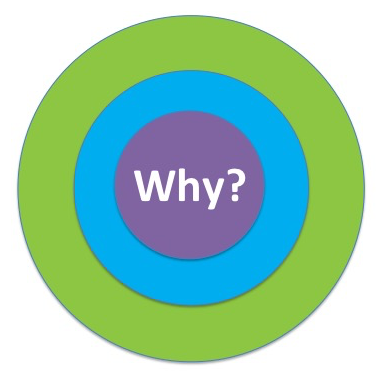 I’m quite familiar with Sinek’s investigation of “Why?”, but I wasn’t sure it was applicable in the context of my topic. Don’t get me wrong – the “Golden Circle” is a great tool for getting leadership teams to explore and articulate their purpose, and it can help individual business owners to re-connect with the reasons they do what they do.
It can even facilitate new product and service development.
But, I believe it’s harder to apply at an operational or processing level, where the sorts of decisions I was referring to in my blog are typically being made: what tools to use, what systems to adopt, what software to deploy etc.
There are several reasons why organisations do things the way they do them. When undertaking a business process review, I frequently ask the question, “Why are you doing this?”
Here are some typical responses I’ve received (and my conclusions in parentheses):
- “Because we have to” (compliance)
- “Because we’ve been told to” (command and control)
- “Because we’ve always done it like this” (inertia)
- “Because everyone else is doing it” (cheap/easy/popular)
- “Because our consultants recommended it” (cop-out)
In one experience, I had to implement a process change within a publishing team, comprising experts (writers) and technicians (editors). The problem was, that even though the content was published on-line, most of the production processes were done on hard copy, before the final versions were uploaded via a content management system. The inefficiencies in the process were compounded by a near-adversarial relationship between writers and editors, at times bordering on a war of attrition.
When I asked the team why they worked this way, their responses were mainly along the lines of “command and control” and “inertia”. Behaviours were reinforced by some self-imposed demarcation.
The writers felt it was their role as experts to demonstrate everything they knew about the topic (without necessarily saying what they actually thought); while the editors felt they were required to work within a rigid house style (to the point of pedantry), maintain writing quality (at the expense of timeliness), and to maintain content structure and format (over context and insight).
- Both sides felt they were meeting the organisation’s purpose: to deliver quality information to their customers to help them make informed decisions.
- Both believed they were following clear operational guidelines, such as production, technical, and compliance.
- Both were passionate about what they did, and took great pride in their work.
Unfortunately, the procedures which they had each been told to follow were inefficient, at times contradictory, and increasingly out of step with what customers actually wanted.
Based on market feedback clients told us they:
- favoured timeliness over 100% perfection;
- preferred insights over data dumps; and
- really wanted “little and often” in terms of content updates
Thankfully, the voice of the customer prevailed, and the introduction of more timely content management processes resulted in frequent updating (via regular bulletins) backed by the “traditional” in-depth analysis.
When starting a change management project, conducting a process review, or undertaking a root-cause analysis, if asking “Why?” doesn’t get you very far in getting to the bottom of a problem, I find that it can help to pose another question: “What would your customers think about this?” For example, if customers knew how many times a piece of data was handed back and forth before their order/request/enquiry was processed, what impression might that give about an organisation?
For most companies, their sense of purpose is driven by a strong or underlying desire to serve their customers better – it’s as simple as that.
Next week: The 3L’s that kill #data projects

