ANZ’s new CEO on #FinTech, CX and #digital disruption – 10 Key Takeaways

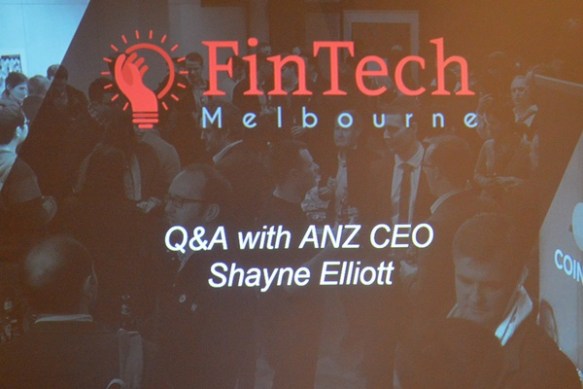
I went to the recent Q&A with the new CEO of ANZ, Shayne Elliott, organised by FinTech Melbourne. It was the first public speaking appearance by Shayne since becoming CEO (excluding his gig at the Australian Tennis Open), and followed a similar event last year with Patrick Maes, the bank’s CTO.
600_446693337The key themes were:

  1. Improving the customer experience (CX) is paramount
  2. Maintaining the high level of trust customers place in their banks is key
  3. Being aware of FinTech disruption is important, but remaining focused on core strategy is even more important
  4. FinTech can coexist with traditional banks, but the latter will win out in the end
  5. The bigger opportunity for FinTech is probably in SME solutions, rather than B2C
  6. Increased process automation is in support of CX, not about reducing headcount
  7. Big data and customer analytics are all very well, but have to drive CX outcomes
  8. Customers still see the relationship with their main financial institution in terms of basic transaction accounts, which is why payment solutions (a high volume/low margin activity) are vital to the banks’ sustainability
  9. ANZ is about to appoint a head of digital banking who will report direct to the CEO
  10. ANZ has been rated as one of the top global banks in terms of its use of Twitter and social media (but from what I have seen, much of the Big 4 banks’ social media presence can be attributed to their sports sponsorship…)

There was also some discussion around ANZ’s Asian strategy, and the statement last year that the “new” strategy is about becoming a digital bank. Shayne was quick to point out that they are not abandoning the Asian strategy (it’s not either/or) but because they embarked on Asia 8 years ago, most of the work has been done. Now they need to consolidate and expand the platform they have built. He also placed ANZ’s Australian business as being a comparatively small part of the group’s portfolio, and also took the view that despite ANZ’s size, resources and reach, digital products have to be developed market by market – it’s not a one size fits all approach. (Several FinTech founders in the audience took a very different perspective on this.)

And, in a bid to appear entirely approachable, both Shayne and Patrick were happy for people to contact them direct by e-mail… So if any budding FinTech founders have an idea to pitch to a major bank, you know who to contact.

Next week: Making the most of the moment…

Another weekend, another hackathon….

Last month, I competed in my second hackathon of the year, the #HSCodeFest sponsored by the Herald Sun and News Corp, and hosted by Melbourne University’s Carlton Connect. I’m pleased to say that our team of four, which was only formed on the first night, came 3rd in the pitch competition – with an idea for a news quiz app.

Screen Shot 2015-12-18 at 3.44.56 PMThat particular weekend was quite an eventful one for local startups – not only were there at least two other hackathons being held in Melbourne at the same time, but the State Government also announced its LaunchVic initiative. Small Business Minister, Philip Dalidakis found time in his busy schedule to address the #HSCodeFest participants, which was a great incentive. The previous weekend saw another Startup Weekend event, and last weekend Carlton Connect hosted yet another industry hackathon sponsored by the GE Industrial Challenge. And of course, since then we have had the Prime Minister announce the National Innovation and Science Agenda. To paraphrase Mr Turnbull, there’s never been a more interesting time to be a startup….

Having participated in Startup Weekend’s first #FinTech hackathon back in March this year, I was a lot more prepared, and had a much better idea of what to expect. Even though I didn’t pitch a specific idea on the opening night, I used my previous team-building experience to make sure we had a balanced mix of skills and expertise. I was also clear to make sure that once we had agreed on the project idea, everyone had specific roles, and we constantly checked in on progress and next steps.

As usual, the team generated far more content, data and ideas than we actually used in the pitch presentation. We also kept it very simple, by focusing on the key concept, demoing an MVP, outlining the commercial strategy, describing the business plan, and establishing just enough knowledge and awareness about the market opportunities, even though it had not been possible to fully scope them. For an insider’s view, check out my team-member Nathan’s blog.

We have seen over the past 12-18 months that the hackathon model is being deployed in many different ways to try to stimulate innovation and generate new business ideas. Even government departments and public utilities are getting in on the act, by enabling participants to access data sets, software, technology and APIs to see what they can come up with. Large corporates, who struggle to embed innovation into their organisations, are also holding internal competitions drawing on the experience of meetups, hackathons and pitch nights.

I only see this as a positive development, as long as the energy, enthusiasm and experience can be channelled into meaningful outcomes, which enable in-house talent and external expertise to combine to build great products and services that customers want, and/or identify and deliver significant process improvements and efficiency gains.

However, part of me is sceptical – as someone who is probably much older than the average age of a hackathon participant, I’m still amazed how many of my contemporaries either have no idea or simply don’t “get” the hackathon or meetup concept. They seem astonished that anyone would want to get together with total strangers, and spend their evenings let alone a whole weekend working with them, for “free”. To those of my peers who may see it that way, I would point out that participating in these events is a cheap and effective way of accessing new ideas and skills, meeting talented people, and acquiring new skills and knowledge.

Finally, if your organisation is thinking about running a hackathon or similar event for the first time, I’m more than happy to share my insights – contact me via this blog.

Since the holidays will soon be upon us, Content in Context is taking a short break. Normal service will be resumed on January 5. To my many regular readers and followers, I wish you all a safe and peaceful New Year.

Next: Surrealism, Manifestos and the Art of Juxtaposition

Do we need a #FinTech safe harbour?

As part of the recent FinTech Melbourne Meet Up, there was some discussion on the regulatory challenges startups face when trying to validate an early-stage concept. The notion of a safe harbour or “regulatory sandbox” has gained some momentum, with ASIC’s Innovation Hub, and a commentary by Deborah Ralston, of the Australian Centre for Financial Services, who is also inaugural Chair of ASIC’s Digital Finance Advisory Committee.

If we assume that the main purposes of financial regulation are: system stability, minimum professional standards, consumer confidence, investor protection, market transparency and risk mitigation, then I doubt anyone can deny the benefit of a formal and robust compliance regime. However, technology and innovation are combining to challenge and disrupt the inherent inefficiencies that can accrue within a static regulatory environment (especially one that is reactive, rather than pro-active), which is largely designed to monitor legacy frameworks and incumbant institutions.

While the ASIC initiative is not the same as obtaining an ATO private tax ruling, it does at least show that the regulator is keen to be more consultative in helping startups test new ideas. But the reality is the cost of initial compliance and licensing can be a barrier to a new venture, before the concept has even been market-tested. So perhaps there is an opportunity to ring-fence emergent FinTech ventures, so they can explore real-world applications, but limited by market scope, number of participants, transaction values and timeframes. (Such a model already exists for private equity offerings….)

As it stands, in the case of P2P lending platforms, a startup might find itself having to be licensed and regulated as a financial services provider, an approved consumer credit provider, an authorised depository institute and possibly a licensed financial planner as well. That’s a lot of compliance for a new business that might not even have a single customer.

From my own experience, what constitutes “financial advice” is subject to very wide interpretation. Several years ago, I was responsible for introducing a new financial product to the local market – a bond pricing information service. The service was aimed only at institutional investors (not retail customers), based on collated and published data supplied by existing market participants. Nor was it a real-time data feed; rather, it delivered intraday and end of day prices calculated on actual traded bonds. Yet the regulator determined this constituted “financial advice”, even though no trading recommendation or investment decision was inherent in the data. It was also designed to offer a more transparent and objective process for pricing portfolios of less liquid or rarely traded securities, where mark-to-market solutions are unavailable or inappropriate – thereby providing some clarity to market participants.

Meanwhile, the responses to shady advice and other malfeasance inflicted upon retail investors by “established” financial institutions and “traditional” financial planners usually take years to work their way through the legal and regulatory processes of investigation, mediation, settlement and prosecution. (And if anyone wants to understand what actually caused the GFC, well before the term FinTech had been coined, check out John Lanchester’s book “Whoops!”)

Next week: What I want from a mobile banking app.

Sharing the love – tips from #startup founders

Startup Victoria, with support from inspire9, BlueChilli, PwC and the Australian Computer Society brought together a mix of expert speakers who shared their insights, experience and advice for aspiring startups. The evening took the form of a series of lightning talks, and again demonstrated the contribution and importance of the Lean Startup Melbourne Meetup events to the local startup community.

First up, Adam Stone from Speedlancer reflected on his experience of the 500 Startups accelerator program, via 6 simple lessons:

  1. Make sure you connect, network and avoid all marketing BS in your pitch
  2. Achieve the target of three growth hacks a week
  3. Work out your Unit Economics
  4. Remember to hustle – it’s important to secure market tests and investor meetings
  5. Play ping-pong (a lot)
  6. Target angel investors rather than VCs

Next, Kristeene Phelan, who was the first regional employee at Etsy, explored the theme of communication, when working with global and remote development teams:

  • Choose your collaboration tools carefully, and have a backup for your backup
  • Know your international time zones (and daylight saving changes…)
  • Compromise the scheduling of cross-border conference calls
  • Slow it down when talking live to multicultural and multilingual teams
  • Get the team together in person whenever possible, and also make time for 1:1 dialogue – face to face time is important

Then, Thomas Banks, Creative Director at the Centre for Access made a very personal and impassioned presentation on website accessibility: about 99% of websites are inaccessible to people with disabilities, underscoring the importance of having an inclusive approach to web and app design.

Geoff Dumsday talked about the significant work CSIRO is doing in accelerated innovation. Most of us probably know about CSIRO’s role in inventing WiFi and polymer banknotes. But perhaps less well-known is the fact that CSIRO work with around 1600 clients, including 350 multi-national companies, and have over 300 commercial licenses in use for technology and inventions coming out of the work their scientists and researchers do. As Australia’s innovation catalyst, CSIRO is enhancing the entrepreneurial culture through evidence-based R&D. Such as the invention of non-animal gelatine for use in biomedicine, food and cosmetics.

LIFX co-founder Daniel May pitched the need to make products that add value or make a difference to the world. As examples, he referred to his new project, AgreeTree, which is trying to take the pain out of drafting commercial contracts; and also to the work of the Asylum Seeker Resource Centre and how it is engaging entrepreneurs via an accelerator program.

Finally, Layla Foord from Envato covered the topic of building successful teams, especially when hiring early-stage employees. Using the theme of “pitch in, not mark territory”, she emphasised leveraging attitude and mindset over job titles.

This smorgasbord of ideas and content was a useful reminder to aspiring founders and entrepreneurs that while a great idea (backed by a solid business plan, market traction and protectable IP) will help get you motivated, the human touch is vital to gaining momentum for your project.

Next week: #FinTech – A Tale of Two Cities: Melbourne vs Sydney