Lesson of the Day: Learning to Learn (Again)

Over the past 6 months, I’ve been privileged to be a participant in, and an adviser to, the Slow School of Business, founded by Carolyn Tate and supported by a team of expert facilitators. It has been an invaluable experience, as it has forced me to think about how I learn – not just my learning style, but what engages me to want to know more.

While Carolyn has articulated her own personal and professional reasons for starting Slow School, the initiative is attracting people who have a natural bias towards a certain type of learning environment. Overall, these people have a preference for education that is:

  • Peer-to-peer
  • Interactive
  • Collaborative
  • In person
  • Practical

That’s not to say participants aren’t also engaged by on-line courses, or pedagogic instruction, or even self-directed learning, but that’s not the full story – there has to be a personal connection as well.

A particular revelation for me was prompted by a question that Carolyn posed at a facilitators’ networking meeting a few weeks ago: she challenged each of us to identify one thing we had learned about learning over the past year. I had recently come across the work of William Cronon, historian, educator and environmentalist. In particular, a paper he wrote in 1998, entitled “Only Connect…” The Goals of a Liberal Education.

Professor Cronon’s article is such an eloquent description of the mindset, attitude and world view that the best students (and therefore, the best learners) should bring to any course of study or learning experience. Education is not simply about rote learning, or fact cramming, or even regurgitation of prescribed texts – although this is what most tests and exams are designed to assess and evaluate.

A better approach is to explore what we have learned through a process of enquiry that demonstrates comprehension, critical analysis, practical application and conceptual re-contextualistion – such as working out a given problem using basic first principles, or testing a stated theory via the use of analogous scenarios.

The benefits of this inquisitive approach to learning cannot be overstated, but here are two examples:

  1. The students of today need to be equipped for future careers that haven’t even been thought of yet – so we need to train them to be adaptive and resilient, not to be “square pegs in square holes”
  2. The true test of a “learning organisation” includes the willingness to embrace uncertainty, the temerity to ask the difficult questions, and the audacity to challenge the status quo – otherwise, businesses are doomed to stagnation and ossification.
Online Pillar 3: #Education

Students don’t need to attend formal classes anymore – they can YouTube a tutorial, sign up for a MOOC, watch a TED talk, Google the answer to a question, or research a Wiki entry. And that’s just the free stuff. Online seminars and workshops, especially in the area of software programming and code writing, are big business; and even vocational courses are looking to deliver more content via the web.

This week is the final part in my mini-series on the Three Pillars. (See Health and Finance.) Of the three, Education has probably done the most to embrace online – it’s certainly been at the forefront of the Internet and the web, both of which have their roots in academia. Yet of the three, it is the one vertical segment that is most vulnerable to disruptive technologies and changing business models.

Lifelong learning is going to become vital in keeping ourselves informed, skilled, up-to-date, relevant and employable (whether as hired labour or as self-employed freelances). Even in retirement, services like the University of the Third Age (U3A) can help in maintaining our mental wellbeing.

Few of us establish long-term relationships with schools or educational establishments we have attended – at best, we may join an alumni group, but in my experience, many such organisations are designed around fund-raising activities, “old boy” networks, quasi-masonic rituals and/or sadomasochistic memory recall at the annual reunion; and they don’t do so well when former students become increasingly mobile in the global workplace. On the other hand, the ability to attend so many different educational establishments and be exposed to different types of education services makes for a richer learning experience.

Online academic reference and research services have been around since the 1980s, and it’s now possible to source post-grad dissertations and PhD papers via vast online library databases. Part of this is driven by the academic need to “publish or perish”, part by changes in the publishing and information industry, part by the need to foster collaboration via better dissemination of primary research.

For myself, I participated in my first online seminar about 15 years ago, and webinars are commonplace for professional development, distance learning and collaborative projects. I have also enrolled in online tutorials for one-off courses on very specific topics – less about getting a qualification, more about enhancing my knowledge.

Students today, including those in primary and secondary education, are expected to participate online, even though they may still attend daily “in person” classes:

  • tablet devices are mandatory – for access to textbooks, and for managing assignments
  • students interact with their teachers and classmates via Learning Management Systems
  • undergraduates are expected to develop online CVs as well as use dedicated social media platforms run by their colleges
  • ebooks are capable of being personalised and customised – e.g., uploading your own notes, accessing peer comments, and interacting with teachers

Mass Open Online Courses (MOOC) are a logical extension of the webinar model – but of course, you don’t get the same certificate or diploma you would receive (assuming you get one at all) if you had enrolled for the class, completed the assignments and passed the exams. Some universities and colleges license their content (syllabus and curriculum) for local delivery by another institution – a bonus for students in remote locations, or unable to access more expensive colleges. Maintaining the integrity and quality of this “distributed” learning is still a challenge, and mutual recognition of qualifications (as well as certification and authentication) may yet be a barrier to student mobility.

Recognition of prior learning is a key feature of vocational education – but I can see a demand for more services that help me validate what I know and what I have learned (in the absence of a formal qualification) as well as helping prospective employers in candidate selection. There are also challenges in monitoring mandatory Continuing Professional Development (CPD), especially in areas such as health services, where even relatively junior nursing and ancillary staff in hospitals are required to maintain an online learning diary or journal as well as evidence of training completion and competence. (Question: who would be responsible if a nurse engaged by a hospital via a labour service provider failed to maintain currency in patient care, resulting in avoidable harm?)

Ultimately, the role of lifelong learning is in helping to plan, manage and develop our careers. Just as we might have a financial plan (to prepare for the future), and we would expect to manage our health (via regular check-ups and preventative measures), why wouldn’t also have a career plan, supported by a learning pathway? And if we are increasingly comfortable accessing content via mobile apps and the web, why wouldn’t we expect to pursue our learning needs online as well?

Next week: Another #co-working space opens in #Melbourne

Infographic Resumes: Form over Content?

I’m old enough to remember when the filofax personal organiser (think PDA for hipsters?) became the must-have accessory in the yuppy culture boom of the early ’80s. (I recall my housemate, a creative at a leading ad agency, dashing around in panic one morning when he couldn’t find his filofax before he left for work – “That’s got my whole life in it!”.)

About the same time, home computers and desktop publishing software came on the market, and everyone became their own graphic designer.

One (thankfully short-lived) outcome when these trends collided was the emergence of the desktop designed resume, that could be printed out and stored in a filofax, including some that folded out to reveal the candidate’s illustrated profile. (I kid you not – I received several of these “cutting edge” CV’s when hiring for graduate-entry roles.)

More recently, there appears to be a fascination for infographic resumes – with a number of online tools available to turn your illustrious career into a poster with apparent ADHD – such as Pinterest, Kinzaa, Vizualize.me, and re.vu, among others.

I have no problem with using infographics to portray data and content in interesting and informative ways. But the problem with many of the resume designs I have seen is that they are either limited to portraying careers in a purely linear and/or statistical fashion; or they overcompensate by using “gimmicks” such as over-stylised graphics, irrelevant iconography and even multiple fonts. Much about these designs reveal a tendency for form over content.

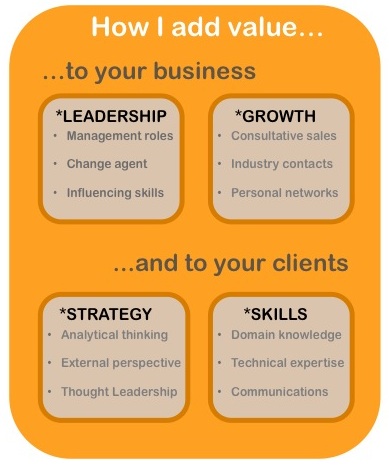
While it’s important to be able to tell a good story, what employers often want to know is: what can you do for them and their clients, now and in the future?

Rory Manchee - Value Proposition - Sept 2014


Health Warning: Entrepreneurship is not all Plain Sailing

Last month’s gathering of Lean Startup Melbourne was devoted to the emotional and psychological downsides to being an entrepreneur. Whether building a startup or managing a successful corporate career, we are accustomed to reading about business success stories; but while we do learn something about corporate failures, we don’t hear much about the personal cost when things don’t go as planned.

But first, given the seriousness of this topic, if anyone reading this feels in need of help then there are some excellent information and support resources available listed here. There are also some useful reference articles such as this.

The evening’s panel Q&A discussion was preceded by a very moving account from Tom Howard, co-founder of Adioso on his own challenges in building a startup, about which he has written here. Tom’s frank and honest story about dealing with personal struggles while trying to manage investor expectations was neatly summed up in this observation: “Writing essays on our struggle was some of the best marketing.”

The panel members were drawn from a mix of startup, entrepreneurial and corporate backgrounds, and their stories revealed episodes of depression, near-bankruptcy and burn-out – tales possibly all too familiar to some experienced startup veterans in the audience, or merely spectres of what the future may hold for other budding entrepreneurs eager to learn from their peers. One of the panel, Andre Obradovic is now a public speaker on mental health issues, and has channeled his own experiences into advocacy and raising awareness.

If there was one recurring theme that ran through the discussion, it was the surprise at what happened to them – seemingly successful individuals who suddenly encountered severe setbacks (personal, financial, emotional, psychological), that came close to derailing their ability to function in their roles (as people, partners, parents or employers). The positive conclusion was that in recognising what was happening, and doing something about it, these individuals have managed to rebuild their lives and their careers, and are probably all the stronger and more resilient as a result.

Meanwhile, a number of hopeful startups were brave enough on the night to showcase their projects in the evening’s Startup Alley: Influx (outsourced customer support for online businesses), Cloakr (mobile device solution for coat check services), Jutsu (personal goal-setting app), Followus (social media site management for small business) and Brakeboard (braking systems for skateboards).

Finally, the evening’s event was sponsored by a clutch of generous supporters: Mondelēz InternationalInnovActionZendesk, Bluechilli, The X Gene and hosts Inspire9.