101 #Startup Pitches – What have we learned?

During the past 3 years of writing this blog, I have probably heard more than 100 startup founders pitch, present or share their insights. Most of these pitch nights have been hosted by Startup Victoria, with a few on the side run by the Melbourne FinTech Meetup and elsewhere.
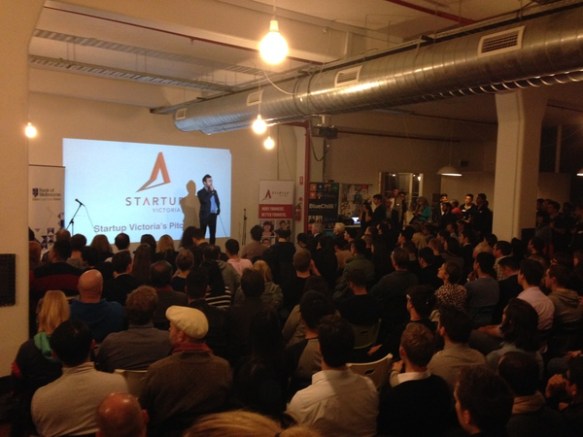
Image sourced from Startup Victoria Meetup

Image sourced from Startup Victoria Meetup

Based on all these presentations, I have collated a simple directory of each startup or pitch event I have covered or mentioned in this blog, as well as a few key accelerators and crowdfunding platforms.

What have we learned over that time?

First, apart from the constant stream of new startups pitching each month, it’s been impressive to witness the Melbourne startup community collaborate and support one another.

Second, some of the international founders who have spoken are among the rock stars of startups – and we are fortunate that they have been willing to spend time in Melbourne.

Third, a number of the local startups who have pitched during this time have become well-established and well-known businesses in their own right.

This all means that besides creating great products and services, and being willing to share their experiences, the founders have helped aspiring founders and entrepreneurs to appreciate the importance of:

  • product-market fit;
  • working with agile processes and lean startup models;
  • tackling prototyping and launching MVPs;
  • learning what to measure via key metrics;
  • figuring out funding; and
  • knowing when to pivot or fold.

Looking at the cross section of pitch nights, panel discussions and guest speakers, there are some significant trends and notable startups to have emerged:

Industry focus: Not surprisingly, the pitches are heavily biased towards FinTech, MedTech, Education, Digital Media, Enterprise Services and Consumer Services. There are a some key startups focused on devices (e.g., SwatchMate and LIFX); a smattering in recruitment, fashion, gaming, health and well-being, property services, social media and even logistics. But there are surprisingly few in environmental technology or services.

Business models: Two-sided market places abound, as do customer aggregators, sharing platforms (“the Uber for X”, or “the AirbnB of Y”), freemium apps and subscription services (as opposed to purely transactional businesses). There are also some great social enterprise startups, but surprisingly no co-operative models (apart from THINC).

Emerging stars:  Looking through the directory of startups, some of the star names to have come through during this time, based on their public profile, funding success, awards (and ubiquity at startup events….) include:

CoinJar, LIFX, Tablo, SwatchMate, etaskr, DragonBill, Culture Amp, Eyenaemia, Timelio, Moula, nuraloop,  Konnective, OutTrippin and SweetHawk.

Acknowledgments: Some of the startups and pitches in the list are just ideas, some don’t even have a website, and some didn’t get any further than a landing page. However, I have not been able to include all the startups that turned up at Startup Alley, nor the many more startup founders I have met through these events (but whom I didn’t get to see pitch or present), nor the startup ideas that were hatched during the hackathons I have participated in. And there are a few startups that I could not include because I heard them pitch at closed investor events. Finally, I am and have been very fortunate to work with a number of the startups listed, in various capacities: Brave New Coin, Ebla, Re-Imagi, Slow School of Business and Timelio. To these startups and their founders, I am extremely grateful for the opportunities they have given me.

Next week: Putting a Price on Value
 

Whose IP is it anyway?

Why should we claim ownership of our IP? This was the topic up for discussion at the recent Slow School dinner on Collaborative Debating presented by Margaret Hepworth. I won’t reveal how a collaborative debate works (I recommend you sign up the next time Slow School runs this class…), but I do want to share some of the issues and insights that were aired. In particular, the notion that shared knowledge is the basis for greater prosperity.

The use of Creative Commons means knowledge becomes easier to share (Photo by Kristina Alexanderson, image sourced from flickr(

The use of Creative Commons means knowledge becomes easier to share (Photo by
Kristina Alexanderson, image sourced from flickr)

First, the discussion centred on IP issues relating to ideas, content, knowledge, creative concepts and theoretical models. Not surprising, as the participants were all independent professionals, consultants, bloggers, creatives, facilitators, teachers and instructors. So we didn’t address the areas of patents, registered designs or trade marks.

Second, as someone who has worked in the publishing, data and information industries for nearly 30 years, I believe it is essential that authors, artists, academics, musicians, designers, architects, photographers, programmers, etc. should be allowed both to claim copyright in their work, and to derive economic benefit from these assets. However, I also recognize that copyright material may often be created in the course of employment, or under a commercial commission or as part of a collaborative project. In which case, there will be limitations on individual copyright claims.

Third, the increasing use of Open Source and Creative Commons means that developers, authors and end users have more options for how they can share knowledge, access resources and foster collaboration through additive processes and “common good” outcomes. A vital component of these schemes is mutual respect for IP, primarily through acknowledgment and attribution. Equally, an online reputation can be established (or destroyed) according to our own use of others’ material, especially if we are found to be inauthentic.

Leaving aside the legal definitions of IP and how copyright laws work in practice, the discussion explored the purpose and intention of both authors (as “copyright creators”, narrowly defined) and end users (as “licensees”, broadly defined). There was general agreement that sharing our content is a good thing, because we recognise the wider benefits that this is likely to generate.

But there is a risk: merely acknowledging someone else’s authorship or copyright is not the same as accurately representing it. Obviously, plagiarism and passing off someone else’s ideas as your own are both copyright infringements that can give rise to legal action. Even with the “fair use” provisions of copyright law, a critic or even an acolyte can mis-interpret the content or attribute a meaning that the author did not intend or even anticipate. As one participant noted, “Copyright is not just concerned with what we claim ownership over, but what others may claim as their own.” Not for nothing have we developed “moral rights” in respect to authorship of copyright material.

Although we did not discuss specific issues of copyright remuneration (e.g., through royalties, licensing fees or financial consideration for copyright assignment), there was a proposition that establishing copyright protection can lead to social, intellectual and even economic limitations. The understandable, but often misguided need to protect our copyright (as a form of security) is driven by fear, underpinned by scarcity models. Whereas, a more generous approach to copyright can actually lead to greater shared prosperity, based on the notion of the abundance of ideas and knowledge. And since, as one speaker put it, “there is no such thing as an original concept because all ideas build on previous knowledge”, the inherent value in IP is in how we contribute to its nurturing and propagation.

At the end of the discussion, and reflecting on my own recent experiences with copyright infringement and geo-blocking, I found I had shifted my position – from one that tends to take a more absolute view on copyright ownership, to one that identifies the need for some further modification to the current copyright regime, along the lines of the following:

  • Copyright ownership should not entitle the owner to abuse those rights – if anything, the copyright holder ought to be placed in a position equivalent to a trustee or custodian, to ensure that they act in the best interests of the IP asset itself, not merely their own interests. That should not preclude the owner from being compensated for their work or being allowed to commercialize it, otherwise, why would anyone bother trying to create new ideas or content?
  • Establishing copyright in ideas and creative concepts needs to be supported by a notion of “intent” or “purpose” (a bit like mens rea in criminal law). For example, if the intent is to merely prevent anyone else using or sharing the idea, then any copyright protection might be limited to a much shorter duration than the usual “life of author plus XX years” model.
  • Equally, under a “use it or lose it” provision, if copyright owners (and/or their publishers, distributors and license holders) elect to take their content out of circulation from a market where it had been widely available, then they would need to establish good cause as to why the copyright should not be open to anyone else to use and even commercialize (subject to reasonable royalty arrangements).
  • If we accept that all knowledge is additive, and that the proliferation of collaboration and co-creation is because of the need to share and build on what we and others have already created, how can we ensure the integrity and mutual benefits of open source and creative commons initiatives? One analogy might be found in the use of blockchain technology to foster contribution (adding to and developing an existing idea, concept, model or platform) and to support authentication (to validate each idea extension).

Perhaps what we need is a better IP model that both incentivizes us to share our ideas (rather than rewards us for restricting access to our content), and encourages us to keep contributing to the furtherance of those ideas (because we generate mutual and ongoing benefits from being part of the collective knowledge). I’ve no idea what that model should look like, but surely we can agree on its desirability?

Next week: Finding purpose through self-reflection

Japan – renewing my long-standing relationship

I’ve just spent three weeks in Japan, travelling around by train, staying in Airbnb accommodation, and soaking up the art, architecture, design, food, beer and general culture. It was the longest time I have spent in Japan, and several years since my last trip in 2010. But given I have been to Japan more than 25 times in the past 20 years, it was like renewing an old friendship.

Image © Rory Manchee - all rights reserved

Akashi Castle – Photo © Rory Manchee – all rights reserved

My earliest visit to Tokyo, back in 1995, was to spend a few days with a friend from London who was managing a now-forgotten Britpop band on their debut tour of Japan. After attending a couple of their concerts, being entertained by their Japanese record company, visiting a few tourist spots and hanging out in a number of Tokyo nightclubs, it was a very limited/skewed introduction to the country.

My next visit the following year was even shorter, and even more skewed. Another friend from London (now a well-known writer and broadcaster) was supposed to be covering yet another Britpop band on their Japanese tour, on behalf of a British magazine. Instead, we scored some free tickets to see the Sex Pistols at Budokan (it was their infamous Filthy Lucre tour), and my one night in Tokyo was spent drinking with the band after the gig, in a bizarre subterranean bar. But that’s another story.

Most of my trips to Japan have been for business, and only to Tokyo. So this latest visit was an ideal opportunity to stretch out and explore in more depth. Over the next few posts, I’ll be commenting on my experiences, across such topics as coffee, AirBnB, art & architecture, crate digging and some navigational issues.

First, here are just a few of the reasons why I appreciate Japan:

  • The love of good design
  • Hardly any graffiti, virtually no petty vandalism, and scarcely any litter
  • The food
  • People rarely talk on their mobile phones on the train or in public places
  • The service culture and overall politeness
  • Trains run on time
  • The convenience stores
  • IC cards (take note, Myki…)

Of course, nothing’s perfect: Japanese TV is mostly awful; good espresso coffee is in short supply; everything comes over-packaged; and in many situations, it’s still a cash-only economy. I also appreciate that it’s a complicated society, often seen as repressed, and difficult for outsiders to understand.

But for all its challenges, Japan must be doing something right, as in-bound tourism numbers (especially from Greater China) are at record-breaking levels.

Next week: Seeing Japan with #Airbnb


A couple of No-No’s for content marketers

If you are just getting started in content marketing, or if social media is still a bit of a novelty for your organisation, there are a couple of things you should definitely avoid when attempting to use third-party content for your own promotional purposes: don’t misappropriate, and don’t misrepresent.

All marketers will be alert to false, deceptive or misleading advertising. More experienced content developers should also understand legal issues such as plagiarism, copyright infringement, passing-off and libel. However, even seemingly innocent and well-intentioned references made to third-party content may inadvertently border on unconscionable conduct.

Last week, I had the rather disturbing experience of a company attempting to use my blog to promote a service, and in a way that not only implied I was endorsing that service, but also suggested that my blog was somehow the reason why customers should sign up for it.

I found this problematic for three reasons:

First, I had no knowledge of or connection with this particular service, and the promotional message gave the impression I was endorsing it, which was obviously misleading, and it quoted my article out of context. At an extreme level, if I ever wrote a blog about the “10 reasons why I take public transport”, and then a political party co-opted my content to say “10 reasons why you should vote for our transport policy”, that would be misappropriation (of my content) and misrepresentation (of my views).

Second, even though the service referred to was being offered for free, if the company had managed to generate new clients via this particular campaign, there’s no direct benefit to me or my business, but lots of benefit to the company and/or its partners. In this increasingly self-directed, interconnected and collaborative environment, it’s important to make sure we are all “paying it forward” in a constructive and mutually beneficial way. (I have no problem with receiving a referral fee or a direct benefit in kind if my efforts have been instrumental in securing new customers for your business!)

Third, I am fortunate that a number of my blog articles have been re-syndicated via social media and other channels. In writing about third-party products and services, I am very careful not to endorse specific businesses or brands, other than to mention names (and link to relevant sites). Where I am providing criticism, I endeavour to do so under the auspices of “fair comment”. This is important when establishing credibility with an audience: that my content is seen to be authentic, that I demonstrate awareness about the purpose and context of my blog, and that I attribute whenever I am referencing or citing third-party content. (See an earlier blog I wrote on this topic) But, if in doubt, always ask the content owner in advance before linking, referencing, quoting, attributing or re-contextualising their content.

Finally, if I can be of any assistance in relation to your own content marketing, please let me know via this site.