Revolving Doors At The Lodge

Since his unceremonious dumping as leader by his colleagues in the Parliamentary Liberal Party, former Prime Minister Malcolm Turnbull must be wondering why the party that spat him out twice (despite benefiting from his personal donations) accepted his membership in the first place. So adamant were his conservative enemies that Turnbull was “not one of us”, they were willing to sacrifice not only Turnbull’s status as preferred Prime Minister, but also his popular deputy, Julie Bishop, and their own preferred leadership candidate, Peter Dutton.
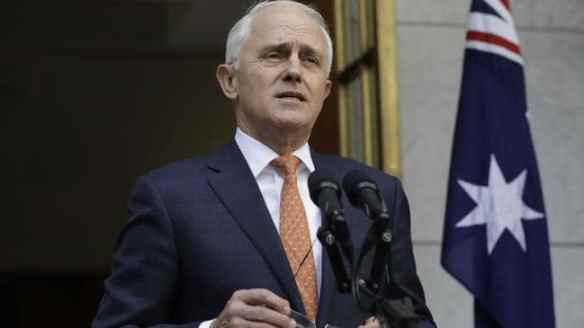
Turnbull’s farewell speech – image sourced from The Australian

All of which suggests Australian democracy (or at least, the version played out by our political parties) is seriously damaged, if not actually broken.

Turnbull is the fourth sitting Prime Minister to be dumped by his or her own party in less than 10 years (and let’s not forget he himself ousted his predecessor). This latest incident suggests that the problem is not with the electoral system, but with the party system that controls the management and exercise of political power – and with scant regard for the voters who directly elect their constituency representatives.

Here’s why I think party politics are the root cause of Australia’s current leadership malaise:

1. No legal or constitutional basis

Quite simply, political parties are neither mentioned in the Constitution, nor formally defined in any Act of Parliament. Their role in our democracy is entirely by custom and convention – in a way, we tolerate them as a “necessary evil”, because we are led to believe that Parliament cannot function without them. At best, Parliamentary parties operate under a license, one which should not be seen as a right, but as a privilege. And like all such licenses, this privilege should be subject to being revoked at the will of those who granted it – the electorate.

2. If our political parties were treated like corporations….

…. they would likely be hauled before the ACCC every time they broke an electoral promise, for misleading, unconscionable or deceptive conduct. Sure, circumstances can change once governments are elected – but should it be a requirement for governments to re-establish their political mandate before they make a significant u-turn? In fact, political parties are exempt from a number of legal provisions that apply to companies. Political parties may have a paying membership that determines policy, candidate selection and other procedural matters – but they are not directly answerable to the customers they purport to serve: the general electorate.

3. Our elected representatives are not even accountable to their electorates….

…. except at election time. The notion that voters elect parties into power needs to change. Voters elect individual candidates who stand for office. Even if a candidate aligns with a specific political party, there is no binding obligation on them to sit as a member of that party once they are elected. By switching party allegiance, elected representatives who cross the floor are being disrespectful of the same (flawed) party system that saw them selected to stand for election. But they are also disregarding the wishes of their electorate, who may have been convinced or persuaded to vote for them on the basis of their stated party allegiance.

4. Voters are increasingly excluded from choosing their Prime Ministers (and their governments)

Of course, we do not directly elect our Prime Ministers. The parliamentary convention is that the elected member who commands a majority in the house of representatives is invited by the Governor General to form government. The parliamentary custom and practice is that the leader of the parliamentary party that holds most seats becomes the de facto leader of the government, and hence Prime Minister. Increasingly, the largest party bloc may not command a majority. So formal and informal coalitions have to be formed, often between competing political parties, to enable minority government to function. Such alliances may be politically expedient, but they cannot be said to represent the will of the people, if we assume that the electorate is expected to vote along formal party lines. Besides, if the party system is to retain any credibility, shouldn’t voters be entitled to expect that the leaders of the parliamentary parties, which they have (indirectly) elected to lead that party, should continue to lead unless and until they have been voted out by that same electorate?

5. Voters are not even consulted when Prime Ministers are rolled mid-term

Since Prime Ministers are not directly elected, voters have also been excluded from the process when political parties choose to roll their own Prime Minister (and effectively change the government without having to call a general election). Do the party factions who seek a leadership change bother to directly consult their paid-up local party members, or their own party voters, or the local constituents they purport to represent (regardless of which way they voted at the previous election)? To me, this represents a huge fraud on the population – and the party system is at the heart of this “madness”.

6. The failure of (party) political leadership

During the 2013 general election I commented on the lack of public support for the then leaders of both major political parties – part of what I saw as a broader failure of leadership across multiple public institutions that claim to represent our interests. Regardless of their party allegiances, the electorate seems increasingly disillusioned, if not repelled, by the party back-stabbing, treachery and disloyalty. The result is, we are poorly served by our elected representatives and the governments they form along supposed party lines.

7. Politics is not binary….

…. but the party system forces us to think this way. On most party-driven policy questions, the answer cannot be reduced to “for” and “against” – there are just too many shades of grey. This is especially true of the key policy area that seems to have brought down the last four Prime Ministers – climate change, energy and the environment.

First, Kevin Rudd abandoned the ETS, a decision which he later regretted. He claimed that the main actors in his own demise were the ones who agitated for this policy u-turn.

Second, Julia Gillard avowed that she would not introduce a carbon tax – and the electorate never forgave her for her later u-turn, resulting in her being dumped by Rudd.

Third, Malcolm Turnbull was unhappy at the direction Tony Abbot was taking the Liberal Party on climate change.

Fourth, Turnbull came a cropper on energy policy (linked to climate change), even though he had decided to capitulate to the right-wing views in his own government and Party.

You have to think that something as important as climate change demands a bipartisan solution – but the party system just keeps getting in the way.

8. “Power, corruption & lies”

Finally, in recent years we have seen a litany of corruption and other cases involving our major (and some minor) parties, and the factions within – a further cause of the lack of public trust and respect for parties, politicians and power-brokers. Add to this mix the relatively small numbers of directly paid-up members of political parties, issues of party funding and campaign donations, the party stuff-ups on disqualification due to dual citizenship, and the ongoing saga of MP’s expenses, a key conclusion is that the political party system is not conducive to modern democracy or the electoral, parliamentary and government processes. And while it is sometimes said that we get the type of governments we deserve, I don’t think any member of the general electorate would say they voted for the current situation.

Next week: Separating the Truth from the Facts
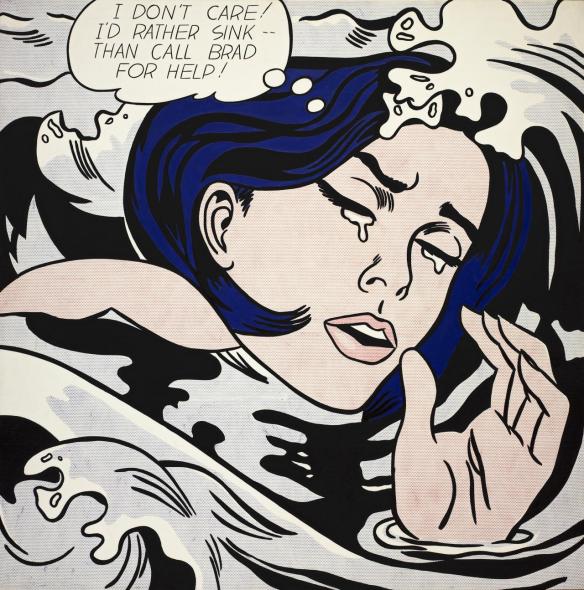
 

MoMA comes to Melbourne

For its current “Winter Masterpieces”, Melbourne’s NGV International gallery is displaying around 200 works from MoMA’s permanent collection. And a finely selected, and well-curated exhibition it is. But this focus on the received canon of mainly 20th century European art has the inevitable effect of sidelining other eras/schools – and perhaps overlooks the importance of Australia’s own art movements.

Roy Lichtenstein (American 1923–97): “Drowning girl” (1963 – oil and synthetic polymer paint on canvas, 171.6 x 169.5 cm); The Museum of Modern Art, New York – Philip Johnson Fund (by exchange) and gift of Mr. and Mrs. Bagley Wright, 1971
© Estate of Roy Lichtenstein/Licensed by Copyright Agency, 2018

The NGV International display presents the work in a broad chronological sequence, but specifically collated by reference to key movements, themes and styles. It also takes in print-making, photography, industrial design, graphics and illustration, not just painting and sculpture.

Even though I have visited MoMA many times, and seen the bulk of these works in their usual setting (as well as when they have been on loan to other galleries), there were still some surprises – like Meret Oppenheim’s “Red Head, Blue Body”, which I don’t recall seeing before. And Salvador Dali’s “The Persistence of Memory” always feels like it is much smaller than the ubiquitous reproductions and posters imply.

Of course, one of the benefits of presenting a survey of modern art like this is that it affords us the opportunity to re-assess and re-calibrate the works within a contemporary context. Both to find new meaning, and to compensate for the over-familiarity that many of these images convey. While at times, we have to separate the artists’ lives and times from the legacy of their work – the changing conventions and social mores of our contemporary society cannot always be used to judge the behaviours, values or common prejudices that were acceptable 100, 50 or even 25 years ago.

Meanwhile, over at NGV Australia, there is a reconstruction of the exhibition that marked the opening of the gallery’s new building in 1968. In “The Field Revisited”, we have a fascinating opportunity to experience a slice of Australian art that feels over-looked and under-appreciated – ironic, given that at the time, this exhibition revealed the cutting-edge nature of young artists working in Australia, and divided opinion among established artists and the art establishment. “Where are the gum trees, where are the shearers, where are the landscapes, where are the figurative images?” might have been the refrain in response to this startling collection of bold colours, geometric designs, psychedelic undertones, modern materials, and unorthodox framing.

The fact that far more people are flocking to see the MoMA collection (and it is worth seeing), than are visiting the re-casting of The Field sadly confirms that Australia’s cultural cringe is alive and well….

Next week: Modern travel is not quite rubbish, but….


Long live experts….

Along with “liberal, metropolitan elite”, the word “expert” appears to have become a pejorative term. Well, I say, “long live experts”. Without experts, we’d still believe that the world was flat, that the sun orbited around the Earth, and that the universe is only 6,000 years old…. Without experts we’d also have no knowledge of ancient civilisations, no comprehension of languages, no awareness of scientific phenomena, no understanding of how to prevent and cure disease, no patience to engage with the human condition, and no appreciation of nature, technology, art or culture.

Just a couple of “experts”: Marie Curie and Albert Einstein

I read recently that, “Marie Curie and Albert Einstein went hiking together in the Alps”. At first, I thought this was some fantastic fiction, because I wasn’t aware they knew each other, let alone went walking. But the line didn’t come from a David Mitchell novel – I came across it in Alex Soojung-Kim Pang‘s recent book, “Rest: Why You Get More Done When You Work Less”. It reveals something of the way knowledge seeks out knowledge – how great minds (experts) often get together to collaborate, or just hang out and shoot the breeze. The expert mind is also an inquiring and creative mind, open to new ideas and influences, unlike the hermetically sealed personalities of many of our current leaders.

(According to Pang, regular physical activity, creative pursuits, technical mastery and planned rest are among the key traits for many experts – so much for the 35-hour working week, 9-5 routines, and a couple of weeks’ annual vacation….)

Maybe one reason for this increased disregard for experts is the fact that many experts tend to make us feel uncomfortable (about our own ignorance?), they challenge our assumptions (and highlight our personal prejudices?), and they tell us things we’d rather not think about (even if it’s probably for our own good?).

And while I accept some experts can be patronising, aloof and even smug, there is a breed of experts, like Demis Hassabis, who are brilliant communicators. They can explain complex ideas in straightforward terms, and through their enthusiasm and natural curiosity, they show how they continue to wonder about what they don’t yet know. They also manage to bring us on their journey into difficult topics and uncharted areas, such as artificial intelligence.

Finally, and in the interest of balance, the only thing worse than a recognised expert is a self-appointed one…. (a theme Laurie Anderson explored in her satirical work, “Only an Expert”.)

Next week: SportsTech and Wearables Pitch Night at Startup Victoria

The arts for art’s sake…

Last week I wrote about the importance of learning coding skills. This prompted a response from one reader, advocating the teaching of STEM (science, technology, engineering and maths) in schools: “Coding and the STEM subjects are our gateway into the future.” I would agree. But, as other commentators have noted elsewhere, we also need to put the A (for art) into STEM to get STEAM to propel us forward….

Equivalent VIII (1966) Carl Andre (b.1935) Purchased 1972 http://www.tate.org.uk/art/work/T01534

Equivalent VIII (1966) Carl Andre (b.1935) Purchased by Tate Gallery in 1972 http://www.tate.org.uk/art/work/T01534

I recently attended a talk by renowned arts administrator Michael Lynch, as part of the FLAIR art event, where he expressed frustration at the state of the arts in Australia, the lack of a public arts policy, and the associated cuts to government funding. It can’t help that from John Howard onward, we have had a sequence of Prime Ministers who, while not total Philistines, have shown little enthusiasm, appetite or appreciation for the arts. And during Q&A, Mr Lynch referenced the conservative and “safe” nature of so much arts programming as evidenced by the lack of risk-taking and the stale and over-familiar choice of repertoire, although he did acknowledge some arts organisations were doing exciting work.

The debate then shifted to whether we need a new method to evaluate the benefits of a strong arts sector that is not purely dependent on economic terms or financial performance. It was not possible in the time available to come up with a suitable indicator, but I suggest we can derive a range of benefits from putting more emphasis on teaching, supporting and sponsoring the arts. This RoI might be measured in such terms as the following:

  • Enhancing creativity among students will benefit individual problem-solving skills and collective innovation;
  • A healthy arts scene is indicative of a balanced, self-assured and progressive society;
  • Participating in the arts can give people a sense of confidence and well-being;
  • Through art we can learn about culture, philosophy and history – especially of other societies;
  • Giving people the means to express themselves through art is an important outlet for their skills, talent and interests.

We agonize about the amount of investment in our Olympic athletes in pursuit of gold medals, and whether the money can be justified (goodness – Australia only just made the top 10!)  But no-one (yet) has suggested it’s not worth doing, even if we don’t win as many medals as is often predicted. And of course, together with the wider popular entertainment industry, professional sports attract more dollars, airtime and support through sponsorship, advertising, broadcasting rights, gambling revenue, club memberships and merchandise than the arts could ever hope to.

Part of the challenge lies in the popular notion that arts are either elitist, worthy, self-important, or simply frivolous – which makes it harder to build an economic case for the arts, but which can also lead to the worst kind of cultural cringe. Also, if the arts are really doing their job, they hold up a mirror to our society, and we may not like what we see. Populist politicians can’t afford to be associated or identified with such critiques – either as the targets or as de facto protagonists – so would they rather be seen shaking hands with gold medalists (or attending a Bruce Springsteen concert…) than maybe attending a cutting-edge performance by The Necks?

Next week: The latest installment of Startup Victoria pitch night