University Challenge – #Startup Victoria’s Student #Pitch Night

There were around 500 people in the audience for last week’s #StartupVic University Startup Battle, which either says there was nothing better to do on a chilly Melbourne evening, or that this new Meetup format is working – or that the students of today are less interested in finding a job, and more interested in building their own career opportunities that connect with their purpose. (Our political leaders should take note….)
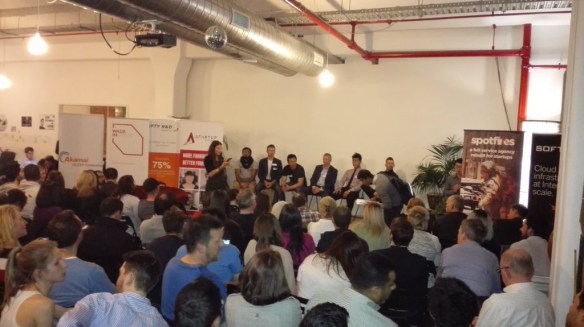
A sell out audience for the University Startup Battle (Image by Stefan Welack sourced from Twitter)

A sell out audience for the University Startup Battle (Image by Stefan Welack sourced from Twitter)

After a series of campus competitions, the finalists on the night were representing 6 of Victoria’s universities, and revealed a wealth of talent, ideas, innovation and inspiration. In order of appearance, the pitches were:

InternMe – (Victoria University)

With a tagline of “Experience the Experience”, this is a 2-sided market for graduate recruitment, that revealed some interesting stats about the student employment market.

Revenue is expected to come from fees for successful placements, and job advertisements. The business plans to cover work experience, internships, part-time and temporary work during study, as well as permanent and full-time roles.

Currently sourcing leads via LinkedIn and social media (notably Instagram), the founders say they may include psychometric profiling tools for better matching applicants with opportunities.

The pitch was to raise $100,000 for website development, but as the judges commented during the Q&A, the biggest challenge is engaging employers. As regular attendees to these pitch nights will recall, this mismatch or disconnect between students/graduates and employers continues to provide startup opportunities.

Printabox – (Swinburne University)

This website is designed to reduce the time, cost and complexity of ordering short-run branded boxes. Basically a self-serve model, the founders have spent $500,000 in development costs, primarily on a proprietary design tool. The resulting products come in 3 standard sizes – perhaps more customisation will become available?

The target clients are the 44,000 online stores in Australia who often need small numbers of branded boxes for sending out customer orders. But as the judges noted (based on a quick online search) there does appear to be a lot of competition. And although Printabox claims that their source code is protected, they have not applied (or are unable to apply) for a design patent.

Mech X Innovation – Project Ora – (Deakin University)

The founders have developed a hardware device that fits on standard tablet computers, and is designed to help children reduce and prevent eyesight damage caused by too much screen time, and by being too close to the device.

Essentially a Bluetooth-enabled accessory linked to an app, Ora monitors the amount of user screen time, proximity to the device and ambient lighting, and can be used in conjunction with “time outs”, scheduled messages and reminders to “go and do something else”. It can be semi-customised, so that parents can create a reward system, for example.

According to the designers, the competitor products (Appomate and samtime) are app-based only, and focus on time and distance – not lighting. Ora may also integrate with other devices, e.g. FitBit, but the target market is children and teenagers up to age 18, and their parents.

Asked about their path to market, they are planning a crowdfunding campaign. The key to adoption, though, will be via schools (who either provide or prescribe what devices pupils use) and schools suppliers (e.g., digital text books and e-learning tools).

ICallDibs – (Monash University)

This idea grew out of direct user experience, namely how can overseas students coming to Melbourne buy and sell furniture? The business is aiming to provide a market place for “Second Hand Furniture, First Class Deals”.

The biggest challenges faced by international students when buying/selling furniture are transportation, timing and finding buyers/sellers. The business will offer bundled services, including storage and removals/delivery, via partnerships.

The company aims to target international student agencies, and will ensure better matching between buyers and sellers (although they may want to consider changing the name unless they can trademark it….).

Rather than an “Ask”, the team offered a “Give” in the form of a customer discount for the evening’s attendees.

When asked about logistics and insurance, the founders clarified that the counterparts (buyer and seller) bear the direct risk. The business takes their commission upfront, then release the order details to the customers.

Assignment Hero – (Melbourne University)

It felt that this app, a collaboration tool for group work (sort of Slack for education?) was speaking to the converted, given the audience response. In short, having access to lots of different collaboration tools sounds great, but they each only do one or two things (albeit, really well). And if you use more than one app, you end up with too many tools and too many notifications.

While students may hate group assignments, they’re an important aspect of learning how to work with other people and acquiring other soft skills. They also seem to comprise a greater component of student assessments – possibly because they require less direct teacher-student face time?

Rather than build a whole new system, the founders have opted for native integration with Google Docs, plus some dashboard reporting tools (including the amount of individual input to a project).

The app is free to end users, but will generate revenue from education providers (enterprise sales) and on-demand services and commissions. When asked about existing tools like Moodle and Blackboard, the founders noted that these were designed for teaching, not collaboration.

It was also noted that existing productivity apps are not easily accessible by students (although no doubt, as with education content providers, enterprise app vendors will make student versions and pricing available). Plus, the “edtech” sector is of particular interest when linked to life-long learning, professional development and self-directed study.

Eat Up – (RMIT)

Finally, Eat Up is a social enterprise trying to address the number of school children who turn up at school without anything for lunch – estimated to be as many as 1 in 8 schoolchildren. Personally, I find this an indictment on our society – why should anyone in Australia need to go without basic food? – but the causes/reasons are far too complex to address here.

Essentially a partnership for sourcing, assembly and distribution, Eat Up has created a service model which they hope to roll out in more and more schools. They tap into the established Food Bank network for supplies, engage TAFEs to prepare the lunches, and use OzHarvest and SecondBite for logistics. There has also been support from Virgin Australia, ygap, Karma Canteen and Education Changemakers.

Eat Up aims to avoid passing on the costs to kids, parents or schools, and in part takes inspiration from another social enterprise, Thank You Water.

During a panel Q&A, the founders were asked about the apparent lack of technical skills or resources on their teams. In response, it was noted that there are many open source apps, available templates and market places for code and plugins. One founder commented that despite studying computer science, he used very little of what he learned to develop his app.

Revealing another apparent weakness in their pitches, the founders were quizzed on their respective sales models, costs of acquisition and pathway to revenue. The responses suggested that the startups risk being limited by their own inexperience, and that they each need to do more market analysis, assessment of customer willingness/ability to pay, and identify the best ways to scale their businesses.

There was also a lack of clarity around near-term goals and milestone planning.

In the end, the winner was Assignment Hero, no doubt reflecting the needs of the audience, plus the fact that the business has gained traction with some universities.

Next week: ASIC’s new regulatory sandbox for #FinTech #startups
#StartupVic showcases the next batch of startup hopefuls

Startup Victoria‘s monthly pitch event is gaining momentum, and continues to draw a good crowd at inspire9. It can’t just be the beer’n’pizza, can it? April’s event brought together an intriguing mix of startups – from the FinTech, SoMe, health food and enterprise sectors.

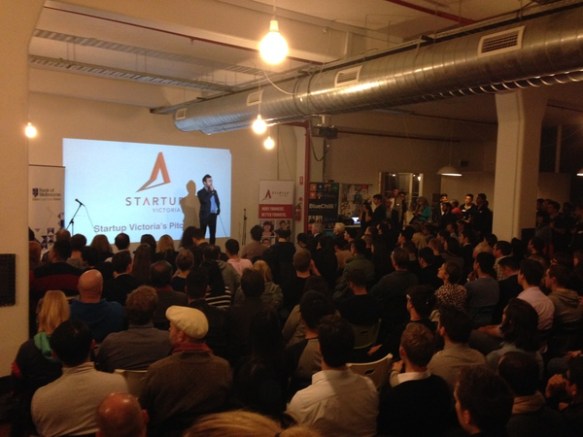
If it's the last Tuesday in the month, it must be Startup Vic's pitch night at inspire9.... (Photo sourced from Meetup)

If it’s the last Tuesday in the month, it must be Startup Vic’s pitch night at inspire9…. (Photo sourced from Meetup)

Liive

This app-based solution claims to have more than just its finger on the pulse of Melbourne’s nightlife, in the form of a “Teleportation” experience. If you want to check out what’s going on at that club or bar before you leave home, Liive will beam visitor and sponsor sourced content onto your smart phone. It’s sort of a social media cum streaming cum location-based service, which promoters and venues can license and then encourage patrons to share their video grabs (in return for free drinks….).

While the app is free to download and use by individual customers, revenue comes from event and venue promotion, and is pitched as a user experience that enables patrons to “try before they buy”. Liive reckons it has got the CPA down to A$1.68, and is experiencing 20% weekly growth based on user numbers.

Already signing up some significant leisure businesses, Liive seems to be making a splash within a relatively short space of time. In the words of one of the judges, I’m probably not the target demographic, so it’s difficult to relate to this concept. Unsurprisingly, students are a key market, but having spent time this past week facilitating a team of international students, I hope the founders can think of culturally inclusive uses and ways to promote their app.

I was also reflecting on things like privacy, content ownership, and whether this is a solution in search of a need – why not just use other, existing SoMe platforms? But it was good to hear that the content is moderated and subject to take down notices.

Estate Baron

This FinTech business is bringing equity crowdfunding to property development – and is clearly designed to displace banks. With a background in residential mortgage-backed securities (RMBS) the founder has some relevant market experience.

The business model does away with the need for traditional investor syndicates, and is offering an alternative source of funding for property developers. To be clear, investors are taking equity in the entity (usually a special purpose vehicle – SPV) that is launching the development, not the properties themselves – so they do not get any title over individual units or apartments.

Given the need to be fully compliant with AFSL and MIS requirements, Estate Baron has a retail financial services license, and issues full product disclosure statements for each venture. So far, it has raised over $2m in project funding, from over 1100 investors.

The pitch was at pains to explain that Estate Baron holds an RG146 license for general advice only, not individual advice, so potential investors are advised to seek professional financial and investment advice suitable and appropriate to their own needs and circumstances.

Estate Baron charges a capital raising fee, which allows developers who don’t typically hold a financial license to access more investors. Currently, funding is usually done via syndicates, off-line, or via managed property funds etc.

The founders acknowledge that the idea originated overseas, and is part of a global movement. They even mentioned the possibility of using a Blockchain solution for deal origination and management.

Personally, the idea of crowdfunding for property development is appealing, but I’d like to see more market engagement before determining whether this is the right (or only) model.

Athlete’s Gift

Originally launched under the name “The GeneSpark”, this food business is promoting customised menus and recipes based on customers’ individual DNA. I think the recent change of name was prompted by brand confusion, rather than any medical concerns, but I was still left unclear as to what this business actually offers.

If I am understanding correctly, the products are special mixes of super foods, nuts, seeds and berries designed for high-protein, high-energy or recovery – using all-natural, organic and raw ingredients. Customers make their own product selections, and can even develop personal recipes to suit their DNA. But the business does not conduct DNA tests, and I don’t believe there is any verification process to ensure customers are making appropriate or safe choices – which would possibly stray into medical territory?

I sort of understand the business model (3-month subscription packages, distribution via gyms and sports clubs, etc.), and I even applaud the long-term goal of reducing chronic diseases. But I was left with the question: Is this proven science, another food fad or a product placement strategy?

Konnective

Konnective has developed an enterprise solution that brings an employee messaging tool for frontline staff, regardless of their location or whether they have access to a desktop computer.

The tool was originally developed for schools (to replace the paper-based parent communications), but is finding traction within the health care, hospitality, mining, manufacturing and services sectors. To my personal surprise, many workers in these industries do not have corporate e-mail addresses. Based on push technology, it’s cheaper than SMS. The app is free to end users, but businesses pay a tiered price based on the number of employees, at $10 per person per annum.

It’s flexible enough to support mixed content types, and is managed via a back end admin platform. Already, some major public companies are on board, with the founders claiming to have 100+ clients.

To clarify, this app is about broadcasting, not team collaboration or project management. It can be used for two-way communications with employees, but only for structured content such as surveys and polls. It was not clear whether the back-end allows messaging to be targeted by location, function, department, team or even seniority – maybe not everyone in the company will have the same information needs?

I can see an opportunity among organisations that engage large numbers of contractors, freelancers and casual staff who might not have company-based individual e-mail accounts. But part of me thinks that with increased smart phone usage and BYOD (plus the fact that most e-mail clients are easily configurable to mobile devices), what makes Konnective attractive? Clearly it’s doing something right as it took out first place!

Next week: A new co-operative model for equity crowdfunding

#FinTech Melbourne’s latest #pitch event

The latest FinTech Melbourne meetup event was the second of their pitch nights. Co-hosted by NAB (at their Docklands Arena venue) and Capgemini (who were promoting the World Retail Banking Report 2016), the pitches were preceded by a panel discussion on a regulatory sandbox for Fintech startups.

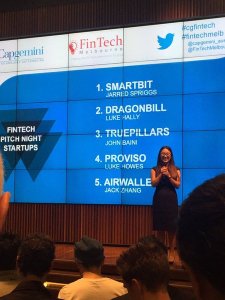
The list of contenders.... (Photo By Andrew Lai, sourced from Meetup)

The list of contenders…. (Photo By Andrew Lai, sourced from Meetup)

The panel was composed of Ben Heap from H2 Ventures, Deborah Ralston from the Australian Centre for Financial Services (who is also the inaugural Chair of ASIC’s Digital Finance Advisory Committee), Sudhir Pai (CTO at Capgemini), and NAB’s Todd Reichmann. This is a topic that FinTech Melbourne has aired before, but it seems despite much industry anticipation and some cautiously positive noises from government, bureaucrats and regulators, there are still, to date, no concrete developments or proposals.

I fully understand the need for formal regulation in financial services, and FinTech in particular, to support investor protection, foster market confidence and maintain industry stability. But the cost or burden of compliance can act as an inhibitor for innovation and entrepreneurship. And of course, regulation and compliance are no guarantees that nothing will ever go wrong, even among our established and highly regulated financial institutions. The debate needs to move on to some practical solutions – such as ring-fencing FinTech startups so that they can trial new products and services in the market, within a limited, defined and narrowly permitted scope and range of activity, under some sort of provisional permit prior to obtaining fully licensed status.

Some members of the panel were in favour of a principles-based regulatory framework (e.g., focus on outcomes and intentions, rather than a reductive model, where nothing is allowed unless it is expressly permitted). The problem with this is that the industry already has to work within a very broad definition of what constitutes “financial advice” that is subject to regulation. So there needs to be a further re-think about what “financial advice” means, especially as between retail, sophisticated and institutional investors; and in turn, I see an opportunity for a more variegated approach to licensing or regulating different advice models: e.g., face-to-face and custom financial planning; scaled and personalised robo-advice; or broader, generalised “class” or “category” advice (by product, platform or service type). (Analagous models to draw on already exist in the areas of therapeutic goods licensing and food labelling measures.)

The panel also thought that partnerships between FinTech startups and established licensees offer one way to navigate the regulatory regime. And I can see that the right type of roboadvice could bring truly independent and objective financial advice on product and brand selection.

There was also a suggestion that the sandbox model could act as an umbrella entity for FinTech innovation. While there may be some merit in the idea (e.g., for regulating the API’s that provide access to customer financial data and credit history – although these should already be adequately covered by data protection and privacy requirements), I am sceptical of regulators’ ability to innovate. Plus, the key retail investor failures during the GFC were about investor ignorance, not just “poor”advice; so the need for financial literacy cannot be overstated.

On to the pitches themselves, which were judged by Ben Heap, Deborah Ralston and Rohen Sood from Reinventure:

Smartbit

Offering an automated finance layer for the Internet of Things, Smartbit has already built a secure, Blockchain-backed price index. The goal is to enable automated, real-time payments, between any two devices connected to the internet. They see themselves as the “Blockchain of Things”, and proceeded to give a cute (if somewhat pointless?) live demo of switching on a LIFX bulb with a Bitcoin payment token.

The judges were curious to know what the actual use case was (apart from turning on light bulbs…). In reply, they were told that Smartbit can deliver real-time settlement (unlike the 15 minutes delay of an US competitor), and is designed to support micropayments. Personally, I think the technology is already proven, but the need less so, at least from a B2C perspective. The fact that so many banks, exchanges and clearing houses are exploring Blockchain solutions means that it’s day will soon come when it is not just a “Bitcoin thing”, but will be an integral part of financial services, data solutions and digital asset management.*

Dragonbill

This is a smart payments platform to reduce cashflow stress. The main benefit is to shorten the time SME’s have to wait before they get paid. It offers both a secured payment facility (escrow), and an express payment option (e.g., a tradie can get paid as soon as they finish a job).

The chosen paths to market are social media, accountants, business advisors and mentors, and (unusually?) sports clubs. But it becomes clearer when you consider that clubs need to manage multiple, small membership payments; and many members of sports clubs are SME owners, independent tradies and sole proprietors. Dragonbill are also setting up a partnership with Xero accounting software.

The main questions from the judges concerned the ability to scale the business, and whether Dragonbill generates interest on amounts in escrow.

Truepillars

Another version of the peer-to-peer lending platform for SME borrowers, the business model is based on an online auction system where, for as little as a $50 bid, investors can bid on specific loan requests, with risk-adjusted interest rates, that are also determined by the number and amount of competing bids.

Access to traditional SME loans under $500k is increasingly limited as banks need to allocate more risk-weighted regulatory capital to cover their SME exposures, making them an inefficient and expensive use of bank capital.

The Truepillars platform offers borrower and investor dashboards for tracking and portfolio reporting, but the panel were worried that it wasn’t a unique proposition. However, unlike some of their competitors, Truepillars offers loan terms out to 5 years. It would also be interesting if investors (lenders) could build proper fixed income portfolios (by loan duration, yield curve, exposure type, recourse/rollover etc.), and if borrowers could cap the number of, and limit their exposure to, individual bids or lenders/borrowers.

Proviso

Claiming to be transforming lending, Proviso work with lenders to streamline the submission of borrowers’ financial data and bank statements in support of their loan applications. The prospective borrower logs into their account and gives permission for the lender to access their banking information, but Proviso does not “see”, hold or store the customer data – it merely acts as a pass-through. The goal is to reduce borrower application abandonment, and the service is already being used by 180 financial institutions – generating 60,000 requests per month. The business is being driven by enhanced customer experience, and ASIC directives on more prudent lending processes. In short, they claim to offer better, faster data.

The judges wanted to know how Proviso compares to Yodlee: “we’re local, and less painful to use” was the response – meaning that proximity offers speed and local market knowledge. Finding a market among non-conforming customers, Proviso is also looking at providing validation services. But in my mind, there is a risk that Proviso could be displaced by an industry-owned or regulatory mandated platform or utility (such as the creation of PEXA for real estate conveyancing and settlement.)

Airwallex

With a tag line, “cross-border payments made easy“, this another solution aiming to  transfer money between people, regardless of location, bank, currency, etc. Currently, Airwallex is focussing on Asia Pacific, and is the only Australian holder of a cross-border license to transact in Chinese RMB. It has also integrated with the three largest payment platforms in China – AliPay, WeChatPay and UnionPay, and built an API for e-commerce solutions. Airwallex claims to be faster, cheaper and simpler than the competition, using real-time FX rates.

The panel was naturally curious about how the platform is addressing anti-money laundering concerns and complying with counter-terrorism legislation. In order to offer lower fees than PayPal, and by only taking fees from the FX spreads, Airwallex has to automate the transaction process to achieve mid-market prices – but does the increased automation heighten the risk that the platform can be used for nefarious purposes?

After their deliberations, the judges declared Proviso as the winner – hard to argue with that sort of market traction.

*Note: Declaration of interest – I have recently joined the team at Brave New Coin, a FinTech building market data and infrastructure solutions for Bitcoin and Blockchain.

Next week: #StartupVic showcases the next batch of startup hopefuls


4 more #startup hopefuls pitch at Startup Victoria

Is it just me, or are we seeing more and more B2B startups and 2-sided market makers, rather than consumer/retail opportunities? Based on the latest pitch night hosted by Startup Victoria it feels like B2C and “pure” app plays are in the minority. (Enterprise solutions are gaining traction, especially among portfolio companies.) Of the four latest hopefuls that pitched at inspire9, half were straight B2B, the other half were aiming at 2-sided markets.

Screen Shot 2016-04-11 at 11.16.52 AMFirst, I should declare that I know one of the teams who pitched, and I also know one of the advisors working with the other startups. But I have not let that influence my comments.

Second, the comments are taken from my contemporaneous notes, and appear in the order in which the teams pitched. That way, I hope to convey more accurately how the night evolved from the spectator’s point of view.

Third, the format was as follows: pitch, followed by comments and questions from the panel of judges, plus if time permitted, some audience Q&A – all ably compered by Monsieur French.

Pundit Connect

The goal is to streamline the recruitment of professional consultants. Currently at the pre-commercialisation stage. Building a 2-sided digital market place – a platform for posting project briefs and allowing consultants to bid on them.

Part of the current challenge is the lack of transparency/visibility on new projects – but there is also a lack of trust online.

Platform components include:

  • Member Connect – P2P, nested, trusted networks, with a particular focus on local government and local procurement (they see a growing need among regional economies)
  • Pundit Score – ranking tool built with help from Deakin University
  • Professional Services market place
  • Revenue model – subscriptions, fee for service, commission, data sales
  • LinkedIn integration – including individual consultant accounts

When asked about building critical mass, the team pointed to the fact that they are seeing 3 or more quotes for some projects posted in the market.

There was a suggestion that the platform could be reverse engineered, to enable clients to target niche talent, plus an option to work with professional associations.

When asked about Expert360, they felt it’s not really a competitor.

Angel Auctions

To paraphrase, this is like “Gumtree with a social conscience“. People can sell unwanted items online, the proceeds are donated to a charity of their choice, and the seller can claim a tax deduction against their donation. Meanwhile the site deducts a commission before distributing the proceeds to the charities.

The so-called “parallel economy” (charities and NFP) is considerable – 55,000 entities with DGR status, and 600,000 registered NFPs: 9 new charities are registered each day in Australia.

The “alternative” options for fund-raising are spam, telemarketing or street sign-ups.

Angel Auctions provides a private branded application for each charity. However, despite some active charity partners who have already signed up, the platform needs both traction and critical mass to develop multiple single-sided markets.

Meanwhile, there is some controlled leakage to aggregate auction sites.

The judges were somewhat critical of the relatively high commission rate – what value does this represent? They also asked about the integration with social media, and were probably a bit concerned by the team strength – it was clear this is something of a personal pet project.

When asked about the seller’s eligibility for a tax deduction, apparently there is an ATO ruling that the sale proceeds are treated as cash when donated by the seller. There was also a related question about transaction verification which I’m not sure was fully addressed.

Product Lighthouse

This is a content management and distribution platform for product information. It’s designed to make product info more accessible – content which is the lifeblood of consumer electronics retailing between manufacturers and retailers.

Currently, content is managed and posted manually, leading to data inconsistencies, errors, and inefficient distribution. According to the team, their “unified approach works for all”. They plan to further monetize the business (“pay to publish” model?) and add value through a standardised CMS and distribution platform. In particular, they are reducing the  time to load individual SKUs onto the system.

One of the key universal benefits to equipment manufacturers, distributors, wholesalers and retail clients is the accuracy and integrity of the data input loaded by manufacturers, a process which will increasingly be automated and backed by a data dictionary.

So far, The Good Guys are using the platform as a channel to market, and Samsung is starting to load inventory.

Currently seeking capital of $300k.

The judges wanted to know more about the customer discovery process, and felt that the pitch perhaps contained too much information. In response, the team said their focus was  based on actual industry experience and the known need.

MyMic

This is an app/software solution that turns smart phones into live communication devices at events, such as conferences and seminars.

Born out of necessity, the team has addressed the “dilemma of the last mile of delivery”. Anyone with the app loaded onto their smart phone and a connection to the event’s PA system running the installation can submit content via their device. (Apparently, audio-visual can represent up to 40% of event costs.)

The app can be used to broadcast live voice, capture text and comments, as well as audience polling. The system is platform agnostic, and the IP is being registered.

Asked about monetizing the technology, the team are proposing a mix of per event, per month and per user licensing models. At this stage, the product is still in beta, but the team were alert to the opportunities in Asia. (Sadly, due to the Pitch Night’s “No demo” rule, we were unable to see the system in action. Pity!)

Finally, there were some technical questions on latency and live operation. It can run on a WiFi network, and can be controlled by a moderator. Other connectivity options may be available, including Bluetooth and wireless.

Later, as part of an open Q&A with the audience and the teams, the judges gave some general feedback to the teams:

  • focus on a single purpose or proposition;
  • don’t forget to introduce yourselves properly;
  • get appropriate tech skills on the team; and
  • be positive (as well as authentic)

On the night, Pundit Connect came first based on audience votes.

Next week: “I’m reframing, the situation….”