First published in 2014, this highly accessible introduction to economic theory and practice was written in the wake of the GFC, and the fallout that ensued from the US housing bubble and the consequential collapse (and public bailout) of major banks and financial institutions. The US bubble was largely caused by an imbalance in housing supply, poor lending standards, and over-engineering of mortgage-backed securities that quickly unraveled when banks lost confidence in each other, causing a major credit crunch and a lack of market liquidity.
Chang couldn’t have foreseen COVID and the knock-on effect on global supply chains and the impact of lock-down policies on overall productivity. He overlooks (ignores?) Bitcoin, a key ideological and technological response to the GFC, and he downplays the role of innovation in economic growth. However, his historical survey, his analysis of major economic theories (or “schools”) and his explanation of the roles that governments and the private sector play are all spot on and serve as a great resource for anyone wanting to try and make sense of the world.
Given the credit crunch at the heart of the GFC, the recent sell-off in the US bond markets reminds us that:
1. History repeats itself time and time again (albeit for different reasons)
2. Global markets are deeply interconnected, despite various attempts at de-coupling and policies designed to challenge globalisation and bring about increased protectionism
3. The US housing market is heavily reliant upon foreign investors since US treasuries both create market liquidity for new mortgage lending, and set key interest rates for borrowers – and major holders of US treasuries are foreign governments and institutional investors
If a global trade war results in higher cost of goods for US consumers, and a bond sell-off results in higher interest rates, could we see a repeat of the GFC but driven by different causes?
When I was 7 or 8 years old, I asked my parents to buy me a specific brand of toy as a birthday or Christmas present. With the best of intentions, they chose instead a close approximation of the real thing – presumably because it was cheaper, and to them it was exactly the same. Of course, being cheaper, it was badly designed, poorly made, and was nothing like the toy I had asked for. From memory, it only lasted only a few months before falling apart.
This was my first lesson in false economies – cheap and cheerful can quickly become cheap and nasty, rather like some cheaper brands of peanut butter, which are bulked out with sugar, oils, fats and other additives (instead of containing 100% peanuts).
Many years ago I had some shirts made in Shenzhen, because they seemed like a bargain. Sadly, another false economy – after I got them home, I realised the cut was all wrong, and I’m sure they had substituted a cheaper fabric to the one I had chosen. They were unwearable. On the other hand, some jackets I had made in Hong Kong lasted nearly twenty years, because I had paid a bit more to go to an established tailor.
I’m not saying that more expensive branded goods and so-called luxury items are always “better” – but as a general rule, when doing like-for-like comparisons, you get what you pay for. When an item costs more to buy, it invariably lasts longer because of the materials used, the better design, the superior manufacturing and the overall higher quality.
I appreciate that in the current economic environment, consumers are even more cost conscious, and are looking for value for money, if not actual bargains. But just because something is cheap, doesn’t mean it’s the better option. Look at the true cost of fast fashion, fast food, fast money…
Last week’s Jobs and Skills Summit hosted by the Federal Government in Canberra was clearly designed to be a statement of intent by Prime Minister Anthony Albanese and his Labor administration. Part policy endorsement, part policy road map, the Summit was hailed (by the Prime Minister at least) for reaching agreement on “36 immediate initiatives”. By all accounts, it was a jolly affair and everyone in the Government sounded very pleased with themselves. The reality is that despite some significant pronouncements, most of them lack detail, many of them relate to existing initiatives, a number of the “36 agreements” were largely concluded and/or telegraphed ahead of the Summit – and of course, the one item that got most attention was the most divisive: the renewed prospect of multi-employer collective bargaining.
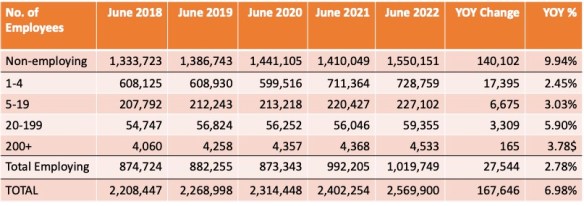
Number of Australian companies by employment size, 2018-2022 (Source: ABS)
There were some contentious views about the small business association’s pre-Summit MoU with the ACTU. Some peak industry bodies and other commentators felt that COSBOA had “sold out” in apparently agreeing to sector-wide negotiations on pay and conditions. However, this does not appear to be the case – COSBOA is merely seeking better co-operation and consultation on areas of mutual interest, and is not endorsing any form of enforced unionisation or compulsory sector bargaining. There have been suggestions that sector-wide collective bargaining will result in higher wages, but without more detail, and pending greater clarity on the “Better Off Overall Test”, this will simply add friction to the current debate about wage and employment growth.
If we do return to a previous form of Industrial Relations policy, it’s interesting to look at the latest ABS data on Australian businesses by employment size (table above). I think it’s worth noting the number of working people in Australia who are employed by SMEs. Large employers are actually small in number, so if multi-employer collective bargaining does come into effect, it could mean tens of thousands of businesses will be involved, and many probably for the first time. On the other hand, in an industry like construction, which is both highly unionised and covered by significant industry awards, many workers are either self-employed or they are employed by independent sub-contractors.
Representation at the summit was reasonably well-balanced, between Unions (including Industry Superfunds), Business (individual companies and industry associations), the NFP and Community sectors, Academia, Think Tanks, and of course Politics. The absence of the Leader of the Federal Opposition meant that his voter base was effectively disenfranchised, although his Deputy (and Leader of the National Party) did attend. Go figure.
Much was said about “streamlining” and “updating” parts of the Industrial Relations regime. Like Australia’s tax laws, the system of Modern Awards as overseen by the Fair Work Commission feels unwieldy, unnecessarily complex, over-bureaucratic, at times vague, and often archaic bordering on arcane. There are currently over 140 different awards in place – some of them relate to an individual company, some to a particular trade or profession, and some cover a whole industry. Interpretation is often in the eye of the beholder as to whether or not it applies to a particular employer and/or employee – here is an extract from one award:
“NOTE: Where there is no classification for a particular employee in this award it is possible that the employer and that employee are covered by an industry modern award or a modern award with occupational coverage.” (Emphasis added.)
I should add that one reason given by the Labor Government for removing the prohibition on sector-wide collective bargaining is because the process for employers to request an exemption from the relevant Minister is “too cumbersome”. I don’t see how this is so given that much of the IR system is overly bureaucratic. Surely the reason for this administrative process is to avoid collusion and other cartel-like activities that would otherwise fall foul of competition law and anti-trust provisions.
The Summit had some notable things to say about gender equality and pay parity, (“Legislate same job, same pay”), training, immigration and child care; but some proposals sound vague without defined objectives (“Boost quantum technology research and education”); draconian if they inhibit workplace flexibility, especially in seasonal industries (“Limit the use of fixed-term contracts”); or too aspirational without more detail such as specific goals and measurable targets (“Leverage greater private capital into national priority areas, including housing and clean energy”). We know that Labor ministers have been vocal in their dislike of the so-called “gig economy” (a “cancer” on the economy, and “I’d like to regulate the sh*t out of it”), but perhaps they need to do more to understand why some workers actually prefer it, and what benefits it brings in terms of workplace flexibility, especially in start-ups and emerging sectors, many of which are SMEs from where much of our longer-term innovation and employment opportunities actually come.
One item that didn’t receive as much attention was the “Digital Apprenticeships Scheme”, which (subject to details…) would likely have the combined support of the Tech Council of Australia and the ACTU. Certainly, despite a vibrant and innovative IT sector, and some notable high-tech and high-end manufacturing businesses in Australia, we lag behind in STEM education, and lack basic digital literacy skills in the wider population. (Hence the need for adjustments to the skilled migration scheme?) A friend of mine who runs a small manufacturing business in Melbourne recently hired an Office Assistant. The successful candidate claimed to be proficient in standard productivity tools such as Word and Excel. In fact, they didn’t know how to COPY-PASTE, nor how to use the SUM-ALL function, which are both very basic routines. They thought they could “wing it” by watching a YouTube video…
Finally, if there is one note of caution or concern about the Summit, it is the niggling thought that this was more of a talk-fest, and that any new ideas to have emerged were either covered by existing programmes and “policy settings”, or were already in train. Going through the list of Outcomes, I counted at least three dozen separate initiatives (Plans, Schemes, Agreements, Reports, Statements, Codes, Programs, Compacts, Task Forces, Working Groups or Funds) many of which already exist, or were part of Labor’s election promises, or have been proposed prior to the Summit. (And that list excludes Federal Ministries and Government Departments.) Sounds a lot like “Talks about Talks”, with “new” money already allocated and spoken for (hence Labor’s push back on some of the implied costs of the Summit proposals). At worst, this “wish list” represents a huge amount of expensive and bureaucratic overlay, whereas we need agile and flexible economic, education and employment measures.
The incoming Labor government in Australia is currently enjoying a post-election honeymoon period. And while the new Prime Minister has spent about as much time overseas as he has been at home, there is sense that domestically, something has changed under Mr Albanase.
First, the strident, discordant and caustic tone of federal politics is subtly being dialled down, even if much of the same partisan rhetoric remains. Second, it has been suggested that Mr Albanese is seeking to evoke the spirit of Bob Hawke rather than looking for inspiration from either of his immediate ALP predecessors. Both Kevin Rudd and Julia Gillard were technocrats (rather than being natural politicians) and neither of them enjoyed a solid or stable power base within their own party (hence, they were both rolled while in office). Third, there does not appear to be any radical departure from the previous LNP administration, apart from a commitment to an indigenous voice in Parliament, a plan to establish a federal anti-corruption commission, and a greater focus on renewable energy.
Of course, the new administration faces a number of challenges in the budget deficit and in key areas of economic activity, most of which they have inherited from the outgoing LNP government. Federal largesse (in the form of industry subsidies, public grants, welfare payments and pandemic handouts) is under pressure. The era of “cheap money” is coming to end as we witness higher inflation, lower unemployment, skills shortages, and a very mixed set of economic results. Interest rates are on the way up to try and prevent parts of the economy overheating, and are designed to reduce both borrowing and retail spending. But there is a risk that higher interest rates will result in a decline in house prices and an increase in mortgage stress; and reduced discretionary consumer spending may dent employee expectations of wage growth. Despite the low level of unemployment, there can be no reasonable hope of higher wages without an accompanying increase in productivity. Perhaps the issue is that too many people have fewer hours of employment than they want or need, while those already in full-time employment seek to maximise the amount of work they have. Or productivity gains are difficult to achieve in sectors where wages are the biggest input cost, or where operating margins are already very thin, or where investment in technology has been lacking.
Despite the increase in domestic travel and tourism during and since the height of the pandemic in 2019-21, we should remember that domestic borders were also closed for extended periods. As a result, local tourism was hit hard, and even as things started to open up again, the hospitality industry struggled to find staff or was unable to operate economically due to capacity limits – and a lot of small operators haven’t come back.
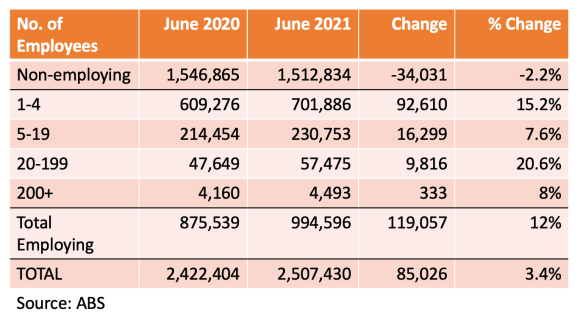
I would expect to see bankruptcy numbers to rise – especially among sole-proprietors and SMEs (the latter of whom, in aggregate, account for the bulk of employment by headcount). This is always a lag economic indicator, given the time it takes for insolvencies and liquidations to work through the system. Despite the overall increase in the number of business in 2020-21 (see table below), 93.0% of businesses had turnover of less than $2 million, and 28.7% of businesses had turnover of less than $50,000. There was a 12.5% increase in businesses with turnover of less than $50,000, and only a 0.5% increase in businesses with turnover of $5 million to $10 million and $10 million or more. Given that 81.7% of exiting businesses had turnover of less than $200,000, there is a likelihood that more businesses will go under. This period is going to be especially challenging for sole traders and SME owners who typically mortgage their principal home to fund their business. The next ABS business entry/exit report in August will be very interesting.
Past stimulus packages have been spent on household goods (computers, mobile phones, HDTVs, etc.) that aren’t manufactured in Australia; or put towards the mortgage; or saved for a rainy day – and it’s highly likely a similar pattern emerged with the recent pandemic-related measures. All of which means their net effect on the domestic economy and the balance of payments was probably negligible. Sure, during the pandemic some consumer spending was diverted from things like overseas travel towards domestic purchases, but recent data suggests consumers are cancelling their internet streaming services and curbing their on-line shopping (in part because they are no longer working from home).
During the federal election campaign, one of the few areas of economic “policy” that both ALP and LNP ventured was the promise of financial incentives for first-time home buyers. The idea being, I suppose, helping people onto the property ladder enables them to establish long-term household wealth, while taking some pressure off the rental market. Although there has been a softening in city house prices, price increases in some regional areas have more than compensated for those recent declines (thanks to an urban exodus from cities like Melbourne and Sydney). If you’ve just paid at the top of those regional markets, and now face interest rate hikes (as well as coming off introductory fixed mortgage rates), I’m sure this will bring a new layer of mortgage stress.
Finally, it’s still not clear where the wage growth will come from (apart from a lift in the minimum wage?). Businesses (especially SMEs) that struggled during lock-down won’t easily be able to afford pay rises, and the skills shortages are in many areas where there is a lack of local talent, so increased skilled immigration quotas may actually depress salaries. Something of a vicious circle.
 Content in Context