A new co-operative model for equity #crowdfunding

**Updated with some clarifications** Last week, I attended the launch of a new equity crowdfunding scheme, called The Innovation Co-op (THINC). It’s the latest model I have seen that is trying alternative approaches to startup and SME funding – given that equity crowdfunding still isn’t possible in Australia.* There’s been the venture bank model, straightforward sweat equity, slicing the pie, and of course, the small-scale offering approach. What they are all trying to do is connect three core assets: capital, ideas and expertise.

Screen Shot 2016-05-16 at 7.01.28 PM

THINC works on the basis that the Co-operatives National Law allows members to come together for a common benefit. This includes the financial benefit of generating economies of scale via the collective purchase of goods and services, the use of capital for the group’s common interest, and the distribution of profits to members from investment and trading activities. Co-operatives fall outside the Corporations Law (so, are not regulated by ASIC), but are subject to the State-based Consumer Affairs and/or Fair Trading authorities.

Participation in THINC involves three types of membership:

  1. Custodians – the founders of THINC, who form the initial Board of Management and represent the “expertise“, will provide commercial services to the companies that THINC invests in (see #2). As founders, they also control 50% of the equity in THINC itself. Based on a notional valuation of the cash and in-kind contributions they have made in setting up THINC, they calculate that they have provided around $1m in contributed equity.
  2. Pioneers – entrepreneurs, founders and SME owners (the “ideas“) in whose businesses THINC will take an equity stake (initially 10%, but may rise to 50%), in return for which the Pioneers receive help in the form of commercialisation strategies and other support to grow their companies. Pioneers are subject to a number of selection criteria, and are expected to use the shared managed services offered by the Custodians (at discounted rates).
  3. Champions – general members of THINC, who also provide the “capital” as investing members by buying Capital Contribution Units (CCU). Collectively, they hold the other 50% of THINC’s equity (albeit as a different class of share to the Custodians) and will also split any distributions or dividends with the Custodians (the latter can only attract a maximum 12% of any dividends, leaving the rest for distribution to Champions, for operating capital, and for maintaining cash on hand).

I should say upfront, that I have applied for membership of THINC as a Champion, but I haven’t yet decided whether or not to invest via the purchase of the CCU scheme. I am seeking clarification on the legal and financial structure, as it is quite complex, and not as straightforward as buying shares or bonds in a company, purchasing units in a managed fund, or becoming a member of a “traditional” mutual such as a credit union, building society or member-owned community bank, for example. Also, I am not qualified to say if this is a good investment, and anyone interested should seek their own professional advice.

Some advantages of this co-operative model are that, unlike other small-scale offerings limited to “sophisticated” investors (legally defined), anyone can invest, and there is no cap on the number of investors. Each CCU costs $500, and Champions may invest up to $5,000 (any more may breach the maximum individual shareholdings of a co-operative). On the other hand, regardless of how many CCUs a member owns, they only have one vote (whereas with normal equity, voting weight is in proportion to the number of shares). And while the CCUs are tradeable, they can only be sold or transferred to other members.

THINC expects to exit each investment it makes after 5 years. I understand that THINC itself may be dissolved or divested, and the final proceeds distributed to the relevant members in proportion to their CCU holdings.

Whatever else, the organisers behind THINC must be applauded for their ingenuity – innovation comes from pushing the envelope. (There is even a patent pending on the model – generating an additional revenue stream from licensing opportunities?) However, I am somewhat wary of schemes that are largely designed to get around either tax issues or legal impediments. Generally, I would say it is preferable to start with a clear set of goals and objectives, and choose the most appropriate funding vehicle or legal structure to achieve that outcome, rather than identifying a structure and fitting the business model to fit.

* Footnote: Although there’s some draft legislation going through Parliament, it hasn’t been passed by the Senate, and some commentators say that the Bill does not achieve the stated goals of what most people would regard as an equity crowdfunding model.

Next week: Design thinking is not just for hipsters….

Getting Stuck – and how to deal with it

We’ve all witnessed (or even experienced) those moments when a speaker or presenter gets stuck. They stumble over their material, they offer an inappropriate response to a tricky question, or they simply go off topic and stray into verbal quicksand. And although they realise they are in difficulty, they carry on regardless, only to wade deeper and deeper into the mire. Some of our current political leaders know exactly how that feels…

Photo by Mark Roy - Licensed under Creative Commons

Photo by Mark Roy – Licensed under Creative Commons

In my experience, many small business owners do the same thing when they get stuck. They carry on doing the same as they’ve always done, even though they know they need to change course, take another approach, or try a different tactic. Which is where someone like me comes to the rescue. As a consultant, I can bring an objective, external and independent perspective that can help clients navigate away from the problem, and steer them back onto the right track.

The Inflexion Point

The typical scenario is that the business is faltering. Most often it’s about sales and business development – either not enough new customers, or too few of the “right” customers (and too many of the “wrong” ones). Sometimes it’s about an aspect of their strategy that isn’t working. It could be a problem with their operations, such as workflow, resourcing or IT systems. Or it might be that they have lost their way and are facing some sort of external challenge. Or maybe there is a disconnect between the products and services that they offer, and what their customers actually need. Or it could be a need to recast their financial information to get a better idea of how the business is really tracking.

Whatever the issue, the common feature is a point of inflexion – the business is either stuck, has hit a plateau, or come to a fork in the road.

So, how do they get help?

The 3-Step Recovery Program

First, the client has to realise that doing the same thing won’t work, doing nothing is not an option, and they have to be open to the idea of change. They recognise that bringing in some external help will relieve the log jam (even though at this stage, they don’t know what form that help will take, or where it will come from).

Second, they do some basic research, or get a referral from their networks, on where they can get help. Much of my work comes via word-of-mouth and personal contacts, and in large part this is due to the need for trust in any consulting relationship. Sometimes, a prospective client has liked something they read in my blog, or heard something in our conversation that has clicked with their own needs. There has to be a connection or match with what the business needs, and what someone like me can offer. It’s a bit like finding a GP, financial planner or personal trainer – there has to be a fit.

Third, they are able to define a specific problem that needs addressing, or at least prioritize the issues. This requires some reflection, self-awareness, and willingness to have their assumptions challenged. There is a need for honesty, and even vulnerability, if the intervention is going to succeed.

Helping clients get back on track

I will say upfront that my services are not suited to everyone. If your business is running like a well-oiled machine, I probably can’t add much value, unless you are looking to improve an area of your operations, or embark on a new initiative where you need help in getting it off the ground. Alternatively, I may be able to help if you simply want to tap into some external perspectives to challenge your current thinking, or if you require some specific expertise that draws on my knowledge and experience. Otherwise, my role is to help clients get free of what is bogging them down.

One of my clients recently said that working with me felt like “keyhole” surgery, rather than undergoing open heart surgery. I think I know what he means, and that he meant it as a compliment….. In my experience tackling “the whole” is not always practical. Rather, zooming in on a particular aspect of the business allows for incremental change, that if applied appropriately, can have a multiplier effect. Such an approach is hopefully less disruptive, and therefore less threatening, to the existing business.

As part of my consulting work, I tend to break the business down into its component parts, look at the business model, review the revenue streams, and analyse the workflow, both internal operations and customer-facing services. For example, clients often have a slightly misplaced perception of where/how they add customer value – so, if they spend a lot of time on a particular task or activity, they naturally assume that this should form the greater part of what their customers pay for. Whereas in reality, the customers may value something else the business does, but the business has not realised that value.

It’s always important to encourage clients to develop an action plan, with specific goals, responsibilities and timelines. I’m not talking about a 50-page business plan, but a more manageable working document for the next 6, 12 or 18 months (depending on their circumstances). A key outcome of this is a list of priorities, plus agreement on which activities to wind-down or discontinue. Despite limited resources, businesses often make the mistake of trying to continue doing everything they’ve always done, plus all the new stuff – the law of physics suggests that something has to give, so they need to stop doing things that are no longer relevant, or are no longer working.

Making a Difference

When it comes to more direct business coaching, I know from the client feedback I receive that the insights I offer and the way I reframe their situation are as valuable as a re-engineered business plan. By analysing the problem, taking it apart and putting it back together again, it allows me to share my observations and offer fresh thinking – which is sometimes all the client may need to get back on track.

If you feel your own business could use some external assistance in getting back on track, or if you think you may be stuck as to what to do next, please get in touch via this blog.

Next week: The David and Goliath of #Startup #Pitching

How to spend $60m on #Innovation and #Entrepreneurship for #Startups

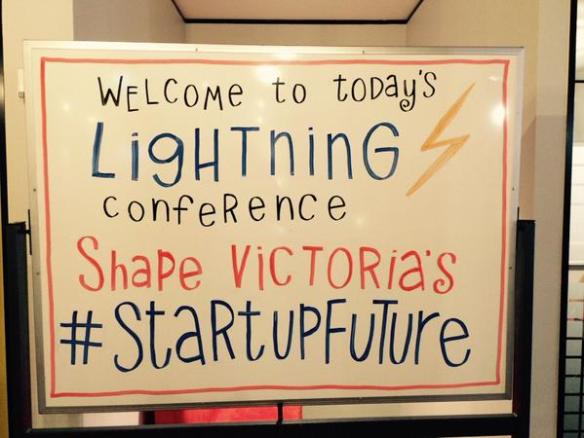
In the recent Victorian State Budget, the government allocated $60m over 4 years to supporting startups, via innovation and entrepreneurship. While not an insignificant sum, it’s still not a huge amount in the overall scheme of things. Having made the announcement, the government hurriedly undertook some rapid community and stakeholder consultation, to figure out how to spend the money. I was fortunate enough to be invited to one of the consultation exercises, a half-day lightning conference organised by Dandalo Partners, facilitated by Collabforge, and hosted by Teamsquare co-working space.

LightningConference

The theme of the Lightning Conference was #StartUpFuture

At the outset, there was an assumption that whatever recommendations came out of the consultation process, a new quango would be formed to oversee the implementation of the program and distribution of the funding. I don’t think I was alone when I expressed my concern that this was rather like putting the cart before the horse – the implication being, “Why seek our opinion, views and recommendations if you’ve already decided the solution?”

To their credit, the organisers took this on board – for example, rather than creating yet another entity, maybe the funding could be facilitated by an existing body such as Startup Victoria – but it felt that the consultation exercise was at risk of “going through the motions”.

Across the various topics that were discussed in the self-forming and self-directed breakout sessions, there were probably 5 key themes:

  1. Community
  2. Infrastructure
  3. Funding
  4. Sustainability and 
  5. “Picking Winners”. 

Here are the main points from each of those themes:

1. Community

There was general agreement that the local startup and entrepreneurial community is well-established, reasonably well-connected (I myself knew about 10% of the participants from various networks) and growing fast.

However, there was also a common view that more could be done to bring entrepreneurs and like-minded people together. For example, how do people know what ideas or projects everyone is working on, how can people find help or make offers of help in terms of matching skills, experience, knowledge, resources? How do we connect suppliers and investors to startups?

Sure, there are numerous meetups and regular startup events, but is there a better way to leverage this potential?  And there are various matching services linking entrepreneurs to mentors, but they are rather ad hoc, and in the case of connecting startups and investors, there are probably more challenges than there are opportunities (see Funding, below).

In short, how can the community come together in a more collaborative way?

2. Infrastructure

It’s quite easy to see that Victoria (mainly Melbourne) has a vibrant startup ecosystem, simply based on the number and frequency of meetup events, founder workshops and hackathons. But there still appear to be numerous obstacles to getting started – from establishment costs and bureaucratic red tape, to tax impediments and access to funding.

Some of these challenges are being addressed at Federal level (e.g., streamlining the company registration process, tax cuts for SMEs, and changes to both equity crowdfunding and employee share schemes). But that’s part of the challenge in itself – at the individual State level, there is relatively little that can be done on fiscal policy (apart from payroll tax and land tax), and all reforms relating to securities financing need Federal legislation and the involvement of market regulators.

The State government has more autonomy around local industry policy settings and planning, as well as making funding available via grants. This means, though, that government is forced to prioritize one sector over another (see “Picking Winners”, below), and a system of grants often results in a mini-industry that is created around grant applications, awards and distribution.

At a practical level, some participants took the view that more could be done to facilitate early stage startups and product prototyping – such as a continuous education and open-enrollment program for entrepreneurs, and co-working spaces for small-scale manufacturing, materials-testing, and engineering. (I am aware of at least a couple of local projects in this space – a biotech co-working lab and an “Internet of Things” open access workshop).

If the State government is looking to plug a gap, investing in R&D facilities might be one option.

3. Funding

This remains the biggie – and a topic previously covered both in this blog, and via numerous commentators and advisers. Even though there are many local pitch competitions, incubators and accelerator programs (plus Shark Tank and That Startup Show make for interesting/amusing viewing…) the elephant in the room is that there are too many startups chasing too few investors.

Competition for resources is positive, as long as it’s an efficient, transparent and accessible market, where the laws of supply and demand are equitable and the rules of engagement are clearly understood.

One industry veteran noted that the local investor community can normally provide small-scale startup funding up to $5m (via “family, friends and fools” and angel backers), and even larger, early-stage equity funding over $50m (via Venture Capital, Private Equity and Family Offices). But in the $5m-$50m range there are far fewer options.

Leaving aside the pros and cons of traditional secured and unsecured bank lending and emerging P2P lending platforms, there is a funding gap that could be filled via Australia’s superannuation scheme:

  • First, we need to find ways to get large retail and industry super funds along with other institutional investors to invest directly in local startups. At present, thanks to the Silicon Valley effect, these instos are more comfortable handing their money to US-based fund managers who then charge a premium to invest the assets in local startups. (I call this a very expensive boomerang….)
  • Second, in the absence of suitable investments for retail investors who may want to allocate part of their portfolio to startup opportunities, part of their superannuation assets could be used to invest in early-stage startups via a form of savings products or fixed income bonds. The retail bond market (such as it is) is heavily skewed towards sovereign debt (treasury bonds) and bonds issued by financial institutions (often in the form of hybrid securities, which are essentially a form of deferred equity). There have been attempts (and even regulatory reforms) to encourage the development of a deeper retail bond market in Australia, but these efforts appear to have stalled.

An enlightened approach to asset allocation could direct even a very small part of the $1.8tn superannation savings into startups that could have significant outcomes. If SMEs are seen as the backbone of future economic activity and jobs (as well as innovation and entrepreneurship), helping to accelerate startup growth will deliver multiple long-term dividends.

4. Sustainability

This wasn’t a huge topic of discussion, but it deserves an honourable mention because it surfaced in several ways:

  • Economic (e.g., making better use of available resources, not funding startups that go nowhere etc.)
  • Social impact (e.g., the growth of social enterprises)
  • Environmental (e.g., the conscious capitalism movement and the importance of “for purpose” enterprises such as B-Corps that want to minimize their environmental footprint)
  • Government (e.g., how to foster startups that want to help deliver better public services, and how to change public sector procurement policies that give startups more of a look-in)

There is also a need to reflect the changing demographics of the workplace, so that sustainable employment opportunities (in whatever form they exist) are made available to both mature-age workers and new school leavers.

So perhaps part of the $60m could be put towards (re)training initiatives.

5. “Picking Winners”

First up, let me say I always get nervous when we put our elected representatives in charge of deciding the fate of specific industries, especially when it’s taxpayers’ money at risk. Call me a cynic, but I’m not sure that picking winners is the government’s forte. I understand the need to support certain sectors that contribute to GDP growth, create employment opportunities, generate taxable revenue, instil industry innovation and develop cutting-edge technology – but the example of the domestic automotive industry is one where political ideology probably got the better of sound economics, as public subsidies eventually came to look like throwing good money after bad.

If nothing else, picking or backing winners is fraught with problems of favouritism, lobbying, murky back room deals and “jobs for the boys”. Better to create the foundations upon which broader innovation and entrepreneurship can thrive, and let the market decide. That way, the government can still claim the credit, and frame the conversation around its role as an enabler.

On the day, the discussion was more about the long lead time before anyone would know whether the program had been successful (assuming we can agree on what success should look like). In reality, re-tooling innovation and entrepreneurship is a 10-year initiative (which is difficult to manage in the face of short-term policy settings linked to 3 and 4-year election cycles).

  • Should we teach entrepreneurship and innovation in schools (alongside coding and STEM subjects)?
  • Should government use local plebiscites to determine where/when/how the funding should be allocated?
  • Should we use the money to directly fund startup founders (rather like the UK’s enterprise allowance scheme in the 1980s)?

There was also a suggestion that the money could be used to promote local startup success stories, in order to foster an understanding of truly viable startups, to identify and fast-track high-potential entrepreneurs, as well as define what is takes (time, money, resources, networking and connections) to build scalable and sustainable startup businesses (i.e., companies generating $250m+ in revenue, not lifestyle ventures or small family owned concerns).

If we do need to pick winners, perhaps we can easily agree which ones they are based on current trends, future needs and demographic demands:

  • Health, biotech and medtech
  • Fintech and big data analytics
  • Education and lifelong learning
  • Renewables and green technologies
  • High-tech engineering and manufacturing

In which case, we should simply help the State government prepare an investor profile, set an optimum portfolio performance target (based on financial returns, innovation scores and a mix of social and environmental outcomes) and give the $60m to a skilled fund manager.

FOOTNOTE:

For further ideas, please see 10 Random Ideas…

POSTSCRIPT:

A couple of further contributions to the innovation debate from AVCAL around tax reform, and from OneVentures around superannuation allocation.


Next week: Medtech’s Got Talent
Connecting Investors and Founders

In recent weeks I have been listening to business founders and investors talk about what each party is looking for in the other when it comes to striking a potential deal. We know that due diligence, planning and preparation as well as financial analysis are all critical to success – but investors are essentially buyers, and as with any product or service, people buy from people. More often than not, relationships based on a common connection, mutual respect, purposeful rapport and personal interaction will form the basis of most investment decisions.

Here are some examples of what you might expect to encounter when thinking about selling your own business, or bringing in external investors.

handshake-220233_1280

What are investors looking for?

At a networking event hosted by Startup Victoria, established investors talked about their criteria for investment.

First and foremost, investors need to know the business you are in (the basic principle being “if you don’t understand it, don’t invest in it”). In the case of an early-stage business, investors also need to know how/where they can add value, since they expect to be more involved with the strategy and execution.

Second, as explained at a workshop hosted by AICD/KPMG, there are only a few types of transactions:

  • Strategic – such as a trade buyer or targeted M&A transaction
  • Financial – such as a Private Equity fund or Family Office
  • Succession – a management buy-out or generational transfer
  • Public – an Initial Public Offer, such as an ASX listing

Each will have their preferences and processes, and as a business owner or founder, you need to understand what each option means for you. Your interests need to be fully aligned, otherwise all the planning and due diligence in the world won’t prepare you for potential disappointment, unmet expectations or even a failed transaction. For example, as a founder wishing to sell your business, are you prepared to see the new buyer shut down one of your cherished products?

Third, financial and strategic investors will have very specific objectives and timelines. As one early-stage investor said: “I’m not a lifestyle investor”, meaning, “I don’t invest in a business to fund your lifestyle” (I invest to fund my own lifestyle…). So, the goal is to invest, drive growth and exit within 3-5 years having generated a target multiple of return on investment. Another investor took a contrarian view, commenting that he had never yet sold out of any business he had invested in – because he takes a longer perspective, and he likes the people he invests in.

Finally, and following on from the last point, investors (especially in start-ups and founder-operated businesses) are often buying the people and the team, not just the business. This prompted the comment about “can you have a beer” with the business owners or founders? The “getting to know you” process is very important for establishing the relationship, exploring what each party is looking for, and framing the nature and terms of the transaction.

What are founders and owners looking for?

Apart from money, what else might you be looking for when contemplating a business sale or bringing in external investors?

Depending on what stage your business is, you will likely need capital for specific purposes, or you may be looking for a particular type of investor. So, know what type of funding you require, and what you might be expecting from the investor.

If it’s contacts and introductions you want, then as shows like Dragons’ Den and Shark Tank demonstrate, investors will extract a high price in return for opening up their precious address books.

Just as investors check out the people as well as the business, owners who are seeking external funding should really do their homework on prospective investors – especially when it comes to unsolicited or unexpected offers to buy your business.

One speaker (who has been on both sides of the transaction) noted that he was wary of a particular investor, because he knew that the relationship would be difficult – a feeling that was borne out by problems at board meetings, and challenges getting shareholder alignment and agreement on critical strategic decisions.

Even if as a founder you are seeking to exit your business via a trade sale or equity transaction, in many cases the new owners or investors will expect you to stay on in the business, to maintain continuity. As is frequently the case, the owner’s sale proceeds will be subject to an earn out to ensure the business meets its projected forecasts.

I have known some entrepreneurs who have left a corporate role to start a new business, with the specific aim of being acquired by their former employer – and I know of at least one such founder who has managed to do this more than once, but a condition of purchase is usually golden handcuffs linked to a performance target.

Other Considerations

There is a commonly held view that if you don’t need to bring in external investors, then you should hold out as long as possible. It’s also said that debt is cheaper than equity, and with current interest rates at a record low, borrowing from a bank or other lender is quite possibly a better option.

However, as I have written previously, there are several obstacles to getting startup funding, especially from banks. In particular, banks prefer secured lending, so if you don’t have sufficient assets (or if you are reluctant to put the family home at risk), and if you don’t have consistent cashflow (for factoring or invoice discounting purposes), your borrowing options will be limited.

An alternative to either bringing in external investors or taking out a loan might be to enter into a joint venture or similar partnership that gives you access to cash and other facilities, while retaining control of your business. For example, a JV to develop a new product or enter a new market can de-risk the opportunity, while enabling you to leverage skills or other expertise that you may not have.

If you are intending to sell your business, even one that is a mature and going concern, most advisers will tell you that the planning and preparation will take 2-3 years, especially as buyers will likely want to see a minimum of 3 years’ trading information and financial records. Don’t underestimate the time it will take to pull together the accounts, document key aspects of the business such as IT systems and processes, catalogue the IP, consolidate CRM and client account information, get a valuation and ensure key personnel are in place as part of the transition team.

Finally, don’t forget to obtain professional tax and accounting advice – I’ve heard business advisers lament the fact that many retiring business owners just about realise enough money to pay off their mortgage, once the sale transaction costs, business debts and tax bills have been settled.

Next week: The changing economic relationship of “work”