Triennial? Could try harder!

The NGV 2023 Triennial is really perplexing. It promises a lot, but ends up delivering very little of substance. I came away with no lasting impression of any particular work, and given there are 100 “projects” on display, that’s a very low strike rate.

First, the positives: it’s free; it draws in the crowds (especially during Melbourne’s late summer heatwave); there are over 120 artists involved; they include local and international, established and emerging names; most forms of art practice are represented; there is a LOT to look at.

Now the negatives: the curation felt scatter-gun, with the lack of a clear narrative theme or contextual thread; BIG is interpreted as being GOOD; the juxtaposition of new works with the NGV permanent collection must have seemed like a good idea, but the joins are abrupt and the implied associations often make no sense at all; and despite the variety of media, it all felt very samey, and nothing cutting edge; in fact, it all felt rather safe.

Much of the work looked like it had come off a conveyor belt, or designed by a focus group. So it ended up feeling bland, anodyne, tokenistic, worthy, “shocking” for its own sake, and was like a production line of the “latest thing”.

Often, less is more. This felt bloated and over done.

A great shame, and a lost opportunity.

Next week: State of the Music Industry…


Ballarat International Foto Biennale (BIFB)

This past weekend saw the opening of the 10th Ballarat Internationale Foto Biennale. The overarching theme this year is “The Real Thing”, recognising the impact that digital, AI, NFTs and image manipulation are having on the visual arts in general, and the photographic medium in particular.

The highlight of the first weekend was the keynote presentation by Platon, one of the most high-profile and prolific portrait photographers of our age, famous for his images of political figures, popular icons, and social activists. Given that Platon works mostly with traditional 35mm film and captures living subjects, his work certainly deals with the “real” thing.

At the end of the first day, visitors were also treated to a Victorian magic lantern presentation, combining authentic analog apparatus, multi-media components and live performance. For audiences of the day, such events would have been their first encounter with moving images and projections – which we take for granted in our screen-obsessed culture.

As with any festival on this scale and duration, there is a wide range of work on display. This is especially so outside the Core Program, with the Outdoor and Open Programs taking on the challenging task of representing different aesthetics, styles, techniques, subject matter, and as such they reflect varying levels of quality and competence.

It wasn’t possible to see all of the exhibitions in the first two days – and some works don’t go on display until later in the program – but for me, the highlights beyond the major Platon show included: Stephen Dupont‘s happy accidents; Jon Setter‘s stunning abstract images of Ballarat; several of the works by regional photographers curated by Jeff Moorfoot; the scattered works by the Oculi Collective; and the display presented by the Australian Association of Street Photographers Inc.

Some exhibitions were less successful: I really wanted to engage with William Yang‘s work, but the unfocused curation and haphazard presentation undermined any appreciation of the images and their underlying narrative; Erik Johansson‘s highly stylised images are humorous and surreal, but they can also come across as very superficial, so we are left marvelling at the surface technique rather than any depth behind the work; and while it was nice to see some of Andy Warhol‘s original Polaroids, they were presented with very limited context, as if they were an afterthought (the fact that they are probably the earliest works in the whole festival may have something to do with them feeling out of place, as well as out of time).

It is easy to see how some photographers could get constrained, either by their subject matter, or by their technique. Working with self-imposed limitations should be positive. Using fewer tools can drive creativity (“less is more”). Having less time can result in better outcomes (“the first take is usually the best take”). Innovation comes from exploring our curiosity. Inventiveness is the result of challenging ourselves through problem-solving. However, an artist can reveal themselves to be a one-trick pony, or their technical expertise overwhelms the output (“form over substance”). Sometimes, the narrative or subject matter is more important than the quality of the image, but just as a crappy technique can impair a great image, a perfect technique cannot compensate for a poor composition.

The notion of “reality” prompts us to consider what is a photograph? The fact that most modern photos are captured on a smart phone rather then a camera simply confirms that not all photographic images need to be created using a dedicated physical device (think of photograms). And since most photos are digital rather than on film means we are not limited to think of photography as a combination of manual, chemical and mechanical processes.

However, some of the work on display does challenge the definition of “photography”, especially in the context of art. For example, an image can be surreal or satirical, but when does that stray into being fake news? Equally, even though professionals like Platon render their work in a digital environment during the post-production process, should a composite of stock images manipulated using Adobe Photoshop qualify as a work of photographic art (or is it a mere illustration)? And with the growth of AI tools to generate images (which raises questions of authorship, copyright and attribution), should their use be disclosed and identified (just as paintings, sculptures and other art works are catalogued by their materials, processes and editioning)?

In the early days of music CDs, the recording industry developed the “SPARS code”. Letter combinations such as “AAD”, “ADD”, and “DDD” are intended to inform listeners that the music has been recorded, mixed and mastered using either analog or digital processes and equipment. Perhaps something similar should be considered for photography and digital art?

Next week: Banking Blues (pt. 481)
William Kentridge – Modern Polymath

For the next couple of weeks, an exhibition of work by William Kentridge is showing at Australian Galleries in Melbourne – and I highly recommend it. If you are familiar with his art, you’ll know what to expect; but if the name is new to you, then hopefully you will be curious enough to give it a go. Kentridge is both prolific, and proficient, across many media – this current exhibition includes prints, drawings, sculptures, tapestries and films.

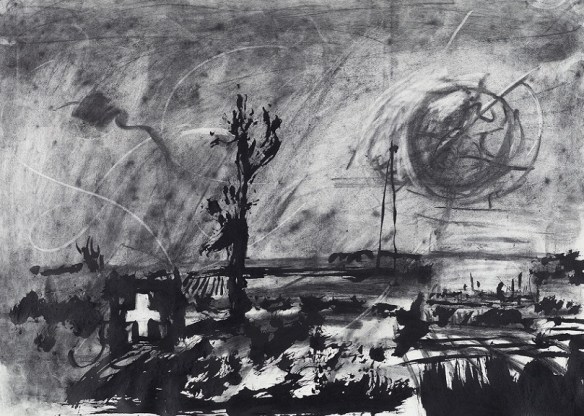
William Kentridge – “Untitled (Drawing from Wozzeck 2)” (2016) – Image sourced from Australian Galleries

I think I first became aware of Kentridge’s work via his multimedia installation, “What Will Come (has already come)” when it was shown at the Städel Museum, Frankfurt in 2007. Thanks to his distinctive style and use of recurring motifs, once you see one of his prints or drawings, you can easily recognise other pieces by him. Using a graphic-based visual language and free-flowing lines in his mark-making, he also incorporates polemic and performance into his work. In addition to his stage design and production, his films and stop-motion animations portray the artist as actor, literally sketching out his lines across paper, wall and screen. Images of coffee pots, oil rigs, megaphones, tripods and windmills feature in many of his works, and he is also drawn to three key texts: Mozart’s “The Magic Flute”, Alfred Jarry’s “Ubu Roi”, and Nikolai Gogol’s “The Nose”.

Since that first encounter in 2007, I have been fortunate to see a few of Kentridge’s key exhibitions, most notably “Five Themes” (2010) at MoMA, New York (which later came to ACMI, Melbourne), and “Thick Time” (2016) at Whitechapel Gallery, London (and later at The Whitworth, Manchester). I also hope to see his major retrospective at London’s Royal Academy later this year.

All of which makes this exhibition at Australian Galleries a remarkable achievement for a local commercial space. If there is one piece that could sum up Kentridge’s artistic CV, it would have to be “Black Box/Chambre Noire” (2005) – this YouTube video does a pretty good job, but you need to see this mix of installation, automata, video, sculpture and audio in the flesh to appreciate the full effect. Luckily, there is a related video, “Preparing the Flute” (2004), based on a similar installation work, in the current show in Melbourne.

Next week: Lightscape


Hands on the wheel

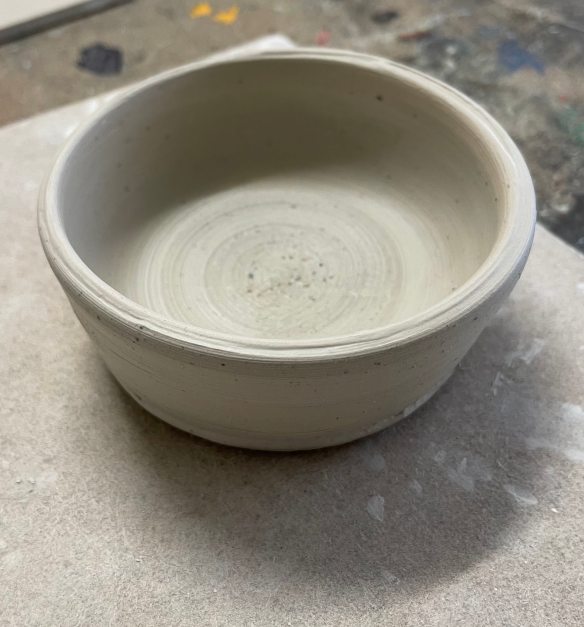
A couple of weeks ago, I got some hands-on experience of the potter’s wheel (or Wheel Throwing, to use the technical term). I’ve played around with modelling clay before, but this was probably my first attempt at ceramics, and certainly the first experience of wheel throwing. The result (so far) can be seen in the photo below…

The class was a 2.5 hour introductory workshop, conducted by Little Woods Studio in Collingwood (via WeTeachMe), and I highly recommend it. I don’t think I was any good, but that’s not the point. The only pot I managed to make (shown above) is actually quite small, and wouldn’t have happened without a lot of direct assistance from the instructor, who was incredibly patient.

Learning the physical technique of throwing, fixing and initially shaping the clay on the wheel is a skill in itself that needs more than a couple of hours to achieve a consistent level of proficiency.

Then there are the many variables to consider – the quality of the clay and whether it has been prepared sufficiently; the amount of water to use, and how much arm and hand pressure to apply; the stability and responsiveness of the wheel; the height of wheel and stool; and probably the weather (barometric pressure). Then there is knowing when and how quickly to start bringing up the sides of the pot, what thickness of base to settle on, and what wheel speed to achieve – too often, I ended up collapsing the walls just as was beginning to shape the rim; or I applied too much bracing support from my arms so that my hands ripped the clay off the wheel again. (Is this where the phrase, ‘to throw a wobbly’, comes from?)

And this is all before the two-stage process of firing and glazing, when anything might happen to cause the pot to crack or crumble. Hopefully, in a couple of weeks, I’ll be able to pick up the finished item, a souvenir of my first (and probably only) pottery class.

If nothing else, I now have a huge respect for potters, and a greater appreciation for the fruits of their labours.

Next week: William Kentridge – Modern Polymath