3 Ways to Fund Your #Startup

At a recent forum organised by Startup Victoria, co-founders and advisors discussed alternative ways of funding a startup. Part of Startup Week, the event was hosted by inspire9 and sponsored by BlueChilli and Slush Down Under.

button-41706_1280Bootstrapping

Doug English from CultureAmp talked about the benefits of bootstrapping, especially for B2B startups: “You have fewer clients, but with bigger budgets, and fewer of the hassles associated with a consumer startup.”

Initially, the founders used consulting work as a means of funding themselves, but focussed on specific market segments and customer domains – in short, they got paid to learn about their clients.

Having several co-founders was also helpful in providing “cheaper access to more labour”.

However, they have learned a significant lesson from those early consulting gigs: although they were able to secure upfront lump sum payments for client development work, they are still supporting some of those initial product features and functions, without necessarily getting paid for it. Whereas, if they had aligned product development with their client road map, they would have been able to generate recurring and iterative revenue from new product features. In short, annual payments and subscription fees help with the cash flow!

There was also the opportunity cost of bootstrapping, instead of bringing in external funding. The team realised that pursuing VC funding was always going to be a long haul, so they decided against it; but they then found themselves in the position of receiving an unsolicited approach from a VC source.

Note: CultureAmp recently closed a Series A round of funding for $8.1m.

Crowdfunding

Alan Crabbe, co-founder at Pozible explained how the team had seen a trend in crowdfunding projects in music (Europe) and film (US), and saw an opportunity in the visual arts. A key strategy was to use story-telling through video to help artists pre-sell their projects. Success can be rapid – one Brisbane project was funded within 3 hours. Globally, $5bn raised has been through crowdfunding – but beware domain name squatters…

Three trends have helped crowdfunding as an alternative funding platform:

  • Social Media – to provide critical mass
  • Online Video – experiencing exponential growth
  • Payment Innovation – e.g., PayPal etc.

Alan had a number of tips for anyone contemplating crowdfunding their startup project:

  1. Use social media comments, likes and other feedback to validate your idea
  2. Taking a more hands-on approach means they have a success rate of around 60%
  3. Find your audience first – typically among the FFF (“family, friends and fools”) and your other networks

As for equity-based crowdfunding, he observed that nothing happens quickly in Australia, but predicted it might be a reality within 6-9 months’ time.

Note: a couple of local platforms that resemble equity-based crowdfunding are already in operation: VentureCrowd and ASSOB – but as with anything of this nature, read the small print, and make sure the model is right for your business or startup idea.

R&D tax breaks

The final speaker was Sean Moynihan from PwC who talked about some of the R&D tax incentives available from the government. A major hurdle for many startups is that these tax breaks are generally only available to companies that have notional R&D deductions of at least $20,000.

Other programs such as the Export Market Development Grant are being phased out, and even incentives for product design must be able to demonstrate research activity and expenses. Since these initiatives can largely be described as “matching” programs, they can be summarised as “no taxable revenue, no grant available”.

PwC have launched their own service to assist companies navigate the R&D claim process.

Although an estimated $1.8bn will be made available in R&D grants this year, less than 10% will go to startups.

Note: the closing date for grant applications for the year ended June 30, 2014 is April 30.

Conclusions

Although there is a noticeable change in VC attitudes, most early-stage funding finds its way to B2C startups, because B2B is just “too hard”. However, even angel investors want to see an established client base, a revenue stream, and a well-defined team of founders.

With lower tech and product development costs in mobile apps and software tools, bootstrapping is a more realistic option for many startups, and the received wisdom appears to be to hold out for as long as you can before bringing in external funding.

Crowdfunding is gaining traction for specific projects or more tangible products (including some apps) – but legal and other restrictions means it’s not really a viable option for raising equity. (Maybe P2P lending for businesses will offer alternatives to a bank overdraft, a personal loan or even secured lending?)

Next week: Taxing the Intangibles – coming soon to a screen near you!
 

Update: Health, AusPost, eTaskr and Slow School

Over recent months, I have blogged about health and the digital economy, the challenges facing AusPost, the progress of eTaskr and the birth of Slow School of Business. Here are some updates on each of these topics:

IMG_0211Apple launches developer platform for health apps

On top of launching “Health” with iOS8, Apple has released a software tool called ResearchKit designed to help researchers and developers build and test new health apps.

I think that while we hear a lot about the Internet of Things (#IoT), health is one area where the connection of the physical and the digital will really deliver tangible benefits (not just a fridge with a screen…).

Australia Post plans to raise the cost of sending letters

In the wake of declining letter volumes (and poorer financial performance), AusPost is considering jacking up the price of letter postage, and introducing a 2-speed letter service.

While this is not a surprising move, it does seem shortsighted. Given the increase in parcel volumes, especially from e-commerce and small online purchases, I reckon AusPost would be better off with more refined domestic parcel rates. For example, using exactly the same dimensions and weight, I can either send an item as a “large letter” for $2.10 (which is perhaps too cheap?), or as a “small parcel” for $7.45 (which is incredibly expensive for an item that might cost no more than $25). Maybe different band rates of 50g, from 100g up to 500g (the current weight limit for a small parcel/large letter) or even 1kg  might be a better option, coupled with improved payment and lodgment automation? Just saying…

etaskr secures seed funding

Described as a “private label elance”, etaskr is a graduate of the AngelCube accelerator program, and was a finalist at last year’s Big Pitch organised by Oxygen Ventures.

Following their appearance at the Big Pitch, etaskr have recently closed $1.3m in seed funding from Oxygen Ventures. As mentioned in an earlier blog, etaskr is starting to see traction among corporate clients, including overseas markets, but the nature of the B2B sales cycle has meant that investors, incubators and accelerators are traditionally wary of such startups. Hopefully, this latest development will start to change market perception.

Slow School founder in the news

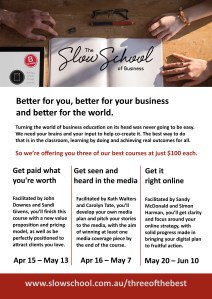
Finally, Carolyn Tate, the founder of Slow School of Business has been busy launching a new program of short courses (including Three of the Best) a new website and a new book. Oh, and she’s also become a B Corp. (Declaration of interest: I am a participant in, and adviser to, Slow School.)

Previously featured in Slow Living (required reading for the Slow Movement), Carolyn has taken a simple idea based on collaborative and peer-to-peer learning, and created a potentially disruptive platform for professional development and corporate training. Slow School is also tapping into the growing trend for people to work as independent contractors, freelancers and consultants (rather than permanent employees), and the dynamics of the digital economy where participants are also looking to make deep, personal connections rather than just online “friends”.

The new normal?

Post GFC, we’ve been told to expect a low/slow/no growth environment – that this is the “new normal”. I would add to that digital disruption, non-traditional commercial models and emergent ecosystems as being the other key influences on how we do business in this new environment. From what I have skim-read of the latest Intergenerational Report, the language is still couched in traditional terms of “jobs”, “productivity” and “industries”. Yes, there is mention of innovation, demographics, technology and flexible workplaces (i.e., deferring retirement?), but nothing that inspires me to think our political leaders understand what is really going on within the startup economy and the broader digital movement.

Next week: How to survive a Startup Weekend

AngelCube15 – has your #startup got what it takes?

Startup Victoria‘s first Lean Startup meeting of the year heralded the launch of AngelCube‘s 2015 accelerator program (#AC15), for which applications are now open. A good opportunity to check in with previous successful applicants, and find out if your startup is made of the right stuff.

Screen Shot 2015-02-25 at 10.03.58 amThe info evening was hosted by inspire9, and supported by PwC, and Nathan from AngelCube kicked off proceedings by giving a run down on the accelerator program, the application process, and the type of startups that are more likely to be accepted.

What does the program offer?

  • A 3-month intensive learning and development experience
  • $20k in funding (in return for 10% of the business)
  • Co-working facilities
  • Working with Lean methodology (focus on Product-Market fit)
  • Access to great mentors and advisers, and early-stage investors
  • Participation in a fundraising roadshow (including time in the US)

There is an application form via AngelList, and the closing date is May 10 (but the sooner you can submit the better). From the hundreds of applications, AngelCube puts together a shortlist of 20, of which no more than 10 will likely be accepted.

What is AngelCube looking for?

  • Globally scalable tech startups (think beyond Australia!)
  • In-house tech skills/resources (it’s not really a matching service)
  • Great teams (more than the ideas themselves)
  • Customer traction (ideally revenue-generating)
  • Consumer-oriented solutions (rather than B2B)

What has the experience been like for successful graduates?

Three alumni of previous AngelCube programs offered some personal insights, and then participated in a Q&A with the audience of 400:

Screen Shot 2015-02-25 at 10.02.34 amFirst up was Peter from Ediply, a service that matches students to the course or university of their choice. Given the growth in education and lifelong learning, and the increasing numbers of students (especially from Asia) looking to study overseas, the business seemed like a natural fit for AngelCube. However, it was still a relatively new or unknown sector in terms of end-user or independent services (rather than in-house marketing and enrollment efforts) – which sort of broke one of AngelCube’s rules for acceptance: no established market. Peter stressed that the main reasons for applying were the need to overcome some development barriers, and to get out of a “Melbourne mindset”.


Screen Shot 2015-02-25 at 10.03.01 amAsh from Tablo (“YouTube for books”) probably broke another AngelCube rule, in that he was a sole applicant (not part of a team) and he had limited tech resources. AngelCube made him work harder, think big, and keep going – and helped him to become a disruptive force in publishing, with customers in 130 countries collectively publishing 1 million words a day. He’s also closed a C-round of funding, and has some impressive investors on his share register.

Screen Shot 2015-02-25 at 10.03.28 amLastly, David from etaskr (“a private label elance”) had to quit a full-time job with one week’s notice once he got accepted into AngelCube. He even had to Google how to pitch. Plus he came into the program with a totally different idea, got slammed, failed to get customer traction, and ended up pivoting to an enterprise software solution (and broke another AngelCube rule in the process – no B2B, because of the longer sales cycle). Despite having to live on very little money for 6 months (less than $200 pw) the team persevered, and are now starting to get traction, including overseas markets like Holland. His final words were “risk is not something to fear, but to overcome”.

Q&A with the audience

Most of the questions were about the application process for AngelCube, and how it helped the successful startups, particularly with going global. In large part, this due to some great networks, access to high-profile connections (“we got to meet the first employees at Yammer!”) and links to some influential investors. There was also some discussion about how to secure your first customers (mainly via social marketing techniques), and the challenge of enterprise sales (“it sucks, because you need 100 different minds to all say ‘Yes!'”).

Finally, for more insights, please visit these links to previous posts about AngelCube and some of the successful applicants.)

Next week: Help! I need to get some perspective…

What the *%@#? Dave McClure vents his spleen…

The final Lean Start Melbourne event of 2014 was a Q&A with Dave McClure, tech entrepreneur, early-stage investor and founder of 500 Startups. It was certainly an ear-opening experience, as Dave laced his comments with enough expletives to fund a small start-up (if only the organisers had thought to provide a swear jar…).

But while he was vociferous in his refusal to answer questions like “what’s hot?”, or “where’s the next big thing?”, he did provide some refreshing insights on how founders and investors need to adjust their expectations on funding and returns.

The event was hosted by inspire9, with sponsorship from BlueChilli, General Assembly, and Loud & Clear. Adrian Stone from Investors’ Organisation was acknowledged for helping to bring Dave to Australia, and Amanda Gome was the MC for the evening.

Dave’s investing model is basically a numbers game – identify a large enough pool of startup opportunities, place smaller “bets” on each one, in the expectation that only 10% will succeed, and of those, only 10% will be really successful, and very, very few will reach an IPO – but the spread of successful bets should each return between 5x and 20x. Whereas, some investors still try to “bet on unicorns”, in the expectation of a 20x-25x exit every time. Such opportunities will be increasingly unlikely, as the technology costs of production continue to decrease, therefore startups don’t require the same level or type of funding.

Based on current trends, Dave sees huge potential in video commerce, mobile video, and anything that monetizes search – e.g., influencing followers via social media, and converting this traction to sales driven by personalised recommendations. He’s also big on Spanish- and Arabic-speaking markets, and “anything that arbitrages sexism and racism” – hence his interest in women and minority entrepreneurs.

Dave’s advice is pretty simple: get the product, market and revenue model right, and then build scale into the business as quickly as possible. As such, he hates people asking him his opinion on their startup ideas (“what do I know?”); instead, he emphasises the need to get paying (and profitable) end users plus building scale through marketing as the true proof of concept.

Throughout the evening, Dave talked a lot about unit economics – not just production costs, but the real cost of customer acquisition, and time to convert leads to sales. It was also interesting that unlike some speakers at previous Lean Startup events, he was not particularly negative towards startups developing enterprise solutions – rather, he prefers to segment clients based upon their decision-making and purchasing limits. So, he looks at revenues based on the respective number of end users, SME customers and enterprise clients, because of their different price points and procurement methods, as well as the different customer acquisition costs.

Finally, he encouraged potential startups to think of the “most boring and mindless” business activities or processes, and figure out ways to make them more interesting via apps that use gamification and social media tools.