Cooking the books?

Over the many years I have been writing this blog, I have often commented on the publishing industry, from my personal experiences, to industry trends and future outlook. The recent collapse of Australia’s online bookseller, Booktopia, prompted me to revisit the topic.

First, a declaration – I am an unsecured retail creditor of Booktopia. Orders for books I  paid for in advance of their publication dates still have not been fulfilled. Obviously, I am not alone; there are about 170k retail creditors, owed a total of $15m. That is an average of about $90 per creditor, although some retail customers are owed more than $10k.

Second, Booktopia’s total debts of around $60m are nearly one third of annual turnover ($198m in FY2023). In FY2022, annual turnover was $240m. Clearly, this was a business in decline, and in financial trouble.

Third, I should have been alert to the problems when I enquired about my outstanding orders, shortly before the administrators were called in. I knew the books had already been published, so I wanted to know when to expect them. This was part of the reply I received, in mid-June:

“We have been experiencing difficulties procuring new stocks from our supplier lately, we are so sorry for the delay.”

Fourth, it transpires that publishers, wholesalers and distributors were experiencing payment delays from Booktopia. Suppliers were reducing or cutting off their credit lines, and declining to supply more stock unless the existing debts were cleared. The administrators are doing their best to realise any remaining value of the business, including a trade sale of Booktopia (as a whole, or as parts). The assets include warehouse stock (some of which may still be owned by the publishers/wholesalers), customer lists, technology, goodwill and other IP. But it was made pretty clear at the first creditors’ meeting that unsecured trade and retail creditors should not expect to get their money back any time soon, and certainly not in full. (A total of $15m in secured debt will get preference, including employees.) So even if the unfulfilled but paid-for stock can be located, there is no apparent obligation for outstanding orders to be completed. In fact, the administrators were suggesting that retail creditors should contact their banks or credit card providers, to see if they could recover their money via those channels. (Which is why insurance premiums, card fees and bank charges go up, of course.)

I don’t understand why Booktopia’s retail and trade debts were allowed to get to such a high percentage of their turn over. Book publishing and distribution shouldn’t be that hard – either the book is in stock at Booktopia, and can be sent immediately, or it is available to order from suppliers and can be fulfilled within a reasonable time. For books that have not yet been printed, surely the customer’s money should be held in some sort of escrow account, and the cash not accessible by the seller or recognised as revenue until the order has been completed?

Of course, books go out of print, and customers may have to wait for a re-print or a new edition. Or the industry needs to consider print-on-demand solutions. Funnily enough, that is one of the key recommendations of the Ad Rem report on the Australian publishing industry (“The Australian Book Industry: Challenges and Opportunities”) in 2001….

Next week: Notes from the UK


The Last Half-Mile

One evening last week, I came home to find two separate deliveries waiting on my doorstep. Both had been delivered in error. The first was a bunch of flowers, but the named recipient, the street address and the suburb were all incorrect – it was for someone else in another postcode. The second was a packet of coffee beans (part of my monthly subscription), but I had already received the same delivery the day before – so this was clearly a duplicate. Welcome to the perennial logistics challenge of the “last half-mile”.

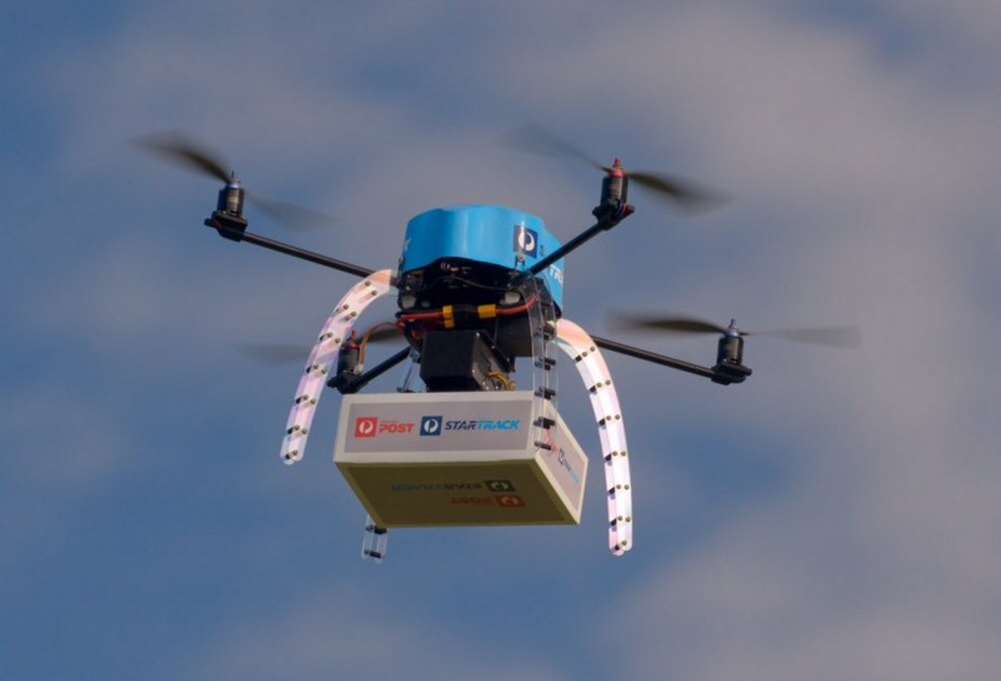
Delivery-on-Demand: 5 years ago, Auspost was experimenting with drone deliveries (image sourced from IT News)

It seems that despite the increased demand for on-line shopping and home deliveries during lock-down, supply chain logistics are still struggling to find a consistent and reliable solution. Coincidentally, in recent weeks I have been pitched two different start-up ideas that aim to address the last half-mile challenge for e-commerce. Although they are each taking slightly different approaches, both start-ups are trying to address the “recipient not at home” dilemma – what to do with parcels and deliveries when there is no-one at home? Their respective solutions revolve around a “localised point of collection/delivery” – either using a more convenient network of click & collect facilities, or a network of trusted neighbours to receive deliveries on your behalf. I have previously covered another Melbourne start-up called Passel based on a network of trusted local couriers – but it doesn’t seem to have progressed very far.*

So if this is a recurring theme, why can’t it be fixed – or are the solutions out of step with the actual problem? Or is the problem not that big of an issue to warrant over-engineered answers? In attempting to provide constructive feedback to both the recent pitches, I gave similar responses in each case, which can be summarised as follows:

Using a proxy recipient still does not solve the problem of items being delivered to the wrong address (or wrong items delivered to the correct address). In particular, it doesn’t address the issue of Australia Post personnel carding an item as “not at home” when in fact they simply can’t be bothered to attempt delivery and prefer drop it off at the local Post Office for collection – believe me, I have had more than my fair share of those.

Localised click & collect services already exist – usually in convenient locations, and often accessible outside Australia Post’s normal hours. Plus more parcel locker and similar services are appearing – so is the demand really there for another delivery solution?

Who is responsible for insurance claims on lost or damaged packages, where the named recipient (who has the sales contract with the seller) does not match some of the relevant transaction details associated with the proxy recipient?

Likewise, if you are using proxy delivery or collection services, who is responsible for managing returns and/or unclaimed items? Some retailers will take items back and offer refunds as a matter of policy – but others won’t or can’t process returned stock, and end up re-selling into secondary supply chains at a discount.

How do you recruit and screen proxy recipients and deliverers, and build trust into the network? How do you avoid an under/over-supply of proxy providers – too few and the system gets choked; too many and it’s not worth their time and effort to sign up.

How do you recruit and service multiple retailers and/or their point of sale and fulfillment providers to make it a viable service for customers who wish to shop from multiple shops and brands?

Who (and how) do you charge for the additional convenience you are trying to offer – retailer, customer, or both? Suggested options include a per transaction fee and/or an annual subscription fee, or a check-out fee which can be rebated based on loyalty or other frequent buyer rewards. But the “convenience premium” cannot be disproportionate to the value of the transaction.

Even with more customised delivery options such as trusted neighbours, the issue of having to be at home during quite wide delivery hours (e..g, 8am to 1pm, or 9am to 5pm) still applies.

Confirming proof of delivery is still a pre-requisite – even more so if using proxy delivery addresses – and potentially adds another layer of complexity.

Finally, the need for immediate “Delivery-on-demand” may be overstated, at least on non-perishable goods, so a constant stream of delivery drones down every suburban street is probably some way off….. but maybe don’t rule it out if we have further pandemic-related lock-downs or continuing challenges in the COVID vaccine rollout.

* Similarly, I also blogged about other customer experience with the final step in fulfillment across a number of sectors, including e-commerce.

Next week: Notes from Blockchain Week

Antler Virtual Demo Day

As with other virtual demo days I have attended this year, it was remarkable to hear how far the teams in Antler’s Sydney Cohort #3 had progressed in light of the current pandemic and associated lock-down restrictions.

Each participating team was categorised into an industry sector:

Consumer Tech

Remote Social is designed to connect remote and hybrid teams. The ethos is that with the shift in working patterns (heightened by the current pandemic) corporate culture and organisational engagement are “at risk”. The solution aims to foster socialisation and build culture through curated games and activities. Claiming to have generated over 200 organic signups, including team members at big tech brands, the founders are adopting a “bottom, land and expand” customer acquisition strategy. In addition to a seat-based subscription model, the platform will also offer a revenue share for marketplace providers.

Coder One claims to be “the home for AI sports”. The team describe their project as an API platform for AI games, with unique combination of AI and e-sports. The goal is to make AI and programming more accessible via an AI Sports League, where bots compete, programmed by developers. With more than 250 registrations for an upcoming competition, the team are also looking to secure sponsorship deals. The commercial model has three components: free access to programs for developers, individual subscription fees to access games/tournaments, and corporate fees to access talent for potential recruitment.

Feather is an online platform which enables instructors and creators to deliver and monetise their digital services. According to the founders, existing tools are not fit for purpose, complex or clunky. Initially targeting yoga teachers, the solution will sell tiered subscriptions, plus take a small revenue share. The team also see themselves as part of the “creator economy”, but I was confused by the name – is it a deliberate attempt to suggest a link to Dumbo Feather magazine? Plus, there was some feedback that the platform may be vulnerable once tools like Zoom start putting up more pay walls.

Tactiq is a tool to “capture valuable insights from remote meetings”. The founders claim it can be used with any conferencing software, and is platform agnostic (although currently limited to a Google Meet via a Chrome Extension). The product, essentially “speech to text plus”, also generates AI assisted summaries, and the team has attracted over 100,000 users from around 4,500 organisations. Pricing is $9 per user per month, plus $20 per month to access team functionality. While the team appears to know and understand their target users, they were questioned about privacy and security issues. Although the transcription content is not stored on the platform, my experience of other similar tools is that once they are integrated, they have a tendency to “take over” and insert themselves, unprompted, into e-mail and calendar applications – “you seem to have a meeting now – would you like me to record it?”

SaaS

Upflowy wants to help B2B companies improve their customer conversion rates. Intended to be a “no-code” sign-up engine, the team explained that from their experience, in-house developers tend to focus on product features, rather than improving the sign-up experience. Typically, in-house sign-up optimisation is slow, expensive or totally non-existent – the key issues being scaleability and reliability. Essentially a form builder, the solution enables A/B testing, and claims to deliver a 40% improvement in conversion rates (compared to 17% improvement achieved with other optimization tools).

Flow of Work Co is positioning itself as the “Future of Work SaaS”. With a mission to help companies to retain the best people, it is HR tech using AI in the form of a smart matching engine to identify in-house talent, based on proprietary ontology. It also helps employees to find development resources, as well as to match projects with in-house talent. According to the founders, talented staff leave because they are bored or lack career development. With an initial focus on software companies, the team then plans to tackle the financial services sector. The team was asked about integration with existing HR tech stacks, and how they ensure objective assessment of competing project candidates – but it wasn’t so clear how they achieve either.

Portant is an end-to-end project reporting tool, designed to be a “consolidated single source of truth”. Asked why existing project management tools don’t work, the founders identified a number of factors: teams are using different tools, the process is often repetitive and/or highly manual, or project tracking typically relies on data from different sources. The team have launched an MVP on Google Workspace Marketplace, and will soon launch on Microsoft AppSource (and appears to use AWS Comprehend as the analytical tool?). There is an SaaS pricing model, and content privacy is ensured via end-to-end encryption plus the use of private keys.

StackGo helps clients achieve stronger B2B sales via SaaS marketplaces, rather than relying on direct sales. However, the initial setup costs and effort required to connect to existing SaaS marketplaces can be daunting. With an approach based on “build once, deploy many”, StackGo enables users to connect to multiple SaaS marketplaces via a single solution. However, the team, did not explain what the setup costs are for StackGo nor were they very specific about the price range or typical sales value their clients achieve – “free to hundreds of dollars per month”.

EdTech

GradVantage wants to reduce the cost of getting graduates job ready, and reckons it can save employers $30k per new hire. Offering a personalised learning experience for each user, the founders have adopted a “Slack” model – team first, then enterprise sale. Acknowledging that the EdTech sector is crowded, the team think their point of differentiation is the fact that they are a career-entry solution, and not in the K-12 market. The focus is on tech talent and SaaS vendors. Employers pay per learner, and the platform saves time and reduces on-boarding costs. Typically, 30% of program content is about tech applications, and 70% on how to use the tech. A more fundamental issue is the huge gap between university courses and actual job requirements.

HealthTech

eQALY is an integrated tech platform that enables the elderly to achieve a higher quality of life in their own home, by predicting their individual needs in advance, and identifying the right Home Care Package funding (which can be worth up to $26k). Using 360 degree data inputs, a risk model, and a proactive care plan, the product takes into account client needs as well as family concerns, plus financial considerations. Although the aged care industry is regarded as being slow to adopt new technology, the founders plan to focus on aged care organisations, who will then distribute predictive data and analytics to care providers and managers. The platform is tech agnostic but IoT devices, AI tools and virtual assistants can be integrated, plus new voice analysis technology is emerging that can monitor client well-being, and
all of the activity monitoring tech is passive. meaning the end user does not have to worry about learning new applications.

Retail and E-Commerce

The One Two is a very specific, and very targeted, D2C solution offering a hyperpersonalised service for fitting and buying bras. According to the founders, current customer experience suffers from ill-fitting products, poor product design, bad materials, and inadequate size configurations. As a result, customers feel overwhelmed and give up. The basic product IP has been tested, along with an on-line measuring and fitting tool, combining to provide better customer diagnosis and product tips. The team have already secured a startup partnership with a global lingerie manufacturer and distributor.

m8buy did not make much sense to me. Maybe I’m the wring demographic, but why would anyone want to “shop online with [their] friends”? Describing itself as “a social layer on any e-commerce store”, it feels like this is aimed at the “buy now, pay later” audience.
According to the founders, merchants will only pay a commission (“low single digit %”?) on successful sales. But it’s not clear whether this is a group buying service, a discount marketplace, or a loyalty programme, nor how it will be differentiated within the Shopify marketplace.

PropTech

Sync Technologies is a digital solution for construction industry – with the tag line of “turning data into insights”. The problem being addressed can be summarised as follows: 1) Building
sites are fragmented and complex 2) Progress reporting and bottleneck identification is poorly done 3) 12% of a typical job has to be reworked 4) 80% of projects are late and/or run over budget. Using a digital twin concept, the solution aims to provide a “single source of truth”, and the team are already working with some key firms, and have 2021 forecast revenue of $2m.
Key obstacles to overcome are entrenched on-site behaviours, and slow the tech adoption across so many stakeholders in the construction industry. The founders claim to have identified the solution via their Construction Assistance System which offers better project and status visualisation via the digital twin.

Next week: Version / Aversion
Pitch X – Launch Into A New Decade

Last week I was invited to be one of the judges at the final Pitch X event of 2019 (and of this decade), organised by Academy Xi and Melbourne Silicon Beach Group, and hosted by YBF Ventures. My fellow judges were Abena Ofori of MAP and Michelle Bourke of Foresight Digital.

As usual with Pitch X, each pitch was given 90 seconds to present, and the top 3 were then invited back for a 5 minute pitch. After each pitch, the panel of judges were given time for Q&A. The pitches in order of presentations in the first round were:

MotionAI

Remote monitoring system for people who require care, in case they fall or need assistance in their home. Designed around a combination of machine learning, AI and motion sensors (that don’t track facial recognition). Only decision-based information is sent to the monitoring network.

Sola.io

Investment platform to fund solar power under a virtual power plant structure, bringing together investors and producers, who might not otherwise have access to the financial and production benefits of this renewable energy resource.

Oyumz

Bringing home-cooked meals to the food delivery market. Currently in beta launch, looking to bring on new cooks and suppliers. Limited number of providers at this stage, and having to manage regulatory (food hygiene and licensing) and logistical (delivery, inventory, geography) challenges.

CPAP Buddy

Developing CPAP (Continuous positive airway pressure) oxygen masks, designed for premature babies, and intended to prevent brain damage or other injury that can arise from incorrectly fitted or poorly designed devices. Combines real-time monitoring with continuous visual feedback and detection of interfacial contact pressure.

Travels by TM

Helping people to gain the confidence and resilience to go travelling alone. Part curated travel planner, part counselling course, part self-help guide. As judges, we felt it was difficult to see how this business would scale, given the very personal nature of the service.

Mentor Community

Positioned as a match-making mentoring platform, it is designed to overcome some of the challenges people can experience in trying to find a suitable or appropriate mentor. Very difficult to know what technology is being deployed (to match mentors and mentees), in what is an uneven “market place” – more people seeking mentors than there are people willing or able to mentor them. And no opportunity to examine the financial model.

Fulfilled

Bringing “zero waste” cleaning products to the market. Distributes concentrates, that simply need diluting in water, and avoids the use of single-use packaging. Using Australian-produced botanical ingredients. There was some confusion on the business model – the pitch mentioned a home delivery subscription service, and supplying to professional cleaning companies.

VibeDate

Describing itself as a curated service offering unique and personalised dating experiences. No doubt there is a market for outsourcing your date decisions (or just to get some fresh ideas), but this was another pitch that would be difficult to scale, and again, it wasn’t clear how technology is being deployed in the solution.

PetMate

A total marketplace for pet products, services and solutions that also uses ML, AI and data analytics to track, recommend and predict your pets’ needs.

Cari

Another customised CPAP solution for premature babies, but also targeting neo-natal infants with sleep apnea conditions. Already at prototype stage (and scoping manufacturing options for medical grade silicon), but with at least 2-3 years of clinical trials before achieving medical device approval, the team have already identified multiple channels to market including hospital purchasing committees.

The three winning finalists were 1st: Sola.io; 2nd: MotionAI; and 3rd: Cari

As part of their prize, the winners will be featured in this blog in the near future. Stay tuned for more updates…

Next week: Signing off for Saturnalia