Do we need a #FinTech safe harbour?

As part of the recent FinTech Melbourne Meet Up, there was some discussion on the regulatory challenges startups face when trying to validate an early-stage concept. The notion of a safe harbour or “regulatory sandbox” has gained some momentum, with ASIC’s Innovation Hub, and a commentary by Deborah Ralston, of the Australian Centre for Financial Services, who is also inaugural Chair of ASIC’s Digital Finance Advisory Committee.

If we assume that the main purposes of financial regulation are: system stability, minimum professional standards, consumer confidence, investor protection, market transparency and risk mitigation, then I doubt anyone can deny the benefit of a formal and robust compliance regime. However, technology and innovation are combining to challenge and disrupt the inherent inefficiencies that can accrue within a static regulatory environment (especially one that is reactive, rather than pro-active), which is largely designed to monitor legacy frameworks and incumbant institutions.

While the ASIC initiative is not the same as obtaining an ATO private tax ruling, it does at least show that the regulator is keen to be more consultative in helping startups test new ideas. But the reality is the cost of initial compliance and licensing can be a barrier to a new venture, before the concept has even been market-tested. So perhaps there is an opportunity to ring-fence emergent FinTech ventures, so they can explore real-world applications, but limited by market scope, number of participants, transaction values and timeframes. (Such a model already exists for private equity offerings….)

As it stands, in the case of P2P lending platforms, a startup might find itself having to be licensed and regulated as a financial services provider, an approved consumer credit provider, an authorised depository institute and possibly a licensed financial planner as well. That’s a lot of compliance for a new business that might not even have a single customer.

From my own experience, what constitutes “financial advice” is subject to very wide interpretation. Several years ago, I was responsible for introducing a new financial product to the local market – a bond pricing information service. The service was aimed only at institutional investors (not retail customers), based on collated and published data supplied by existing market participants. Nor was it a real-time data feed; rather, it delivered intraday and end of day prices calculated on actual traded bonds. Yet the regulator determined this constituted “financial advice”, even though no trading recommendation or investment decision was inherent in the data. It was also designed to offer a more transparent and objective process for pricing portfolios of less liquid or rarely traded securities, where mark-to-market solutions are unavailable or inappropriate – thereby providing some clarity to market participants.

Meanwhile, the responses to shady advice and other malfeasance inflicted upon retail investors by “established” financial institutions and “traditional” financial planners usually take years to work their way through the legal and regulatory processes of investigation, mediation, settlement and prosecution. (And if anyone wants to understand what actually caused the GFC, well before the term FinTech had been coined, check out John Lanchester’s book “Whoops!”)

Next week: What I want from a mobile banking app.

“I’m old, not obsolete”

In the recent “Terminator” sequel, Arnold Schwarzenegger coins a new catchphrase: “I’m old, but I’m not obsolete”. He may not be the latest android, but he has learned to adapt, he is still relevant and his purpose remains consistent. A bit like older workers, then: not ready to be consigned to the scrap-heap, consistent and reliable, and even capable of being upgraded (as Arnie is towards the end of the film).

Terminator Genisys

Remaining relevant is tough, even for a Terminator….  (Copyright 2015 Paramount Pictures)

A great deal of the discussion on employee engagement, business productivity, workplace flexibility and career transition talks about what we do with older employees, particularly those in their 50’s, who often struggle to find comparable work when they are retrenched or “restructured”.

Many 50-somethings can vouch for the fact that making a career transition into another full-time role can be extremely difficult. In my own case, I left my last corporate position just after I turned 50, and I soon realised it would be virtually impossible to find the exact same or similar permanent role elsewhere. So I embarked on a portfolio of interests (non-executive board positions, consulting work, contract roles and entrepreneurship) in order to remain “economically active”.

Over the past four years, in order to remain active, retrain and build my professional networks, I have:

  • completed the AICD Company Director course
  • served on a number of advisory and pop-up boards
  • launched this weekly blog, and written for 3rd party sites
  • coached business owners and entrepreneurs
  • competed in a FinTech hackathon and a MedTech startup competition
  • consulted in the education, public, NFP, publishing, manufacturing, technology and professional services sectors
  • joined numerous MeetUp and networking groups
  • participated in the Lightning Conference on Victoria’s StartUp Future
  • developed a new app for employee performance management,
  • trained as a presenter on community radio, and
  • become a participant and adviser at the Slow School of Business.

As part of my plan to become familiar with new technology, I have also built a side-project to record and release my own music via Bandcamp and Soundcloud, incorporating many iOS apps for which I am a beta-tester.

Not all of this activity is remunerated, yet the people I work with all tell me how much they value my unique input and original insight, and so I keep on doing it. Given the need/expectation to work longer, and the continued tinkering with tax, super and income rules and policies, I’m not sure many of us can ever think about full-time “retirement” (whatever that now means).

I’m aware that there are some ad hoc initiatives to engage older workers as mentors for new entrants to the workplace. While such projects are well-meaning, and may have some desirable benefits, they are not yet financially sustainable, and don’t address the core issue that the expectation of full-time, permanent, lifelong employment is no longer realistic, and we will all have to adapt to these new circumstances.

On the few occasions I have considered full-time roles, I am staggered that so many prospective employers seem incapable of thinking outside the box: on the one hand, they say they want diversity and fresh thinking; but on the other, they resort to the habit of appointing square pegs for square holes.

There is a real sense among many of my peers that their age counts against them, because either employers don’t believe they can learn new technology or processes, or that their previous seniority means they are only interested in roles where they can wait out their retirement, or simply “direct traffic”, rather than getting their hands dirty. Which is both insulting and demoralising. I recall one early discussion where the recruitment consultant said, “despite what the ad says, the business just wants a safe pair of hands – someone who has done the exact same role in a similar organisation for the past 20 years”. How does that support diversity, in particular, cognitive diversity?

So, my question to employers, hiring managers, industry bodies and policy-makers is: when will you truly embrace the challenge of (and opportunity for) change in your hiring and employment practices, and how do older age workers fit into your thinking (if at all)?

Next week: Startups, VC’s and Entrepreneurs

Who needs banks? My experience of “We R One World”

This past weekend, I participated in the “We R One World” game hosted by Carolyn Tate on behalf of the Slow School of Business, and facilitated by Ron Laurie from MetaIntegral. The game is an immersive learning experience in the form of a simulated global strategy workshop, based on the work of Buckminster Fuller. I joined a team whose role was to represent the interests of the commercial banks. It was a rather sobering experience, because as the workshop unfolded, it soon became clear that in the context of the game the banks were almost redundant – which partly reflects what is going on in the real world, as banks face increased disintermediation and disruption by FinTech, crowdfunding and the shared economy.

The Fuller Projection or Dymaxion Map

The Fuller Projection or Dymaxion Map

The Premise – Earth as Spaceship

Without going into too much detail, “We R One World” mimics elements of the board games “Risk” and “Monopoly”, and takes the form of a narrative-based hackathon, combined with a meetup and an unconference. Played out on a floor-size version of the dymaxion map, the game also draws on Fuller’s concept that the Earth is a spaceship, of which the players are the crew, and the “fuel” is the inventory of global resources at the crew’s disposal, including people, technology, capital, food, energy, munitions, water, etc. The participants form teams to represent various geo-political regions, supranational NGOs, multinational corporations and banks. The goal is to achieve (through trade negotiations), the best socio-economic outcomes for everyone, with a few surprises along the way!

There is a lot of information to absorb, as well as the structure of the game. One challenge for the players is to not get hung up on the presented “data” (which is more representative, rather than precisely factual). Even though we live with access to real-time, on-line statistics and research, and despite the Internet and search engines, in real life we still experience considerable information asymmetry.

The Prelude – We Are Star Dust

As a prelude, we were shown the documentary “The Overview Effect”, which includes the comment by former Apollo astronaut Edgar Mitchell that we are made of star dust (a now common concept echoed in various songs such as Moby’s “We Are All Made of Stars” or Joni Mitchell’s “Woodstock”, depending on your musical taste/cultural perspective).

It was also a timely connection, given the increased media coverage of space exploration, and Hollywood’s renewed interest in space travel. The recurring theme (in reality as much as in fiction) is that human survival will depend on relocating to, or harnessing other planets.

As examples, in the real world, we have the latest discovery of an Earth-like planet, tweets from Philae on a frozen comet, and the remarkable images from Pluto. While the entertainment world is enjoying critical and popular success with films such as “Moon”, “Gravity”, “Elysium” and “Interstellar” (plus the forthcoming “The Martian”). Even veteran Sci-Fi writer Brain Aldiss has bowed out with his final space novel, “The Finches of Mars”.

The Banks – Increasingly dispensable

But back to the game, and what we might conclude from the outcomes.

From the start, in the role of the banks we had a strategy for encouraging “good” behaviour, and punishing the “bad”. We had a catalogue of regional problems, and a set of possible solutions. “Good” behaviour was predicated on regions finding creating solutions to their problems, based on partnering, prioritization, planning and promotion. “Bad” behaviour might include late or failed interest repayments, misuse of funds (e.g., deploying more military hardware ahead of feeding their population), or actions that led to worsening conditions (increased poverty, hunger and illiteracy, or depleted natural resources).

At the outset, the banks’ role was to manage existing loans (by collecting interest due), and to originate new loans for development and commercial projects. In the initial stages, despite Japan’s attempt to renegotiate its existing repayment terms on the fly, the commercial banks managed to collect all interest due, on time and in full (with a small surplus, thanks to some regions’ lax monetary management). One region paid up without much prompting, cheerfully (or ironically?) commenting that “we must keep the banks happy!”.

However, as the game progressed, the banks were basically ignored, as regions switched their focus to responding to new circumstances, such that the consequences of not servicing their debts seemed irrelevant. Even the risk/threat of bankruptcy did not carry much persuasion, as regions were more willing to find new ways to trade with each other, less reliant on bank capital, and more focussed on alternative value exchanges (part of the game’s secret sauce).

For example, we received only two loan applications throughout the game: one was for a worthy but ambitious development project, but when asked to resubmit the request with some further information, the loan did not materialise; and the other was more in the way of a short-term deposit with the bank, to generate interest income to buy food. Given that deposit rates are low, our response was to suggest using the capital (with additional bank funding) to increase food production, but our offer was declined, maybe because of the need to trade out of a short-term food shortage rather than investing in long-term supply.

Towards the end, the banks were almost mere spectators in the game, and were reduced to protecting their self-interests: namely their capital, and their stalled/stagnant loan assets. If borrowers don’t want the banks’ money, where and what will the banks invest in order to generate depositor, investor and shareholder returns? As one regional participant commented, “we are all bank shareholders”. Just as in real life, we deposit money with the banks, we invest in their financial products (especially through our superannuation and pension funds), and we may even buy their shares and bonds. And of course, following the GFC, many taxpayers found themselves indirect shareholders of banks that were bailed out by their respective governments.

The Conclusion – An alternative approach?

I’m not going to give the game away (you can experience it for yourself in September) but the conclusion and outcome reinforce the view that in order to tackle the world’s problems, we all have to take a different perspective – whether that is challenging existing structures, subverting traditional business models, or questioning our personal motives and objectives. For myself, I recognise that this means an increased awareness of “living lean” (mostly around personal preferences and lifestyle choices), and (multi-)lateral thinking.

For institutions like banks (as well as governments, corporations and NGOs) this alternative approach means re-assessing their roles and contribution (which can also be framed as re-connecting with their “purpose”), remodelling their processes and systems, and redefining the measures of their success. As my team member concluded, “the other players only see the banks as a source of capital, rather than a resource for knowledge, expertise and networks”.

Footnote

Declaration of interest: I participated in the game at the kind invitation of the Slow School of Business.

Next week: “I’m old, not obsolete”


How to spend $60m on #Innovation and #Entrepreneurship for #Startups

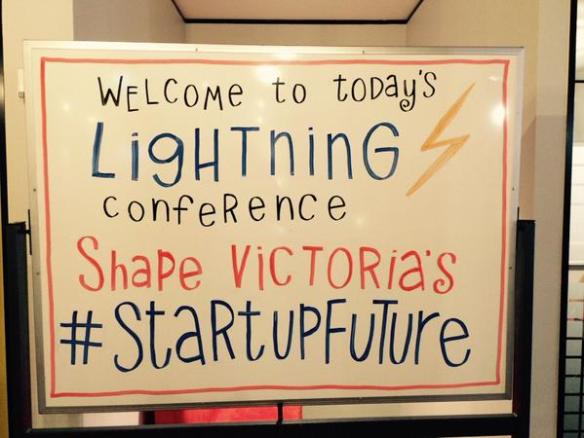
In the recent Victorian State Budget, the government allocated $60m over 4 years to supporting startups, via innovation and entrepreneurship. While not an insignificant sum, it’s still not a huge amount in the overall scheme of things. Having made the announcement, the government hurriedly undertook some rapid community and stakeholder consultation, to figure out how to spend the money. I was fortunate enough to be invited to one of the consultation exercises, a half-day lightning conference organised by Dandalo Partners, facilitated by Collabforge, and hosted by Teamsquare co-working space.

LightningConference

The theme of the Lightning Conference was #StartUpFuture

At the outset, there was an assumption that whatever recommendations came out of the consultation process, a new quango would be formed to oversee the implementation of the program and distribution of the funding. I don’t think I was alone when I expressed my concern that this was rather like putting the cart before the horse – the implication being, “Why seek our opinion, views and recommendations if you’ve already decided the solution?”

To their credit, the organisers took this on board – for example, rather than creating yet another entity, maybe the funding could be facilitated by an existing body such as Startup Victoria – but it felt that the consultation exercise was at risk of “going through the motions”.

Across the various topics that were discussed in the self-forming and self-directed breakout sessions, there were probably 5 key themes:

  1. Community
  2. Infrastructure
  3. Funding
  4. Sustainability and 
  5. “Picking Winners”. 

Here are the main points from each of those themes:

1. Community

There was general agreement that the local startup and entrepreneurial community is well-established, reasonably well-connected (I myself knew about 10% of the participants from various networks) and growing fast.

However, there was also a common view that more could be done to bring entrepreneurs and like-minded people together. For example, how do people know what ideas or projects everyone is working on, how can people find help or make offers of help in terms of matching skills, experience, knowledge, resources? How do we connect suppliers and investors to startups?

Sure, there are numerous meetups and regular startup events, but is there a better way to leverage this potential?  And there are various matching services linking entrepreneurs to mentors, but they are rather ad hoc, and in the case of connecting startups and investors, there are probably more challenges than there are opportunities (see Funding, below).

In short, how can the community come together in a more collaborative way?

2. Infrastructure

It’s quite easy to see that Victoria (mainly Melbourne) has a vibrant startup ecosystem, simply based on the number and frequency of meetup events, founder workshops and hackathons. But there still appear to be numerous obstacles to getting started – from establishment costs and bureaucratic red tape, to tax impediments and access to funding.

Some of these challenges are being addressed at Federal level (e.g., streamlining the company registration process, tax cuts for SMEs, and changes to both equity crowdfunding and employee share schemes). But that’s part of the challenge in itself – at the individual State level, there is relatively little that can be done on fiscal policy (apart from payroll tax and land tax), and all reforms relating to securities financing need Federal legislation and the involvement of market regulators.

The State government has more autonomy around local industry policy settings and planning, as well as making funding available via grants. This means, though, that government is forced to prioritize one sector over another (see “Picking Winners”, below), and a system of grants often results in a mini-industry that is created around grant applications, awards and distribution.

At a practical level, some participants took the view that more could be done to facilitate early stage startups and product prototyping – such as a continuous education and open-enrollment program for entrepreneurs, and co-working spaces for small-scale manufacturing, materials-testing, and engineering. (I am aware of at least a couple of local projects in this space – a biotech co-working lab and an “Internet of Things” open access workshop).

If the State government is looking to plug a gap, investing in R&D facilities might be one option.

3. Funding

This remains the biggie – and a topic previously covered both in this blog, and via numerous commentators and advisers. Even though there are many local pitch competitions, incubators and accelerator programs (plus Shark Tank and That Startup Show make for interesting/amusing viewing…) the elephant in the room is that there are too many startups chasing too few investors.

Competition for resources is positive, as long as it’s an efficient, transparent and accessible market, where the laws of supply and demand are equitable and the rules of engagement are clearly understood.

One industry veteran noted that the local investor community can normally provide small-scale startup funding up to $5m (via “family, friends and fools” and angel backers), and even larger, early-stage equity funding over $50m (via Venture Capital, Private Equity and Family Offices). But in the $5m-$50m range there are far fewer options.

Leaving aside the pros and cons of traditional secured and unsecured bank lending and emerging P2P lending platforms, there is a funding gap that could be filled via Australia’s superannuation scheme:

  • First, we need to find ways to get large retail and industry super funds along with other institutional investors to invest directly in local startups. At present, thanks to the Silicon Valley effect, these instos are more comfortable handing their money to US-based fund managers who then charge a premium to invest the assets in local startups. (I call this a very expensive boomerang….)
  • Second, in the absence of suitable investments for retail investors who may want to allocate part of their portfolio to startup opportunities, part of their superannuation assets could be used to invest in early-stage startups via a form of savings products or fixed income bonds. The retail bond market (such as it is) is heavily skewed towards sovereign debt (treasury bonds) and bonds issued by financial institutions (often in the form of hybrid securities, which are essentially a form of deferred equity). There have been attempts (and even regulatory reforms) to encourage the development of a deeper retail bond market in Australia, but these efforts appear to have stalled.

An enlightened approach to asset allocation could direct even a very small part of the $1.8tn superannation savings into startups that could have significant outcomes. If SMEs are seen as the backbone of future economic activity and jobs (as well as innovation and entrepreneurship), helping to accelerate startup growth will deliver multiple long-term dividends.

4. Sustainability

This wasn’t a huge topic of discussion, but it deserves an honourable mention because it surfaced in several ways:

  • Economic (e.g., making better use of available resources, not funding startups that go nowhere etc.)
  • Social impact (e.g., the growth of social enterprises)
  • Environmental (e.g., the conscious capitalism movement and the importance of “for purpose” enterprises such as B-Corps that want to minimize their environmental footprint)
  • Government (e.g., how to foster startups that want to help deliver better public services, and how to change public sector procurement policies that give startups more of a look-in)

There is also a need to reflect the changing demographics of the workplace, so that sustainable employment opportunities (in whatever form they exist) are made available to both mature-age workers and new school leavers.

So perhaps part of the $60m could be put towards (re)training initiatives.

5. “Picking Winners”

First up, let me say I always get nervous when we put our elected representatives in charge of deciding the fate of specific industries, especially when it’s taxpayers’ money at risk. Call me a cynic, but I’m not sure that picking winners is the government’s forte. I understand the need to support certain sectors that contribute to GDP growth, create employment opportunities, generate taxable revenue, instil industry innovation and develop cutting-edge technology – but the example of the domestic automotive industry is one where political ideology probably got the better of sound economics, as public subsidies eventually came to look like throwing good money after bad.

If nothing else, picking or backing winners is fraught with problems of favouritism, lobbying, murky back room deals and “jobs for the boys”. Better to create the foundations upon which broader innovation and entrepreneurship can thrive, and let the market decide. That way, the government can still claim the credit, and frame the conversation around its role as an enabler.

On the day, the discussion was more about the long lead time before anyone would know whether the program had been successful (assuming we can agree on what success should look like). In reality, re-tooling innovation and entrepreneurship is a 10-year initiative (which is difficult to manage in the face of short-term policy settings linked to 3 and 4-year election cycles).

  • Should we teach entrepreneurship and innovation in schools (alongside coding and STEM subjects)?
  • Should government use local plebiscites to determine where/when/how the funding should be allocated?
  • Should we use the money to directly fund startup founders (rather like the UK’s enterprise allowance scheme in the 1980s)?

There was also a suggestion that the money could be used to promote local startup success stories, in order to foster an understanding of truly viable startups, to identify and fast-track high-potential entrepreneurs, as well as define what is takes (time, money, resources, networking and connections) to build scalable and sustainable startup businesses (i.e., companies generating $250m+ in revenue, not lifestyle ventures or small family owned concerns).

If we do need to pick winners, perhaps we can easily agree which ones they are based on current trends, future needs and demographic demands:

  • Health, biotech and medtech
  • Fintech and big data analytics
  • Education and lifelong learning
  • Renewables and green technologies
  • High-tech engineering and manufacturing

In which case, we should simply help the State government prepare an investor profile, set an optimum portfolio performance target (based on financial returns, innovation scores and a mix of social and environmental outcomes) and give the $60m to a skilled fund manager.

FOOTNOTE:

For further ideas, please see 10 Random Ideas…

POSTSCRIPT:

A couple of further contributions to the innovation debate from AVCAL around tax reform, and from OneVentures around superannuation allocation.


Next week: Medtech’s Got Talent