#FinTech Melbourne’s latest #pitch event

The latest FinTech Melbourne meetup event was the second of their pitch nights. Co-hosted by NAB (at their Docklands Arena venue) and Capgemini (who were promoting the World Retail Banking Report 2016), the pitches were preceded by a panel discussion on a regulatory sandbox for Fintech startups.
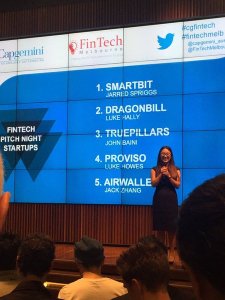
The list of contenders.... (Photo By Andrew Lai, sourced from Meetup)

The list of contenders…. (Photo By Andrew Lai, sourced from Meetup)

The panel was composed of Ben Heap from H2 Ventures, Deborah Ralston from the Australian Centre for Financial Services (who is also the inaugural Chair of ASIC’s Digital Finance Advisory Committee), Sudhir Pai (CTO at Capgemini), and NAB’s Todd Reichmann. This is a topic that FinTech Melbourne has aired before, but it seems despite much industry anticipation and some cautiously positive noises from government, bureaucrats and regulators, there are still, to date, no concrete developments or proposals.

I fully understand the need for formal regulation in financial services, and FinTech in particular, to support investor protection, foster market confidence and maintain industry stability. But the cost or burden of compliance can act as an inhibitor for innovation and entrepreneurship. And of course, regulation and compliance are no guarantees that nothing will ever go wrong, even among our established and highly regulated financial institutions. The debate needs to move on to some practical solutions – such as ring-fencing FinTech startups so that they can trial new products and services in the market, within a limited, defined and narrowly permitted scope and range of activity, under some sort of provisional permit prior to obtaining fully licensed status.

Some members of the panel were in favour of a principles-based regulatory framework (e.g., focus on outcomes and intentions, rather than a reductive model, where nothing is allowed unless it is expressly permitted). The problem with this is that the industry already has to work within a very broad definition of what constitutes “financial advice” that is subject to regulation. So there needs to be a further re-think about what “financial advice” means, especially as between retail, sophisticated and institutional investors; and in turn, I see an opportunity for a more variegated approach to licensing or regulating different advice models: e.g., face-to-face and custom financial planning; scaled and personalised robo-advice; or broader, generalised “class” or “category” advice (by product, platform or service type). (Analagous models to draw on already exist in the areas of therapeutic goods licensing and food labelling measures.)

The panel also thought that partnerships between FinTech startups and established licensees offer one way to navigate the regulatory regime. And I can see that the right type of roboadvice could bring truly independent and objective financial advice on product and brand selection.

There was also a suggestion that the sandbox model could act as an umbrella entity for FinTech innovation. While there may be some merit in the idea (e.g., for regulating the API’s that provide access to customer financial data and credit history – although these should already be adequately covered by data protection and privacy requirements), I am sceptical of regulators’ ability to innovate. Plus, the key retail investor failures during the GFC were about investor ignorance, not just “poor”advice; so the need for financial literacy cannot be overstated.

On to the pitches themselves, which were judged by Ben Heap, Deborah Ralston and Rohen Sood from Reinventure:

Smartbit

Offering an automated finance layer for the Internet of Things, Smartbit has already built a secure, Blockchain-backed price index. The goal is to enable automated, real-time payments, between any two devices connected to the internet. They see themselves as the “Blockchain of Things”, and proceeded to give a cute (if somewhat pointless?) live demo of switching on a LIFX bulb with a Bitcoin payment token.

The judges were curious to know what the actual use case was (apart from turning on light bulbs…). In reply, they were told that Smartbit can deliver real-time settlement (unlike the 15 minutes delay of an US competitor), and is designed to support micropayments. Personally, I think the technology is already proven, but the need less so, at least from a B2C perspective. The fact that so many banks, exchanges and clearing houses are exploring Blockchain solutions means that it’s day will soon come when it is not just a “Bitcoin thing”, but will be an integral part of financial services, data solutions and digital asset management.*

Dragonbill

This is a smart payments platform to reduce cashflow stress. The main benefit is to shorten the time SME’s have to wait before they get paid. It offers both a secured payment facility (escrow), and an express payment option (e.g., a tradie can get paid as soon as they finish a job).

The chosen paths to market are social media, accountants, business advisors and mentors, and (unusually?) sports clubs. But it becomes clearer when you consider that clubs need to manage multiple, small membership payments; and many members of sports clubs are SME owners, independent tradies and sole proprietors. Dragonbill are also setting up a partnership with Xero accounting software.

The main questions from the judges concerned the ability to scale the business, and whether Dragonbill generates interest on amounts in escrow.

Truepillars

Another version of the peer-to-peer lending platform for SME borrowers, the business model is based on an online auction system where, for as little as a $50 bid, investors can bid on specific loan requests, with risk-adjusted interest rates, that are also determined by the number and amount of competing bids.

Access to traditional SME loans under $500k is increasingly limited as banks need to allocate more risk-weighted regulatory capital to cover their SME exposures, making them an inefficient and expensive use of bank capital.

The Truepillars platform offers borrower and investor dashboards for tracking and portfolio reporting, but the panel were worried that it wasn’t a unique proposition. However, unlike some of their competitors, Truepillars offers loan terms out to 5 years. It would also be interesting if investors (lenders) could build proper fixed income portfolios (by loan duration, yield curve, exposure type, recourse/rollover etc.), and if borrowers could cap the number of, and limit their exposure to, individual bids or lenders/borrowers.

Proviso

Claiming to be transforming lending, Proviso work with lenders to streamline the submission of borrowers’ financial data and bank statements in support of their loan applications. The prospective borrower logs into their account and gives permission for the lender to access their banking information, but Proviso does not “see”, hold or store the customer data – it merely acts as a pass-through. The goal is to reduce borrower application abandonment, and the service is already being used by 180 financial institutions – generating 60,000 requests per month. The business is being driven by enhanced customer experience, and ASIC directives on more prudent lending processes. In short, they claim to offer better, faster data.

The judges wanted to know how Proviso compares to Yodlee: “we’re local, and less painful to use” was the response – meaning that proximity offers speed and local market knowledge. Finding a market among non-conforming customers, Proviso is also looking at providing validation services. But in my mind, there is a risk that Proviso could be displaced by an industry-owned or regulatory mandated platform or utility (such as the creation of PEXA for real estate conveyancing and settlement.)

Airwallex

With a tag line, “cross-border payments made easy“, this another solution aiming to  transfer money between people, regardless of location, bank, currency, etc. Currently, Airwallex is focussing on Asia Pacific, and is the only Australian holder of a cross-border license to transact in Chinese RMB. It has also integrated with the three largest payment platforms in China – AliPay, WeChatPay and UnionPay, and built an API for e-commerce solutions. Airwallex claims to be faster, cheaper and simpler than the competition, using real-time FX rates.

The panel was naturally curious about how the platform is addressing anti-money laundering concerns and complying with counter-terrorism legislation. In order to offer lower fees than PayPal, and by only taking fees from the FX spreads, Airwallex has to automate the transaction process to achieve mid-market prices – but does the increased automation heighten the risk that the platform can be used for nefarious purposes?

After their deliberations, the judges declared Proviso as the winner – hard to argue with that sort of market traction.

*Note: Declaration of interest – I have recently joined the team at Brave New Coin, a FinTech building market data and infrastructure solutions for Bitcoin and Blockchain.

Next week: #StartupVic showcases the next batch of startup hopefuls


4 more #startup hopefuls pitch at Startup Victoria

Is it just me, or are we seeing more and more B2B startups and 2-sided market makers, rather than consumer/retail opportunities? Based on the latest pitch night hosted by Startup Victoria it feels like B2C and “pure” app plays are in the minority. (Enterprise solutions are gaining traction, especially among portfolio companies.) Of the four latest hopefuls that pitched at inspire9, half were straight B2B, the other half were aiming at 2-sided markets.

Screen Shot 2016-04-11 at 11.16.52 AMFirst, I should declare that I know one of the teams who pitched, and I also know one of the advisors working with the other startups. But I have not let that influence my comments.

Second, the comments are taken from my contemporaneous notes, and appear in the order in which the teams pitched. That way, I hope to convey more accurately how the night evolved from the spectator’s point of view.

Third, the format was as follows: pitch, followed by comments and questions from the panel of judges, plus if time permitted, some audience Q&A – all ably compered by Monsieur French.

Pundit Connect

The goal is to streamline the recruitment of professional consultants. Currently at the pre-commercialisation stage. Building a 2-sided digital market place – a platform for posting project briefs and allowing consultants to bid on them.

Part of the current challenge is the lack of transparency/visibility on new projects – but there is also a lack of trust online.

Platform components include:

  • Member Connect – P2P, nested, trusted networks, with a particular focus on local government and local procurement (they see a growing need among regional economies)
  • Pundit Score – ranking tool built with help from Deakin University
  • Professional Services market place
  • Revenue model – subscriptions, fee for service, commission, data sales
  • LinkedIn integration – including individual consultant accounts

When asked about building critical mass, the team pointed to the fact that they are seeing 3 or more quotes for some projects posted in the market.

There was a suggestion that the platform could be reverse engineered, to enable clients to target niche talent, plus an option to work with professional associations.

When asked about Expert360, they felt it’s not really a competitor.

Angel Auctions

To paraphrase, this is like “Gumtree with a social conscience“. People can sell unwanted items online, the proceeds are donated to a charity of their choice, and the seller can claim a tax deduction against their donation. Meanwhile the site deducts a commission before distributing the proceeds to the charities.

The so-called “parallel economy” (charities and NFP) is considerable – 55,000 entities with DGR status, and 600,000 registered NFPs: 9 new charities are registered each day in Australia.

The “alternative” options for fund-raising are spam, telemarketing or street sign-ups.

Angel Auctions provides a private branded application for each charity. However, despite some active charity partners who have already signed up, the platform needs both traction and critical mass to develop multiple single-sided markets.

Meanwhile, there is some controlled leakage to aggregate auction sites.

The judges were somewhat critical of the relatively high commission rate – what value does this represent? They also asked about the integration with social media, and were probably a bit concerned by the team strength – it was clear this is something of a personal pet project.

When asked about the seller’s eligibility for a tax deduction, apparently there is an ATO ruling that the sale proceeds are treated as cash when donated by the seller. There was also a related question about transaction verification which I’m not sure was fully addressed.

Product Lighthouse

This is a content management and distribution platform for product information. It’s designed to make product info more accessible – content which is the lifeblood of consumer electronics retailing between manufacturers and retailers.

Currently, content is managed and posted manually, leading to data inconsistencies, errors, and inefficient distribution. According to the team, their “unified approach works for all”. They plan to further monetize the business (“pay to publish” model?) and add value through a standardised CMS and distribution platform. In particular, they are reducing the  time to load individual SKUs onto the system.

One of the key universal benefits to equipment manufacturers, distributors, wholesalers and retail clients is the accuracy and integrity of the data input loaded by manufacturers, a process which will increasingly be automated and backed by a data dictionary.

So far, The Good Guys are using the platform as a channel to market, and Samsung is starting to load inventory.

Currently seeking capital of $300k.

The judges wanted to know more about the customer discovery process, and felt that the pitch perhaps contained too much information. In response, the team said their focus was  based on actual industry experience and the known need.

MyMic

This is an app/software solution that turns smart phones into live communication devices at events, such as conferences and seminars.

Born out of necessity, the team has addressed the “dilemma of the last mile of delivery”. Anyone with the app loaded onto their smart phone and a connection to the event’s PA system running the installation can submit content via their device. (Apparently, audio-visual can represent up to 40% of event costs.)

The app can be used to broadcast live voice, capture text and comments, as well as audience polling. The system is platform agnostic, and the IP is being registered.

Asked about monetizing the technology, the team are proposing a mix of per event, per month and per user licensing models. At this stage, the product is still in beta, but the team were alert to the opportunities in Asia. (Sadly, due to the Pitch Night’s “No demo” rule, we were unable to see the system in action. Pity!)

Finally, there were some technical questions on latency and live operation. It can run on a WiFi network, and can be controlled by a moderator. Other connectivity options may be available, including Bluetooth and wireless.

Later, as part of an open Q&A with the audience and the teams, the judges gave some general feedback to the teams:

  • focus on a single purpose or proposition;
  • don’t forget to introduce yourselves properly;
  • get appropriate tech skills on the team; and
  • be positive (as well as authentic)

On the night, Pundit Connect came first based on audience votes.

Next week: “I’m reframing, the situation….”

#StartupVic launches new-look #pitch event

The team at Startup Victoria have been working hard over the summer: not only have they brought on a whole bunch of new commercial sponsors, but they have also launched a new format for their pitch nights. The idea is to invite startup founders to register their interest in pitching to a panel of judges. The contestants get the opportunity to compete in front of a live audience, for a chance to win face time with local VC’s, along with some other startup goodies.

global_446720634It’s not Shark Tank (there’s no hard cash on offer), nor is it an open mic night (there is a pre-screening and audition process) – but it does enable entrepreneurs to test their pitch, get some early exposure, and receive some great feedback and advice. It also doesn’t matter what stage the startups are at, although businesses that already have some market traction or have built and tested an MVP are probably in a better position to compete.

The launch night saw pitches from four startups, who are at various stages of development. In no particular order they were:

Ad Hoc Media with Passenger Pad, a digital Out Of Home advertising medium for taxis, using interactive touch screens inside the cab. To date, there has been a low take-up rate of this technology by the taxi industry in Australia, mainly due to regulatory issues, but the landscape is changing. With a background in taxi electronics and hardware, the founders are about to launch with 400 taxis in Melbourne, and plan to expand to other cities. There is no doubt that using a combination of passenger, location and fare data (duration, time of day, pick-up and drop-off points), the screens will be able to offer brands and their media buyers targeted audiences and in-depth customer analytics. The challenge will be to offer advertisers a competitive rate card, especially as this is essentially a new medium: it offers viewer choice like TV, can serve up targeted content like web or mobile, and is ideal for special offers linked to location and time of day.

Global Patient Portal offers a free platform for e-health records. Having already launched in Kolkata, India with 40,000 users signed up in 11 weeks, GPP is aiming at lower socio-economic communities and emerging markets. The initial business goal is simple: to support ownership of e-health records by users. Using a combination of bootstrapping and NGO funding, GPP has been able to hire a team of “scribes” in India who sit in on patient consultations and capture the medical notes, which can then be referred to at the next consultation. (Currently, a lot of time and resource is wasted because patient records are captured on paper, which is easily lost once the patient leaves the clinic.) Commercial revenue will come from selling anonymized patient data (subject to legal compliance, privacy obligations and data accuracy) for research and policy planning purposes. In choosing to launch in Kolkata, GPP was aware that in some more affluent urban communities in India, the favoured means of patient communication is WhatsApp?, so they would be less likely to adopt a separate platform. Also, in Australia, having talked to GPs about the various government attempts to establish the e-health system for patient records, I am aware of a reluctance within the medical profession to buy in to the scheme: first, there is no financial incentive for them to capture patient data via a common e-health platform; second, why would they want to share patient data with their competitors?

prevyou is aiming to disrupt a large part of the recruitment and job ad market, by directly connecting students with job opportunities at SMEs. The two-sided market effectively crowdsources available jobs from SMEs, who typically do not have access to the hiring market or to full-time and dedicated HR resources. The goal is to streamline the hiring process, and to offer a mix of standard and premium services (e.g., video resumes, applicant screening, skills matching, personality profiling etc.) and later to add validation of applicant credentials and qualifications. In return, the business will take a commission once a job has been offered and/or candidate hired. While the focus is initially on capturing the market for casual and part-time jobs, the judges urged them to look at the enterprise HR market (under an outsourcing or white label model?). Looking ahead, there is the opportunity include student internships (although, like the legal issues with Year 10 work experience, internships and placements present additional challenges such as achieving student learning outcomes and other employment law issues).

OurHome is an app to help families manage, share and track household chores, so that children learn to take some responsibility around the house, and they can get rewarded for their contribution. It emerged out of an earlier app, Fairshare, that was aimed at shared houses. Apparently, people living in shared houses don’t care enough about whose turn it is to clean the bathroom, or are happy with paper charts and lists on the fridge door. Describing itself as “an integral household tool with indirect network effects (i.e., like Google, not Facebook)”, OurHome also claims to be the #1 chores app. Using advanced algorithms, and other features such as customisation and Dropbox integration, the app also introduces an element of gamification through rewards (intrinsic and extrinsic). For busy families, it replaces those fridge notes and task charts (although, as the judges noted, there’s no calendar yet). Of particular interest is the very positive feedback the team have had from families who have children with ADD.

Despite a few technical glitches (concerning mics and audio quality), the first new-look pitch night was a success, and Global Patient Portal won the on-line audience vote. I was luck enough to meet with one of the teams a few days later. They thought it was a useful experience, but they hadn’t quite known what to expect, and they had anticipated more of a grilling from the judges and tougher questions from the audience.

Next week: More In The Moment


Another weekend, another hackathon….

Last month, I competed in my second hackathon of the year, the #HSCodeFest sponsored by the Herald Sun and News Corp, and hosted by Melbourne University’s Carlton Connect. I’m pleased to say that our team of four, which was only formed on the first night, came 3rd in the pitch competition – with an idea for a news quiz app.

Screen Shot 2015-12-18 at 3.44.56 PMThat particular weekend was quite an eventful one for local startups – not only were there at least two other hackathons being held in Melbourne at the same time, but the State Government also announced its LaunchVic initiative. Small Business Minister, Philip Dalidakis found time in his busy schedule to address the #HSCodeFest participants, which was a great incentive. The previous weekend saw another Startup Weekend event, and last weekend Carlton Connect hosted yet another industry hackathon sponsored by the GE Industrial Challenge. And of course, since then we have had the Prime Minister announce the National Innovation and Science Agenda. To paraphrase Mr Turnbull, there’s never been a more interesting time to be a startup….

Having participated in Startup Weekend’s first #FinTech hackathon back in March this year, I was a lot more prepared, and had a much better idea of what to expect. Even though I didn’t pitch a specific idea on the opening night, I used my previous team-building experience to make sure we had a balanced mix of skills and expertise. I was also clear to make sure that once we had agreed on the project idea, everyone had specific roles, and we constantly checked in on progress and next steps.

As usual, the team generated far more content, data and ideas than we actually used in the pitch presentation. We also kept it very simple, by focusing on the key concept, demoing an MVP, outlining the commercial strategy, describing the business plan, and establishing just enough knowledge and awareness about the market opportunities, even though it had not been possible to fully scope them. For an insider’s view, check out my team-member Nathan’s blog.

We have seen over the past 12-18 months that the hackathon model is being deployed in many different ways to try to stimulate innovation and generate new business ideas. Even government departments and public utilities are getting in on the act, by enabling participants to access data sets, software, technology and APIs to see what they can come up with. Large corporates, who struggle to embed innovation into their organisations, are also holding internal competitions drawing on the experience of meetups, hackathons and pitch nights.

I only see this as a positive development, as long as the energy, enthusiasm and experience can be channelled into meaningful outcomes, which enable in-house talent and external expertise to combine to build great products and services that customers want, and/or identify and deliver significant process improvements and efficiency gains.

However, part of me is sceptical – as someone who is probably much older than the average age of a hackathon participant, I’m still amazed how many of my contemporaries either have no idea or simply don’t “get” the hackathon or meetup concept. They seem astonished that anyone would want to get together with total strangers, and spend their evenings let alone a whole weekend working with them, for “free”. To those of my peers who may see it that way, I would point out that participating in these events is a cheap and effective way of accessing new ideas and skills, meeting talented people, and acquiring new skills and knowledge.

Finally, if your organisation is thinking about running a hackathon or similar event for the first time, I’m more than happy to share my insights – contact me via this blog.

Since the holidays will soon be upon us, Content in Context is taking a short break. Normal service will be resumed on January 5. To my many regular readers and followers, I wish you all a safe and peaceful New Year.

Next: Surrealism, Manifestos and the Art of Juxtaposition