Startup Victoria’s #Pitch Night for #Startup Week

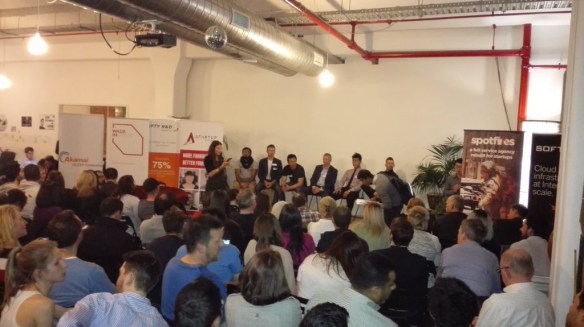
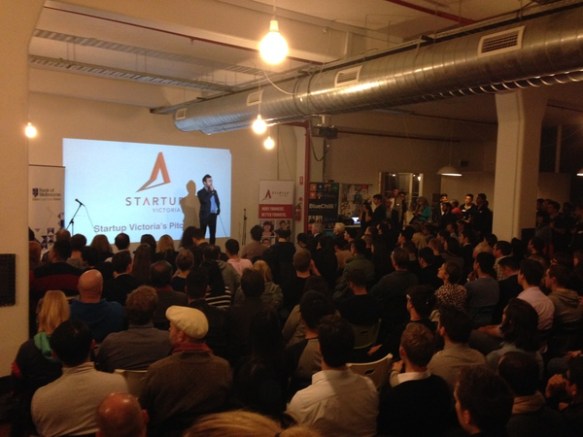
The grand finale of Melbourne Startup Week was Startup Victoria‘s regular pitch night held at inspire9. Six months in, and this new monthly format has become a major fixture on the startup calendar, judging by the audience size, and the range of startups applying to pitch. There are still a few teething problems (the AV quality is a bit variable, and some of the judging panels are probably too “soft”…), but it’s established something of a benchmark against which other pitch nights might be compared. This month’s cohort covered medtech, wellness and the greetings industry.
StartUp Vic 240616

Cardly

Cardly is an online service that allows users to send personalized greetings cards to friends and loved ones. Under the banner of “you write, we post”, customers can choose from a range of artist-designed cards, add their own message, and Cardly will then print and send the card from a location as close as possible to the recipient (currently London, Sydney and New York).

A variant on the familiar 2-sided market model, Cardly has built a community of independent artists who supply the card designs. Artists are charged a sales commission on each order, and they get their own store front on Cardly. And for anyone struggling for words, there’s a range of predefined texts and doodles.

Because this is a print-on-demand model, using digital printing, there is zero wastage (unlike the traditional greeting card industry where over-production and limited distribution are commercial headaches). However, even with some “handwriting” fonts, there are some design and user limitations, which something like the Sensel Morph touch-sensitive track-pad may be able to address?

Cardly is aiming to take a chunk of the retail market and disrupt the global greetings card industry. The judges took a slightly different view. Based on the founders’ own data, consumer customers will probably send an average of 12 cards per annum, and at $6.45 per card, it’s a tough sell. However, by looking at a lower cost per acquisition, addressing the corporate market and offering a white label solution, the business would be in a better position to scale. There was also a suggestion for an engineered viral solution to drive traction through collaborative cards, and other ideas for partnerships (e.g., gift buying services and gift cards).

Cardihab

Cardihab (“Get Back To Life”) has appeared in this blog before, and is a CSIRO spin-out that has developed a mobile support solution for cardiac patients via an app and a patient/GP portal. As someone whose father is recovering from major heart surgery, this pitch got my personal vote!

The success rate is staggering – patients using the app are 70% more likely to complete rehab. So far, four hospitals have signed up, with three more in the pipeline. As well publishing their research, the founders see Cardihab as being a broader platform for managing chronic illnesses.

Currently in the process of getting investor ready, the proposed business model will charge an annual license for hospitals, plus a per patient fee.

The judges had some questions about the potential market (“Anyone with heart disease”) and wanted to know a bit more about the bench strength of the team.

Black

Staying with the medtech and after-care theme, Black‘s modest goal is to “revolutionise healthcare”, via an in-home observation solution that scans patient movement and analyses interaction with their helpers. The scanner strips out personal data (features, attire) using skeleton tracking to monitor movement and falls, while learning from patient gestures. It can use real-time alerts to contact helpers, carers and emergency services.

The scanning software is currently trialing in casinos to refine the machine-learning algorithms, and all trials are subject to ethical approval.

Although still at a conceptual stage (in terms of health care applications), and notwithstanding privacy concerns, this project demonstrates that predictive tools will be vital to helping the elderly and the infirm to continue living independently in their own homes, which will have significant advantages to the cost of long-term care, preventative health services, patient rehabilitation and after-care services. There are doubtless other, similar solutions in development, and the outcome will likely be a mix of blended services based on ease of use, cost of roll-out, system interoperability and patient efficacy.

Honee

Last to present was the team from Honee which is bringing digital connectivity to the wellness, fitness and beauty industry. The solution they offer is designed to make it easier to discover and book an appointment for a treatment, consultation or workout session, by connecting merchants and users.

With previous international experience at Delivery Hero, Quandoo and Zomato, the founders have strong startup business credentials in adjacent markets – connecting consumers to service providers via search discovery, customer reviews, personal recommendations and proximity.  Of particular interest in this sector is the growing “wellness travel market”.

There are undoubtedly competitors already working on similar solutions; and it may just be that I’ve seen far too many pitches in the past few years, but I’m sure there was a startup out there offering a “just in time” service to help find and book appointments for personal services – Fit Me In? – and I recall another comparable startup idea for restaurants to offer last-minute menu specials via a location-based app.

Nevertheless, as we know, execution is key, and the judges asked about the huge cost to build a consumer brand – hence Honee is focusing on service providers to get their brands on line. There is an MVP in pre-launch, and Honee has built a mobile responsive website, with a grant from the Melbourne Accelerator Program.

After the vote (and thanks to technology, the results of which were available in minutes….) Cardly was declared the night’s winner.

Next week: Moving #innovation from “permitted” to “possible”

Level 3’s Enterprise #Pitch night

As part of the recent Melbourne #Startup Week, IT consulting firm, Versent hosted a B2B pitch event at their product development lab, Level 3. Introduced by Thor Essman, the judges for the evening were Grant Thomson from York Butter Factory, Paul Naphtali of VC fund Rampersand, and Carl Rigoni, Head of Digital at Australia Post. It presented a very focussed cohort of enterprise solutions, that covered employee comms and engagement, design thinking and cybersecurity.

Screen Shot 2016-07-03 at 2.14.42 PMPax Republic

Pax Republic is positioned as an employee engagement platform that grew out of the founders’ background in mediation. Recognizing that organisational change programs have a high failure rate, the founders explained that lack of project or employee data isn’t the problem; it’s a shortage of actionable insights and recommendations.

The solution offers text-based content and scripted dialogue combined with AI and online facilitators. Many traditional enterprise tools don’t work, either because they don’t reduce time and cost, or they can’t scale.

When asked if AI can measure sentiment or mood, the founders explained that the system makes use of emoticons to capture employee feedback plus keystroke analysis. In terms of a commercial model, the goal is to train up internal facilitators to deliver the service, rather than getting involved with specific change management projects.

The judges felt that the pitch needed to refine the problem statement and the solution proof points, as well as explain what makes this solution different. In particular, who is the buyer? It’s also important to tell the sales story, and expand on the risk transfer and pricing benefits.

Forticode

Forticode has developed an elegant and deceptively simple password protection solution, to remove the risk and costs of password resets for their corporate clients. Basically, it can support multi-factor authentication using colour coding and a randomized keypad, incorporating character sets as well as emojis.

It can provide context aware authentication, and native protection from endpoint hacking attacks, via a plug-in architecture and 3-factor authentication, using patented technology.
According to the founders, finger prints are immutable, but still do not provide 100% identity confirmation on touch screen devices.

There were questions from the judges and the audience about alternative solutions. Compared to an IPA gateway for trust and authentication or password aggregators, Forticode offers a much more robust solution and can support machine-to-machine verification.

The sales model is to target security teams within risk and compliance departments, and price on a per user per month basis. Importantly, there is no third-party software in the stack. And, there was even an offer to introduce the founders to Auspost….

Naked Ambition

With the tag line of “Always Be Creating”, Naked Ambition is a consultancy for innovation and design thinking. Their process is to focus on future needs, help clients get closer to their customers, and in doing so, help employees to leverage customer insights. The ultimate goal is to make design thinking skills ubiquitous. Naked Ambition’s aim is to embed the teaching in the organisations they work with.

The judges questioned who exactly is the customer, and what segments do they work in? There was also some discussion whether the service was more about personal branding and intrapreneurship, rather than pure solution design.

In particular, the judges wanted to know what gives Naked Ambition the “license” to offer their services? Despite hiring a leading design thinking expert from IBM, there was a sense that there is an oversupply of similar services, and that clients are not looking for yet another program. Instead, they are thinking about “buying units of innovation” for specific projects, as and when they need them.

Konnective

Last to present was Konnective, a business I have blogged about before. In short, this is an employee messaging app for frontline staff, many of whom do not have corporate e-mail addresses, let alone access to a their own desktop computer.

As part of the product development, Konnective now offers Groups, dashboards, analysis of what’s working and employee reach. Charging a basic annual fee per employee, Konnective has clients in mining, healthcare and manufacturing. The platform supports OH&S comms, promotes shift availability that can reduce agency hiring fees, and help reach hourly employees who don’t access corporate e-mail.

The judges asked about BYOD, and the risk of/resistance to having organisational data on personal mobile phones. Plus, why Konnective and not, say Yammer or Slack? These are answers that need to be made more explicit. Finally, Konnective is still working on data analytics, and there was a suggestion of opportunities among travel companies and tour guides, but that would require some multilingual capabilities.

On the night, Forticode won the judges over and took out first prize. This was the second of these events, and I look forward to attending more in future.

Next week: Startup Victoria’s #Pitch Night for #Startup Week

University Challenge – #Startup Victoria’s Student #Pitch Night

There were around 500 people in the audience for last week’s #StartupVic University Startup Battle, which either says there was nothing better to do on a chilly Melbourne evening, or that this new Meetup format is working – or that the students of today are less interested in finding a job, and more interested in building their own career opportunities that connect with their purpose. (Our political leaders should take note….)

A sell out audience for the University Startup Battle (Image by Stefan Welack sourced from Twitter)

A sell out audience for the University Startup Battle (Image by Stefan Welack sourced from Twitter)

After a series of campus competitions, the finalists on the night were representing 6 of Victoria’s universities, and revealed a wealth of talent, ideas, innovation and inspiration. In order of appearance, the pitches were:

InternMe – (Victoria University)

With a tagline of “Experience the Experience”, this is a 2-sided market for graduate recruitment, that revealed some interesting stats about the student employment market.

Revenue is expected to come from fees for successful placements, and job advertisements. The business plans to cover work experience, internships, part-time and temporary work during study, as well as permanent and full-time roles.

Currently sourcing leads via LinkedIn and social media (notably Instagram), the founders say they may include psychometric profiling tools for better matching applicants with opportunities.

The pitch was to raise $100,000 for website development, but as the judges commented during the Q&A, the biggest challenge is engaging employers. As regular attendees to these pitch nights will recall, this mismatch or disconnect between students/graduates and employers continues to provide startup opportunities.

Printabox – (Swinburne University)

This website is designed to reduce the time, cost and complexity of ordering short-run branded boxes. Basically a self-serve model, the founders have spent $500,000 in development costs, primarily on a proprietary design tool. The resulting products come in 3 standard sizes – perhaps more customisation will become available?

The target clients are the 44,000 online stores in Australia who often need small numbers of branded boxes for sending out customer orders. But as the judges noted (based on a quick online search) there does appear to be a lot of competition. And although Printabox claims that their source code is protected, they have not applied (or are unable to apply) for a design patent.

Mech X Innovation – Project Ora – (Deakin University)

The founders have developed a hardware device that fits on standard tablet computers, and is designed to help children reduce and prevent eyesight damage caused by too much screen time, and by being too close to the device.

Essentially a Bluetooth-enabled accessory linked to an app, Ora monitors the amount of user screen time, proximity to the device and ambient lighting, and can be used in conjunction with “time outs”, scheduled messages and reminders to “go and do something else”. It can be semi-customised, so that parents can create a reward system, for example.

According to the designers, the competitor products (Appomate and samtime) are app-based only, and focus on time and distance – not lighting. Ora may also integrate with other devices, e.g. FitBit, but the target market is children and teenagers up to age 18, and their parents.

Asked about their path to market, they are planning a crowdfunding campaign. The key to adoption, though, will be via schools (who either provide or prescribe what devices pupils use) and schools suppliers (e.g., digital text books and e-learning tools).

ICallDibs – (Monash University)

This idea grew out of direct user experience, namely how can overseas students coming to Melbourne buy and sell furniture? The business is aiming to provide a market place for “Second Hand Furniture, First Class Deals”.

The biggest challenges faced by international students when buying/selling furniture are transportation, timing and finding buyers/sellers. The business will offer bundled services, including storage and removals/delivery, via partnerships.

The company aims to target international student agencies, and will ensure better matching between buyers and sellers (although they may want to consider changing the name unless they can trademark it….).

Rather than an “Ask”, the team offered a “Give” in the form of a customer discount for the evening’s attendees.

When asked about logistics and insurance, the founders clarified that the counterparts (buyer and seller) bear the direct risk. The business takes their commission upfront, then release the order details to the customers.

Assignment Hero – (Melbourne University)

It felt that this app, a collaboration tool for group work (sort of Slack for education?) was speaking to the converted, given the audience response. In short, having access to lots of different collaboration tools sounds great, but they each only do one or two things (albeit, really well). And if you use more than one app, you end up with too many tools and too many notifications.

While students may hate group assignments, they’re an important aspect of learning how to work with other people and acquiring other soft skills. They also seem to comprise a greater component of student assessments – possibly because they require less direct teacher-student face time?

Rather than build a whole new system, the founders have opted for native integration with Google Docs, plus some dashboard reporting tools (including the amount of individual input to a project).

The app is free to end users, but will generate revenue from education providers (enterprise sales) and on-demand services and commissions. When asked about existing tools like Moodle and Blackboard, the founders noted that these were designed for teaching, not collaboration.

It was also noted that existing productivity apps are not easily accessible by students (although no doubt, as with education content providers, enterprise app vendors will make student versions and pricing available). Plus, the “edtech” sector is of particular interest when linked to life-long learning, professional development and self-directed study.

Eat Up – (RMIT)

Finally, Eat Up is a social enterprise trying to address the number of school children who turn up at school without anything for lunch – estimated to be as many as 1 in 8 schoolchildren. Personally, I find this an indictment on our society – why should anyone in Australia need to go without basic food? – but the causes/reasons are far too complex to address here.

Essentially a partnership for sourcing, assembly and distribution, Eat Up has created a service model which they hope to roll out in more and more schools. They tap into the established Food Bank network for supplies, engage TAFEs to prepare the lunches, and use OzHarvest and SecondBite for logistics. There has also been support from Virgin Australia, ygap, Karma Canteen and Education Changemakers.

Eat Up aims to avoid passing on the costs to kids, parents or schools, and in part takes inspiration from another social enterprise, Thank You Water.

During a panel Q&A, the founders were asked about the apparent lack of technical skills or resources on their teams. In response, it was noted that there are many open source apps, available templates and market places for code and plugins. One founder commented that despite studying computer science, he used very little of what he learned to develop his app.

Revealing another apparent weakness in their pitches, the founders were quizzed on their respective sales models, costs of acquisition and pathway to revenue. The responses suggested that the startups risk being limited by their own inexperience, and that they each need to do more market analysis, assessment of customer willingness/ability to pay, and identify the best ways to scale their businesses.

There was also a lack of clarity around near-term goals and milestone planning.

In the end, the winner was Assignment Hero, no doubt reflecting the needs of the audience, plus the fact that the business has gained traction with some universities.

Next week: ASIC’s new regulatory sandbox for #FinTech #startups

#StartupVic showcases the next batch of startup hopefuls

Startup Victoria‘s monthly pitch event is gaining momentum, and continues to draw a good crowd at inspire9. It can’t just be the beer’n’pizza, can it? April’s event brought together an intriguing mix of startups – from the FinTech, SoMe, health food and enterprise sectors.

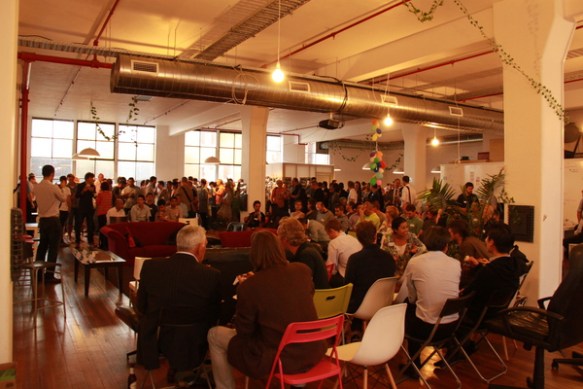
If it's the last Tuesday in the month, it must be Startup Vic's pitch night at inspire9.... (Photo sourced from Meetup)

If it’s the last Tuesday in the month, it must be Startup Vic’s pitch night at inspire9…. (Photo sourced from Meetup)

Liive

This app-based solution claims to have more than just its finger on the pulse of Melbourne’s nightlife, in the form of a “Teleportation” experience. If you want to check out what’s going on at that club or bar before you leave home, Liive will beam visitor and sponsor sourced content onto your smart phone. It’s sort of a social media cum streaming cum location-based service, which promoters and venues can license and then encourage patrons to share their video grabs (in return for free drinks….).

While the app is free to download and use by individual customers, revenue comes from event and venue promotion, and is pitched as a user experience that enables patrons to “try before they buy”. Liive reckons it has got the CPA down to A$1.68, and is experiencing 20% weekly growth based on user numbers.

Already signing up some significant leisure businesses, Liive seems to be making a splash within a relatively short space of time. In the words of one of the judges, I’m probably not the target demographic, so it’s difficult to relate to this concept. Unsurprisingly, students are a key market, but having spent time this past week facilitating a team of international students, I hope the founders can think of culturally inclusive uses and ways to promote their app.

I was also reflecting on things like privacy, content ownership, and whether this is a solution in search of a need – why not just use other, existing SoMe platforms? But it was good to hear that the content is moderated and subject to take down notices.

Estate Baron

This FinTech business is bringing equity crowdfunding to property development – and is clearly designed to displace banks. With a background in residential mortgage-backed securities (RMBS) the founder has some relevant market experience.

The business model does away with the need for traditional investor syndicates, and is offering an alternative source of funding for property developers. To be clear, investors are taking equity in the entity (usually a special purpose vehicle – SPV) that is launching the development, not the properties themselves – so they do not get any title over individual units or apartments.

Given the need to be fully compliant with AFSL and MIS requirements, Estate Baron has a retail financial services license, and issues full product disclosure statements for each venture. So far, it has raised over $2m in project funding, from over 1100 investors.

The pitch was at pains to explain that Estate Baron holds an RG146 license for general advice only, not individual advice, so potential investors are advised to seek professional financial and investment advice suitable and appropriate to their own needs and circumstances.

Estate Baron charges a capital raising fee, which allows developers who don’t typically hold a financial license to access more investors. Currently, funding is usually done via syndicates, off-line, or via managed property funds etc.

The founders acknowledge that the idea originated overseas, and is part of a global movement. They even mentioned the possibility of using a Blockchain solution for deal origination and management.

Personally, the idea of crowdfunding for property development is appealing, but I’d like to see more market engagement before determining whether this is the right (or only) model.

Athlete’s Gift

Originally launched under the name “The GeneSpark”, this food business is promoting customised menus and recipes based on customers’ individual DNA. I think the recent change of name was prompted by brand confusion, rather than any medical concerns, but I was still left unclear as to what this business actually offers.

If I am understanding correctly, the products are special mixes of super foods, nuts, seeds and berries designed for high-protein, high-energy or recovery – using all-natural, organic and raw ingredients. Customers make their own product selections, and can even develop personal recipes to suit their DNA. But the business does not conduct DNA tests, and I don’t believe there is any verification process to ensure customers are making appropriate or safe choices – which would possibly stray into medical territory?

I sort of understand the business model (3-month subscription packages, distribution via gyms and sports clubs, etc.), and I even applaud the long-term goal of reducing chronic diseases. But I was left with the question: Is this proven science, another food fad or a product placement strategy?

Konnective

Konnective has developed an enterprise solution that brings an employee messaging tool for frontline staff, regardless of their location or whether they have access to a desktop computer.

The tool was originally developed for schools (to replace the paper-based parent communications), but is finding traction within the health care, hospitality, mining, manufacturing and services sectors. To my personal surprise, many workers in these industries do not have corporate e-mail addresses. Based on push technology, it’s cheaper than SMS. The app is free to end users, but businesses pay a tiered price based on the number of employees, at $10 per person per annum.

It’s flexible enough to support mixed content types, and is managed via a back end admin platform. Already, some major public companies are on board, with the founders claiming to have 100+ clients.

To clarify, this app is about broadcasting, not team collaboration or project management. It can be used for two-way communications with employees, but only for structured content such as surveys and polls. It was not clear whether the back-end allows messaging to be targeted by location, function, department, team or even seniority – maybe not everyone in the company will have the same information needs?

I can see an opportunity among organisations that engage large numbers of contractors, freelancers and casual staff who might not have company-based individual e-mail accounts. But part of me thinks that with increased smart phone usage and BYOD (plus the fact that most e-mail clients are easily configurable to mobile devices), what makes Konnective attractive? Clearly it’s doing something right as it took out first place!

Next week: A new co-operative model for equity crowdfunding