A couple of No-No’s for content marketers

If you are just getting started in content marketing, or if social media is still a bit of a novelty for your organisation, there are a couple of things you should definitely avoid when attempting to use third-party content for your own promotional purposes: don’t misappropriate, and don’t misrepresent.

All marketers will be alert to false, deceptive or misleading advertising. More experienced content developers should also understand legal issues such as plagiarism, copyright infringement, passing-off and libel. However, even seemingly innocent and well-intentioned references made to third-party content may inadvertently border on unconscionable conduct.

Last week, I had the rather disturbing experience of a company attempting to use my blog to promote a service, and in a way that not only implied I was endorsing that service, but also suggested that my blog was somehow the reason why customers should sign up for it.

I found this problematic for three reasons:

First, I had no knowledge of or connection with this particular service, and the promotional message gave the impression I was endorsing it, which was obviously misleading, and it quoted my article out of context. At an extreme level, if I ever wrote a blog about the “10 reasons why I take public transport”, and then a political party co-opted my content to say “10 reasons why you should vote for our transport policy”, that would be misappropriation (of my content) and misrepresentation (of my views).

Second, even though the service referred to was being offered for free, if the company had managed to generate new clients via this particular campaign, there’s no direct benefit to me or my business, but lots of benefit to the company and/or its partners. In this increasingly self-directed, interconnected and collaborative environment, it’s important to make sure we are all “paying it forward” in a constructive and mutually beneficial way. (I have no problem with receiving a referral fee or a direct benefit in kind if my efforts have been instrumental in securing new customers for your business!)

Third, I am fortunate that a number of my blog articles have been re-syndicated via social media and other channels. In writing about third-party products and services, I am very careful not to endorse specific businesses or brands, other than to mention names (and link to relevant sites). Where I am providing criticism, I endeavour to do so under the auspices of “fair comment”. This is important when establishing credibility with an audience: that my content is seen to be authentic, that I demonstrate awareness about the purpose and context of my blog, and that I attribute whenever I am referencing or citing third-party content. (See an earlier blog I wrote on this topic) But, if in doubt, always ask the content owner in advance before linking, referencing, quoting, attributing or re-contextualising their content.

Finally, if I can be of any assistance in relation to your own content marketing, please let me know via this site.
Content Marketing and the “New Hierarchy of Needs”

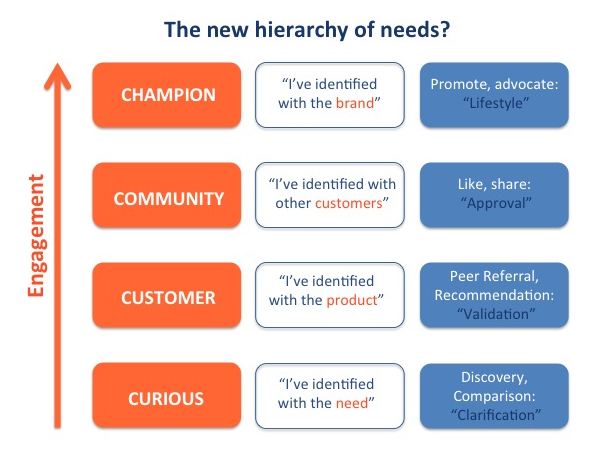
Maslow’s theory on the “Hierarchy of Needs” has become shorthand for explaining human behaviour and motivation – primarily in our personal lives, but increasingly in our working lives. At the risk of offering an answer to yet another first world problem, it seems to me that many social media platforms and content marketing solutions are trying to recalibrate Maslow for generating deeper (and sometimes more meaningful) engagement with consumers. So, by way of a simple infographic, I am offering my own theory on the new hierarchy of needs:

New Hierarchy of Needs


When we are looking for a product or service to meet a need, we are usually in “discovery mode” – we are searching for content that helps us by offering suggestions, comparing products and prices, and clarifying the precise need. So, we are either browsing, curious, or looking for assistance.

Having found some possible solutions, we seek reassurance via informed recommendations, peer referrals and published reviews. We may place different weight on this information depending on the source, but we are seeking justification for our reason to buy, or validation for becoming a customer.

If we are happy with our choice, and given the right opportunity and encouragement, we may be willing to tell our friends and anyone else who’s interested via Likes and social media posts and reviews. This is an interesting point in the engagement transaction – going from peer-to-peer sharing, to looking for approval for our decision from the wider community.

Finally, if we are so enamoured with the product, and we enjoy sharing our experiences, we may be flattered into making a lifestyle statement about our preferences; we could become a self-identified “voice of authority” through blogging and endorsements, or we might be willing to be closely identified with a brand as an advocate or champion (the sort of customer beloved of Net Promoter Scores).

The ultimate consumer-turned-champion was, of course Victor Kiam, the customer who liked the product so much, he bought the company….

C-Suite in a quandry: To Blog or Not To Blog…

Should CEO’s be on social media? That is the question many boards, PR advisers, marketeers and C-Suite occupants are faced with these days. Partly driven by existentialist angst (“I Tweet therefore I am”), partly a desperate act of “me too”, many CEOs are in a dilemma about how to engage with the new media.

While it might sound like a good idea to have a CEO blog, in the wrong hands or used inappropriately, it can come across as inauthentic, too corporate, or just crass.

The use of CEOs as “personal brands” is nothing new – think of Richard Branson, Anita Roddick, Steve Jobs, Jack Welch etc. And while social media has the potential to extend the CEO’s reach to customers, shareholders and employees, it also abhors a vacuum. If companies do not take control of their public persona, their customers and employees (supporters and detractors alike) will fill the void for them.

I am seeing this debate play out in different ways:

First, there is a difference between a personal brand and a business brand, so it is important to establish boundaries while recognising how the CEO’s personal standing can be used effectively to complement the corporate presence.

Second, having the CEO recognised as an expert can enhance personal influence but may not directly benefit the company if it is not relevant to the business – does Warren Buffet’s prowess on the ukulele boost instrument sales, or help the share price of Berkshire-Hathaway?

Third, if CEOs do choose to outsource their blog content, make sure it is genuine and aligns not only with the CEO’s personal values but also with those of the company, customers, shareholders and employees.

Finally, CEOs or Boards struggling with this topic, or those worried about whether to take the plunge into social media would be advised to consult Dionne Kasian Lew‘s new book, “The Social Executive”, which is sure to become an essential guide on the subject.


Defining RoDA: Return on #Digital Assets

How do we measure the Return on Investment for digital assets? It’s a question that is starting to challenge digital marketers and IT managers alike, but there don’t appear to be too many guidelines. Whether your social media campaign is being expensed as direct marketing costs, or your hardware upgrade is being capitalised, how do you work out the #RoDA?

In most businesses, measuring the expected RoI of plant or equipment is usually quite easy: it’s normally a financial calculation that takes the initial acquisition price, amortized over the useful life of the asset, and then forecasts the “yield” in definable terms such as manufacturing output or capacity utilisation.

However, when we look at digital assets, many of those traditional calculations won’t apply, either because the usage value is harder to define, or the benchmarks have not been established. Also, while hardware costs may be easy to capture, how are digital assets such as websites, social media accounts, software (proprietary and 3rd party) and domain names being reported in the P&L, cash-flow analysis and balance sheet?

Sure, most hardware (servers, PCs and physical networks) can be treated as capex (e.g., if the purchase price is more than $1,000 and the useful life is 2-5 years). But how do you make sure you are getting value for money – is it based on some sort of productivity analysis, or is it simply treated as fixed overhead – regardless of your turnover or operating costs?

As we move to cloud hosting and #BYOD, many of these assets utilised in the course of doing business won’t actually appear on the company balance sheet. Yet they will have some sort of impact on the operating costs. Most software is sold under a licensing model, where the customer does not actually own the asset. (But, if the international accounting standards change the treatment of operating leases longer than 12 months, that 2-year cloud hosting fee might just became a balance sheet item.)

I was once involved in the acquisition of a publishing business that was converting legacy print products to digital content. Not only did they capitalise (and amortize) the servers and the conversion software, they also capitalised the data entry costs (using freelance editors) to avoid the expense hitting the P&L. Nowadays, that’s a bit like putting the HTML coding team on the balance sheet and not the payroll…

In some cases, the costs associated with maintaining an e-commerce website or registering a URL, will remain as overhead or operating expenses. But over time, businesses will want to have a better understanding of their RoI for different online sales and digital marketing channels, especially if they have been investing considerably in their design, build and maintenance. Measuring online visitor data, customer conversion rates and average yield per sale, etc. are becoming established metrics for many B2C sites. Having a good grasp of your #RoDA may just give you a competitive edge, or at least provide a benchmark on effective marketing costs.