#StartupVic launches new-look #pitch event

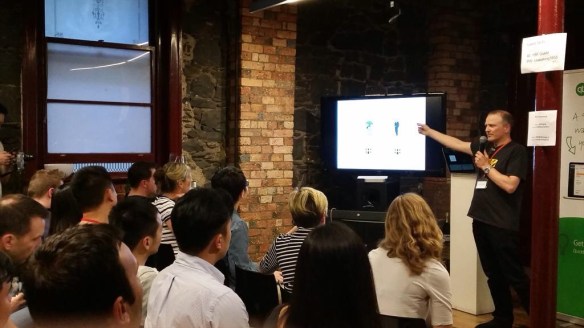
The team at Startup Victoria have been working hard over the summer: not only have they brought on a whole bunch of new commercial sponsors, but they have also launched a new format for their pitch nights. The idea is to invite startup founders to register their interest in pitching to a panel of judges. The contestants get the opportunity to compete in front of a live audience, for a chance to win face time with local VC’s, along with some other startup goodies.

global_446720634It’s not Shark Tank (there’s no hard cash on offer), nor is it an open mic night (there is a pre-screening and audition process) – but it does enable entrepreneurs to test their pitch, get some early exposure, and receive some great feedback and advice. It also doesn’t matter what stage the startups are at, although businesses that already have some market traction or have built and tested an MVP are probably in a better position to compete.

The launch night saw pitches from four startups, who are at various stages of development. In no particular order they were:

Ad Hoc Media with Passenger Pad, a digital Out Of Home advertising medium for taxis, using interactive touch screens inside the cab. To date, there has been a low take-up rate of this technology by the taxi industry in Australia, mainly due to regulatory issues, but the landscape is changing. With a background in taxi electronics and hardware, the founders are about to launch with 400 taxis in Melbourne, and plan to expand to other cities. There is no doubt that using a combination of passenger, location and fare data (duration, time of day, pick-up and drop-off points), the screens will be able to offer brands and their media buyers targeted audiences and in-depth customer analytics. The challenge will be to offer advertisers a competitive rate card, especially as this is essentially a new medium: it offers viewer choice like TV, can serve up targeted content like web or mobile, and is ideal for special offers linked to location and time of day.

Global Patient Portal offers a free platform for e-health records. Having already launched in Kolkata, India with 40,000 users signed up in 11 weeks, GPP is aiming at lower socio-economic communities and emerging markets. The initial business goal is simple: to support ownership of e-health records by users. Using a combination of bootstrapping and NGO funding, GPP has been able to hire a team of “scribes” in India who sit in on patient consultations and capture the medical notes, which can then be referred to at the next consultation. (Currently, a lot of time and resource is wasted because patient records are captured on paper, which is easily lost once the patient leaves the clinic.) Commercial revenue will come from selling anonymized patient data (subject to legal compliance, privacy obligations and data accuracy) for research and policy planning purposes. In choosing to launch in Kolkata, GPP was aware that in some more affluent urban communities in India, the favoured means of patient communication is WhatsApp?, so they would be less likely to adopt a separate platform. Also, in Australia, having talked to GPs about the various government attempts to establish the e-health system for patient records, I am aware of a reluctance within the medical profession to buy in to the scheme: first, there is no financial incentive for them to capture patient data via a common e-health platform; second, why would they want to share patient data with their competitors?

prevyou is aiming to disrupt a large part of the recruitment and job ad market, by directly connecting students with job opportunities at SMEs. The two-sided market effectively crowdsources available jobs from SMEs, who typically do not have access to the hiring market or to full-time and dedicated HR resources. The goal is to streamline the hiring process, and to offer a mix of standard and premium services (e.g., video resumes, applicant screening, skills matching, personality profiling etc.) and later to add validation of applicant credentials and qualifications. In return, the business will take a commission once a job has been offered and/or candidate hired. While the focus is initially on capturing the market for casual and part-time jobs, the judges urged them to look at the enterprise HR market (under an outsourcing or white label model?). Looking ahead, there is the opportunity include student internships (although, like the legal issues with Year 10 work experience, internships and placements present additional challenges such as achieving student learning outcomes and other employment law issues).

OurHome is an app to help families manage, share and track household chores, so that children learn to take some responsibility around the house, and they can get rewarded for their contribution. It emerged out of an earlier app, Fairshare, that was aimed at shared houses. Apparently, people living in shared houses don’t care enough about whose turn it is to clean the bathroom, or are happy with paper charts and lists on the fridge door. Describing itself as “an integral household tool with indirect network effects (i.e., like Google, not Facebook)”, OurHome also claims to be the #1 chores app. Using advanced algorithms, and other features such as customisation and Dropbox integration, the app also introduces an element of gamification through rewards (intrinsic and extrinsic). For busy families, it replaces those fridge notes and task charts (although, as the judges noted, there’s no calendar yet). Of particular interest is the very positive feedback the team have had from families who have children with ADD.

Despite a few technical glitches (concerning mics and audio quality), the first new-look pitch night was a success, and Global Patient Portal won the on-line audience vote. I was luck enough to meet with one of the teams a few days later. They thought it was a useful experience, but they hadn’t quite known what to expect, and they had anticipated more of a grilling from the judges and tougher questions from the audience.

Next week: More In The Moment



#AngelCube favours B2B #startups…

The latest intake to AngelCube‘s accelerator program presented at the recent Startup Victoria meetup event. It was interesting to see that all 6 pitches were aimed at B2B audiences, since I have heard several angel investors and startup advisers express a strong preference for end-consumer products (or those with 2-sided markets). Perhaps there is more appetite for enterprise solutions, despite the longer lead times for sales, and the challenge of strategies required to displace incumbant products.

Screen Shot 2015-08-31 at 5.18.46 pmWhether there is a new interest in B2B startups, or whether more founders are identifying B2B opportunities, there’s probably some further analysis to be done. Meanwhile, here are the 6 fledgling startups in the order they pitched on the night:

Screen Shot 2015-08-31 at 5.45.53 pm1. Peer Academy

Peer Academy aims to “change the way professionals learn”. It does this by offering students access to open enrollment classes via an online market place. The classes are conducted by facilitators and experts (“hosts”) who have been “screened” for quality by Peer Academy, with a focus on “soft” management and leadership skills.

Peer Academy hopes that students will act as “warm leads” for corporate sales, by taking their classroom experience back into their organisations, and acting as champions or brand advocates. With follow-up introductions to training and HR managers, Peer Academy then curates programs for corporate clients, by matching training needs to individual users.

I like the notion of “peer-to-peer” learning (although I presume that the hosts are expected to have more advanced and developed skills than their students), and there is certainly a trend for alternative learning platforms. At least one major bank has expressed interest in sourcing corporate training via Peer Academy, who take a 30% commission on course sales.

A huge challenge will be to engage corporate clients who already have established relationships with trusted training providers, or who have existing panels of approved organisations, or who outsource training procurement to third parties.

Screen Shot 2015-08-31 at 6.04.05 pm2. Jack

Workplace wellbeing is becoming big business ($5bn and counting?), and in the process, sedentary workers are in the firing line. According to Apple CEO TIM Cook, “Sitting is the new cancer”, and hence the recent fad/trend/fashion for sit-stand desks which is driving market interest in ergonomic solutions. The team at Jack have built a device that can monitor how much time people are sitting or standing, and even provide some feedback on user posture.

As you would expect, Jack uses cloud connectivity to monitor user activity, and to relay data via cross-platform apps and dashboards. It also uses elements of social media engagement and gamification, and has already launched a pilot scheme with several desk suppliers, as well as a paid beta at a well-known payments provider.

Customers will buy the device plus pay for a monthly subscription service. There is a direct competitor, but Jack claim their device can be retrofitted to any sit-stand desk. The unit price is much higher than, say a Fitbit, but since this is not a consumer product, Jack is confident it can sustain current pricing.

Finally, with the data it aims to collect, Jack reckons it may even be able to help reduce insurance premiums, although this will no doubt be subject to actuarial scrutiny, Work Cover and OH&S requirements, as well as data privacy issues.

Screen Shot 2015-08-31 at 6.24.11 pm3. Coin-Craft

In the professional services and consulting sectors, tracking project costs and resourcing have become highly demanding activities – witness the plethora of project management, costing, billing, ERP and time-tracking solutions on the market. Based on personal experience, the founders of Coin-Craft have identified a specific need among architects, and have built an all-in-one tool for Project Management, Cashflow Analysis and Resource Planning. Built “for architects by architects”, Coin-Craft is designed to help clients stay optimal, by managing staff over/under utilisation, and tracking cashflow projections.

The system also claims to integrate with third-party accounting software, and has around a dozen firms using the service, with another 30 in the pipeline. Although Coin-Craft have chosen a niche client base to protect their market entry, they claim the solution can also be adopted by engineering practices, graphic art studios and project management firms.

However, feedback from the audience suggested there are already similar, mature products that are tracking individual billable hours against specific projects, so Coin-Craft may need to work on their value proposition and differentiation.

Screen Shot 2015-08-31 at 6.38.22 pm4. CurveUp!

As social media and content marketing become more ubiquitous (if not more sophisticated), companies need to understand the value of their direct marketing spend. Mostly, they can do this via web analytics, e-commerce tracking, campaign conversions, and cost of customer acquisition. According to CurveUp! however, measuring the ROI of your PR activity is not so easy using “conventional” social media monitoring tools. For example, CurveUp! claim they can deliver tailored reports to show which blog post or article converted to a ticket sale for a concert or event.

Currently using web and online sources only, CurveUp! track mentions and link this to customer data. Some platforms, such as Instagram, are harder to track, and even via a possible API solution, it will only be possible to monitor the number of views and shares, but otherwise little or no data will be available.

However, at least one online market place has expressed interest, and CurveUp! has the potential to integrate with Facebook and Google, so that clients could possibly use campaign codes to track referral activity from mention to firm sale. Overall, the service will need to align itself with the ROI outcomes linked to PR campaign goals – which will vary between clients and markets, depending on organisational KPIs around brand advocacy, share of wallet, products per customer and customer satisfaction.

Screen Shot 2015-08-31 at 6.56.07 pm5. TribeGrowth

In a similar vein, the team at TribeGrowth claim to have built “artificial intelligence for social media marketing“. Their goal is to help clients build an audience and get customers, via the use of “intelligent engagement” to generate conversions.

Initially targeting startups, professional service providers and the hospitality sector, TribeGrowth offers a tiered monthly subscription service, and claims to be a (cheaper) alternative to agencies or even Twitter ads.

Currently in private beta (and so far, only designed for Twitter and Instagram), TribeGrowth focuses on audience growth by careful selection of connections and influencers. According to the founders, this is not “pay & spray”, but uses machine learning to refine audience outreach and engagement.

Screen Shot 2015-08-31 at 6.59.11 pm6. SweetHawk

Finally, and in what was probably the most technical presentation of the evening, came SweetHawk, which is building “voice for e-commerce”. I have to confess that, although I had previously heard about this product, I’m still not totally clear how it works.

In essence, it’s an outbound platform that enables companies to have more focused/targeted real-time conversations with warm sales prospects, namely people who are visiting their websites. Personally, I would find that a bit spooky, if I was browsing a site and suddenly a widget popped up asking me if I wanted to receive a call right there and then. Isn’t it a bit like stalking?

The business model is designed to offer tiered services in return for monthly subscription fees – depending on call volumes and functionality, such as workflow tools. I would see it as sitting somewhere between an outbound sales call centre and a SaaS-style inbound helpdesk solution.

On the plus side, I do see the opportunity to deliver superior and more responsive customer service, except that SweetHawk appears to be a sales and prospecting platform, not an after-sales or support solution. I’m also used to live chat tools that pop up on various software and other service sites I use, so I would probably engage with a similar offering if I was browsing to purchase.

Final Thoughts

While none of these pitches has so far demonstrated anything truly disruptive (but let’s not criticise them for that), they all seem reasonably sensible and logical solutions using a mix of digitally-driven technologies (cloud, mobile, social, peer-to-peer, data analytics) that we are all increasingly familiar with. So, rather than major game changers, I see each of them building on established platforms. By refining the potential that new technologies and business models are creating, they are tapping into better-defined client needs rather than taking a “build it and they will come” approach.

In conclusion, I was generally impressed by the 6 pitches on offer, although some of the presentations will no doubt be reworked in light of the audience feedback and Q&A, and before the plucky founders hit the investor road show organised by AngelCube.

The event was hosted by inspire9, and sponsored by BlueChilli and PwC.

Next week: More on FinTech – another look at data and disintermediation


How to Survive a #Startup Weekend

A rite of passage for any startup founder or budding entrepreneur is a weekend hackathon, and a Startup Weekend is probably the best way to throw yourself in at the deep end. As part of Startup Week, the York Butter Factory hosted Melbourne’s first fintech event. Here’s how I managed to survive the ordeal….

IMG_0210

Your correspondent in full flow at the Final Pitch…

Rather than provide an hour-by-hour account of my experience (the schedule is on the website and you can read the Twitter feed), here’s my thoughts on what it takes to participate and get the most out of the experience:

Courage

Take a leap of faith, step up and pitch an idea at the open mike session on the first night. Not only does this force you to craft your message, it also helps overcome any nervousness or awkwardness in joining a room full of total strangers with whom you will be working for the next 54 hours. My idea didn’t get enough votes, but it did spark several interesting conversations with other participants, such that I will probably take it further.

Stamina

Pace yourself. Yes, you could spend every available hour on finishing that customer validation, or refining the pitch, or making sure your demo site is up and running – all of which are important – but you also need to make time for rest, sleep, eating (all catering is laid on) and exercise. Again, 54 hours is a long time to spend on a single activity.

Open Mindedness

I had some idea from the program notes what to expect, but I still didn’t really know what it would it be like. So it was great to just go with the flow, to see what would happen. The format, structure and schedule (as well as the rules and requirements for the Final Pitch competition), pretty much define what goes on. But your attitude and willingness to be open to new ideas determine how much you get out of the experience.

I should also mention the value in having direct access to so many experienced mentors throughout the weekend – although I know from the experience, it’s hard not to get too defensive when mentors find fault with your project, and difficult to remain true to the idea when some of the feedback is contradictory.

Teamwork

Building teams to collaborate on a startup idea forms the basis of the hackathon model. As my own idea did not get enough votes at the open pitch, I looked to join a team that was a good fit in terms of the idea, the mix of skills to complement my own, and the ability to execute. As a “non technical” participant, I was extremely fortunate to be part of team that had a great balance of back-end and front developers, design skills and mobile deployment. Plus, given the theme was fintech, it was fantastic working with people from a banking IT background. (It also helped that several team members were veterans of Startup Weekend.)

Defining Roles

Although we didn’t spend a great deal of time creating or defining roles within the team, each of us played to our strengths, by self-determining what we would work on, and what our contribution would be. The only tricky decision was choosing who would present the Final Pitch to the panel of judges – but a process of elimination, preference and negotiation resulted in yours truly taking on the role.

Tools

In addition to the various software, hosting and domain name resources provided to each team, I was impressed by how many other tools the team plugged into – such as Trello, GoogleForms, Hangouts, ThemeForest, CanvasModel Design and Launchrock – most of which were free. We also spent some time reviewing competing and complementary products as part our MVP validation.

Less Is More

We could have spent a lot of time on customer validation – but we chose instead to talk to 3 or 4 key target customers for the MVP (qualitative), and run an on-line survey (quantitative) which generated around 100 responses overnight (not bad considering it was a weekend…). We also had more content than we actually used: the lean canvas business model was used sparingly, as was a competitor heat map; but it also meant that when we came to developing our pitch presentation, we had the luxury of being able to take stuff out and only focus on the important and most relevant points. Thanks, also, to a presentation template that one of the team had just used at a recent management course!

Practise

Having been chosen to make the Final Pitch on behalf of the team, and despite quite a lot of experience in making business presentations and in public speaking, I was extremely grateful for the coaching, feedback and rehearsals the team put me through. Getting to know the material, understanding the anchor points and how to navigate from topic to topic, helped me to give a presentation that flowed logically and hopefully demonstrated that the team had met the competition brief.

The Result?

Unfortunately our team did not win, nor did it place in the top 3. The judges pinged our presentation for being “too confident”, and for not demoing our prototype (we did briefly put up our beta website) – but given the working prototype mostly comprised some backend coding, it wouldn’t have been that interesting from a visual perspective.

Notwithstanding our disappointment on the night, the team is planning to get together to see how far we can take the idea, and separately I’ve been asked to join a new team at an upcoming hackathon.

(If anyone is interested, we designed a P2P payments tool called PayMee)

Next week: 3 Ways to Fund Your #Startup

The Great #Data Overload Part 3: Differentiating in a #Digital World

Have you noticed that what was once old is new again? In particular, I’m talking about traditional direct marketing techniques, such as door-to-door sales, print circulars, and telephone cold calling. It’s as if businesses realise that to be heard and to get noticed in the digital world, you have to do something different or unexpected, and nobody expects to see a door-to-door salesperson these days!

MBPI mostly work from a home office, and in recent months I have had door-knockers trying to sell me car tyres, energy-saving devices and fire extinguishers. That’s in addition to the telesales calls persuading me to switch phone and utility providers, take out insurance or upgrade my security software (yes, I know that last one is probably a scam). Plus, more and more local businesses and tradespeople are using good old-fashioned leaflets and letter box drops (which is interesting, given that around 58% of local search is done on a mobile device).

Why are some advertisers reverting to this form of direct marketing?

I can think of several reasons:

  • They need to cut through the digital noise and reach their target audience via “novel” promotional tactics.
  • Their products and services are less-suited to on-line or in-app purchasing decisions.
  • Their sales activities are focused on acquiring existing customers from competitors, a conversion process more likely to succeed via personal contact.
  • Or simply, the costs make more sense.

Why is it important to differentiate? 

It’s 10 years since “Blue Ocean Strategy” was published, which stressed the need to stand apart from your competition (“avoid the shark-infested waters”). The message is even more relevant today, because the ubiquity of social media and content marketing platforms means that everyone has access to the same tools, and it’s not that difficult to play technology catch up; and while there may be good reasons for your business to engage with these channels to market, you also need some alternatives, like offering direct customer engagement that is not wholly reliant upon on-line and digital. That’s why some banks are opening more branches as part of their growth and customer acquisition strategy, why some retailers are offering “buy on-line, collect in-store”, and why some service companies are moving to an integrated, end-to-end customer experience, so that customers get the same person helping to resolve their problem from start to finish.

How to differentiate?

Standing out from the crowd (for the right reasons!) is critical to attracting customer attention. Competing on price alone is typically a race to the bottom where nobody wins. Getting noticed, especially when everyone is using the same marketing tools and sales offers, may mean doing something unusual or unexpected (for example, ALDI‘s “anti-ads”) as part of your marketing campaign. Or connecting directly with your audience in a way that doesn’t rely on “Likes”, “Shares” or “Follows”.

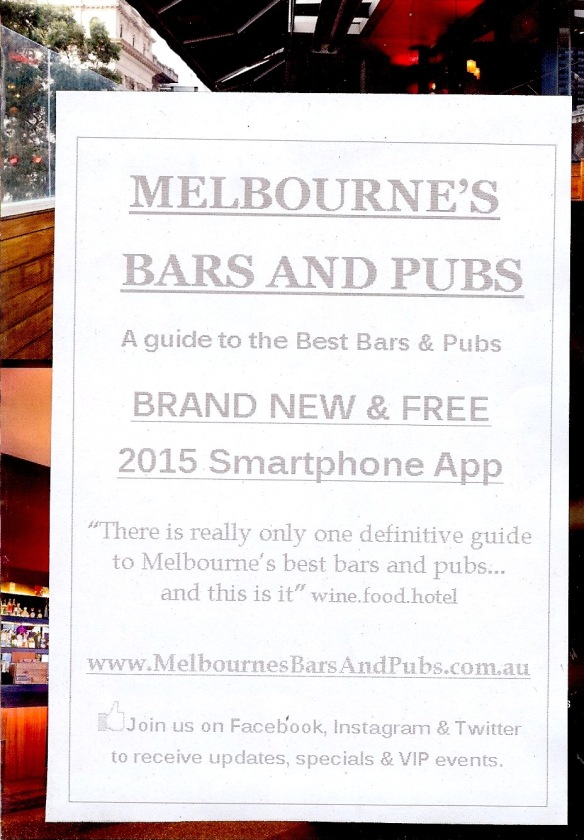
Sometimes it’s as simple as as this leaflet (shown above) found in my letter box the other day. At first, I thought it was a flyer for a local bar. Then, I noticed it was promoting a new smart phone app. On closer inspection, the flyer comprised a printed sheet hand-pasted onto a page torn from a magazine. That’s a lot of manual effort to promote a digital product, but using a lo-tech solution that totally makes sense! (No doubt, it appeals to the hipster crowd, ’cause retro’s cool, right?) So, the element of surprise (if that was the intention) worked – it got my attention because I wouldn’t have expected to receive a leaflet for a new app.*

Next week: “Why? Because we’ve always done it this way…”

Notes

* For an interesting story on the power of the unexpected, see Adam Posner’s talk on customer loyalty programs.