Pop in Perpetuity

Exactly a year ago, I blogged about ageing rockers and their propensity to continue touring and recording. This past weekend I experienced two events that provided almost polar opposites as to how musicians will perpetuate their “live” legacy. (Of course, in theory, their recordings will last forever, in physical, digital and streaming formats – as long as the equipment, technology and platforms survive…)

On the one hand, there was the Sun Ra Arkestra, who since their founder’s death in 1993, have continued to play the music of Sun Ra, respecting the sound, format and spirit of the original band formed in the 1950s. Some of the current band members played with Sun Ra himself, so there is a thread of continuity that connects us back to the past. But even as these surviving members depart this world, the music of Sun Ra will live on in concert form through subsequent generations of players. This type of perpetuity is not uncommon among bands of the 60s, 70s and 80s, although in many cases, there is usually at least one original band member performing, or members who overlapped with the band founders. (Some notable exceptions: Soft Machine, who continue performing and recording, but whose remaining original member left nearly 50 years ago; and Faust, who split into at least two separate bands that still tour and record under the same name.)

On the other hand, there was the high-tech concert presentation by the late composer and performer Ryuichi Sakamoto, entitled KAGAMI. This involved the use of AR headsets and a 3D avatar of Sakamoto, captured in sound and vision performing a selection of his music, sat at a grand piano. The audience, initially seated in a circle around the virtual performance area in order to acclimatise to what they were seeing, was invited to move around the avatar, and even peer into the open grand piano. Two things were striking: first, the 360 degree image was very impressive in the level of detail; second, even if someone was standing between the viewer and the avatar zone, the headset still presented the image of Sakamoto sat at the keyboard. The technology not only captures a digital visualisation of the pianist in action, it also replicates the notes he played as well as the tonal expression and the timbres, resonances and acoustics of the physical instrument. While the audio HiFi was superior to the atavistic CGI, the latter will no doubt improve; as will the slightly clunky and heavy headsets – the 50 minute duration is probably the most I could have endured.

Neither format of the above concerts is better or superior to the other. Both are authentic in their own way, and true to the artistry of musicians they celebrate. Of course, if we end up using AI to compose “new” music by Sakamoto, that may undermine that authenticity. But given Sun Ra’s origin story, I wouldn’t be surprised if he started beaming his new works from Saturn.
 

All that jazz!

I’d be the first to admit I’m a music snob. Not that I think my tastes are better than anyone else, just that they are very particular. I like to think I have an informed opinion about the listening choices I make.

When I went to university, I was asked if I had any preferences about whom I shared student accommodation with. “No heavy metal freaks or jazz buffs”. I’ve still not changed my opinion of heavy metal, but my attitude towards jazz, like my appreciation for red wine, has only improved with age.

Not all, jazz, mind. Two words that strike dread in me are “gypsy jazz” – along with trad, dixieland and rag time, I find it most of it too fiddly, over-ornate, bordering on cheesiness. Similarly, for me, listening to “smooth” artists like Kenny G is akin to wading through treacle. There are certain instruments that I find very difficult to stomach in a jazz context – trombone, soprano saxophone, violin and acoustic guitar. And the big band sound is something I can only endure very selectively. Much of what is labelled fusion also leaves me cold, although I do make an exception for Soft Machine.

I suppose my point of entry is post bop, along with modal and free jazz. And while cool jazz can take itself far too seriously, at least it generally doesn’t fall into the trap of virtuosity for its own sake. (I’m always reminded of the criticism of Mozart attributed to Emperor Joseph II – “too many notes!” – when it comes to the noodly end of the jazz spectrum.)

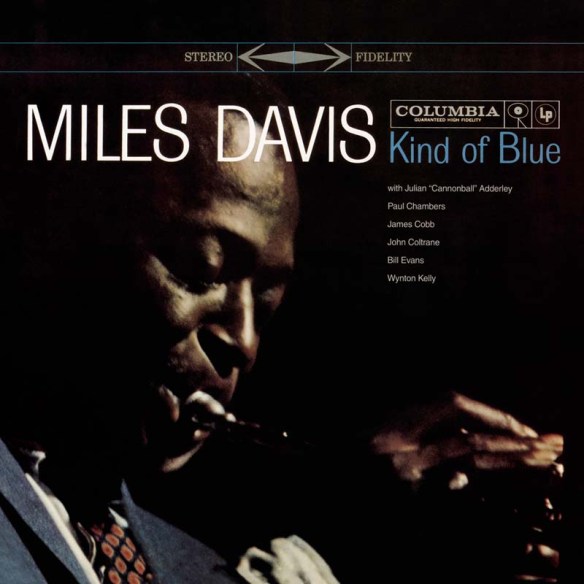
Like many people, one of my first real engagements with jazz was Miles Davis’s “Kind of Blue”. As a self-contained statement on “modern” jazz, it still astonishes with each listen. Despite its ubiquity, I never tire of hearing it. (In point of fact, the first Davis album I sought out was “In A Silent Way”, after it was used as a reference point in a review of A Certain Ratio’s debut album. Strange but true.) I’ve since come to appreciate the full canon of Davis’s work, although I have never warmed to his final records, recorded for the Warner Brothers label. His albums are often grouped into specific periods, rather like Picasso’s art, which only adds to his status and legacy.

At various times, my personal journey (and at specific stages in their careers) has encompassed Thelonious Monk, Modern Jazz Quartet, John Coltrane, Oscar Peterson, Ornette Coleman, Herbie Hancock, Pharoah Sanders, Alice Coltrane, Nina Simone, Stan Getz, Keith Jarrett, Freddie Hubbard, Wayne Shorter, Ahmad Jamal, Mulatu Astatke, Sun Ra, Chet Baker, Antonio Carlos Jobim, McCoy Tyner, Eric Dolphy, Hank Mobley, Joe Henderson, Cecil Taylor, Marion Brown and Albert Ayler.

In terms of newer and contemporary artists, the only one who has managed to sustain my interest is Brad Mehldau, in particular his live solo performances – where he seems to have picked up from where Keith Jarrett left off in the 1990s.

And as I get older, I find that the only music radio station I can listen to is ABC Jazz….

Next week: Wholesale Investor’s Crypto Convention