Analog games – interactive, real-time, educational, creative

At various times this blog has featured articles on analog technology, and the importance of making time for play. My theme this week returns to these topics – and quite appropriately as the holiday season and gift-giving are upon us.

As part of the run-up to the holidays, last week my wife and I were at a local restaurant to meet with friends who were visiting from overseas. Among the party were four children, all aged under 10. Now, I’m sure many readers will be familiar with the situation – friends who haven’t seen each other for a while want to catch up and enjoy some good conversation over a relaxing dinner, and more often than not, the digital pacifier (smart phone, tablet, portable DVD player or games console) will be brought out to keep the children occupied.

Well, I have to say I was very pleasantly surprised that our four younger diners were fully engaged in each other’s company for nearly four hours – and not a screen in sight. Instead, they happily played together with the following toys and games:

  • A board game of Ludo
  • Some LEGO mini-figures
  • A box of alphabet flash cards

They even managed to invent their own game using the flash cards.

I’m not saying that younger children shouldn’t be playing with apps or video games – but screen time has to be used constructively, not as a default setting. I’m also aware that many apps and games can be educational and interactive. But I don’t think we place enough value on enabling and encouraging children to play games in real-time, with real friends, using toys that they can easily understand and control.

On a related note, another friend recently bought his wife a record player, so they could rediscover their vinyl music collection. Their young daughter, on seeing and hearing the gramophone in action asked, “How does the sound come out of those round things?”

How often do children display the same curiosity about how mp3’s or YouTube work?

On that note, I would like to take this opportunity to wish you a safe and peaceful festive season. In particular, I would like to thank all my regular readers who have each given me feedback on what they like about this blog, especially those who have been generous enough to either comment on or critique specific content.

The New Alchemy – Turning #BigData into Valuable Insights

Here’s the paradox facing the consumption and analysis of #BigData: the cost of data collection, storage and distribution may be decreasing, but the effort to turn data into unique, valuable and actionable insights is actually increasing – despite the expanding availability of data mining and visualisation applications.

One colleague has described the deluge of data that businesses are having to deal with as “the firehose of information”. We are almost drowning in data and most of us are navigating up river without a steering implement. At the risk of stretching the aquatic metaphor, it’s rather like the Sorcerer’s Apprentice: we wanted “easy” data, so the internet, mobile devices and social media granted our wish in abundance. But we got lazy/greedy, forgot how to turn the tap off and now we can’t find enough vessels to hold the stuff, let alone figure out what we are going to do with it. Switching analogies, it’s a case of “can’t see the wood for the trees”.

Perhaps it would be helpful to provide some terms of reference: what exactly is “big data”?

First, size definitely matters, especially when you are thinking of investing in new technologies to process more data more often. For any database less than say, 0.5TB, the economies of scale may dissuade you from doing anything other than deploy more processing power and/or capacity, as opposed to paying for a dedicated, super-fast analytics engine. (Of course, the situation also depends on how fast the data is growing, how many transactions or records need to be processed, and how often those records change.)

Second, processing velocity, volume and data variety are also factors – for example, unless you are a major investment bank with a need for high-frequency, low-latency algorithmic market trading solutions, then you can probably make do with off-the-shelf order routing and processing platforms. Even “near real-time” data processing speeds may be overkill for what you are trying to analyze. Here’s a case in point:

Slick advertorial content, and I agree that the insights (and opportunities) are in the delta – what’s changed, what’s different? But do I really need to know what my customers are doing every 15 seconds? For a start, it might have been helpful to explain what APM is (I had to Google it, and CA did not come up in the Top 10 results). Then explain what it is about the resulting analytics that NAB is now using to drive business results. For instance, what does it really mean if peak mobile banking usage is 8-9am (and did I really need an APM solution to find this out?) Are NAB going to lease more mobile bandwidth to support client access on commuter trains? Has NAB considered push technology to give clients account balances at scheduled times? Is NAB adopting technology to shape transactional and service pricing according to peak demand? (Note: when discussing this example with some colleagues, we found it ironic that a simple inter-bank transfer can still take several days before the money reaches your account…)

Third, there are trade-offs when dealing with structured versus non-structured data. Buying dedicated analytics engines may make sense when you want to do deep mining of structured data (“tell me what I already know about my customers”), but that might only work if the data resides in a single location, or in multiple sites that can easily communicate with each other. Often, highly structured data is also highly siloed, meaning the efficiency gains may be marginal unless the analytics engine can do the data trawling and transformation more effectively than traditional data interrogation (e.g., query and matching tools). On the other hand, the real value may be in unstructured data (“tell me something about my customers I don’t know”), typically captured in a single location but usually monitored only for visitor volume or stickiness (e.g., a customer feedback portal or user bulletin board).

So, to data visualisation.

Put simplistically, if a picture can paint a thousand words, data visualisation should be able to unearth the nuggets of gold sitting in your data warehouse. Our “visual language” is capable of identifying patterns as well as discerning abstract forms, of describing subtle nuances of shade as well as defining stark tonal contrasts. But I think we are still working towards a visual taxonomy that can turn data into meaningful and actionable insights. A good example of this might be so-called sentiment analysis (e.g., derived from social media commentary), where content can be weighted and scored (positive/negative, frequency, number of followers, level of sharing, influence ranking) to show what your customers might be saying about your brand on Twitter or Facebook. The resulting heat map may reveal what topics are hot, but unless you can establish some benchmarks, or distinguish between genuine customers and “followers for hire”, or can identify other connections with this data (e.g., links with your CRM system), it’s an interesting abstract image but can you really understand what it is saying?

Another area where data visualisation is being used is in targeted marketing based on customer profiles and sales history (e.g., location-based promotion using NFC solutions powered by data analytics). For example, with more self-serve check-outs, supermarkets have to re-think where they place the impulse-buy confectionary displays (and those magazine racks that were great for killing time while queuing up to pay…). What if they could scan your shopping items as you place them in your basket, and combined with what they already know about your shopping habits, they could map your journey around the store to predict what’s on your shopping list, thereby prompting you via your smart phone (or the basket itself?) towards your regular items, even saving you time in the process. And then they reward you with a special “in-store only” offer on your favourite chocolate. Sounds a bit spooky, but we know retailers already do something similar with their existing loyalty cards and reward programs.

Finally, what are some of the tools that businesses are using? Here are just a few that I have heard mentioned recently (please note I have not used any of these myself, although I have seen sales demos of some applications – these are definitely not personal recommendations, and you should obviously do your own research and due diligence):

For managing and distributing big data, Apache Hadoop was name-checked at a financial data conference I attended last month, along with kdb+ to process large time-series data, and GetGo to power faster download speeds. Python was cited for developing machine learning and even predictive tools, while DataWatch is taking its data transformation platform into real-time social media sentiment analysis (including heat and field map visualisation). YellowFin is an established dashboard reporting tool for BI analytics and monitoring, and of course Tableau is a popular visualisation solution for multiple data types. Lastly, ThoughtWeb combines deep data mining (e.g., finding hitherto unknown connections between people, businesses and projects via media coverage, social networks and company filings) with innovative visualisation and data display.

Next week: a few profundities (and many expletives) from Dave McClure of 500 Startups

End to #geoblocking proposed in Competition Policy Review

Australian consumers would benefit from key Recommendations contained in the Competition Policy Review Draft Report released last week – meaning better access to, and cheaper prices for digital content and tech products. In particular:

  • any remaining prohibitions on parallel imports would be abolished, unless there is a public interest factor in retaining them; and
  • Intellectual Property licenses would no longer be exempt from the requirements of the Competition and Consumer Act.

Introduction

I don’t propose to cover the whole scope of the Policy Review here – but instead focus on the practice known as geo-blocking, whereby customers in one jurisdiction can be prohibited from buying goods and services from another jurisdiction, simply due to their country of residence. (For example, Australian consumers are currently unable to purchase music downloads from Amazon’s dedicated Australian site, or from any of its international sites; and numerous titles listed on iTunes’ US and UK stores are not available for download via iTunes Australia.)

Context

It is now more than 20 years since the Hilmer Report (which led to the National Competition Policy), and as last week’s Draft Report states, much has changed since then in terms of new technology, market globalisation, the Internet and the digital economy. (Back in the mid-90s, before Amazon, PayPal and eBay, I recall having to buy from overseas via e-mail – including the payment information!)

The Review Panel, under the Chairmanship of Professor Ian Harper is to be commended for the speed of its draft review, and the breadth and depth of its Draft Recommendations, which cover a full range of structural and regulatory reforms. The Review was announced in December 2013, and based on current performance, is on target to deliver its Final Report within 12 months of being launched. (But I don’t expect much to happen by way of legislation until after the next Federal Election in 2016.)

The end of geo-blocking?

Most notable for the purposes of this article is Draft Recommendation 9 – the removal of any remaining prohibitions on parallel imports. Since this is a rather technical aspect of IP law, and because the proposal seeks primarily to benefit consumers, any reforms in this area will require extensive public education initiatives.

For example, some current restrictions on parallel imports may relate to health and safety issues (e.g., electrical items sourced from overseas which are not designed to run on Australian power supplies); others appear to be merely the capricious whims of trade mark owners, copyright holders, IP licensors and their licensees, designed to create artificial market barriers, especially when it comes to product pricing and availability).

So, if consumers and businesses are going to benefit once parallel imports are fully legitimized, they will need help in understanding their rights and obligations under the proposed reform. By way of example, if I can’t download a movie from iTunes Australia, and if this content is not available via any other local online store, can I force Apple to sell it to me if it is available in another iTunes store (and at a truly comparable price)? Can I seek to buy a copy directly from the copyright owner or from the locally licensed distributor, even though neither of them have chosen to make it available in this market?

Shades of Grey?

Parallel imports (also known as “grey market goods”) are not the same as counterfeit or pirated goods – grey goods are authentic and otherwise legitimate products originating in one country that have not been specifically licensed for direct sale or distribution into another market. Given that local consumers can already access many goods from overseas online retailers, and since items bought for personal consumption are generally not caught by the ban on parallel imports, there are already ways to get round these obstacles. (For example, Levis Australia does not import all sizes of its jeans for sale in the domestic market, but a careful search on eBay can usually uncover a retailer in the US willing to ship direct – and probably cheaper than buying locally if available, even allowing for shipping costs).

The bum deal for Aussie consumers

In its Issues Paper released in April this year, the Review Panel highlighted the impact of international price discrimination on Australian consumers, which in my view is a direct consequence of both the ban on parallel imports and restrictive IP licensing practices:

“A further issue in relation to imports is international price discrimination. International price discrimination occurs when sellers charge different prices in different countries and those prices are not based on the different costs of doing business in each country. A recent parliamentary inquiry found that Australian consumers and businesses must often pay much more for their IT products than their counterparts in comparable economies, in some cases paying 50 to 100 per cent more for the same product.” (1)

Noting that price discrimination is not specifically prohibited under Australian competition law, the Issues Paper also acknowledged that consumers and businesses alike already circumvent this “legitimate” trade practice via parallel imports, despite the potential legal and other risks.

Redefining the market

Unsurprisingly, the Draft Report does not recommend a ban on international price discrimination (2), mainly because of the cost and difficulty of enforcement (similar arguments have been made against lowering the GST-free threshold on online imports). And yet the Review Panel is in favour of extra-territorial reach under the Competition Law (making it easier to pursue legal action against off-shore parties). It also suggests redefining the scope of “competition” to include markets for goods and services that are “capable” of being imported or supplied into Australia (Draft Recommendations 20 and 21).

Delivering the desired outcome

Consequently, for Draft Recommendation 9 to have any real impact, it must facilitate consumer and business access to goods (especially technology, software and other digital content) that have not been licensed for direct sale or distribution in Australia, either because the overseas manufacturer chooses not to make it available in the Australian market or because the local licensee/distributor chooses not to supply it (or not at a comparable price). In other words, it should not be more onerous (or expensive) for an Australian customer to acquire legitimate goods from overseas if an off-shore supplier is willing to fulfil local orders direct. (Expect huge resistance from the global tech suppliers – who are probably concerned about the implications for transfer pricing and other international tax issues; and await a backlash from the FMCG sector – where some companies have already been disputing territorial control over sales of instant coffee.)(3)

Related reforms

Along with the repeal of Section 51(3) of the Competition and Consumer Act 2010 (to bring IP licenses within the purview of the Act – Draft Recommendation 8), the Draft Report also proposes a thorough review of Intellectual Property law in light of “new developments in technology and markets” and their impact on competition (Draft Recommendation 7).

The latter recommendation can be linked not only to the practice of geo-blocking, but also to the emergence of the shared economy, aspects of which challenge traditional notions of markets, vertical supply chains, business models, ownership and licensing.  Elsewhere, the Draft Report comments on the significance of services like Uber (which has faced industry resistance since launching in Australia).

Conclusion

Most importantly, the Review Panel is keen to ensure Australia has a more relevant (and robust) IP regime that both encourages innovation and enhances market competition. A positive start would be an end to geo-blocking.

Footnotes:

(1) Source: The Australian Government Competition Policy Review – Issues Paper, April 2014, Chapter 2.6 (emphasis added; see also my earlier blog).

(2) It is worth noting that price discrimination is prohibited within the EU.

(3) The full ACCC Decision can be found here. Makes for interesting reading.

NEXT WEEK: What is CSIRO up to?
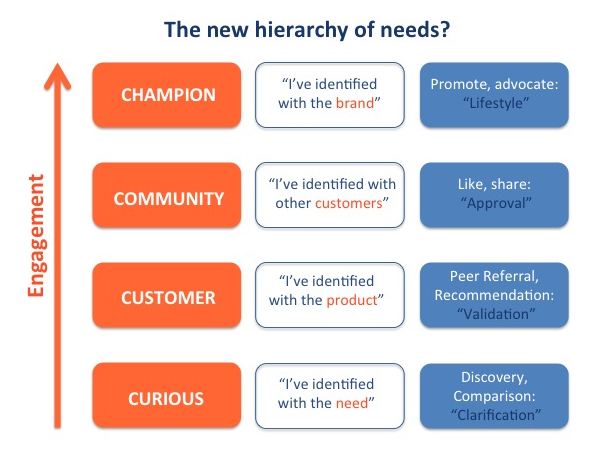
 

Content Marketing and the “New Hierarchy of Needs”

Maslow’s theory on the “Hierarchy of Needs” has become shorthand for explaining human behaviour and motivation – primarily in our personal lives, but increasingly in our working lives. At the risk of offering an answer to yet another first world problem, it seems to me that many social media platforms and content marketing solutions are trying to recalibrate Maslow for generating deeper (and sometimes more meaningful) engagement with consumers. So, by way of a simple infographic, I am offering my own theory on the new hierarchy of needs:

New Hierarchy of Needs


When we are looking for a product or service to meet a need, we are usually in “discovery mode” – we are searching for content that helps us by offering suggestions, comparing products and prices, and clarifying the precise need. So, we are either browsing, curious, or looking for assistance.

Having found some possible solutions, we seek reassurance via informed recommendations, peer referrals and published reviews. We may place different weight on this information depending on the source, but we are seeking justification for our reason to buy, or validation for becoming a customer.

If we are happy with our choice, and given the right opportunity and encouragement, we may be willing to tell our friends and anyone else who’s interested via Likes and social media posts and reviews. This is an interesting point in the engagement transaction – going from peer-to-peer sharing, to looking for approval for our decision from the wider community.

Finally, if we are so enamoured with the product, and we enjoy sharing our experiences, we may be flattered into making a lifestyle statement about our preferences; we could become a self-identified “voice of authority” through blogging and endorsements, or we might be willing to be closely identified with a brand as an advocate or champion (the sort of customer beloved of Net Promoter Scores).

The ultimate consumer-turned-champion was, of course Victor Kiam, the customer who liked the product so much, he bought the company….