Interlude: Looking for some design inspiration

I’m currently working on a start-up project in the area of performance management. Part of the challenge is designing a user interface that combines the visual language of iconography with universally appropriate contextual metaphors, without lapsing into mere skeumorphism.

Having read some of the criticisms of Apple’s iOS7 logos and user frustration with the “improved functionality” of Apple’s new operating system, I found myself turning to the design philosophy of Paul Rand, who created the famous IBM rebus – the genius of which lies in the way it deployed human and natural components to depict a major computer brand. Rand said that simplicity wasn’t his goal, more a result of the design process. He also said design is simple, which is why it is so complex, and that design is everything.

So, while I ponder the application of human factors to a new product design, and as I search for some inspiration, I came across this animated version of Rand’s logo by Chris Rush.

In Praise Of Analogue…

Let me start by saying that I am not a technophobe, and I certainly do not consider myself a Luddite. But in this digital age, I do have a certain fondness for all things analogue.

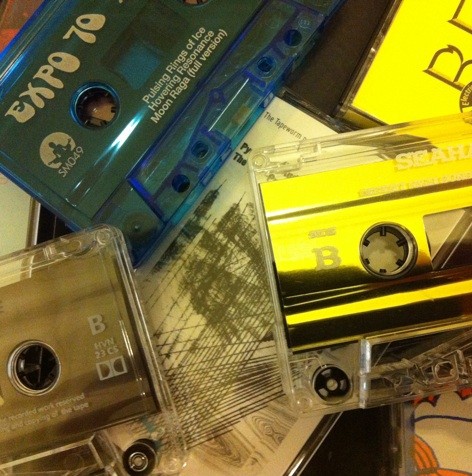
Cassette Culture is alive and well in the analogue world...

Cassette Culture is alive and well in the analogue world…

There are growing analogue trends in:

  • photographyLomography and Polaroid
  • music – vinyl and cassette
  • publishing – zines and artists’ books
  • filmSuper 8
  • graphics – letterpress
  • arts & craftsEtsy and Craftsy

More and more of us are drawn to the charms and quirks of the analogue world, and not out of some perverse counter-culture posturing – we actually like this stuff for its own sake, and for the qualities that it represents:

  • slowness
  • tactile
  • considered
  • basic
  • hand-made
  • imperfect
  • uncomplicated
  • finite
  • flawed
  • serendipitous
  • warm
  • personal
  • custom-made
  • limited
  • simplicity

In fact, these key characteristics of analogue are antonyms of most things digital….

For many people who are using analogue production processes, the medium really is the message; and what you see really is what you get, because the products are usually a true representation of the work and effort that go in to making them.

However, the appeal of analogue is not just about the format or the technology; the inherent limitations of analogue production processes lead to natural constraints which inform the content and determine the final outcome of the finished object. For example, the number of photographs an analogue camera can take at any one time is limited by the length of the roll of film; a vinyl album can carry about 22-23 minutes of music on each side; a plate used in a hand-made printing process can usually generate editions of no more than 30 before it starts to deteriorate.

There are some traditional analogue domains where the digital format does enhance the user experience e.g., digital radio (although I sometimes miss the hum and crackle of AM broadcasts); or where digital technology introduces a whole new dimension e.g., 3-D printing; or where digital can resurrect/replicate a virtual experience of analogue e.g., iOS apps that mimic classic analogue synthesizers.

On the other hand, on-line communities are moving to “analogue” events via meet-ups because being there in person offers a deeper connection. I recently attended an afternoon salon conducted by a digital media agency, because they recognize the need to interact face-to-face with customers.

I anticipate that in response to a growing sense of digital disintermediation, more of us will start to engage with and interact through analogue media. This should not be seen as an out and out rejection of digital, but more as a means to establish balance and to find a deeper level of engagement beyond the often superficial shimmer of digital gloss.

Declaration of interest: the author, under an assumed nom de musique, recently released a limited edition cassette version of his last album, available on-line and from select record stores in Melbourne

“Everything on the Internet should be free…”

Last week I got into a very heated dinner-party debate with an artist, an academic and a publisher about the economic value of copyright protection in particular, and intellectual property rights in general.

It started with a discussion about file-sharing and illegal downloads, and led to an argument about patenting genomes. I can’t attribute directly, but the gist of the argument was as follows:

1 Copyright and patents do not encourage innovation – they stifle it

2 Intellectual property rights represent a modern phenomenon – ancient societies managed to exist without them

3 Everything on the Internet should be free – and not subject to copyright protection

Let’s agree that formal intellectual property laws are a relatively recent invention – the modern concept of patents emerged in 15th century Europe, and the first British copyright law was passed in 1710. These laws then grew in importance as technology introduced the printing press and the industrial revolution.

I would argue, however that all civilisations have placed a premium on knowledge, creativity and invention. Regardless of whether this knowledge is based on folklore, scientific experiment, geographical discovery or geological exploration – specific rights, actual economic benefits and certain legal protections have been afforded to those who establish ownership or control of these assets. Examples would include the right to copy ancient manuscripts held in monastic libraries; the monopolies and protection granted to members of craft guilds in plying their skills; the trading rights granted to merchants; and restricting the practice of certain tribal traditions to selected community elders.

Most of these knowledge-based activities involve a high degree of effort, ingenuity and risk-taking – so in return, it was acknowledged there needed to be financial and other rewards to act as incentives. In the case of science and technology, these incentives are often deemed essential to offset the huge capital costs of developing new products and processes. In the case of copyright, the rewards of author royalties and content licensing fees are desirable to encourage people to come up with new ideas and new concepts – even if the purpose is simply to amuse and entertain us.

Of course, the economic rewards need not simply be derived from patents or copyright – tax-breaks for R&D or public grants to fund academic research are some examples of alternative financial incentives for both inventors and people of ideas.

As for the concept that “everything on the Internet should be free”, I am reminded of what I once told a client, who could not understand why access to the on-line version of a printed reference work was costing him more than the “physical” cost of adding a new user log-in and password to our content publishing platform: “OK”, I replied, “you can have all the content for free, but we’re not going to index it, or structure it with headings and sub-headings; we won’t tag it, insert cross–references, or add hypertext links; we won’t even edit it; and finally, we won’t update it every time there is new material.” He soon got the point.
Why Francis Bacon would never be on Facebook

“Champagne for my real friends, real pain for my sham friends” is a dictum widely attributed to the  20th century artist Francis Bacon, although its origins have been traced to the  late 1800’s. Whatever its provenance, Bacon is known to have used the phrase frequently in the company of friends and hangers-on in the pubs and clubs of London’s Soho district. It was a sort of rallying cry when he was buying drinks for his companions – some of whom were close friends, others were mere acquaintances, associates, groupies and antagonists.

Bacon died in 1992, but even if he was alive today, I doubt he would have used Facebook. Not because he was out of touch with popular culture (the collection of source material from his studio attests to his artistic interest in photography, sport, film, magazines, advertising etc.). No, his antipathy to Facebook and other social media would be based on the inability to distinguish between “real” and  “sham” friends. Facebook may allow users to categorize “friends” as Close Friends, Family, Acquaintances, but this is mostly about levels of sharing and frequency of updates; it does not really allow for more subtle categorisation reflecting the different types and varied nature of relationships we have with our professional and personal contacts; nor does it allow us to distinguish between sub-categories (e.g., “friends I’m willing to have dinner with”, “cinema friends”, “family we visit for the holidays”, “Friday night drinks colleagues”, “clients to invite to the cricket” etc.)

The Internet in general (and social media in particular) is a great leveller, but has the capacity to reduce all our real-world relationships to a homogenous mass of digital contacts.