New Year Wishes: What I hope for in 2014

A new year normally brings with it the usual predictions for the 12 months ahead. Sometimes, as with political elections, the World Cup, fiscal budgets and the Oscars, most informed commentators can usually hope to get at least one or two things right. But as a former colleague once wrote, anticipating new developments in technology is like “trying to predict the unpredictable”.*

Rather than attempting to gaze into a crystal ball, here are a few of my personal wishes** for 2014

Politics

I think it’s interesting that in 2013, two of the political leaders that generated most of the news were Margaret Thatcher and Nelson Mandela – and in both cases, it was their passing that dominated the headlines. Neither had been in power for many years, yet in death they were more noteworthy than most of today’s world leaders. Why? Well, a lack of truly charismatic politicians could explain it. But I rather think the lure of holding political office has been undermined by the need to micromanage the machinery of government – so rather than attracting visionary leaders capable of projecting big picture thinking, we mostly get a collective mediocrity blinkered by the spin doctors and party pollsters, and rarely willing to tell the public what they actually think or what they personally believe in, for fear of offending voters in marginal electorates. Whether or not you agreed with or liked their particular brands of politics, it was pretty clear that both Thatcher or Mandela actually believed what they were saying when addressing parliament, giving interviews, or delivering campaign speeches.

In 2014 it would be wonderful to see the return of political leaders who were not simply trying to avoid defeat at the next election. Even better, wouldn’t it be wonderfully refreshing to hear politicians willing to amend their policies because they have been persuaded by informed argument, prepared to admit that they might have got it wrong, and able to speak their mind without being accused of knee-jerk reactions or heretical u-turns; situations change, so shouldn’t our politicians be entitled to adapt and clarify their thinking accordingly?

Leadership

Which brings me to my next wish – a willingness to openly embrace situational leadership. Yes, organisations should have a clear purpose, stated objectives and well-articulated means for achieving them, but there also needs to be flexibility and the ability to adapt and evolve based on changing circumstances.

We hear a great deal about the need for diversity on boards, among executive teams and across the workplace generally. Much of the diversity debate centres on gender and ethnicity – which is fine, but we require organisations with greater cognitive diversity. Such diversity could help avoid group-think, constructively challenge the status quo and counter the underlying causes of institutionalised inertia.

Business

Unless you are a single-product company, with a unique and proprietary production process, a guaranteed market monopoly, and an endless supply of materials and customers, your business cannot afford to exclude alternative thinking or ignore external perspectives on your industry, your markets or your products and services.

Equally, in a low-growth/no-growth market environment, companies have to develop or acquire better strategic growth skills. Expansion via capturing market share (usually achieved by competing on price, and resulting in lower margins) will be hard to sustain, and will likely result in a race to the bottom.

My big wish for 2014 is that businesses in general, and service industries in particular, will recognize what their true value proposition is, and build strategies for competing on quality (not just on quantity). For example, unless you understand your cost structures, and can relate those to your customers’ perceptions of what they are paying for, you will either waste resources on stuff customers don’t value, or miss opportunities for serving them better.

Technology and the Internet

It’s hard to think of any significant developments in popular technology or on the Internet during 2013. Sure, there was some consolidation among social media platforms, and product rationalisation at Yahoo! and elsewhere; but apart from launching iOS7 and the iPhone 5, Apple did not bring any major new products to market. Although Apple’s global share of smart phone sales may be declining, it may simply be market maturation rather than any product advances from its competitors. (There is also evidence that in key markets, iPhone 5 has boosted Apple’s smart phone sales, and the iPhone 5 itself lays claim to being the most popular model.)

The Internet continues to grow exponentially, largely driven by social media and user-contributed content. But I’m not sure that our collective knowledge and wisdom have improved at a corresponding rate. (Plus, targeted and streamed advertising means it takes much longer to watch YouTube clips, resulting in a lower return on the time we invest in consuming content.)

I’m hoping that 2014 will herald the launch of Internet 3.0 – an on-line environment that is more informative, more insightful and more interactive, and which connects more intuitively between my desktop and mobile devices. (For example, various upgrades to iOS and their associated back-ups forced me to transfer manually a large archive of Notes from my iPhone 4 to my iCloud account, simply because Apple unilaterally changed the way legacy content was “recognized” between my iPhone and my iMac.)

Culture

Perhaps we should also wish for a slightly kinder and more caring social media environment in 2014 – and as I heard one media commentator observe this week, professional sports people and other celebrities should probably refrain from using social media after 11pm, even if they are only slightly inebriated. Anyway, at the risk of revealing some of my own prejudices and preferences, this is what I expect from 2014 in Culture.

First up, I don’t want to see any more of the following categories of movie: sequels, prequels, comic-strip franchises, CGI extravaganzas or anything containing anthropomorphism (unless it’s a Director’s Cut of “Animal Farm”).

Second, I eagerly await the end of geo-blocking for digital content – copyright owners, music labels, publishers, licensors/licensees, distributors and on-line retailers please get your act together, and don’t make it unnecessarily difficult for me to buy your content just because of where I happen to live.

Third, I’d like to advocate a special tax on reality TV shows – the proceeds of which will be directed towards alleviating human suffering, solving important world issues, or nurturing genuine artistic/culinary/terpsichorean talent.

Finally, I hope that David Bowie’s return to form with 2013’s “The Next Day” was not a fleeting reminder of past glories….

NOTES:

* Anthony Kinahan in his introduction to “Now and Then 1974-2024: A Celebration of the Bicentenary of Sweet & Maxwell” (1999) a collection of essays on the future of legal publishing

** Aside from, of course world peace, the end of poverty and a global commitment to address the negative impacts of climate change
The Music Collectors’ Guide to Personality Types

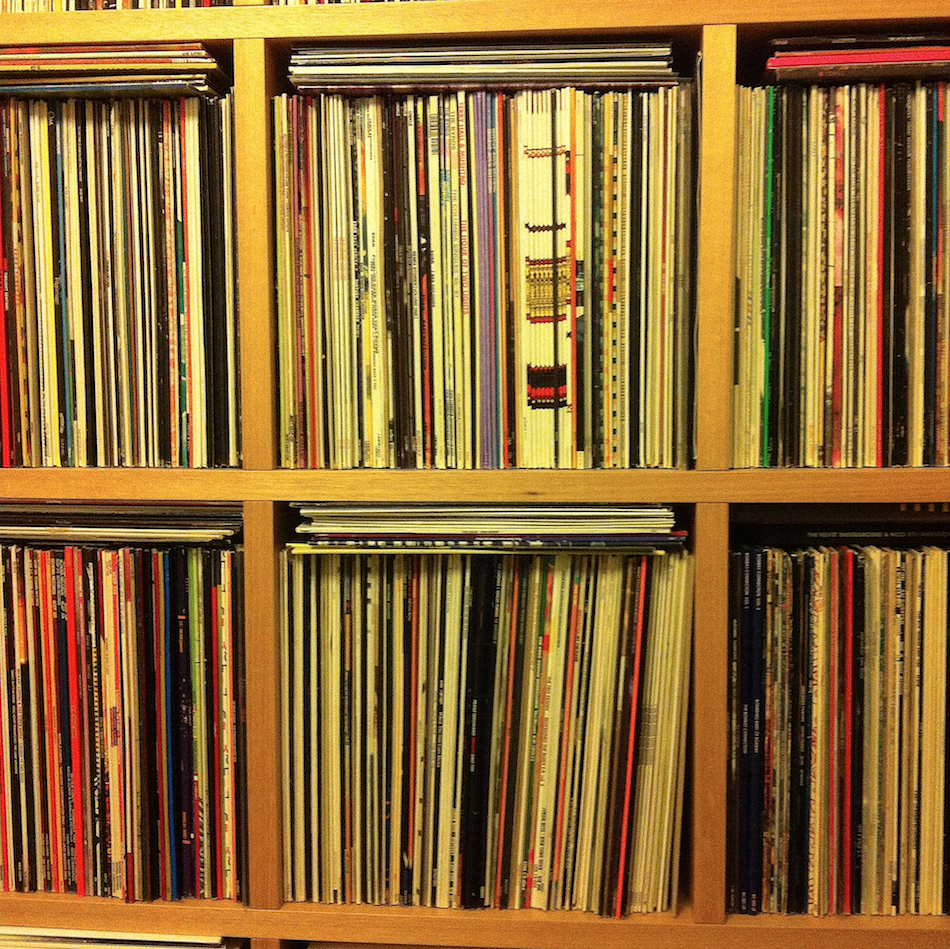
ShelvesSomething a little less serious this week. Recently, I’ve been working with various clients across executive coaching, career development, talent management and psychometric testing. Given my former experience in music retailing (it was like Nick Hornby’s “High Fidelity” without the romantic interest….) and in deference to my own lifelong hobby of record collecting, I thought it would be amusing to classify people according to their collecting habits, as a way of helping HR managers and team leaders everywhere understand their colleagues.

So, in no particular order:*

1. Listomaniac – Always making lists of their favourite songs, and then constantly updating them. Whether it’s “Top 10 songs about ice-cream”, or “All-time Top 5 pop songs featuring saxophone”, or “10 Songs containing the word ‘toothbrush’ in the lyrics”, Listomaniacs love to demonstrate their arcane (but selective) musical knowledge, and are so absorbed with the process of list-making that they are incapable of committing to a final, definitive choice. Don’t expect the Listomaniacs on your team to make a decision, let alone stick to it. Definitely don’t give them too many choices or too much time to select the catering menu for the office party. (Cf. Mixologist)

2. Completist – More than a mere fan, the Completist is compelled to collect every record ever released by a particular artist (and some Completists are also driven to seek out unreleased recordings, including juvenilia, studio out-takes and rehearsals…). In more extreme examples, this form of OCD involves collecting the entire output of specific record labels or whole musical genres. While the Completist can demonstrate deep knowledge of their chosen subject, they can also get lost in the detail and don’t realise that not everyone shares their passion. When assigning roles to your team, make sure the Completist is in charge of their chosen specialist subject area, but set well-defined boundaries, and don’t let them near eBay. (Cf. Archivist)

3. Anthologist  – The Anthologist doesn’t have time to read music reviews or even listen to anything that hasn’t been recommended to them or curated for them by someone else. In fact, the archetypal Anthologist relies on the end of year polls and critics’ lists to decide what music to buy. Now, of course, the Anthologist’s task is made even easier through music subscription services, podcasts, and personalised web-streaming. Although capable of making discerning choices and informed decisions, the Anthologist often lacks any original thought, and would be lost without apps like Spotify. On the other hand, the Anthologist can give you the low-down on the latest thinking around best practice in agile software development, productivity tools and structuring compensation packages (because they’ve read some blogs and a few trade newsletters).

4. Populist – Never one to let taste get in the way, the Populist knows that a song is good because it went to Number 1 in the charts. Those “Now That’s What I Call Music…” compilations are made to measure for the Populist, who simply wants to buy the biggest-selling hits of the year all in one go. While many Populists might include a few “Greatest Hits” and “Best Of” albums in their collections, the more adventurous types have been known to buy a “proper” studio album (as long as it has at least 4 top 10 singles on it). On a positive note, the Populist will likely be happy working with numbers or in customer service, as they don’t need to exercise personal discretion, and because the data never lies.

5. Audiophile – The Audiophile has to have the latest and most expensive music hardware, with full 7.1 surround sound, if only to play Dire Straits. (I’m pretty certain that every hi-fi shop in the world only has one customer demonstration CD, namely “Brothers in Arms”.) Some would say that it’s the software not the hardware that matters, but the Audiophile knows the price of everything and the value of nothing. History is littered with music technology that promised the world, but failed to deliver – 8-track cartridge, Quadraphonic, DDC, MiniDisc, DAT – so it may be unwise to let the Audiophile on your team manage any IT projects. Likewise, they may insist on having the most expensive laptop available, but if they only use it update their Facebook page, maybe you should be a bit concerned.

6. Archivist – Like the Completist, the Archivist is a fount of musical knowledge – but unlike their counterparts, Archivists know enough of the received musical canon to be able to differentiate the great from the merely ordinary, and they know that not every artist has an immaculate back-catalogue. The Archivist also understands why Big Star’s “Third/Sister Lovers” is rightly regarded as one of the best (if flawed) albums of all time. At the extreme end of the spectrum, the Archivist is a neo-Trainspotter, able to recall minutiae such as the album catalogue numbers, recording dates, orchestral arrangers and sleeve designers (and studio caterer) of every 5-star album since 1957. But on a good day, the Archivist will display great perseverance in pulling together internal knowledge, external data and other essential information to get the right answers.

7. Mixologist – Finally, the music collector who is so enthusiastic about their personal taste in music that they just have to share it with everyone else, via lovingly created mixtapes. Adept at making tapes for every occasion and at every significant stage in their lives (the break-up tape, the road trip mix, songs for a sunny day), the Mixologist will also have regard to and openly acknowledge their sources, influences and inspirations. Unlike the Listomaniac the Mixologist’s choices demonstrate exquisite musical taste and are backed by erudite concepts, connections, and cross-references – they are not simply motivated by the compilation process. True Mixologists are happy to allow their tapes to be circulated, to be copied, and even to spawn “response” tapes in return. As team players, Mixologists will be more than happy to share information, and they like nothing more than to see their ideas taken up and then built upon by the rest of the team.

*Note: This list does not claim to be exhaustive; and of course as with all profiling tools, music collectors may display two or more of the above traits, often at the same time. But they will likely demonstrate a leading preference for a particular style of collecting. As the music critic once observed, “a little knowledge can be dangerous – but too much can be deadly boring”.

Some gratuitous advice for customer service managers – 7 handy hints

I make no apologies for the fact that this week’s post is something of a rant. But in venting my spleen I hope to offer some invaluable and sincere feedback to customer service managers everywhere.

Over recent weeks, I have had numerous phone conversations with front line customer service staff working for utilities, telcos and financial institutions. From my personal experience, these companies appear to be among the most frustrating companies to deal with, but my comments could equally apply to retailers, hotels, travel agents, software vendors, local governments or logistics companies.

Here are my suggestions on how customer service managers could improve their performance:

1. Train team members on the full product or service life-cycle – There is nothing worse than being passed off to a never-ending chain of “specialists”, people who know only their own few centimeters of the billing or fulfillment process (albeit their knowledge is probably several kilometers deep…). I am not saying they all have to be experts at everything, but having at least a common and consistent understanding of the end-to-end process would be a great start.

2. Update all team members on latest product and service changes on a timely basis – Following on from the above, I get really annoyed when given contradictory information from different client-facing employees, especially when the person I am speaking to is clearly not up-to-date with the company’s own offerings.

3. Tell the teams not to keep blaming the “system” – For one thing, the “system” is only as good as the humans who designed it. For another, the “system” is not some abstract or imaginary force over which nobody has any control. Often those designers are their colleagues. So in criticising the system for any shortcomings, the customer service representatives are in effect criticising their fellow employees and by extension, the company itself.

4. Listen to customer feedback relayed by the front line employees – For the most part, customers actually want to help service providers to do better. They don’t give their feedback so it can be ignored and disregarded – they would like it to be acknowledged, followed up and acted upon. No doubt most front-line employees would also like to think they are being taken seriously – but often I think there is an element of “shooting the messenger” which dissuades employees from raising genuine customer feedback and criticism with their managers.

5. Give customer service teams clear parameters to exercise their discretion – I understand that organizations require consistency, and they also expect adherence to operating guidelines and protocols. However, it gives me very little pleasure to have to go over the head of a front line employee to speak to a supervisor or team leader, who then ends up making their subordinate look ineffective because they have the “power” to reverse that erroneous charge on my bill. Rather than forcing customers to escalate issues in order to get attention from further up the chain of command, how about providing front line teams with more individual discretion as to how they can resolve customer complaints? I once heard of a major hotel chain that empowered front desk employees by granting them a program and quota of refunds, rewards, upgrades, discounts which they could allocate and award as they saw fit to address guest issues.

6. Learn to be more customer-centric, not product-led – So many service providers like to believe they focus on the customer. In fact, we know that customers are managed according to the products they purchase and the services they subscribe to. How often are internal systems jargon and inward-looking product terms used as a justification for a particular client outcome? To me, this demonstrates that many organizations are not interested in serving their customers – they are often rigidly organised around product processes and internal systems.

7. Don’t expect customers to train customer service staff (and certainly not for nothing) – Finally, we know that many organisations record in-bound customer calls. Sometimes, they bother to listen to the recordings. Occasionally, they might even contact the customer to seek more information. But rarely, if ever, do they contact their customers to say they listened, they heard and they did something about the issue. Sure, feel free to use my customer feedback for “staff training and coaching purposes”, but please give credit where credit is due. A voucher or a discount off my next bill would be a nice gesture!

While most retail markets are competitive, and customers have at least some choice between providers, the reality is that we all need access to gas, water, electricity, telecommunication and banking services. All of these sectors are highly regulated (and in some cases they also enjoy government protections), which by necessity reduces the amount of choice. Wouldn’t it be nice if these powerful and monopolistic companies used their enviable market position to benefit their customers, rather than taking them for granted?

Winter blues

I think I may be suffering the early onset of SAD (seasonally adjusted disorder). Even though the Australian winter only started at the beginning of June, I am already feeling the cold and the despondency. My condition is not helped by the knowledge we don’t have another public holiday until early November. Or maybe it’s a symptom of the current national mood, which suggests that although we are highly likely to vote for a change of government in the forthcoming federal election, we don’t exactly relish the prospect.

According to the latest opinion poll, most of us would actually prefer to see a former leader of both the two main political parties lead their respective sides into the election, rather than the present incumbents. Given our compulsory voting law, the preferential voting methodology, and the parliamentary system for choosing party leaders, the electorate is basically denied the opportunity to vote for its preferred Prime Ministerial candidate.

The general election campaign is taking place against the backdrop of an extraordinary period of critical self-analysis about the type of society we live in. For various reasons, our politicians, the media and the chattering classes have been debating the notion of whether or not Australia is a classless society, a racist society, or a sexist society. (To which questions the answer would probably be: “Possibly, but not all the time, and not everywhere.”)

Much of the surface debate has been prompted by behaviour and language generally deemed offensive, and by arguments about whether people actually meant (or understood) what they said or did, whether they appreciated the impact of their deeds, or whether they simply didn’t know any better. While everyone should be held accountable for their individual behaviour, this is not just about semantics, or different moral standards or conflicting social attitudes; after all, Australia is ostensibly an egalitarian, pluralistic and secular country, founded on the notion of “a fair go for all”.

I think this national malaise stems from a collective failure of leadership, which in turn leads to disrespect for our leaders and disregard for the institutions they represent. This failure of leadership is especially acute among institutions that were primarily designed to promote, serve, protect and cater to the interests of the working population. Too often in recent years have leaders, office holders and key figures within political parties, trade unions, religious orders, the armed forces, the media and even major sporting codes been found wanting in upholding a culture of robust ethical behaviour and acceptable moral standards. Quite rightly, people feel angry, demoralised and almost disenfranchised because they have been let down by the very establishments they believe were designed to be there to support and represent them.

It’s not surprising, therefore, that much of the population is tuning out of the election debate (such as it is) because they have little faith in our political leaders in particular, and in public institutions as a whole. Cynicism, even despair, prevails. Hence the mid-winter chill….