Australia 3.0 – beyond the mining boom….

In the wake of the G20 Brisbane meeting, Australia’s place in the world has been under scrutiny, in particular our role in Asia Pacific. With the announcement of a Free Trade Agreement with China (following similar treaties with Japan and Korea), a flurry of extra-mural visits by G20 leaders, and our current Presidency of the UN Security Council, you’d be forgiven for thinking that Australia was now front and centre of the world stage. Well, I hate to disappoint anyone, but I’ve recently spent 3 weeks overseas, and the only news I heard from home was the death of Gough Whitlam.

However, this does seem like a timely opportunity* to consider the question: “What’s next?” after the resources bubble has burst. This was the topic of discussion at this month’s Directors Suite luncheon, where I delivered some opening remarks based on the following text: 

Introduction

Our theme of Australia 3.0 is not to be confused with the think tank of the same name. Although it is interesting to note that their four areas of interest are Infrastructure, Health, Government Services and Mining.**

Historical Perspective?

I’m not a political or economic historian, but I would suggest that Australia’s policy agenda has followed a rough but discernible narrative:

  • Australia 1.0 – from the launch of Federation to the 1960’s – post-colonial era, bookended by WWI and the Vietnam War, and despite the dominant figure of Menzies, largely a protectionist, semi-nationalised, highly collective and quasi-socialist mixed economy
  • Australia 1.5 – The Whitlam Upgrade (or Experiment) – radical, short-lived, too much too soon?
  • Australia 2.0 – The Hawke/Keating System Reboot – currency and interest rate reforms, major privatization, re-engagement with Asia
  • Australia 2.5 – Rudd/Gillard bug fixes – a micro-managed response to the GFC, but despite the hype/promise, not much was actually achieved in macro terms, witness the 2020 summit…

What Issues Will Define Australia 3.0?

If we take it as read that there are demographic and environmental challenges ahead, I see that there are 5 Key Drivers for social and economic change, each with their own particular issues and consequences:

1. THE BIG ONE:
Economic activity post-GFC, post-mining boom, post-dollar parity
The “new normal”: slow/low/no growth and the struggle for sustainable growth; sunset on the baby boomer era; how to get internationally competitive, streamline SME regulations, remove the burden of tax administration
2. THE TECH TREND:
The age of mobile, cloud and social technology
Digital innovation backed by a new spirit of Gen Y/Gen I entrepreneurial start-ups; no more “job for life” employment – 1.3m non-employing businesses in Australia…. (40% of US workers will be freelance/self-employed by 2020)
3. THE END OF EMPIRE(S):
Declining respect for/relevance of political structures & public institutions
Minority governments, heightened clash of ideologies, power shift from Federal/State to Regional/Community; also reflects a failure of leadership within political parties, unions, corporations, religious bodies, professional sporting codes, armed forces etc.
4. OUR PLACE IN THE REGION
Free Trade Agreements with Asia, realigning regional interests
At what price? Implications for our traditional political allegiances? Challenges to Australia’s regional relevance if it’s one-way traffic only? Threat to food security?
5. NEW NATION BUILDING
Upgrading declining infrastructure and building capacity for the future
Who decides? Who pays? NIMBY? Too little too late?

Some international perspectives

Based on my recent travels to the UK and Hong Kong, we can make some interesting comparisons with conditions here at home. For example, like Australia, both UK and HK have very unpopular governments at present (but for different reasons); they are currently enjoying relatively higher (albeit still sluggish) GDP growth rates compared to other developed economies; and like the Australian dollar, Sterling has also declined recently against the US dollar (HK’s dollar is, of course, pegged to the US).

I got the impression that the cost of living in the UK has not gone up much since my last visit just over two years ago, although like Australia’s capital cities, London house prices are probably achieving/exceeding pre-GFC levels. (However, GDP growth is mainly due to pent-up demand from continuing austerity measures.) Relations with the EU are strained by budget issues and immigration polices. Following the Scottish referendum, there has been increased discussion on regional devolution, and Manchester looks set to acquire new regional powers (similar to the Mayor of London model). London remains as an important international financial centre, while selected manufacturing and services industries are enjoying renewed growth. There were numerous signs of major infrastructure projects (notably the Crossrail in London) and urban renewal initiatives (such as the Manchester City Library upgrade).

Meanwhile, HK is going through yet another constitutional crisis under the post-handover Basic Law (“One Country, Two Systems”). The Occupy Central protests, aka the Umbrella Movement were the most orderly demonstrations I have ever seen. The protests are multi-faceted; they are not just about Universal Suffrage, but also reflect social, economic and cultural struggles/challenges. There is another (speculative) property boom, fuelled in part by new subway systems, new commercial buildings, and a harbour front tunnel to by-pass the CBD; and in part by hundreds of new apartments (attracting mainland buyers). Property prices are at another all-time high (new developments can cost US$4-5m for less than 1,000 sq. ft.) – no wonder that about half of the population now live in public housing projects, and nearly one-fifth are estimated to be living below the poverty line. But food, clothing, public transport, eating out and general consumer goods can still be bought at modest prices (as long as you avoid high-end brands in high-end malls).

Making The Right Connections

I spent two days at a major Asia Pacific financial services conference in HK aimed at stock exchanges, banks and data vendors, where I only saw a couple of delegates from Australian banks, nobody from the ASX and no-one from the Australian superannuation or asset management sectors.

Does this matter? I think it does.

There was much talk about the convertibility (or internationalization) of the RMB, and one currency broker I spoke to suggested that Australia will be the next target for major RMB investment – it’s not just about Toorak mansions. There are huge RMB deposits sitting in HK, and Australia is an approved investment destination (and Australian-managed funds are an approved asset class) for approved mainland investors. The money has to go somewhere.***

By standalone stock market capitalisation, ASX is ranked 14th globally, but represents only about 2.2% by value. Furthermore, when taking into account recent stock exchange mergers and the new HK/Shanghai Stock Connect trading platform, the combined Hong Kong/Shanghai/Shenzhen market cap will leapfrog into 2nd place globally, and into 1st place in Asia Pacific, displacing Japan from its long-held position. And even though conference delegates often talked about the 4 key regional markets of HK, Japan, Singapore and Australia, the ASX comprises a mere 6% of regional market value, and the only exchange ASX has had serious (but failed) merger talks with is Singapore – which does not even make the global top 20.

The ASX market cap is $1.5tn; total superannuation funds and assets under management are about $1.6tn; while the equity in family owned businesses that needs to be refinanced over the next 5-10 years is estimated to be about $3.5tn.

Even financial market experts in Asia were acknowledging that wealth management, retirement planning and private banking services are gaining more significance than IPOs and equities trading. This in turn places greater emphasis on long-term investments, asset management for future returns, a new role for private equity, and more allocations to fixed income and bonds. But regulatory and operating costs threaten to erode any value that is being created in these asset classes, unless service providers and intermediaries can generate better efficiencies and/or develop additional, high-value products and services.

For our part, do we need to explore the role of alternative stock exchanges and non-traditional fund-raising platforms (especially for emerging companies and infrastructure projects)? And what is happening with Australia’s anticipated role as a regional fund and asset manager?

Implications for NEDs

As Non-Executive Directors, does this mean we should be shifting our focus from the “holy grail” of a seat on a public board, and instead look at how we can help, support and build value in the small businesses that will continue to be the long-term drivers of economic growth, and ensure that the boards of super funds have adequate governance?

Footnotes:

*We were not alone: “Head of PwC Australia addresses National Press Club”

**See my own “3 Pillars of the Digital Economy”

***As part of the FTA with Australia, China has opened a RMB clearing house in Sydney, and granted Australia a portion of RQFII asset allocation. And soon after the FTA was announced, the NSW Treasury issued an RMB bond.

Next week: Managing Big Data Analytics and Visualization
 

Understanding the sales people you need…. and when!

SalesSales people come in all shapes and sizes. Some sales people are really adept at only one style of selling; others can adapt according to circumstances.

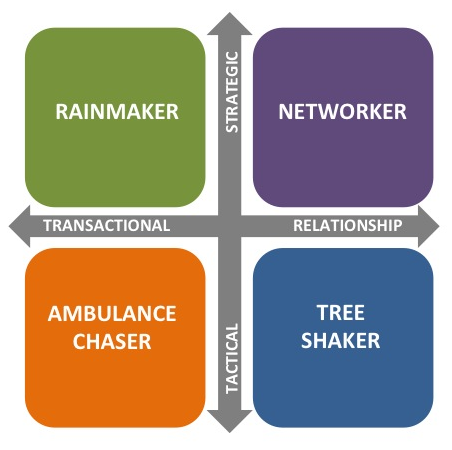
Based on my experiences there are four main types, organised along two axes: Transactional to Relationship-based client conversations; and  Tactical or Strategic sales techniques.

The Ambulance Chasers take their cue from personal injury lawyers who literally follow the stretcher into the emergency room. These sales people are almost entirely reactive, and only ever think about the next “chase”. They are less interested in building client relationships, and more focused on how much they can get from a single sale. Such sales people can often be relied upon to achieve short-term sales targets, but they don’t necessarily generate a lot of repeat business. If they develop a good nose for where more opportunities may be found, and if they can engage in more systematic sales planning, they may be able to transition into the Tree Shaker.

Tree Shakers are skilled in tapping into existing networks and markets, and uncovering latent opportunities – at times it’s simply a question of knowing how to harvest the low hanging fruit, at others it’s knowing when to dig deeper into an established client account. These sales people can usually find an extra sale or two when their colleagues might have given up – but beware of Tree Shakers who are really sand baggers, holding back those deals for when they really need them.

A skilled Tree Shaker or even an experienced Ambulance Chaser will know that leveraging industry contacts can help them get to more opportunities – but in order to cultivate deep client relationships that yield returns time after time, or to build long-term pipeline potential, you really need strong Networkers. These sales people play the long game (not always helpful when short-term sales goal need to be met….) because they know that having a strong strategic plan and resilient relationship skills will pay off in the end. Networkers are great at leading by example when it comes to account management and updating the CRM system – but they can infuriate if they become too reliant on too few contacts. (Tip: check their expense reports to see if they are having coffee with the same people every month…)

However, the type of sales people who can leave all others in their wake are the Rainmakers – those that can literally conjure something up out of nothing. At times, the Rainmaker may appear to be totally opportunistic – pulling a rabbit from a hat just when it was needed (again, beware the sand bagger) – but their forte is going into uncharted waters and coming back with the catch of the season; and while their colleagues may resent their skills (or question their methods?), secretly they admire the Rainmaker because they show what can be done in seemingly difficult or untested markets. The downside is that Rainmakers might only have one big deal in them, unless they can build sales momentum and sustain interest in the market – otherwise, they quickly move on.

In reality, every sales person probably needs to demonstrate each of these styles at different times; and like any balanced team, a sales organisation needs to have all four styles on their bench. The real insights are knowing where and when to deploy these different skills, and understanding what the results mean when doing a breakdown of the sales reports.

NEXT WEEK: Revisiting geo-blocking in light of the Competition Policy Review Draft Report

C-Suite in a quandry: To Blog or Not To Blog…

Should CEO’s be on social media? That is the question many boards, PR advisers, marketeers and C-Suite occupants are faced with these days. Partly driven by existentialist angst (“I Tweet therefore I am”), partly a desperate act of “me too”, many CEOs are in a dilemma about how to engage with the new media.

While it might sound like a good idea to have a CEO blog, in the wrong hands or used inappropriately, it can come across as inauthentic, too corporate, or just crass.

The use of CEOs as “personal brands” is nothing new – think of Richard Branson, Anita Roddick, Steve Jobs, Jack Welch etc. And while social media has the potential to extend the CEO’s reach to customers, shareholders and employees, it also abhors a vacuum. If companies do not take control of their public persona, their customers and employees (supporters and detractors alike) will fill the void for them.

I am seeing this debate play out in different ways:

First, there is a difference between a personal brand and a business brand, so it is important to establish boundaries while recognising how the CEO’s personal standing can be used effectively to complement the corporate presence.

Second, having the CEO recognised as an expert can enhance personal influence but may not directly benefit the company if it is not relevant to the business – does Warren Buffet’s prowess on the ukulele boost instrument sales, or help the share price of Berkshire-Hathaway?

Third, if CEOs do choose to outsource their blog content, make sure it is genuine and aligns not only with the CEO’s personal values but also with those of the company, customers, shareholders and employees.

Finally, CEOs or Boards struggling with this topic, or those worried about whether to take the plunge into social media would be advised to consult Dionne Kasian Lew‘s new book, “The Social Executive”, which is sure to become an essential guide on the subject.


5 Challenges for Performance Management

I recently facilitated a round-table discussion on Performance Management, with senior executives from commercial, not-for-profit and public sector enterprises. Our topic was current practice in Performance Management, and was hosted together with my colleagues at Bravo Consulting Group.

At the outset, we posed a number of discussion points, including:

Are there direct correlations between Performance Management, Employee Engagement and Productivity?

How is Performance Management linked to Rewards, Recognition and Compensation?

Do your people understand the context for Performance Management?

We also discussed the true costs of Performance Management systems (time, resources, software, administration), as well as the different attitudes of management, team leaders, HR and employees toward current processes.

The good news is that all the organisations represented are running annual or semi-annual employee appraisals. There was also an increased focus on performance outcomes (i.e., it’s not just about effort expended on job-defined tasks, but more about what is being achieved and how). And our participants reported the importance of using appropriate tools to deliver effective employee communications around corporate strategy, organizational goals, change management and project roll-outs to ensure greater alignment with, and context for Performance Management.

However, we identified a number of key challenges and critical issues facing any organization that takes Performance Management seriously, or who wishes to increase the effectiveness of their current practices:

1. Negative Perceptions of Performance Management

Despite the widespread use and acceptance of Performance Management systems, there remains considerable negativity around the process, the context, and the even discussions themselves. There appears to be a sense of foreboding when it comes to the mid- or end-of-year appraisal, a fact that was borne out for me just a few weeks ago: I was in the furniture display area of a well-known department store, when I overheard the floor manager say to one of her sales colleagues: “Mike says he’ll do your one-on-one at 3pm today.” What might appear to be a fairly innocuous statement visibly filled the employee with dread, at the prospect of his annual review. Surely Performance Management discussions should not be fraught with such unnecessary anxiety or stress?

2. Performance Management Systems Are All Different, And Too Rigid

Our round-table participants all reported using different software (and paper-based) systems, which is understandable given the proliferation of HRMS tools that support Performance Management. But many of these systems resemble accounting or project management software, and lack more qualitative or cultural performance measures. Alternatively, systems tend to be rigid, process-driven applications that often take a checklist and compliance approach to conducting Performance Management. They can also suffer from a “one size fits all” solution, and don’t readily help organizations to develop meaningful performance measures or point-in-time indicators, mainly because they are backward-looking and use retrospective data. Shouldn’t Performance Management help employees move towards the job that they want (and towards their longer-term career objectives), rather than confining the discussion to current or out-dated tasks?

3. Formal Processes Are Disconnected From Informal Processes

By making it a “process” (and an infrequent one at that), Performance Management becomes artificial, and divorced from day-to-day reality. This can result in performance issues being stored up and only “discovered” during the formal appraisal – which will add to the anxiety and stress if long-term resentments about manager-employee behaviours and relationships are only brought to light during the Performance Management process. A common outcome from the formal Performance Management process is a corrective or punitive response, due to the absence of continuing efforts to manage and direct performance. Why should employees only hear feedback about their performance at the end of the year, when it might be too late to address the issue, leading to knock-on implications for remuneration, recognition and promotion. Shouldn’t Performance Management be part of the everyday dialogue between colleagues?

4. Many Managers Are Simply Ill-Equipped To Have The Performance Conversation

Without the appropriate skills to foster meaningful and open dialogue with their direct reports, managers end up having to manage the Performance Management conversation, rather than helping their people self-manage their own performance. This awkwardness is compounded if there is a lack of organizational context for Performance Management; worse, poor performance is ignored or circumvented because managers do not feel confident to start the dialogue, which is not fair to the individuals concerned if they are not given the opportunity to discuss what might be the root cause of a performance issue. If there is no dialogue around Performance Management, how can employees know what they are being held accountable for, or appreciate the consequences of not meeting performance goals and objectives?

5. Performance Management Systems Ignore The Middle Majority

Most Performance Management systems (certainly the ones I have been exposed to) end up using forced bell curve distribution analysis to classify employees according to high, middle, low and under achievement categories of performance. I recall one former colleague who used to cite Garrison Keillor when annual appraisal ratings had to be allocated according to the expected distribution curve: “Well, that’s the news from Lake Wobegon, where all the women are strong, all the men are good-looking, and all the children are above average.”

When we asked our participants “what keeps you awake at night?”, one CEO commented that he worries about the middle 60%-65% of his employees – the bulk who “do a good job” – because more of his attention and focus is on the high and low performers (the top and bottom 15%-20% respectively). This “bias” can distort management perspective, and lead to disaffection in the middle band, unless there are adequate ways to recognize and reward solid performance independent of annual compensation or promotion. (This issue is particularly acute in Australia when we consider the impacts of slower economic growth, comparatively high wages and sluggish productivity – yet, employers face a war for talent as new and highly valued skills become harder to resource.)

Conclusion

If Performance Management could become a continuous dialogue, backed by meaningful performance criteria and underpinned by a greater emphasis on employee self-awareness and self-directed Performance Management, then organisations could spend more time on strategy and execution, and less time on managing individual performance. Not only would this create greater cost efficiencies in the Performance Management process itself, it would likely lead to improved productivity outcomes because there would be more clarity and engagement around goals, outcomes and incentives.