Making the most of the moment…

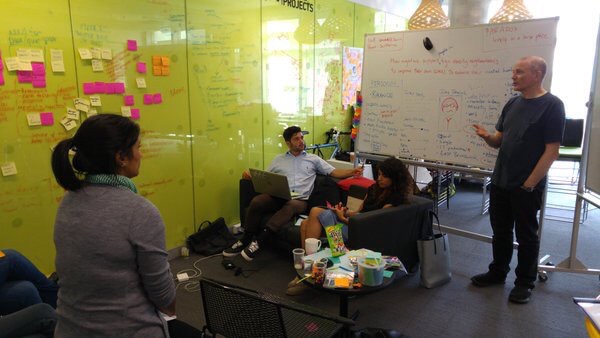
I’m the first to admit that I am not very good at practising meditation. It’s not that I don’t aspire to a state of mindfulness, but I sometimes find it hard to “be in the moment”. It does not come easily or naturally to me, because I’m often too busy thinking about the objective context, rather than the subjective conscious experience. So it was really interesting to see this photo of myself at last weekend’s Global Service Jam, organised by the Melbourne Jam Team at Swinburne Design Factory, and supported by Deloitte Digital, the School of Design Thinking and Huddle.

“This is where the magic happens…” (Photo by Johan Pang – image sourced from Twitter)

This photo was probably taken about halfway through the 48-hour event. Our team had got to the stage where we had articulated our problem statement (after much ideation…), scoped a solution model, done some validation through research and field interviews, and refined our key persona, all supported by some feedback from role-play and scenario testing. We had also just completed a lightning prototyping workshop, so the team needed to decide the overall form of our proposed service design solution, and reach agreement on the presentation format. Although there was so much still to do, we were at risk of revisiting things that had already been decided, because it felt like there was some remaining uncertainty about our prototype and some of the choices we had made along the way.

I don’t recall the exact “moment” (how imprecise a measure of time is that word?) but without realising it I found myself almost urging the team to stick with our existing decisions, and work through the remaining tasks based on the information we had to hand. It was a subconscious reaction to the message we had been given in the prototyping workshop about making decisions based on “the authority of the moment”. (Thank you, Rez Ntoumos!)

Sure, we weren’t having to make split-second, life-or-death decisions under enormous pressure, but if there was any “magic” here, it was probably about being able to be in the zone – the willingness to submit to the situation, to go with the flow. Throughout the weekend, we were advised not to fall in love with a particular idea or solution, but at the same time we were encouraged to get behind the team decisions and the options we chose – partly to sustain momentum, and partly to make sure we met the project deadlines!

There is a huge lesson here, because it goes some way to addressing the dilemma that many organisations face in making and implementing decisions (be they boards, policy makers, executive teams, startups, project managers, entrepreneurs, product developers or designers….). While it’s important to have robust decision-making processes, and it’s vital to consider all available data, the quality of any decision may not rest on whether it was the “best” choice to make, because usually only the benefit of hindsight can tell you that. If, however, at the time, it seemed like the right or appropriate choice, then in that moment it has to be the best-available decision.

Of course, there needs to be governance, transparency, authority and information to support, justify and legitimise the decision. Good decisions are usually those which can be fully articulated, the reasons easily communicated, and the implications clearly understood. Then once a choice has been made, the organisation or team that gets right behind the decision is more likely to succeed in the execution. All organisations at some point make “bad” decisions or inappropriate choices, but I think more often, even good decisions can suffer through poor implementation.

I acknowledge the need to get better at meditating, to enhance mindfulness for both personal reflection and clarity of thinking. Above all I recognise the enormous value of making the most of the moment when it comes to decision-making.

Next week: Startup Victoria’s latest pitch night

Another weekend, another hackathon….

Last month, I competed in my second hackathon of the year, the #HSCodeFest sponsored by the Herald Sun and News Corp, and hosted by Melbourne University’s Carlton Connect. I’m pleased to say that our team of four, which was only formed on the first night, came 3rd in the pitch competition – with an idea for a news quiz app.

Screen Shot 2015-12-18 at 3.44.56 PMThat particular weekend was quite an eventful one for local startups – not only were there at least two other hackathons being held in Melbourne at the same time, but the State Government also announced its LaunchVic initiative. Small Business Minister, Philip Dalidakis found time in his busy schedule to address the #HSCodeFest participants, which was a great incentive. The previous weekend saw another Startup Weekend event, and last weekend Carlton Connect hosted yet another industry hackathon sponsored by the GE Industrial Challenge. And of course, since then we have had the Prime Minister announce the National Innovation and Science Agenda. To paraphrase Mr Turnbull, there’s never been a more interesting time to be a startup….

Having participated in Startup Weekend’s first #FinTech hackathon back in March this year, I was a lot more prepared, and had a much better idea of what to expect. Even though I didn’t pitch a specific idea on the opening night, I used my previous team-building experience to make sure we had a balanced mix of skills and expertise. I was also clear to make sure that once we had agreed on the project idea, everyone had specific roles, and we constantly checked in on progress and next steps.

As usual, the team generated far more content, data and ideas than we actually used in the pitch presentation. We also kept it very simple, by focusing on the key concept, demoing an MVP, outlining the commercial strategy, describing the business plan, and establishing just enough knowledge and awareness about the market opportunities, even though it had not been possible to fully scope them. For an insider’s view, check out my team-member Nathan’s blog.

We have seen over the past 12-18 months that the hackathon model is being deployed in many different ways to try to stimulate innovation and generate new business ideas. Even government departments and public utilities are getting in on the act, by enabling participants to access data sets, software, technology and APIs to see what they can come up with. Large corporates, who struggle to embed innovation into their organisations, are also holding internal competitions drawing on the experience of meetups, hackathons and pitch nights.

I only see this as a positive development, as long as the energy, enthusiasm and experience can be channelled into meaningful outcomes, which enable in-house talent and external expertise to combine to build great products and services that customers want, and/or identify and deliver significant process improvements and efficiency gains.

However, part of me is sceptical – as someone who is probably much older than the average age of a hackathon participant, I’m still amazed how many of my contemporaries either have no idea or simply don’t “get” the hackathon or meetup concept. They seem astonished that anyone would want to get together with total strangers, and spend their evenings let alone a whole weekend working with them, for “free”. To those of my peers who may see it that way, I would point out that participating in these events is a cheap and effective way of accessing new ideas and skills, meeting talented people, and acquiring new skills and knowledge.

Finally, if your organisation is thinking about running a hackathon or similar event for the first time, I’m more than happy to share my insights – contact me via this blog.

Since the holidays will soon be upon us, Content in Context is taking a short break. Normal service will be resumed on January 5. To my many regular readers and followers, I wish you all a safe and peaceful New Year.

Next: Surrealism, Manifestos and the Art of Juxtaposition

It’s not enough to be #disruptive – you also have to #collaborate

For most tech #startups, especially in #fintech, it’s no longer just about being #disruptive – there’s a growing realization that entrepreneurs also have to be #collaborative.

One year on from his last visit to Melbourne, Stripe co-founder John Collison was back in conversation with Paul Bassat from Square Peg Capital, courtesy of Startup Victoria and sponsors Envato, LIFX, BlueChilli, Bank of Melbourne and PwC. Previously, John spoke about the need to be “disruptive rather than incumbent”, yet it seems that Stripe’s growing success can be attributed to relationships with other providers in the payments industry, such as AliPay and VISA, plus deals with retail sites such as Catch Of The Day and RedBalloon. Oh, and it probably helps that most U.S. presidential candidates are using Stripe for campaign donations….

Stripe has already launched an SDK platform for developers, and is planning to launch StripeConnect, a market place platform. The point being, the more users (upstream and downstream) you can plug into your platform, the greater the traction, but also the deeper the collaboration. Why would you want to annoy your potential partners, vendors and suppliers?

Meanwhile, Australia is now Stripe’s 4th largest market, and close to being its 3rd largest.

Going forward, despite some criticism (e.g., it’s still not rolled out in Australia), ApplePay has huge potential. It has an estimated 800m credit cards registered with iTunes (making it 5x bigger than PayPal), and with people currently paying as little as $1.69 per song download, ApplePay could crack the market for broader micropayments (e.g., the $2 on-line daily newspaper?).

However, Stripe stills sees that there are disconnects between traditional credit card application processes, account registration forms, payment solutions, merchant set-up and downstream payments for low-value (but high volume) transactions.

Looking ahead, Collison is talking up opportunities in same-day delivery for e-commerce (hard to see this happening outside of Australia’s main metro areas – unless the infrastructure is there…), and better video-conferencing services (again, in Australia this is hampered by poor broadband services).

A few days later, and Adrian Stone from AngelCube was in conversation with StartUpGrind‘s Melbourne convener, Chris Joannou. Adrian restated the sentiment that angel investors tend to back founders rather than ideas, which can seen by some of the ventures AngelCube has backed so far, including Tablo, LIFX and CoinJar. Each venture has been successful in raising early-stage funding (despite some teething problems and much pivoting), although AngelCube itself has not yet completed an exit.

Rather like his associate Dave McClure from 500 Startups, Adrian recognizes that for various reasons, VCs are having to make smaller, multiple bets, rather than betting the farm on single or a few ideas.

Perhaps this gives further credibility to the proposition that every portfolio (including individual members in retail and industry superannuation funds?) should have a discretionary 1-2% allocation to startups, but you still need an investment vehicle or platform to screen and manage opportunities. Sadly, we see that there is still a disconnect between institutional investors and startup founders. The former are having to get bigger to reduce operating costs, yet this means they have what one friend of mine has defined as the “Allocation Gap”. And of course, founders far outnumber the available sources of VC funding. Time for a rethink on how investors can collaborate to access startup opportunities?

Next week: Cultural Overload


How to spend $60m on #Innovation and #Entrepreneurship for #Startups

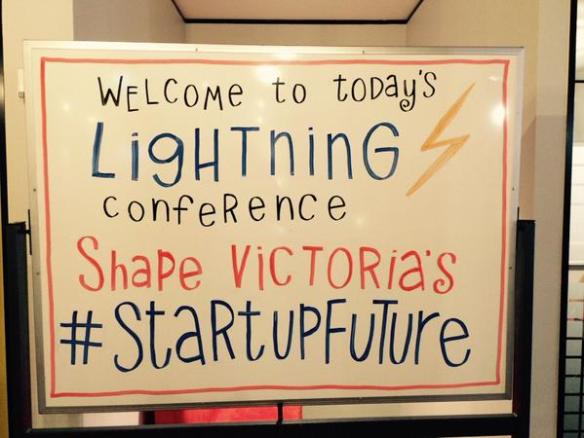
In the recent Victorian State Budget, the government allocated $60m over 4 years to supporting startups, via innovation and entrepreneurship. While not an insignificant sum, it’s still not a huge amount in the overall scheme of things. Having made the announcement, the government hurriedly undertook some rapid community and stakeholder consultation, to figure out how to spend the money. I was fortunate enough to be invited to one of the consultation exercises, a half-day lightning conference organised by Dandalo Partners, facilitated by Collabforge, and hosted by Teamsquare co-working space.

LightningConference

The theme of the Lightning Conference was #StartUpFuture

At the outset, there was an assumption that whatever recommendations came out of the consultation process, a new quango would be formed to oversee the implementation of the program and distribution of the funding. I don’t think I was alone when I expressed my concern that this was rather like putting the cart before the horse – the implication being, “Why seek our opinion, views and recommendations if you’ve already decided the solution?”

To their credit, the organisers took this on board – for example, rather than creating yet another entity, maybe the funding could be facilitated by an existing body such as Startup Victoria – but it felt that the consultation exercise was at risk of “going through the motions”.

Across the various topics that were discussed in the self-forming and self-directed breakout sessions, there were probably 5 key themes:

  1. Community
  2. Infrastructure
  3. Funding
  4. Sustainability and 
  5. “Picking Winners”. 

Here are the main points from each of those themes:

1. Community

There was general agreement that the local startup and entrepreneurial community is well-established, reasonably well-connected (I myself knew about 10% of the participants from various networks) and growing fast.

However, there was also a common view that more could be done to bring entrepreneurs and like-minded people together. For example, how do people know what ideas or projects everyone is working on, how can people find help or make offers of help in terms of matching skills, experience, knowledge, resources? How do we connect suppliers and investors to startups?

Sure, there are numerous meetups and regular startup events, but is there a better way to leverage this potential?  And there are various matching services linking entrepreneurs to mentors, but they are rather ad hoc, and in the case of connecting startups and investors, there are probably more challenges than there are opportunities (see Funding, below).

In short, how can the community come together in a more collaborative way?

2. Infrastructure

It’s quite easy to see that Victoria (mainly Melbourne) has a vibrant startup ecosystem, simply based on the number and frequency of meetup events, founder workshops and hackathons. But there still appear to be numerous obstacles to getting started – from establishment costs and bureaucratic red tape, to tax impediments and access to funding.

Some of these challenges are being addressed at Federal level (e.g., streamlining the company registration process, tax cuts for SMEs, and changes to both equity crowdfunding and employee share schemes). But that’s part of the challenge in itself – at the individual State level, there is relatively little that can be done on fiscal policy (apart from payroll tax and land tax), and all reforms relating to securities financing need Federal legislation and the involvement of market regulators.

The State government has more autonomy around local industry policy settings and planning, as well as making funding available via grants. This means, though, that government is forced to prioritize one sector over another (see “Picking Winners”, below), and a system of grants often results in a mini-industry that is created around grant applications, awards and distribution.

At a practical level, some participants took the view that more could be done to facilitate early stage startups and product prototyping – such as a continuous education and open-enrollment program for entrepreneurs, and co-working spaces for small-scale manufacturing, materials-testing, and engineering. (I am aware of at least a couple of local projects in this space – a biotech co-working lab and an “Internet of Things” open access workshop).

If the State government is looking to plug a gap, investing in R&D facilities might be one option.

3. Funding

This remains the biggie – and a topic previously covered both in this blog, and via numerous commentators and advisers. Even though there are many local pitch competitions, incubators and accelerator programs (plus Shark Tank and That Startup Show make for interesting/amusing viewing…) the elephant in the room is that there are too many startups chasing too few investors.

Competition for resources is positive, as long as it’s an efficient, transparent and accessible market, where the laws of supply and demand are equitable and the rules of engagement are clearly understood.

One industry veteran noted that the local investor community can normally provide small-scale startup funding up to $5m (via “family, friends and fools” and angel backers), and even larger, early-stage equity funding over $50m (via Venture Capital, Private Equity and Family Offices). But in the $5m-$50m range there are far fewer options.

Leaving aside the pros and cons of traditional secured and unsecured bank lending and emerging P2P lending platforms, there is a funding gap that could be filled via Australia’s superannuation scheme:

  • First, we need to find ways to get large retail and industry super funds along with other institutional investors to invest directly in local startups. At present, thanks to the Silicon Valley effect, these instos are more comfortable handing their money to US-based fund managers who then charge a premium to invest the assets in local startups. (I call this a very expensive boomerang….)
  • Second, in the absence of suitable investments for retail investors who may want to allocate part of their portfolio to startup opportunities, part of their superannuation assets could be used to invest in early-stage startups via a form of savings products or fixed income bonds. The retail bond market (such as it is) is heavily skewed towards sovereign debt (treasury bonds) and bonds issued by financial institutions (often in the form of hybrid securities, which are essentially a form of deferred equity). There have been attempts (and even regulatory reforms) to encourage the development of a deeper retail bond market in Australia, but these efforts appear to have stalled.

An enlightened approach to asset allocation could direct even a very small part of the $1.8tn superannation savings into startups that could have significant outcomes. If SMEs are seen as the backbone of future economic activity and jobs (as well as innovation and entrepreneurship), helping to accelerate startup growth will deliver multiple long-term dividends.

4. Sustainability

This wasn’t a huge topic of discussion, but it deserves an honourable mention because it surfaced in several ways:

  • Economic (e.g., making better use of available resources, not funding startups that go nowhere etc.)
  • Social impact (e.g., the growth of social enterprises)
  • Environmental (e.g., the conscious capitalism movement and the importance of “for purpose” enterprises such as B-Corps that want to minimize their environmental footprint)
  • Government (e.g., how to foster startups that want to help deliver better public services, and how to change public sector procurement policies that give startups more of a look-in)

There is also a need to reflect the changing demographics of the workplace, so that sustainable employment opportunities (in whatever form they exist) are made available to both mature-age workers and new school leavers.

So perhaps part of the $60m could be put towards (re)training initiatives.

5. “Picking Winners”

First up, let me say I always get nervous when we put our elected representatives in charge of deciding the fate of specific industries, especially when it’s taxpayers’ money at risk. Call me a cynic, but I’m not sure that picking winners is the government’s forte. I understand the need to support certain sectors that contribute to GDP growth, create employment opportunities, generate taxable revenue, instil industry innovation and develop cutting-edge technology – but the example of the domestic automotive industry is one where political ideology probably got the better of sound economics, as public subsidies eventually came to look like throwing good money after bad.

If nothing else, picking or backing winners is fraught with problems of favouritism, lobbying, murky back room deals and “jobs for the boys”. Better to create the foundations upon which broader innovation and entrepreneurship can thrive, and let the market decide. That way, the government can still claim the credit, and frame the conversation around its role as an enabler.

On the day, the discussion was more about the long lead time before anyone would know whether the program had been successful (assuming we can agree on what success should look like). In reality, re-tooling innovation and entrepreneurship is a 10-year initiative (which is difficult to manage in the face of short-term policy settings linked to 3 and 4-year election cycles).

  • Should we teach entrepreneurship and innovation in schools (alongside coding and STEM subjects)?
  • Should government use local plebiscites to determine where/when/how the funding should be allocated?
  • Should we use the money to directly fund startup founders (rather like the UK’s enterprise allowance scheme in the 1980s)?

There was also a suggestion that the money could be used to promote local startup success stories, in order to foster an understanding of truly viable startups, to identify and fast-track high-potential entrepreneurs, as well as define what is takes (time, money, resources, networking and connections) to build scalable and sustainable startup businesses (i.e., companies generating $250m+ in revenue, not lifestyle ventures or small family owned concerns).

If we do need to pick winners, perhaps we can easily agree which ones they are based on current trends, future needs and demographic demands:

  • Health, biotech and medtech
  • Fintech and big data analytics
  • Education and lifelong learning
  • Renewables and green technologies
  • High-tech engineering and manufacturing

In which case, we should simply help the State government prepare an investor profile, set an optimum portfolio performance target (based on financial returns, innovation scores and a mix of social and environmental outcomes) and give the $60m to a skilled fund manager.

FOOTNOTE:

For further ideas, please see 10 Random Ideas…

POSTSCRIPT:

A couple of further contributions to the innovation debate from AVCAL around tax reform, and from OneVentures around superannuation allocation.


Next week: Medtech’s Got Talent