Making the most of the moment…

I’m the first to admit that I am not very good at practising meditation. It’s not that I don’t aspire to a state of mindfulness, but I sometimes find it hard to “be in the moment”. It does not come easily or naturally to me, because I’m often too busy thinking about the objective context, rather than the subjective conscious experience. So it was really interesting to see this photo of myself at last weekend’s Global Service Jam, organised by the Melbourne Jam Team at Swinburne Design Factory, and supported by Deloitte Digital, the School of Design Thinking and Huddle.
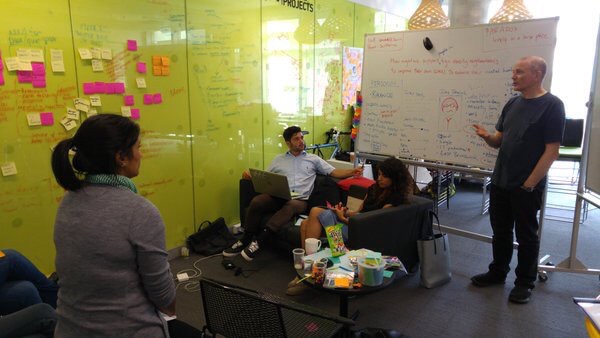
“This is where the magic happens…” (Photo by Johan Pang – image sourced from Twitter)

This photo was probably taken about halfway through the 48-hour event. Our team had got to the stage where we had articulated our problem statement (after much ideation…), scoped a solution model, done some validation through research and field interviews, and refined our key persona, all supported by some feedback from role-play and scenario testing. We had also just completed a lightning prototyping workshop, so the team needed to decide the overall form of our proposed service design solution, and reach agreement on the presentation format. Although there was so much still to do, we were at risk of revisiting things that had already been decided, because it felt like there was some remaining uncertainty about our prototype and some of the choices we had made along the way.

I don’t recall the exact “moment” (how imprecise a measure of time is that word?) but without realising it I found myself almost urging the team to stick with our existing decisions, and work through the remaining tasks based on the information we had to hand. It was a subconscious reaction to the message we had been given in the prototyping workshop about making decisions based on “the authority of the moment”. (Thank you, Rez Ntoumos!)

Sure, we weren’t having to make split-second, life-or-death decisions under enormous pressure, but if there was any “magic” here, it was probably about being able to be in the zone – the willingness to submit to the situation, to go with the flow. Throughout the weekend, we were advised not to fall in love with a particular idea or solution, but at the same time we were encouraged to get behind the team decisions and the options we chose – partly to sustain momentum, and partly to make sure we met the project deadlines!

There is a huge lesson here, because it goes some way to addressing the dilemma that many organisations face in making and implementing decisions (be they boards, policy makers, executive teams, startups, project managers, entrepreneurs, product developers or designers….). While it’s important to have robust decision-making processes, and it’s vital to consider all available data, the quality of any decision may not rest on whether it was the “best” choice to make, because usually only the benefit of hindsight can tell you that. If, however, at the time, it seemed like the right or appropriate choice, then in that moment it has to be the best-available decision.

Of course, there needs to be governance, transparency, authority and information to support, justify and legitimise the decision. Good decisions are usually those which can be fully articulated, the reasons easily communicated, and the implications clearly understood. Then once a choice has been made, the organisation or team that gets right behind the decision is more likely to succeed in the execution. All organisations at some point make “bad” decisions or inappropriate choices, but I think more often, even good decisions can suffer through poor implementation.

I acknowledge the need to get better at meditating, to enhance mindfulness for both personal reflection and clarity of thinking. Above all I recognise the enormous value of making the most of the moment when it comes to decision-making.

Next week: Startup Victoria’s latest pitch night

Another weekend, another hackathon….

Last month, I competed in my second hackathon of the year, the #HSCodeFest sponsored by the Herald Sun and News Corp, and hosted by Melbourne University’s Carlton Connect. I’m pleased to say that our team of four, which was only formed on the first night, came 3rd in the pitch competition – with an idea for a news quiz app.

Screen Shot 2015-12-18 at 3.44.56 PMThat particular weekend was quite an eventful one for local startups – not only were there at least two other hackathons being held in Melbourne at the same time, but the State Government also announced its LaunchVic initiative. Small Business Minister, Philip Dalidakis found time in his busy schedule to address the #HSCodeFest participants, which was a great incentive. The previous weekend saw another Startup Weekend event, and last weekend Carlton Connect hosted yet another industry hackathon sponsored by the GE Industrial Challenge. And of course, since then we have had the Prime Minister announce the National Innovation and Science Agenda. To paraphrase Mr Turnbull, there’s never been a more interesting time to be a startup….

Having participated in Startup Weekend’s first #FinTech hackathon back in March this year, I was a lot more prepared, and had a much better idea of what to expect. Even though I didn’t pitch a specific idea on the opening night, I used my previous team-building experience to make sure we had a balanced mix of skills and expertise. I was also clear to make sure that once we had agreed on the project idea, everyone had specific roles, and we constantly checked in on progress and next steps.

As usual, the team generated far more content, data and ideas than we actually used in the pitch presentation. We also kept it very simple, by focusing on the key concept, demoing an MVP, outlining the commercial strategy, describing the business plan, and establishing just enough knowledge and awareness about the market opportunities, even though it had not been possible to fully scope them. For an insider’s view, check out my team-member Nathan’s blog.

We have seen over the past 12-18 months that the hackathon model is being deployed in many different ways to try to stimulate innovation and generate new business ideas. Even government departments and public utilities are getting in on the act, by enabling participants to access data sets, software, technology and APIs to see what they can come up with. Large corporates, who struggle to embed innovation into their organisations, are also holding internal competitions drawing on the experience of meetups, hackathons and pitch nights.

I only see this as a positive development, as long as the energy, enthusiasm and experience can be channelled into meaningful outcomes, which enable in-house talent and external expertise to combine to build great products and services that customers want, and/or identify and deliver significant process improvements and efficiency gains.

However, part of me is sceptical – as someone who is probably much older than the average age of a hackathon participant, I’m still amazed how many of my contemporaries either have no idea or simply don’t “get” the hackathon or meetup concept. They seem astonished that anyone would want to get together with total strangers, and spend their evenings let alone a whole weekend working with them, for “free”. To those of my peers who may see it that way, I would point out that participating in these events is a cheap and effective way of accessing new ideas and skills, meeting talented people, and acquiring new skills and knowledge.

Finally, if your organisation is thinking about running a hackathon or similar event for the first time, I’m more than happy to share my insights – contact me via this blog.

Since the holidays will soon be upon us, Content in Context is taking a short break. Normal service will be resumed on January 5. To my many regular readers and followers, I wish you all a safe and peaceful New Year.

Next: Surrealism, Manifestos and the Art of Juxtaposition