It’s OK to say “I don’t know”

Thanks to the example set by our media-groomed politicians, it seems that nobody is willing to admit when they don’t know the answer to something. Rather than reveal a gap in their knowledge, they prefer to fudge their way to a non-committal, irrelevant or even incorrect response, by trotting out a favourite policy slogan or party catchphrase. Wouldn’t it be refreshing (and more honest) if they just said “I don’t know”, and then figured out how to find the appropriate answer?

Image by: Alexander Henning Drachmann

Image by: Alexander Henning Drachmann

In previous posts, I have commented on my frustrations at poor customer service, and in particular, the inadequate customer service training given to front-line staff. My latest run-in with poor customer service training came at my local supermarket. Owing to an innocent misunderstanding at the checkout, I asked the checkout assistant to reverse the payment on my credit card payment and debit it instead from the cash balance on my store loyalty card.

“No, that’s not possible”, I was told. “It’s already gone through on your credit card. You’ll have to use the loyalty card next time.”

“Surely,” I replied, “it’s a very simple process to reverse the transaction, and process it again?”

My request was further denied as being “impossible”. Eventually, the checkout assistant admitted that she “didn’t know” how to do it, so she would need to ask her supervisor to do it. “Fine,” I replied, and suggested she could have said this in the first place.

Problem was, the supervisor had no idea either. “I’ll have to re-process your transaction by scanning and reversing each item individually, and then put them through again.” By this time, I was wondering why I chose to shop here, and seriously considering why I would ever do so again.

“There must be an easier way,” I suggested. “I can’t be the first customer to have had this issue.” After further hesitation and prevarication, the supervisor said she would have to ask her manager to show her how to do it, as she herself didn’t know the process.

Turns out, it took one transaction code to reverse the credit card payment, and then reprocess it on the loyalty card – and without having to re-scan my shopping.

I don’t blame the checkout assistant, as clearly she hadn’t been trained how to do it (although she should have admitted as much in the first place). I’m a little surprised that the supervisor didn’t know either (how did she get promoted?). But the real blame must lie with the manager (or his manager) for not making sure the staff working under him knew the process, or knew who could perform the transaction.

To me, leadership (in politics, in business and in the service industry) is about making sure people know how to do their job, that they have the right tools and information to perform their duties, and that they know what is expected of them in the role. In cases where they may not know the answer, then it’s better to admit “I don’t know, but I’ll find the answer”, rather than fumbling the issue.

Next week: Updates on Apple Health, AusPost, eTaskr and Slow School of Business
“Why? Because we’ve always done it this way…”

A couple of blogs ago, one of my regular correspondents kindly laid down a challenge. He suggested that part of the answer to the problem I was writing about (i.e., how to manage data overload) could be found within Simon Sinek’s “Start With Why”.

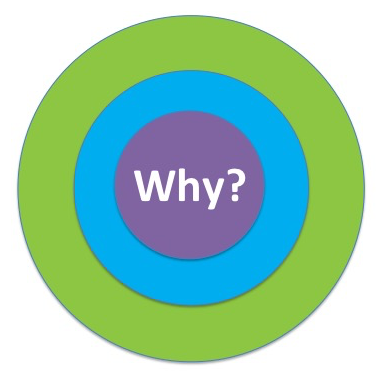
Why?I’m quite familiar with Sinek’s investigation of “Why?”, but I wasn’t sure it was applicable in the context of my topic. Don’t get me wrong – the “Golden Circle” is a great tool for getting leadership teams to explore and articulate their purpose, and it can help individual business owners to re-connect with the reasons they do what they do.

It can even facilitate new product and service development.

But, I believe it’s harder to apply at an operational or processing level, where the sorts of decisions I was referring to in my blog are typically being made: what tools to use, what systems to adopt, what software to deploy etc.

There are several reasons why organisations do things the way they do them. When undertaking a business process review, I frequently ask the question, “Why are you doing this?”

Here are some typical responses I’ve received (and my conclusions in parentheses):

  • “Because we have to” (compliance)
  • “Because we’ve been told to” (command and control)
  • “Because we’ve always done it like this” (inertia)
  • “Because everyone else is doing it” (cheap/easy/popular)
  • “Because our consultants recommended it” (cop-out)

In one experience, I had to implement a process change within a publishing team, comprising experts (writers) and technicians (editors). The problem was, that even though the content was published on-line, most of the production processes were done on hard copy, before the final versions were uploaded via a content management system. The inefficiencies in the process were compounded by a near-adversarial relationship between writers and editors, at times bordering on a war of attrition.

When I asked the team why they worked this way, their responses were mainly along the lines of “command and control” and “inertia”. Behaviours were reinforced by some self-imposed demarcation.

The writers felt it was their role as experts to demonstrate everything they knew about the topic (without necessarily saying what they actually thought); while the editors felt they were required to work within a rigid house style (to the point of pedantry), maintain writing quality (at the expense of timeliness), and to maintain content structure and format (over context and insight).

  • Both sides felt they were meeting the organisation’s purpose: to deliver quality information to their customers to help them make informed decisions.
  • Both believed they were following clear operational guidelines, such as production, technical, and compliance.
  • Both were passionate about what they did, and took great pride in their work.

Unfortunately, the procedures which they had each been told to follow were inefficient, at times contradictory, and increasingly out of step with what customers actually wanted.

Based on market feedback clients told us they:

  • favoured timeliness over 100% perfection;
  • preferred insights over data dumps; and
  • really wanted “little and often” in terms of content updates

Thankfully, the voice of the customer prevailed, and the introduction of more timely content management processes resulted in frequent updating (via regular bulletins) backed by the “traditional” in-depth analysis.

When starting a change management project, conducting a process review, or undertaking a root-cause analysis, if asking “Why?” doesn’t get you very far in getting to the bottom of a problem, I find that it can help to pose another question: “What would your customers think about this?” For example, if customers knew how many times a piece of data was handed back and forth before their order/request/enquiry was processed, what impression might that give about an organisation?

For most companies, their sense of purpose is driven by a strong or underlying desire to serve their customers better – it’s as simple as that.

Next week: The 3L’s that kill #data projects

The Great #Data Overload Part 3: Differentiating in a #Digital World

Have you noticed that what was once old is new again? In particular, I’m talking about traditional direct marketing techniques, such as door-to-door sales, print circulars, and telephone cold calling. It’s as if businesses realise that to be heard and to get noticed in the digital world, you have to do something different or unexpected, and nobody expects to see a door-to-door salesperson these days!

MBPI mostly work from a home office, and in recent months I have had door-knockers trying to sell me car tyres, energy-saving devices and fire extinguishers. That’s in addition to the telesales calls persuading me to switch phone and utility providers, take out insurance or upgrade my security software (yes, I know that last one is probably a scam). Plus, more and more local businesses and tradespeople are using good old-fashioned leaflets and letter box drops (which is interesting, given that around 58% of local search is done on a mobile device).

Why are some advertisers reverting to this form of direct marketing?

I can think of several reasons:

  • They need to cut through the digital noise and reach their target audience via “novel” promotional tactics.
  • Their products and services are less-suited to on-line or in-app purchasing decisions.
  • Their sales activities are focused on acquiring existing customers from competitors, a conversion process more likely to succeed via personal contact.
  • Or simply, the costs make more sense.

Why is it important to differentiate? 

It’s 10 years since “Blue Ocean Strategy” was published, which stressed the need to stand apart from your competition (“avoid the shark-infested waters”). The message is even more relevant today, because the ubiquity of social media and content marketing platforms means that everyone has access to the same tools, and it’s not that difficult to play technology catch up; and while there may be good reasons for your business to engage with these channels to market, you also need some alternatives, like offering direct customer engagement that is not wholly reliant upon on-line and digital. That’s why some banks are opening more branches as part of their growth and customer acquisition strategy, why some retailers are offering “buy on-line, collect in-store”, and why some service companies are moving to an integrated, end-to-end customer experience, so that customers get the same person helping to resolve their problem from start to finish.

How to differentiate?

Standing out from the crowd (for the right reasons!) is critical to attracting customer attention. Competing on price alone is typically a race to the bottom where nobody wins. Getting noticed, especially when everyone is using the same marketing tools and sales offers, may mean doing something unusual or unexpected (for example, ALDI‘s “anti-ads”) as part of your marketing campaign. Or connecting directly with your audience in a way that doesn’t rely on “Likes”, “Shares” or “Follows”.

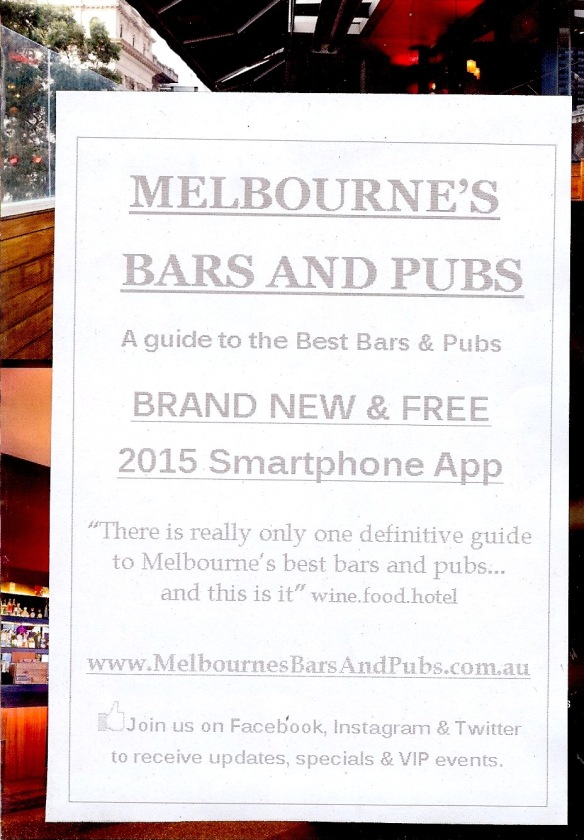
Sometimes it’s as simple as as this leaflet (shown above) found in my letter box the other day. At first, I thought it was a flyer for a local bar. Then, I noticed it was promoting a new smart phone app. On closer inspection, the flyer comprised a printed sheet hand-pasted onto a page torn from a magazine. That’s a lot of manual effort to promote a digital product, but using a lo-tech solution that totally makes sense! (No doubt, it appeals to the hipster crowd, ’cause retro’s cool, right?) So, the element of surprise (if that was the intention) worked – it got my attention because I wouldn’t have expected to receive a leaflet for a new app.*

Next week: “Why? Because we’ve always done it this way…”

Notes

* For an interesting story on the power of the unexpected, see Adam Posner’s talk on customer loyalty programs.


Content Marketing and the “New Hierarchy of Needs”

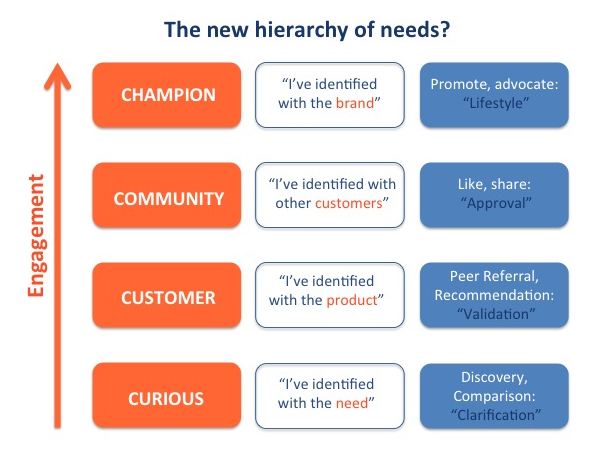
Maslow’s theory on the “Hierarchy of Needs” has become shorthand for explaining human behaviour and motivation – primarily in our personal lives, but increasingly in our working lives. At the risk of offering an answer to yet another first world problem, it seems to me that many social media platforms and content marketing solutions are trying to recalibrate Maslow for generating deeper (and sometimes more meaningful) engagement with consumers. So, by way of a simple infographic, I am offering my own theory on the new hierarchy of needs:

New Hierarchy of Needs


When we are looking for a product or service to meet a need, we are usually in “discovery mode” – we are searching for content that helps us by offering suggestions, comparing products and prices, and clarifying the precise need. So, we are either browsing, curious, or looking for assistance.

Having found some possible solutions, we seek reassurance via informed recommendations, peer referrals and published reviews. We may place different weight on this information depending on the source, but we are seeking justification for our reason to buy, or validation for becoming a customer.

If we are happy with our choice, and given the right opportunity and encouragement, we may be willing to tell our friends and anyone else who’s interested via Likes and social media posts and reviews. This is an interesting point in the engagement transaction – going from peer-to-peer sharing, to looking for approval for our decision from the wider community.

Finally, if we are so enamoured with the product, and we enjoy sharing our experiences, we may be flattered into making a lifestyle statement about our preferences; we could become a self-identified “voice of authority” through blogging and endorsements, or we might be willing to be closely identified with a brand as an advocate or champion (the sort of customer beloved of Net Promoter Scores).

The ultimate consumer-turned-champion was, of course Victor Kiam, the customer who liked the product so much, he bought the company….