The latest installment of Startup Victoria #pitch night

The numbers were out in force for the August edition of Startup Victoria‘s monthly pitch night. A full house (no doubt helped by a new beverage sponsor…) heard from another batch of startup hopefuls, operating in very different sectors: medtech, recruitment, food logistics and domestic services. Despite some AV issues, this event showcased some interesting businesses, all of them demonstrating some impressive early stage traction.

In order of appearance, the night’s pitches came from:

VideoMyJob

Launched in April 2016, this online tool allows recruiters and hiring managers to film, edit and share their job ads. The business already boasts more than 60 clients (some of them very high-profile), with the data suggesting an 82% higher success rate in hiring outcomes. This performance is largely attributed to the simple fact that candidates spend up to 4 minutes watching a video ad, rather than the average 12 seconds candidates spend reading a text-based ad before they submit an application.

The tool, which runs on a mobile device, includes a tele-prompt feature, in-app editing functions, a one-step process to publish to social, plus e-mail. Customer pricing is based on a $79 monthly subscription to place unlimited video ads. One reported benefit for clients is much stronger candidate short lists.

Given the changing dynamics in the recruitment market, where companies are finding themselves competing for talent and striving to become employers of choice, any new hiring solution has the potential to be a game-changer. Which is what the founders are probably banking on as their exit strategy, with a likely trade sale to a complementary recruitment platform.

PredictBGL

This medtech startup (previously known as ManageBGL) offers an app-based solution to help diabetes patients manage, monitor and predict their blood glucose levels. Despite regular patient testing, according to the founders, 80% of the data is actually ignored.

Able to offer more “real-time” testing, the app claims to fix wrong insulin doses within 3 hours (not the usual 14 days with traditional clinic-based testing), offers more precision dosing, and predicts patient levels up to 8 hours ahead.

It also has the option to incorporate live exercise data (from wearables), and serve patients who can’t afford expensive insulin pumps. As well as paying a monthly subscription, patients are also paying for insights based on the data. With a $10 per month fee, over 80% customer retention rates, and around 600 sign-ups per month, the app is breaking into the US market.

Asked about potential risk factors and the margin for error in patient testing, the founders explained that the user results are somewhat conservative, so they are embarking on clinical trials to refine the analytics.

Jarvis

Billed as “your very own personal butler”, Jarvis is one of a number personal concierge services, catering to the time-poor, inner-city residents who want to outsource domestic chores and errands.

From $33 per week (and an average of $55), Jarvis differentiates itself by offering a more personal touch, because the business hires and trains employees, rather than using freelancers or contractors.

Launched in January 2016, Jarvis is experiencing 20% growth per week, 90% customer retention, high referral rates and generating 10-15% margins. The founders are working on their logistical efficiency – routing, grouping – and deploying scalable technology – such as cluster algorithms. Pat of the attraction for clients is the fact that Jarvis does not see itself as a transactional service like some freelance and task-based apps and platforms.

The panel of judges asked about the risk of being disintermediated (by their own employees going direct to client). Jarvis claims that their key defense is the proprietary Butler app for employees.

Pantreeco

Last up was Pantreeco, which was established in 2014, with the goal of building “productive partnerships in food” by streamlining the logistics and supply chain communications between food suppliers and buyers.

A self-styled “co-commerce” solution, Pantreeco includes a messaging tool between producers, wholesalers, distributors, restaurants, cafes, grocers and providores.

Offering a freemium SaaS model (based on a per customer per channel basis plus commission), Pantreeco is in the process of taking its model to overseas markets via some major international expansion.

Asked by the judges about the competition, such as TradeGecko and Unleashed, the founders stress that they are not simply an e-commerce or inventory management solution. Instead, Pantreeco developing a range of integration services in response to customer demand – e.g., invoicing, accounting, communications as well as inventory management with 3rd party platforms such as Xero, ZenDesk and SalesForce. They also have plans to on-board major enterprise clients in the food and beverage industry.

Based on the audience voting, Pantreeco took out the honours on the night.

Next week: When robots say “Humans do not compute…”

Customer service revisited: Navigating The Last Mile

From time to time, I like to comment on the current state of customer service, because this is still one of the key areas where companies can differentiate themselves. So, based on recent experiences with a bank, an insurer, a telco and an e-commerce site, I’m sharing my thoughts on the Last Mile – where even great products and great companies can fall down due to their inability to truly understand the customer experience they create.

Image sourced from LinkedIn

Image sourced from LinkedIn

1. The Bank

After waiting over 30 minutes in a call-centre queue, I eventually spoke to someone who said she could help me with a query regarding the disparity in the amount and rate of interest earned on one of my savings accounts. But first, I was given a choice: either accept an instant $50 “goodwill” payment now, or wait for the outcome of her investigation. Because the amount I was querying was several times that offer, I requested she look into the matter further.

Leaving aside the fact that she failed to get back to me within her stated timeframe (I only managed to re-engage the bank when I queried the lack of response via their social media account…), it transpires that she gave me incorrect product information. This underscores one of my main complaints about customer service – inadequate product and process training. Her supervisor who picked up the query then offered me a $10 “goodwill” payment for my trouble (overlooking I had already been offered $50!).

It was only when I insisted that the amount I was potentially out-of-pocket was closer to $300, and following a protracted and somewhat terse negotiation did the supervisor choose to exercise her (undefined) discretion and settle for an amount in between $50 and $300. While the outcome was closer to what I had expected, the customer service process and experience were far from satisfactory.

2. The Insurer

My home and contents policy recently came up for renewal. I noticed that, even with a customer loyalty discount, the premium increase was far higher than current CPI. It seemed to me that a previous “special discount” I had been offered when I last updated my policy at a bricks and mortar branch, rather than by phone or online, was now being clawed back (and then some) with the latest premium increase.

So, I shopped around online and found a better deal. When I rang the original insurer to advise them I was cancelling and taking my business elsewhere, they said: “Is there anything we can do to keep your business?”. My response was, “Too late.”

I accept that premiums may have to increase. But rather than simply sending out a renewal notice asking for more money, I think the better strategy would be to provide an explanation for the increase, and demonstrate the additional value I would be getting for renewing my policy. I resent being taken for granted, because the insurer clearly assumed I would simply pay the increase on demand, and only attempted to offer a better deal when I rang up to cancel.

3. The Telco

Late last year, I switched telcos, because the service was increasingly reliable, and I had experienced poor customer service from the start of my contract. In the process of transferring my mobile, fixed line and internet accounts, I notified the telco that I was dissatisfied with their service, and was taking my business elsewhere. I also initiated the return of my telco-supplied modem, to avoid incurring any additional fees or expenses. 

However, the telco continued charging me for certain services, long after I had discontinued using them, and 2-3 months after they had been ported over to my new service provider.* I requested the refund of the overpayments. The telco refused, because they claimed they had not actually been formally notified that I wished to cancel the services. So I lodged a complaint via the TIO, but the telco still denied any liability, and refused to refund my money.

Eventually, a TIO Investigation Officer was assigned to my case, and he agreed that on any reasonable reading of my complaint, the telco should have concluded that I was cancelling the service. The telco continued to resist my request for a refund:

E-mail received May 31: “[We have] reviewed the complaint and have decided that we will not be changing our position on the matter.”

I believe that the Case Officer then suggested that the telco listen again to the calls I had made, and place them in the context of the other contemporaneous events and the full history of my contract. He also advised the telco that he was prepared to initiate a full and formal investigation of the complaint.

Only then (and in a remarkably speedy U-turn, worthy of a politician) did the telco respond:

E-mail received June 7: “Thank you for your time and patience throughout this case, it is really appreciated (sic). We apologise for the poor level of service you’ve received that led you to escalate to this point. This is not the kind of service we want our customers to experience and it’s very unfortunate that you have to go through this, especially after you cancelled as a result of the poor service.
 
We will be crediting the account with $XX for the period from the XXth December 2015 to the XXth February 2016 when the service was active after it should have been terminated.”

I’m clearly grateful to the TIO for their assistance, but frankly, it shouldn’t have to get to that point. For an organisation that prides itself on superior customer service, the telco in question clearly does not understand customer experience.

4. E-commerce

There are several reasons why I prefer to order online, rather than buy from local shops: convenience, choice, availability, service and often price as well. Speed of delivery is usually not a factor, especially when ordering from overseas (although in many cases, ordering from overseas can be quicker than buying from a local online store).

However, I’ve recently experienced some delays in overseas deliveries, and upon investigating the matter, discovered that, quite apart from a lack of knowledge on the part of some customer service reps (that old chestnut), the multiple links in the supply chain can result in mis-communication and mis-alignment of their respective operating systems.

For example, if the online retailer does not actually fulfill the order, or if they or their nominated carrier outsources customs clearance and/or the final delivery, there may be as many as 6 or 7 hand-off stages in the process. Unless all the back-end platforms talk to each other (and in the same language), the risk of stuff falling between the cracks is very high.  (The notion of same-day delivery by drone is probably some way off…)

What is particularly frustrating is when one part of the vendor’s website has the (overdue) ETA as one date, but another part of the same website shows a much later ETA – even within a single platform! Perhaps if retailers got their upstream systems in order, the Last Mile would be more likely to take care of itself?

*Footnote: My original provider is merely a re-seller, and therefore is subject to wholesale access provisions. According to some information I received from my new provider, it is illegal for a telco to charge for services over which they no longer have any control or access.

Next week: Field report from Melbourne #Startup Week

Design thinking is not just for hipsters….

In recent months, I have been exploring design thinking, a practice I first encountered nearly 20 years ago (when it was called user-centred design). Whether we are talking about UX/UI, CX, human-centred design, service design or even “boring” process improvement, it’s important to realise that this is not just the domain of hipsters – everyone can, and needs to understand how these design thinking techniques can build better product and service outcomes in multiple applications. Here are three real-world examples to consider:

Curved Space-Diamond Structure by Peter Pearce, Hakone Open-Air Museum, Japan (Photo © Rory Manchee, all rights reserved)

Curved Space-Diamond Structure by Peter Pearce, Hakone Open-Air Museum, Japan (Photo © Rory Manchee, all rights reserved)

1. Financial Services – a case of putting the cart before the horse?

A major bank was designing a new FX trading system, to replace a labour-intensive legacy system, and to streamline the customer experience. The goal was to have more of a self-service model, that was also far more timely in terms of order processing, clearing and settlement.

The design team went ahead and scoped the front end first, because they thought that this was most important from a customer perspective (and it was also a shiny and highly visible new toy!). However, when I heard about this focus on the front end, I was prompted to ask, “What will the customer experience be like?” By automating the process from a front end perspective, the proposed design would significantly diminish the need for customer interaction with relationship managers, and it meant they would have less direct contact with the bank. Whereas, part of the bank’s goal was to enhance the value of the customer relationship, especially their priority clients.

Also, by starting with the front-end first, the design did not take into account the actual mechanics and logistics of the middle and back office operations, so there were inevitable disconnects and gaps in the hand-off processes at each stage of the transaction. (This is a common mistake – a colleague who consults in the retail sector told me about the online storefront for a major retail chain that looked really pretty, but revealed no understanding of the established supply chain logistics and back-office order fulfilment processes.)

The bank team had a rethink of the storyboarding and workflow analysis, to make sure that the customer experience was streamlined, but that there were still adequate opportunities for customer touch points between client and relationship manager along the way.

2. Construction industry – inside and looking inwards

Another colleague told me of a specialist supplier in the construction industry, that was undertaking a review of their processes and service design model. From an internal perspective, everything looked fine. The customer orders came in, they went into production, and were then delivered according to the manufacturing schedule.

However, there were two stages in the process, that did not work so well from a customer perspective:

First, customers did not receive any confirmation or acknowledgment that the order had been submitted; so they might be worried that their order had not been received.

Second, once the order had gone into production, there was no further customer communication until it was ready to be delivered. Meanwhile, the client’s own schedule might have slipped, so they might not be ready to take delivery (we’ve all seen those moments on “Grand Designs”). Resulting in the supplier having to hold unpaid for work-in-progress in their warehouse.

For the supplier, it was a simple case of implementing a formal acknowledgment process, and a check in with the client prior to fabrication and a follow-up prior to delivery to make sure schedules were aligned.

3. Energy sector – gaining empathy in the field

A friend of mine ran a local distribution and installation business for an international supplier of energy switching gear. They specialised in remote operating systems, most notably used in indigenous communities. Head office was in Europe, and the clients were in outback Australia – so communications could be challenging. The overseas engineers would not always appreciate how time critical or simply inconvenient power outages or interruptions could be. “We’ll fix the software bugs in the next upgrade,” was usually the response.

Then the local business started inviting their European colleagues to come and work in the field, to get some downstream experience of how customers use their products. It was also a good opportunity to train technical staff on how to handle customers.

One time, a visiting engineer was in a remote community, trying to fix a power operating system. When Europe said they would take care of it in the next upgrade, the engineer pointed out that he was with the client there and then, and that without power, the community could not function properly, and that Head Office had to solve the problem immediately, even if it meant working overnight. The issue was sorted right away.

If nothing else, the visiting engineer, schooled in siloed processes and internal systems at Head Office, had managed to gain empathy from working directly in the field.*

While none of these examples seems to involve cutting edge design thinking, they do reveal some fundamental service design and product development concepts: the need for empathy, the value of prototyping and testing, the role of user scenario and workflow analysis, and the importance of challenging existing processes, even if they seem to be working fine on the inside.

*Footnote: This reminds me of a time many years ago when I was travelling around Beijing in the back of a cab, between client visits, calling my production team in the US, asking them to investigate a problem the local customers were having in accessing our subscriber website. “The Chinese government must be blocking the site”, I was told. Given that most of the clients were state-owned enterprises, or government departments, I thought this was unlikely. Turns out that the IT team in the States had “upgraded” the SSL without informing anyone and without doing multiple site testing first. Some clients had problems logging on from slower internet services, because the connections timed out. Being in the field, and speaking directly after witnessing the client experience for myself enabled me to convince my colleagues of what the cause actually was. Although we had to implement an interim workaround, going forward, every software upgrade or product modification was benchmarked against multiple test sites.

Next week: More on #FinTech, #Bitcoin and #Blockchain in Melbourne

Why The Service Sector Lacks Self-Awareness

If you did a root cause analysis of companies that rate poorly for customer service, I predict it would reveal one or more of the following:

  • Outdated processes
  • Inadequate staff training
  • Poor product knowledge
  • Operational silos

What it usually comes down to is a chronic lack of self-awareness. (This is not helped if there is a failure of leadership, or a toxic culture within the organisation.) Despite all the customer feedback forms, platitudes such as “your call is important to us”, and the regular customer advocacy reports, unless service providers can truly put themselves in the shoes of their customers, they will never have sufficient knowledge or self-awareness with which to fully evaluate the “customer experience”.

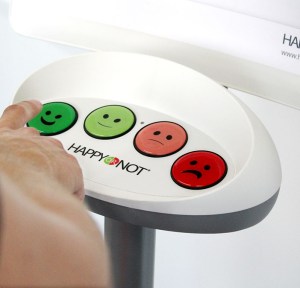
Image: Customer Feedback Device (Source: Smarte Carte)

Image: Customer Feedback Device (Source: Smarte Carte)

Today’s customers are more knowledgable (because they have access to more information, they can shop around, and in some cases, they have more choice). Today’s customers are also actively encouraged to engage with corporate social media (by following, liking and sharing, and by becoming surrogate brand advocates). However, the increased levels of expectation that this “engagement” creates are not always matched by the post-sales customer experience.

I have written before about how companies can improve their customer service, using a practical 7-point scheme. I would challenge any organisation that rates itself highly for customer service, to assess its performance against those criteria, as well using the ubiquitous customer satisfaction scores (CSAT, NPS®, CES, etc.).

Nearly every time I have an interaction with a telco, utility, bank or other service provider, I receive an immediate follow-up customer feedback request. Once upon a time, I would have been quite willing to provide constructive feedback, as I used to believe that it was important for the voice of the customer to be heard. Nowadays, I am more hesitant, because I don’t believe this feedback is ever properly acknowledged, analyzed or acted upon.

So many of these feedback request forms are self-serving, because the person you dealt with is in effect soliciting personal feedback on their individual performance. And while that is important, it is rarely done in the specific context of the customer’s own experience, and is more concerned with the company’s internal policies and procedures.

I am also increasingly sceptical about feedback processes that are ostensibly used for staff training. First, time is valuable, so it would be nice if companies could reward their customers for making the effort to engage. Second, on the rare occasions where a company has contacted me in response to a complaint submitted online or via a feedback form, I never learn what specific steps the company is taking to rectify problems caused by operational or policy failings. Thirdly, why should I be responsible for telling you how to train your staff or improve your service – surely that’s your job!

In many cases, it is not the performance of an individual customer service representative that is the problem. More likely, it’s poor customer service training, inadequate product knowledge or a myopic perspective, reinforced by silo operations. When even the most pleasant and competent service rep tells me, “I’m sorry, but it’s the way the system is designed…”, they probably don’t realize what a disservice they are doing: a “system” is only as good as the people who design it, and the people who implement it. So, they are in effect criticising their own colleagues, and the organisation they work for.

This lack of self-awareness by customer service staff is reinforced by the limited discretion in trying to resolve customer problems. Along with the use of internal jargon and bewildering acronyms, there is nothing worse than having to complain long or loud enough in order to escalate a problem. It would be wonderful if companies could empower their staff by giving them (well-defined) individual discretion on problem solving, and incentivize them for taking responsibility for the end-to-end resolution process.

In addition, it’s really infuriating being handed from one specialist, team or department to another, especially due to labyrinthine help line service menus. Telco on-boarding processes are particularly notorious for having complex operational procedures, multiple hand-offs and ring-fenced communications. I recall one large service provider who told me that in-bound call-centre staff were unable to speak directly to their own web support teams, and even if they communicated via internal e-mail, they could not guarantee a response.

If I am beginning to sound a bit like a broken record, it’s because recent experiences only reinforce my belief that many companies still don’t understand what it’s like to be one of their customers. But there’s a huge paradox here: on the one hand, companies are trying to reduce customer churn, increase “stickiness”, and improve the share of wallet or lifetime customer value; on the other, the cost of new customer acquisition appears to be cheaper (thanks to social media tools and web analytics), so it doesn’t matter if they lose a few customers, because it’s not that difficult or expensive to find new ones.

If it’s no longer true that “the customer is always right”, because profit margins are being squeezed and companies are being told to “stop delighting your customers”, then service providers have to do a much better job of managing customer expectations. They also need to demonstrate genuine empathy and concern if things go wrong (which is difficult if they don’t have sufficient self-awareness). And if things do go wrong, they need to ask the customer “what could we have done differently to provide you with better customer service?”.

In my professional experience of product management and business development, understanding customer needs and identifying ways to improve service delivery (along with customer-centric perspectives rather than product-led processes), are genuine sources of competitive advantage. But it takes considerable self-awareness to engage customers beyond the level of a single transaction, to develop genuine rapport, and to build sustainable long-term relationships. If your organisation is challenged by poor customer service, and if you recognise this is in part due to a lack of self-awareness, please get in touch – I’d be very interested to understand your problem.

Next week: Idea over Form – Gehry vs Ando