Content Marketing and the “New Hierarchy of Needs”

Maslow’s theory on the “Hierarchy of Needs” has become shorthand for explaining human behaviour and motivation – primarily in our personal lives, but increasingly in our working lives. At the risk of offering an answer to yet another first world problem, it seems to me that many social media platforms and content marketing solutions are trying to recalibrate Maslow for generating deeper (and sometimes more meaningful) engagement with consumers. So, by way of a simple infographic, I am offering my own theory on the new hierarchy of needs:
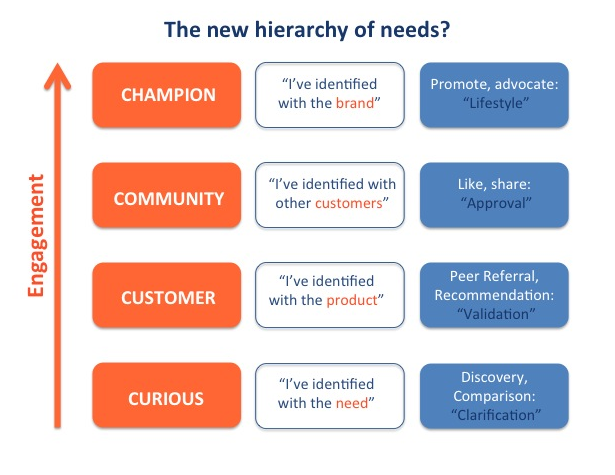
New Hierarchy of Needs


When we are looking for a product or service to meet a need, we are usually in “discovery mode” – we are searching for content that helps us by offering suggestions, comparing products and prices, and clarifying the precise need. So, we are either browsing, curious, or looking for assistance.

Having found some possible solutions, we seek reassurance via informed recommendations, peer referrals and published reviews. We may place different weight on this information depending on the source, but we are seeking justification for our reason to buy, or validation for becoming a customer.

If we are happy with our choice, and given the right opportunity and encouragement, we may be willing to tell our friends and anyone else who’s interested via Likes and social media posts and reviews. This is an interesting point in the engagement transaction – going from peer-to-peer sharing, to looking for approval for our decision from the wider community.

Finally, if we are so enamoured with the product, and we enjoy sharing our experiences, we may be flattered into making a lifestyle statement about our preferences; we could become a self-identified “voice of authority” through blogging and endorsements, or we might be willing to be closely identified with a brand as an advocate or champion (the sort of customer beloved of Net Promoter Scores).

The ultimate consumer-turned-champion was, of course Victor Kiam, the customer who liked the product so much, he bought the company….

Joining Australia Post’s “National Conversation”

In a previous blog, I offered some thoughts on the possible digital future for AusPost. In response, I have been contacted by one of their social media consultants, drawing my attention to the “National Conversation“.

First, I acknowledge that AusPost is attempting to have an “open” conversation with customers, but I don’t see how this is really helping, other than generating a range of (conflicting) opinions, with little cohesion around the key issues. Participation rates in the Topics to date has been very erratic (in terms of numbers, and geographic distribution).

Second, I have read CEO Ahmed Fahour’s latest address, and frankly it did not inspire me. Basically, it was a whinge about the decline in letter volume, and the “challenges” of the Internet (which, as he says, has been with us for 25 years…. hardly a new event!) I also think there are some factual inaccuracies in Mr Fahour’s assumptions: I don’t believe that Australians are any less digital citizens than their OECD counterparts – they have always been reasonably early adopters of new technology (as evidenced by the number of smart phones and tablets). Where they have been slow is in moving to online services, but this is in large part due to poor Internet services (notoriously slow connection speeds and restricted bandwidth, and exorbitant access fees), coupled with a paucity of reliable online platforms – which is ironic given the push towards eGovernment, eCommerce and the digital economy around 1999-2001.

Third, and staying on the topic of eCommerce, the one recurring theme that does emerge from the National Conversation so far is the high cost of sending small parcels. I agree with some of the feedback that it is often cheaper (and quicker!) to order consumer items from overseas online retailers. Shouldn’t Australian consumers expect to benefit from the economies of scale to be achieved from a growing parcel business?

Finally, my previous blog suggested that digital transactions are the future for AusPost (while acknowledging the need to maintain its statutory obligations for letter delivery) – but apart from e-mail and bill payments, Mr Fahour’s address was rather silent on this point. That scares me, as it suggests a lack of vision for an integrated digital strategy. After almost 5 years in the job, you’d think a few more ideas would have emerged by now.

(Afterthought: maybe AusPost should check out what Shomi is doing – a local start-up with some smarts in linking the physical and digital worlds.)